
Big Adventure! The Quest for the Fourth Hokage’s Legacy, Part 2
The final obstacles turn Naruto’s race for a legendary record into a lesson about the teammates who make forward movement possible.
What happens in Naruto Shippuden Episode 171?
Naruto Shippuden Episode 171, "Big Adventure! The Quest for the Fourth Hokage's Legacy, Part 2," sends Naruto, Sakura, and Sasuke through the final stages of the village challenge. The promised secret technique and the Fourth Hokage's unbeaten record remain just ahead, which means Naruto becomes even less willing to slow down.
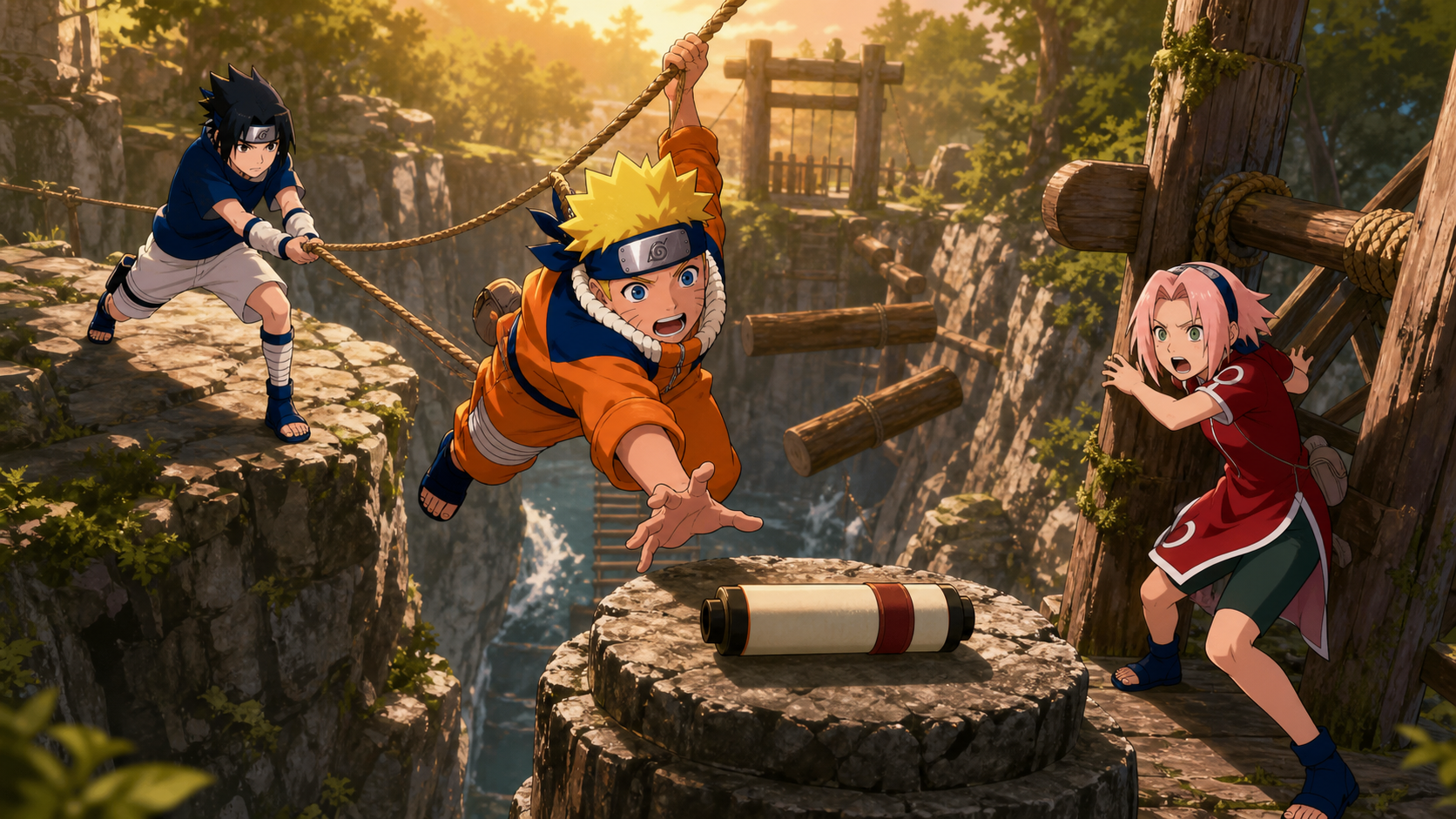
The course answers that impatience with traps. Moving platforms, collapsing routes, rival teams, and misleading shortcuts force Team 7 to coordinate. Naruto's attempts to seize the lead create new problems, but his energy also keeps the team moving when the challenge becomes harder than expected.
By the end, the legacy is not the miraculous jutsu Naruto imagined. The course rewards the ability to work with other people, recover from mistakes, and continue without abandoning the team. Naruto does not get the shortcut to greatness he wanted. He gets a lesson he will spend years learning how to use.
Part 2 turns the treasure hunt into a teamwork test
The first half let Naruto believe the challenge was a race toward a prize. Part 2 reveals that every obstacle is designed around cooperation. A single fast ninja can reach the next platform and still fail if the route leaves everyone else behind.
That design makes sense as a legacy associated with a Hokage. Leadership is not the ability to arrive first. It is the ability to move people through danger without treating them as baggage.
Naruto is not ready to articulate that distinction, but the course makes him feel it. Every impulsive shortcut becomes more expensive when Sakura and Sasuke have to compensate for it.
Naruto keeps confusing speed with progress
Naruto's desire to break Minato's record gives the episode its comic momentum. He sees a timer and immediately turns the challenge into proof of worth. If the Fourth Hokage did something quickly, Naruto wants to do it faster.
The problem is not ambition. Naruto's ambition has carried him through years of rejection. The problem is that he treats hesitation as weakness even when hesitation would reveal the trap in front of him.
Sasuke's precision and Sakura's practical judgment keep exposing the difference between moving and progressing. Naruto can cover distance quickly while taking the team farther from the real solution.
Sasuke competes without abandoning the group
This younger Sasuke is competitive, proud, and eager to prove himself, but he still functions inside Team 7. He does not simply leave Naruto to suffer the consequences of every mistake. He redirects the rope, reads the obstacle, and provides the control Naruto lacks.
That contrast is painful in retrospect. Sasuke's talent has not yet convinced him that every bond is an obstacle. Competition can still make the team sharper rather than pulling him away from it.
The episode gives him room to be impressive without turning his ability into isolation. His competence matters because the others can use it.
Sakura does the work that keeps the adventure coherent
Sakura often occupies the least glamorous position in this kind of Team 7 story. Naruto creates motion, Sasuke makes the spectacular save, and Sakura notices the rule everyone ignored.
That work is essential. She tracks what the team has learned, calls out Naruto's worst assumptions, and keeps the boys' rivalry from becoming the only logic guiding them. The course rewards exactly that kind of attention.
Her frustration is funny because it is justified. She is not asking Naruto to become timid. She is asking him to notice that his teammates are part of the challenge rather than spectators following his personal legend.
The other rookie teams make the lesson communal
The village challenge does not belong only to Team 7. The other rookie teams reveal different ways of solving the same problems. Some rely on sensory skill, some on planning, and some on raw coordination built through familiar roles.
Their presence prevents Naruto from imagining that the Fourth Hokage's legacy can be claimed privately. The generation is being trained together. Even when the teams compete, their strengths expose one another's blind spots.
Naruto wants a prize that will place him above everyone else. The course keeps teaching that a village survives through people whose abilities overlap.
The record matters less than Naruto thinks
Breaking Minato's record would give Naruto a clean measurement. Numbers feel fair in a way the village has not always been fair to him. A faster time would be visible proof that he belongs beside the hero on the mountain.
But a record cannot transfer Minato's judgment, sacrifice, or responsibility. The course may carry his name, yet its value lies in what participants learn while attempting it.
Naruto's fixation on the finish line mirrors his larger dream of becoming Hokage. At this age, he often treats the title as the moment when everyone will finally acknowledge him. The journey will teach him that acknowledgement follows the person he becomes while protecting others.
Jiraiya's lesson arrives disguised as mischief
Jiraiya lets Naruto build an exaggerated fantasy around the legacy because the fantasy gets him onto the course. The teacher understands that a direct lecture about cooperation would bounce off Naruto's forehead protector.
The trick works because the lesson is physical. Naruto has to feel the rope pull when Sasuke catches it. He has to hear Sakura's warning after ignoring the clue. He has to experience the difference between a solo charge and a team crossing.
Jiraiya's methods can be chaotic, but he knows Naruto remembers what his whole body had to learn.
The real legacy is relational
Naruto enters the challenge imagining a scroll that can make him more powerful. He leaves with another experience of being caught, corrected, and carried by teammates. That is less dramatic than a secret technique and much closer to the inheritance that will define him.
Minato's greatest choice was not a move Naruto can copy. It was placing hope in another person at a moment of catastrophe. Jiraiya continues that legacy by placing hope in Naruto. Team 7 continues it every time its members refuse to let one another fall.
The course turns legacy from an object into a pattern of trust. Naruto cannot own it alone. He can only participate in it.
A lighter story still carries grief
Because this episode appears after the Pain assault, every scene with Jiraiya carries an ache the flashback characters cannot feel. His teasing is ordinary to young Naruto. For us, it is time borrowed from someone who will not return to the present.
The same is true of Team 7. Their arguments are funny because separation has not yet hardened them. Sakura expects Sasuke to stay. Naruto expects another chance to compete with him. Sasuke has not crossed the boundary that turns return into the central hope of their lives.
The filler story becomes valuable as a preserved ordinary day. Not every memory needs to predict tragedy, but later tragedy changes how gently we hold the memory.
The second half makes Naruto pay for every rushed assumption
Part 1 let momentum feel like leadership. Part 2 keeps arranging situations where reaching the next platform first accomplishes nothing if Sakura and Sasuke cannot follow. The course turns Naruto’s favorite habit into a visible liability.
The correction is not “stop acting.” His movement remains valuable. The lesson is to let information and teammates change the action before speed becomes another trap.
A course built around a Hokage should measure responsibility
Naruto expects athletic difficulty and a secret reward. The deeper test asks whether a participant can move a group through danger. That is much closer to the work behind the title he wants.
A Hokage who wins alone while everybody else falls has failed. The challenge makes that principle physical enough for young Naruto to remember.
The timer exploits Naruto’s oldest insecurity
A record offers objective recognition. Nobody can whisper that Naruto cheated a stopwatch because of the Nine-Tails or dismiss a faster time as attention-seeking. Numbers promise the fairness people denied him.
That is why slowing down feels unbearable. Naruto hears caution as another person telling him he will never measure up, even when caution is how the team reaches the finish.
Minato’s record is bait, not a complete definition of Minato
The Fourth Hokage was famously fast, so a timed challenge sounds appropriate. Speed alone did not make him a leader, father, teacher, or person capable of sacrifice. Reducing his legacy to a record is another way of turning a complicated life into a monument.
Naruto cannot surpass Minato through a clock. He can carry inherited choices with greater honesty.
Sasuke’s rope work turns precision into support
Sasuke reads movement, controls timing, and stabilizes the route while Naruto reaches forward. His skill matters because another person can use it. That is a healthier version of competition than proving he needs nobody.
The scene becomes bittersweet because later Sasuke will treat connection as a weakness enemies can exploit. Here, connection gives his talent purpose.
Sakura braces what the boys keep trying to race across
Her contribution is structural. She notices what is failing, holds the obstacle together, and calculates the practical cost of another impulsive move. The work receives less visual glory because stability rarely looks dramatic.
Team 7 would collapse without it. Sakura’s judgment turns two competing boys into something resembling a functioning unit.
Naruto leads best when he can feel the team behind him
His courage pulls people through hesitation. When that courage remains connected to Sakura’s warnings and Sasuke’s control, the group moves farther than any one member could.
Leadership is not surrendering his energy. It is learning that other people do not diminish the achievement by making it possible.
The rival teams prevent one approved solution
Every rookie group approaches the course through its own combination of sensory skill, planning, clan techniques, and personality. There is no universal ideal team hiding inside the challenge.
The village needs different forms of competence. Competition can reveal those differences without ranking every child’s worth according to one ability.
Neji’s presence sharpens Naruto’s obsession with the record
Naruto is preparing to face someone who insists destiny establishes permanent limits. Beating Minato’s time would feel like evidence that inherited expectations can be exceeded.
The instinct is understandable. The treasure hunt still teaches that disproving one hierarchy does not require turning every relationship into another hierarchy.
Hinata’s quieter method belongs on the course
She observes before committing and values what teammates can see that she cannot. Those habits lack Naruto’s noise but fit the challenge’s actual demands.
The generation becomes stronger when courage includes careful attention, not only the willingness to charge into danger first.
The traps create consequences without catastrophe
Platforms shift, ropes fail, and shortcuts embarrass the person who trusts them. Nobody loses a village because a child misreads a clue. That margin makes the course genuine education.
Young shinobi need places where failure supplies information instead of trauma. The adult world rarely gives them enough.
Jiraiya lets the body remember what a lecture would lose
Naruto feels Sasuke catch the line and Sakura steady the route. Cooperation becomes weight, tension, and the difference between falling and crossing. The lesson lives in muscle memory.
Jiraiya’s method is messy, but he understands that Naruto learns by doing and remembers what other people helped him survive.
The scroll cannot contain the inheritance Naruto imagined
A secret technique would let Naruto possess greatness privately. Teamwork cannot be stored in his pocket. It exists only when people keep choosing one another under pressure.
The disappointing prize is therefore the better one. Naruto leaves without a shortcut and with another experience of dependence that did not make him weak.
Legacy changes according to the person receiving it
Minato left speed, techniques, sacrifice, a damaged political inheritance, and a son carrying Kurama. Naruto does not honor him by copying every choice. He honors what was hopeful by refusing to repeat what caused harm.
The course offers a smaller version of that responsibility. Understand the purpose before worshipping the record.
The ordinary Team 7 day is painful because it was real
Sasuke participates. Sakura expects both boys to return tomorrow. Naruto imagines rivalry continuing indefinitely. Their casual certainty makes the later fracture hurt more.
This memory is not valuable because the team was secretly perfect. It is valuable because connection existed before pain convinced Sasuke he had to destroy it.
Jiraiya’s mischief survives beside his later sacrifice
The teacher who dies gathering intelligence also built ridiculous training bait around Naruto’s predictable obsession. Both versions belong to him. Grief should not flatten Jiraiya into solemn wisdom.
Naruto inherited jokes, irritation, bad methods, fierce loyalty, and impossible hope from a whole person.
RaeRae's reaction
Naruto swinging ahead while Sasuke and Sakura keep the entire obstacle from collapsing is exactly the Team 7 dynamic I expected. He believes he is leading because he is physically in front. The other two are doing the work that makes his momentum survivable.
I liked the record more as bait than as a real goal. Naruto wants a number that says he surpassed the Fourth Hokage, while the audience now knows Minato wanted something much more personal for him. He wanted Naruto to grow into someone who could face hatred without becoming its next instrument.
This adventure cannot carry that whole meaning, and it should not try. Its small lesson is enough: if your victory requires leaving everyone behind, you misunderstood the course.
The two-part detour ends without giving Naruto a magical inheritance. I am glad. The boy who wants a shortcut receives another memory of teamwork instead. Years later, when he stands before Nagato and chooses to listen, that choice is supported by hundreds of smaller moments when another person kept him from falling.
The two-part detour earns its ending through restraint
No forbidden jutsu falls into Naruto’s hands. No record settles whether he deserves Minato’s legacy. The adventure ends with a lesson too ordinary to satisfy the fantasy and too important to skip.
Teamwork is not glamorous treasure. It is the infrastructure that keeps talent from becoming isolation.
RaeRae’s final word on the Fourth Hokage’s Legacy, Part 2
I still think interrupting Nagato’s confrontation for this story is wild programming. The emotional brakes screech. Once we are here, though, Team 7’s old rhythm carries the episode.
Naruto wants to be first because first place feels like recognition nobody can argue away. Sakura and Sasuke keep demonstrating that a finish reached alone is not the finish this course measures.
The real ache comes from watching Sasuke support the same teammates he will later abandon. His talent does not isolate him here. It catches a rope, reads a danger, and becomes useful through relationship.
Naruto does not obtain Minato in a scroll. He receives another small memory of people holding the path while he moves. Years later, that accumulated experience helps him understand that strength without bonds is not freedom. It is another version of Pain’s empty godhood.
The finish line reveals what Naruto thought he was chasing
Naruto begins with a fantasy of private inheritance. Find the hidden scroll, learn the special technique, break the famous record, and force everybody to acknowledge that he belongs beside the Fourth Hokage. Each part of that fantasy makes sense for a lonely child. None of it can create the belonging he actually needs.
The course keeps redirecting him toward shared effort. Sasuke controls what Naruto cannot see from the front. Sakura understands what the boys skip while competing. Naruto supplies the nerve to move when analysis threatens to become delay. Their differences are not defects waiting to be erased. They are the reason the group crosses.
That message becomes more pointed when we remember Minato’s choices. He left Naruto enormous power and an enormous burden, then trusted a future community to help his son carry both. The village failed that responsibility for years. Team 7, in its imperfect everyday way, begins repairing what the wider community abandoned.
No obstacle-course lesson can excuse the adults who withheld Naruto’s history. Jiraiya’s playful challenge gives him a connection to Minato while avoiding the truth Naruto deserved. Affection and failure can occupy the same teaching relationship. I love Jiraiya, and I can still say the silence was costly.
The record also exposes Naruto’s changing definition of Hokage. Young Naruto wants the title because it will make everyone look at him. The course suggests that leadership begins when he looks back at the people moving with him. Recognition remains important, but responsibility changes the direction of attention.
Sasuke’s participation makes that lesson ache. He can still let another person’s need determine how he uses his talent. He does not become smaller by supporting Naruto. He becomes part of something that gives precision a purpose beyond revenge.
So, yes, the two-parter remains an awkward interruption. It also preserves evidence that Team 7 was not doomed from its first meeting. They had functional patterns, real trust, and ordinary chances to learn together. The loss came later through choices and failures, which means connection was never a childish illusion. It was a real inheritance worth fighting to recover.
Naruto does not leave with the shortcut he wanted. He leaves knowing that forward motion depends on people willing to catch, steady, question, and challenge him. That lesson sounds smaller than a secret jutsu until the series shows how many powerful adults failed because they confused standing above everyone with leading anyone. The legacy survives when strength becomes shared work, not another monument demanding admiration from below ever again.
RaeRae’s call
The final obstacle exposes the trick: Minato’s legacy was never a prize for the fastest child. Naruto reaches the goal because Sakura and Sasuke make his forward motion survivable.