
RaeRae Reacts · One Piece Episode 68
Coby and Helmeppo’s Marine Trial
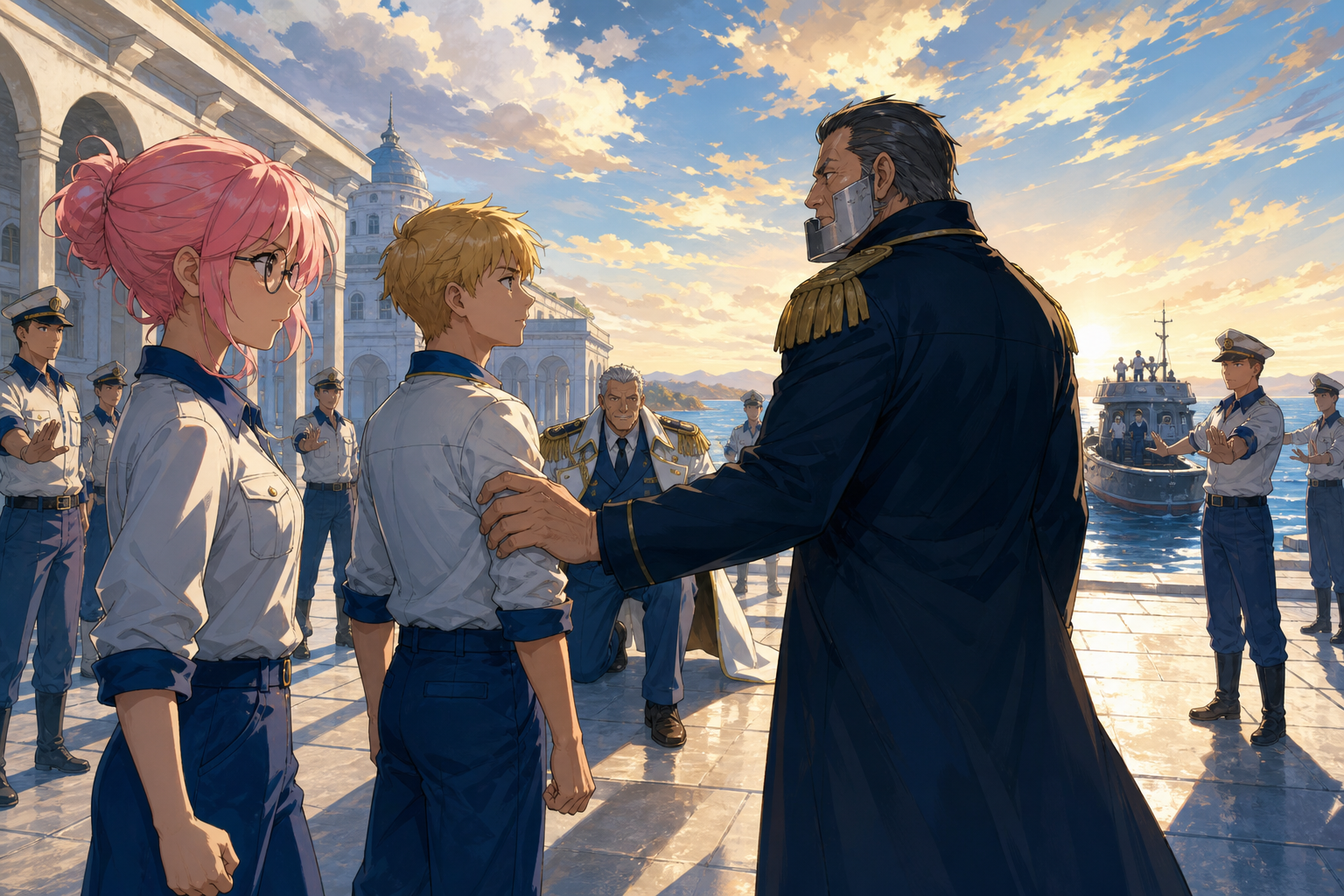
One Piece Episode 68 tests Marine accountability when Morgan escapes custody and takes Helmeppo hostage as Coby begins the disciplined path toward becoming an officer.
Episode information
Japanese title: Ganbare Coby! Coby-Meppo Kaigun Funtoki
English title: Do Your Best, Coby! Coby and Helmeppo’s Marine Struggles
Japanese broadcast: May 13, 2001
Saga: Alabasta
Script: Michiru Shimada
Episode direction: Harume Kosaka
Animation direction: Kenji Yokoyama
Art: Miyuki Sato
The story returns to Shells Town
Episode 68 shifts away from the Straw Hats to people whose lives changed when Luffy and Zoro defeated Morgan. Shells Town is now responsible for rebuilding a Marine base after authoritarian command.
Removing one abusive leader does not automatically repair training, trust, records, or relationships with civilians.
Coby works toward his officer dream
The official summary places Coby in a chore role while he pursues the goal he named from the beginning. Cleaning, carrying, organizing, and following routines may feel distant from command, but they reveal reliability.
Entry-level work should teach service without becoming humiliation or exploitation.
Chores are part of institutional life. A base requires sanitation, food, maintenance, inventory, and communication. Leaders who have never respected those tasks may undervalue the people performing them.
Coby can learn systems while still receiving structured education, rest, and a path to advancement.
A dream needs measurable training. Officer ambition should translate into literacy, navigation, law, ethics, first aid, physical conditioning, conflict de-escalation, and supervised responsibility. Enthusiasm alone cannot substitute for competence.
Mentors should explain standards and review progress rather than promise promotion for loyalty.
Coby’s history matters. He spent time under Alvida’s coercive control before choosing the Marines. Authority can therefore feel both frightening and protective.
Training should help him recognize abuse without teaching blind obedience to uniforms.
Helmeppo is also at the base
Morgan’s son remains near the institution his father controlled. He begins with entitlement, resentment toward Luffy, and a reputation shaped by his past conduct.
He is responsible for his choices but should not be declared permanently incapable of change because of family.
Inherited status is not earned rank. Helmeppo previously benefited from his father’s position. A repaired base should remove special privileges and apply transparent expectations.
Equal standards protect both the institution and Helmeppo from repeating dependency on inherited power.
Inherited guilt is also unjust. He should answer for threats and harm he personally committed, not serve as a substitute punishment for Morgan. Accountability must remain specific.
A person can lose unfair privilege without losing the right to due process and safety.
Resentment can become information. Helmeppo’s anger at Luffy may conceal shame, grief, fear, or loss of identity. None excuses future abuse, but understanding the emotion can guide rehabilitation.
He needs boundaries, honest feedback, and goals not centered on defeating one pirate.
Coby and Helmeppo make an unlikely pair
One was coerced by a pirate and chose service; the other benefited from abusive Marine authority and lost status. Working together forces each to see a different relationship to power.
Peer support should not make Coby responsible for fixing Helmeppo alone.
The base needs trauma-informed leadership. Personnel served under Morgan and may have witnessed or participated in abuse. Civilians may fear the same uniforms even after command changes.
Independent reporting, counseling, retraining, and public accountability are necessary for repair.
Morgan is in custody
The former captain faces transfer for court-martial. Lawful custody matters because the institution must demonstrate that rank does not place a commander above review.
Humiliation or vigilante punishment would reproduce the arbitrary power the process is meant to reject.
A military trial needs evidence. Orders, detention records, property damage, witness statements, financial records, medical documentation, and command communications should be preserved. Civilians need safe ways to testify.
Subordinates who report misconduct should receive protection from retaliation.
Vice Admiral Garp arrives
The official summary identifies Garp as the senior officer responsible for moving Morgan to headquarters. His rank creates authority and responsibility for transfer safety.
A famous officer’s confidence cannot replace a written custody plan.
Transfer is a predictable risk point. Movement changes restraints, personnel, location, and routine. Escape attempts, rescue attempts, retaliation, and hostage-taking become more likely.
Before transfer, teams should inspect restraints, vehicles, routes, communication, staffing, and emergency contingencies.
Morgan’s physical capacity is known. He is large, strong, experienced, and accustomed to command. Custody planning should not rely on reputation loss making him compliant.
Restraints need humane fit and redundancy, with trained officers outside immediate striking range.
Garp is attacked
The official account says Morgan cuts Garp during the escape. The violence should be documented plainly without graphic replay or turning injury into proof of toughness.
Medical assessment is required even if Garp appears calm or capable immediately afterward.
A senior officer is still a patient. Rank, strength, and composure do not rule out blood loss, concussion, shock, or delayed complications. Another officer should assume command during evaluation.
Continuity planning prevents the response from depending on one injured leader.
The custody team needs an immediate alarm. Announce escape direction, suspect description, hostage status, vessel access, and rules of engagement. Lock down dangerous equipment without trapping civilians.
One clear command channel is better than overlapping shouted orders.
Morgan takes Helmeppo hostage
The abusive father uses his own son as leverage. Family relationship does not make the restraint less coercive or the danger less real.
Helmeppo’s past behavior and privilege do not reduce his right to rescue.
Do not blame the hostage. People may say Helmeppo should have expected Morgan or deserves consequences. Hostage-taking belongs to the person choosing coercion.
Rescuers should avoid language that increases shame or pressures him into risky resistance.
Family abuse can remain hidden by authority. Morgan may have treated Helmeppo as an extension of his status rather than an independent person. Public privilege can coexist with private fear.
The escape makes that control visible but may not be its beginning.
Helmeppo needs simple instructions. Breathe, keep hands visible, avoid sudden struggle near weapons, notice exits without staring, and respond only to clear rescue signals. The goal is survival.
No one should demand heroism from a frightened trainee.
Negotiators need time. Open communication, confirm immediate needs, avoid insulting Morgan, and focus on safe release. Time can allow containment and reduce impulsive force.
Promises must stay within what command can lawfully deliver.
Officers must control their firing lines. A hostage close to Morgan makes uncontrolled shots unacceptable. Establish backdrop, distance, cover, and designated authority for any use of force.
Rescue is not an excuse for crossfire.
The harbor needs containment. Morgan may seek a boat, crew, supplies, or open water. Secure vessels where safe, notify coastal patrols, and keep civilians away from docks.
Do not create a chaotic blockade that traps the hostage between armed groups.
Coby faces a personal test
Helmeppo may not have treated him well, but Coby’s values are measured by whether he protects a person without requiring prior kindness.
Courage should follow a plan rather than override trained negotiators.
Friendship does not authorize recklessness. Coby may want to rush forward, yet creating a second hostage weakens the rescue. He can provide information, communicate calmly, or assist assigned teams.
The most caring action may be disciplined restraint.
Helmeppo’s response can mark growth
He may confront the fact that his father values escape over his safety. Recognizing abuse can break the belief that family authority must be obeyed.
Growth does not require him to stop caring about Morgan instantly.
Mixed feelings are normal. Fear, anger, grief, loyalty, relief, and shame can coexist after rescue. Helmeppo should not be forced to denounce or defend his father on command.
Trauma support can separate emotional complexity from legal testimony.
The base must examine the escape failure
Review staffing, restraints, route, intelligence, supervision, response time, and whether deference to senior rank reduced caution. The purpose is prevention, not finding the lowest-ranking scapegoat.
Garp’s decisions should be reviewable like anyone else’s.
Institutional culture matters. If officers assumed Morgan could not challenge Garp, reputation replaced procedure. Hero culture can make systems weaker by treating exceptional people as controls.
Reliable institutions plan for human error and injury.
Court-martial remains necessary. Escape adds charges but does not cancel investigation of earlier command abuse. Authorities should continue evidence preservation and issue a lawful warrant.
Capture goals should prioritize public and hostage safety over revenge.
Helmeppo needs protection after escape. Morgan may return or contact him, and others may harass him as the commander’s son. Housing, confidentiality, escort, and communication limits may be appropriate.
Protection should not become detention or social isolation.
Coby needs support after witnessing violence. A trainee facing an attack on a senior officer and a friend’s abduction can experience fear, guilt, and intrusive memories. Debriefing should distinguish operational facts from emotional care.
He should not be praised into suppressing distress.
Training can unite the pair
Coby and Helmeppo now share a reason to become more capable that is not revenge alone. Physical skill, ethics, law, and teamwork can turn crisis into disciplined purpose.
The institution must ensure growth is supervised and not driven by self-punishment.
Marine service should mean public protection. Coby’s dream has value when officer status becomes a tool for fair process, rescue, and accountability. Morgan represents the opposite: rank used as personal power.
The contrast gives Coby a standard beyond simply wearing the uniform.
Michiru Shimada centers institutional aftermath
Shimada’s script shows what happens after a tyrant loses command. Chores, resentment, custody, trial, escape, and hostage response all ask whether the Marines can reform themselves.
Coby and Helmeppo become the human measure of that repair.
Harume Kosaka balances routine and crisis. Kosaka’s direction begins with humble base work, then introduces Garp’s authority before Morgan breaks the transfer plan. The shift makes procedural failure feel consequential.
Helmeppo’s position remains visible inside the larger action.
Kenji Yokoyama gives courage a smaller scale. Animation direction can emphasize posture, hesitation, eye contact, and controlled movement rather than only impacts. Coby’s determination and Helmeppo’s fear matter beside the senior officers.
Morgan’s size communicates danger without graphic violence.
Miyuki Sato contrasts clean base and damaged trust. Bright stone, blue water, uniforms, and sunrise can suggest order while the escape exposes deeper instability. The institution looks restored before proving the institution is ready.
Harbor geography keeps custody and rescue risks understandable.
RaeRae’s real-time reaction
Putting Morgan in restraints and calling Garp famous was not a custody plan. You knew this man used rank, strength, and fear as weapons. Transfer him like an actual escape risk.
Helmeppo is not collateral for his father’s crimes. Coby can care about rescuing him without charging into a hostage line and giving Morgan another person to control.
The moment that lands. Morgan takes the son who once benefited from his authority and turns him into leverage. The act exposes what Helmeppo always was inside that relationship.
Not an heir to power, but someone his father believed he owned.
What should happen immediately. Treat Garp, establish command, contain the harbor, open negotiation, protect firing lines, gather Morgan’s route information, support Coby, and keep Helmeppo focused on survival.
Notify civilians without releasing details that increase danger.
What accountability requires. Review Morgan’s original abuses, the transfer failure, restraint and staffing decisions, attack evidence, hostage-taking, and any assistance he receives. Protect witnesses and avoid scapegoating junior personnel.
Continue the lawful trial process after recapture.
Reform must survive beyond this emergency. A successful rescue will not prove Shells Town has repaired its Marine culture. The base needs published conduct rules, independent complaints, recurring ethics instruction, transparent discipline, and promotion standards that reward public service rather than intimidation. Civilians should be able to review whether promised changes actually occur.
Coby and Helmeppo can grow inside that structure, but they cannot become symbols used to hide unresolved harm. Institutional recovery belongs to leadership, personnel, and the community together. Garp’s arrival should create independent oversight rather than a temporary performance of order. The final review must preserve testimony from junior Marines, civilians, Coby, and Helmeppo without forcing any witness to confront Morgan. A documented correction plan, deadlines, and outside follow-up would make accountability measurable after the harbor crisis stops drawing attention.
Bottom line
Episode 68 follows Coby and Helmeppo as trainees in a Marine base trying to recover from Morgan’s rule. Garp arrives to transfer Morgan for court-martial, but the former captain attacks, escapes, and takes Helmeppo hostage. The crisis tests whether the institution can protect people through procedure rather than reputation.
RaeRae rating: 9.1/10. Coby’s dream becomes meaningful because Marine authority can either repeat Morgan or answer him. Rescue Helmeppo without blame, treat Garp as a patient, contain the harbor, and build a custody system that does not depend on one hero being impossible to hurt.