
Pain to the World
Pain turns a real history of suffering into collective punishment while Tsunade answers catastrophic force by distributing care.
What happens
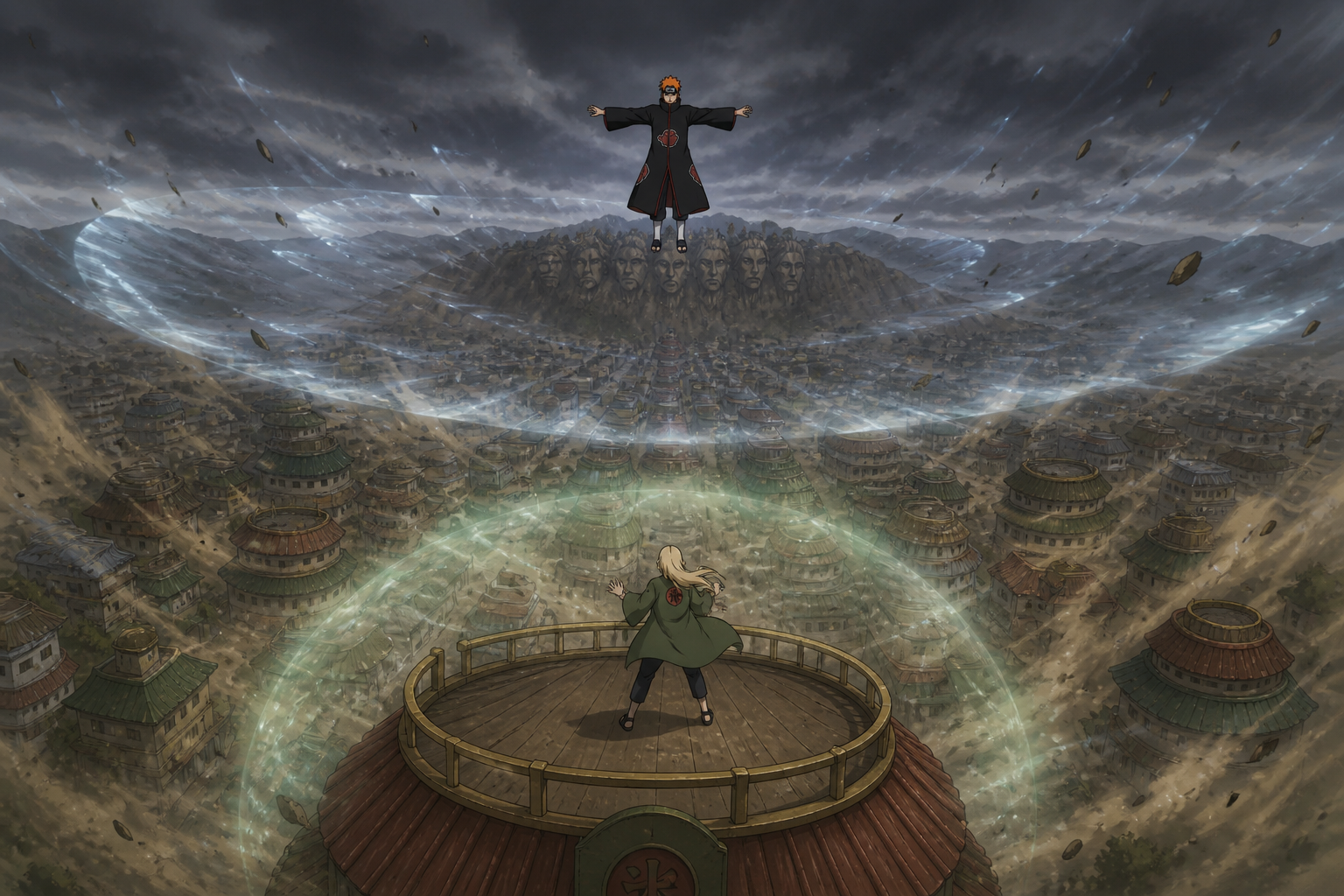
Tendo Pain confronts Tsunade on the roof of the Hokage mansion and demands Naruto's location. Tsunade refuses to surrender him, even as the village's casualties continue to rise.
Elsewhere, the Human Path extracts the information Pain needs: Naruto is training at Mount Myoboku. Once the target's location is known, Pain no longer needs to preserve Konoha as a place to search.
Tendo rises above the village and releases Almighty Push at catastrophic scale. Tsunade commits Katsuyu and her chakra to protecting as many people as possible while the force tears the Leaf Village apart.
Tsunade answers as Hokage
Pain's demand tries to reduce Naruto to an object the village can exchange for relief. Tsunade refuses that premise before she refuses the transaction.
Naruto is a shinobi of Konoha and a person whose growth she has witnessed. Surrendering him would repeat the village's long habit of treating a jinchuriki as strategic property first.
Her answer also accepts consequence. She cannot guarantee that refusal will protect the village, but leadership does not allow her to buy safety by choosing one resident as disposable.
Pain frames destruction as instruction
Pain claims that the great nations understand neither the suffering they create nor the lives erased beyond their borders. His indictment contains history Konoha cannot simply dismiss.
The method he chooses corrupts that truth. He turns civilians into teaching material and mass destruction into a lesson only survivors are expected to interpret.
Pain wants suffering to produce empathy automatically, but pain can also produce fear, revenge, silence, and further isolation. Inflicting it does not control the meaning people make from it.
The major nation critique matters
The Leaf Village has benefited from a political order that pushed wars and proxy conflicts into smaller countries. The Rain Village became one of the places where powerful nations fought without bearing the full damage at home.
Tsunade represents Konoha, so Pain directs that accumulated grievance toward her. The confrontation is larger than a personal feud.
Acknowledging the system's injustice does not make every retaliation just. The episode is strongest when both facts remain visible at once.
Information changes the battlefield
Once the Human Path learns that Naruto is at Mount Myoboku, the logic of the invasion changes. Konoha is no longer the only route to the target.
The extracted memory therefore has consequences far beyond the interrogation itself. Intelligence can preserve lives when shared responsibly, and it can enable catastrophe when taken by force.
Pain's linked bodies convert the discovery into immediate strategic action. There is no delay between knowledge and decision.
Tendo's ascent creates distance
Rising above Konoha does more than prepare the technique. It removes Pain from the human scale of the people below.
From that height, streets become patterns and homes become surfaces. Distance makes it easier to describe destruction as an abstract correction.
The visual position supports his claim to godhood. He places himself above the community whose pain he has decided to measure and administer.
Almighty Push becomes collective punishment
Tendo's ordinary repulsion has already been dangerous in close combat. Expanded across the village, the same principle becomes indiscriminate.
The attack cannot separate military authority from a child in a home, an injured patient, or a medic treating someone underground. Everyone inside the radius receives the same sentence.
Collective punishment promises clarity through scale, but its scale destroys the distinctions moral judgment requires.
Tsunade chooses mitigation
Tsunade cannot stop the force once it is released. Her task shifts immediately from defeating Pain to preserving life.
Through Katsuyu, she distributes chakra and protection across many people she cannot reach directly. The response mirrors what effective command has required throughout the assault: a network rather than one heroic body.
Mitigation is not surrender. When prevention becomes impossible, reducing harm is the most urgent form of resistance still available.
Katsuyu makes care scalable
Katsuyu's divided bodies connect Tsunade to wounded people across Konoha. The technique turns medical support into infrastructure.
That network matters because catastrophe overwhelms ordinary routes. Roads collapse, teams are separated, and central facilities become vulnerable.
Care survives by becoming distributed. Pain concentrates force into one devastating wave; Tsunade spreads protection through countless smaller acts.
The village is more than its buildings
The destruction of Konoha is visually overwhelming because the village has been a stable center for so much of the story. Familiar streets and landmarks disappear in moments.
Yet the village's meaning has never resided only in architecture. It exists in relationships, memory, institutions, and the people who continue choosing responsibility toward one another.
Pain can erase the physical arrangement without automatically erasing the community. Tsunade's protection is an investment in that distinction.
Pain repeats the logic he condemns
Pain criticizes powerful nations for exporting suffering to people they barely see. From above Konoha, he recreates the same moral distance.
He decides that an entire population can absorb damage in service of a political lesson. The victims become interchangeable evidence for his argument.
This contradiction does not make his history false. It shows how trauma can reproduce the structure that caused it when power becomes the only imagined language.
Tsunade's refusal preserves Naruto's agency
Naruto is absent from the rooftop, but the decision concerns his right to remain more than the Nine-Tails container Pain wants.
Tsunade cannot ask him what he would choose in that instant. She can still refuse to authorize his capture on his behalf.
Her stand protects the possibility that Naruto will answer Pain as a person with his own judgment, not as cargo transferred between authorities.
The silence after force matters
The attack creates a before and after for the entire arc. Tactical questions about individual Pain bodies are suddenly placed inside a landscape of mass loss.
The silence is not emptiness. It holds interrupted work, broken routes, separated families, and defenders trying to determine who remains alive.
That aftermath is the true measure of the technique. Power is not only what an attack can move; it is what other people must rebuild when the person using it leaves.
The Human Path turns one person’s knowledge into a death sentence for thousands
Shizune knows Naruto’s location because she belongs inside the village’s command and medical network. Pain extracts that fact by force and kills her in the process.
The violence shows why information security is human security. A secret does not sit in an abstract vault. A person carries the knowledge and becomes vulnerable because the system needs that person informed.
Shizune’s death targets expertise as well as life
She has been studying the chakra receivers and helping the village understand Pain’s mechanism. Killing her removes a medic, analyst, leader, and witness at once.
Konoha loses more than one pair of hands. The attack destroys relationships and specialized knowledge that cannot be restored by rebuilding a room.
Tsunade meets Pain as a leader who knows the history
She does not deny that the great villages caused suffering. Her generation lived through wars that treated smaller nations as terrain. The Rain paid for decisions made elsewhere.
Recognizing history does not require accepting Nagato’s right to punish every person currently living in Konoha. Accountability needs evidence and distinction. His blast removes both.
Pain’s lesson has no consent and no curriculum beyond terror
He claims people will understand one another after experiencing the same pain. The theory assumes suffering delivers one stable meaning.
People can learn solidarity from pain, but they can also learn hatred, fear, submission, or the desire to reproduce the wound. Pain controls the event and cannot control the interpretation.
The blast makes civilian and combatant meaningless categories
Almighty Push strikes hospitals, homes, shops, archives, children, elders, and defenders within the same radius. No individual conduct changes the sentence.
That indiscriminate scale is why the attack cannot become justice. Moral judgment requires the distinctions collective punishment erases.
Pain wants Konoha to experience the geography of the Rain
Ame endured battlefields created by larger powers, destroyed neighborhoods, displacement, hunger, and children learning war before safety. Pain recreates sudden devastation inside a village accustomed to exporting much of that cost.
The parallel explains his purpose. Repetition does not repair the original victims or create an ethical future for the new ones.
Tendo’s height turns political distance into a camera angle
He rises until individual faces disappear. From above, Konoha becomes one target and one symbol of a national system.
The visual abstraction enables collective punishment. Distance helps him stop seeing residents who could complicate his certainty.
Tsunade spends the resource Danzo hoards
Her chakra flows through Katsuyu toward people across the village. Danzo preserves Foundation and himself for political advantage after the destruction.
The contrast defines leadership through distribution. Tsunade uses power to reduce other people’s cost. Danzo protects power by increasing the cost other people carry.
Katsuyu cannot stop the blast and still saves lives
Mitigation can look inadequate beside catastrophic force. The slugs shield bodies, transmit chakra, and hold people through impact even when buildings disappear.
Success should be measured against the harm that would have occurred without intervention. Tsunade’s response preserves futures the crater cannot display.
Medical power answers destruction without imitating destruction
Pain demonstrates authority by moving the entire village at once. Tsunade answers through countless smaller contacts adapted to individual bodies.
Her network does not need one identical intervention for everyone. Care scales by remaining responsive to particular lives.
The village crater is not a blank slate
Collapsed architecture still contains graves, property, records, tools, memories, and contested ownership. Rebuilding will involve labor, displacement, and decisions about whose homes return first.
Calling the destruction a reset would erase the people whose histories occupied the physical space.
Naruto’s location becomes known after people already refused to betray him
Pain extracts the answer from Shizune rather than receiving voluntary surrender from the village. That difference matters.
Konoha’s loyalty does not prevent the information from being stolen. Loyalty proves the community did not choose Naruto’s capture as the price of convenience.
Tsunade preserves Naruto’s moral right to answer Pain himself
She refuses to deliver him as property. Her decision leaves open the possibility that Naruto will confront Nagato’s history, claims, and violence through his own judgment.
That agency becomes essential because the coming conflict cannot be solved by power alone.
Pain’s godhood depends on making consequence appear effortless
One gesture destroys a village and hides the chakra cost, preparation, bodies, receivers, and controller behind the performance.
The spectacle invites worship or despair. Konoha’s investigation matters because mechanisms restore the ability to ask what the display required and where the limits remain.
The survivors will carry unequal versions of the same event
Some people were shielded by Katsuyu. Others lost family, homes, mobility, records, or livelihoods. Shared catastrophe does not produce identical pain.
Recovery must make room for those differences instead of using one heroic story to flatten thousands of experiences.
RaeRae reaction
“Pain to the World” is difficult because Pain's accusation contains real history while his answer becomes indefensible. The smaller nations did suffer under decisions made by larger powers, and Konoha cannot claim innocence simply because many current residents did not make those choices.
But Pain converts that history into permission to make a new population suffer indiscriminately. He calls the attack education, yet no one below consented to become a lesson. The scale that makes his power spectacular is also what strips his judgment of moral precision.
Tsunade's response gives the episode its counterargument. She cannot stop the wave, so she spends her chakra through Katsuyu to preserve people. Pain centralizes authority in himself and delivers one answer to everyone. Tsunade distributes care and lets thousands of individual lives remain individually valuable.
The village is physically devastated, but the episode does not let destruction have the final definition. Konoha remains present wherever someone protects another person, carries information, treats a wound, or refuses to surrender a life for convenience. Pain can flatten buildings in one motion. He cannot prove that suffering is the only force capable of shaping the world.
The blast proves why prevention and mitigation need separate credit
Konoha fails to prevent Tendo from releasing the technique. Tsunade still succeeds in reducing deaths through Katsuyu.
Combining those outcomes into one label would hide both the security failure and the medical achievement.
Nagato turns his childhood wound into public policy
His pain deserves recognition, care, and political response. He instead makes personal trauma the authority deciding how whole populations must learn.
No person’s suffering grants perfect knowledge of what every other person needs.
The crater becomes evidence against painless rhetoric
Pain speaks about peace at philosophical scale. The destroyed village returns every claim to bodies, homes, and work.
A theory of peace must answer who rebuilds, who mourns, who receives care, and why those people were chosen to pay.
RaeRae’s final word on Pain to the World
Pain’s accusation lands because Konoha belongs to a great-power system that pushed war into smaller countries. The answer fails because he turns that history into permission to erase every moral distinction inside another population.
Shizune pays first for information she carried while helping the village understand him. Her death exposes the intimate violence beneath his grand speech. One person’s mind becomes a route to thousands of targets.
Tsunade cannot stop the wave, so she refuses to let inability become inaction. She empties chakra through Katsuyu and makes protection as distributed as Pain’s attack.
The crater is spectacular. The real argument lives in what each leader distributes. Pain distributes suffering to manufacture understanding. Tsunade distributes care because every surviving person retains a value no political lesson can replace.
The destruction creates duties Pain never intends to carry
His technique lasts seconds. Recovery will require years of construction, medical care, mourning, disability support, displaced families, replacement records, reopened schools, and restored livelihoods. The attacker controls the moment and abandons the duration.
Any political theory that uses catastrophe must answer who performs that later labor. Pain speaks as though understanding arrives at impact. Survivors know impact is only the beginning.
Tsunade’s exhausted body records the cost of distributed protection
Her youthful appearance collapses as chakra drains away. The change makes leadership labor visible on her own body after Katsuyu spreads care across everyone else’s.
Power does not appear free. Tsunade survives the decision marked by the resources she spent, while Pain’s elevated distance tries to hide what his decision costs other bodies.
Shizune should not disappear behind the scale of the crater
Mass destruction can make individual deaths feel like statistics. Shizune had relationships, expertise, unfinished work, and a specific final violation. The Human Path entered her mind and removed her life after taking the information.
Remembering her by name resists the same abstraction Pain uses when he turns Konoha into one symbolic target.
Konoha’s historical responsibility survives Konoha’s victimhood
The village is being attacked unjustly. That fact does not erase the wars, covert actions, and power arrangements that harmed Ame. Victimhood in one moment cannot clean an institution’s entire record.
The difficult future requires Konoha to defend residents now and confront its role in the conditions that shaped Nagato later. Justice needs both tasks.
Nagato’s history explains the weapon without absolving the hand
War killed his parents, destabilized his country, and taught him that powerful villages notice smaller lives only when pain reaches their own homes. Those experiences make his conclusion understandable.
Understanding the route does not remove responsibility for the destination. He chooses to reproduce indiscriminate suffering after learning exactly what indiscriminate suffering does to children.
The village survives first as a web of names
Buildings vanish, but people still call for relatives, teammates, patients, teachers, and students. Those names help rescuers locate bodies and decide where care must move.
Community persists through remembered relationships before any wall is rebuilt. Pain destroys the map without destroying every connection that made the map meaningful.
Naruto will return to consequences, not a stage
His Sage entrance may look heroic, but the crater existed before he arrived. Every surviving defender, medic, analyst, and civilian has already carried part of the battle.
Naruto’s responsibility is to join that reality, not perform above it. Victory must answer the people who bought his training time and the people no technique can restore.
The episode’s moral tension works because no easy side receives innocence. Pain speaks truth about the suffering great villages exported and then uses that truth to justify another population’s suffering. Tsunade leads an institution with a damaged history and still makes the correct immediate choice to protect individual lives. Naruto belongs to Konoha and also knows what Konoha can do to a lonely child. The coming confrontation can matter only if these contradictions remain visible. Peace cannot grow from denial, and peace cannot grow from a crater treated as education. Peace requires people willing to name history without turning new bodies into payment for old wounds. Katsuyu gives that argument a physical form before Naruto can speak. Each fragment reaches one person, carries chakra toward one injury, and preserves a life without asking whether that survivor represents the village’s best history. Care does not require innocence before treatment. Accountability comes after breathing, shelter, and the search for missing people. Tsunade understands the order. Pain reverses the order by imposing punishment before individual responsibility can even be considered. The difference is not softness against strength. The difference is whether power recognizes a person before using that person to prove a political point. Konoha will need painful truth after survival. Pain offers pain in place of truth, then calls the crater understanding. That distinction will matter when Naruto answers him directly.
RaeRae’s call
Pain names a real history and commits collective punishment. Tsunade answers with the opposite use of power: one leader spends herself so individual lives remain visible.