
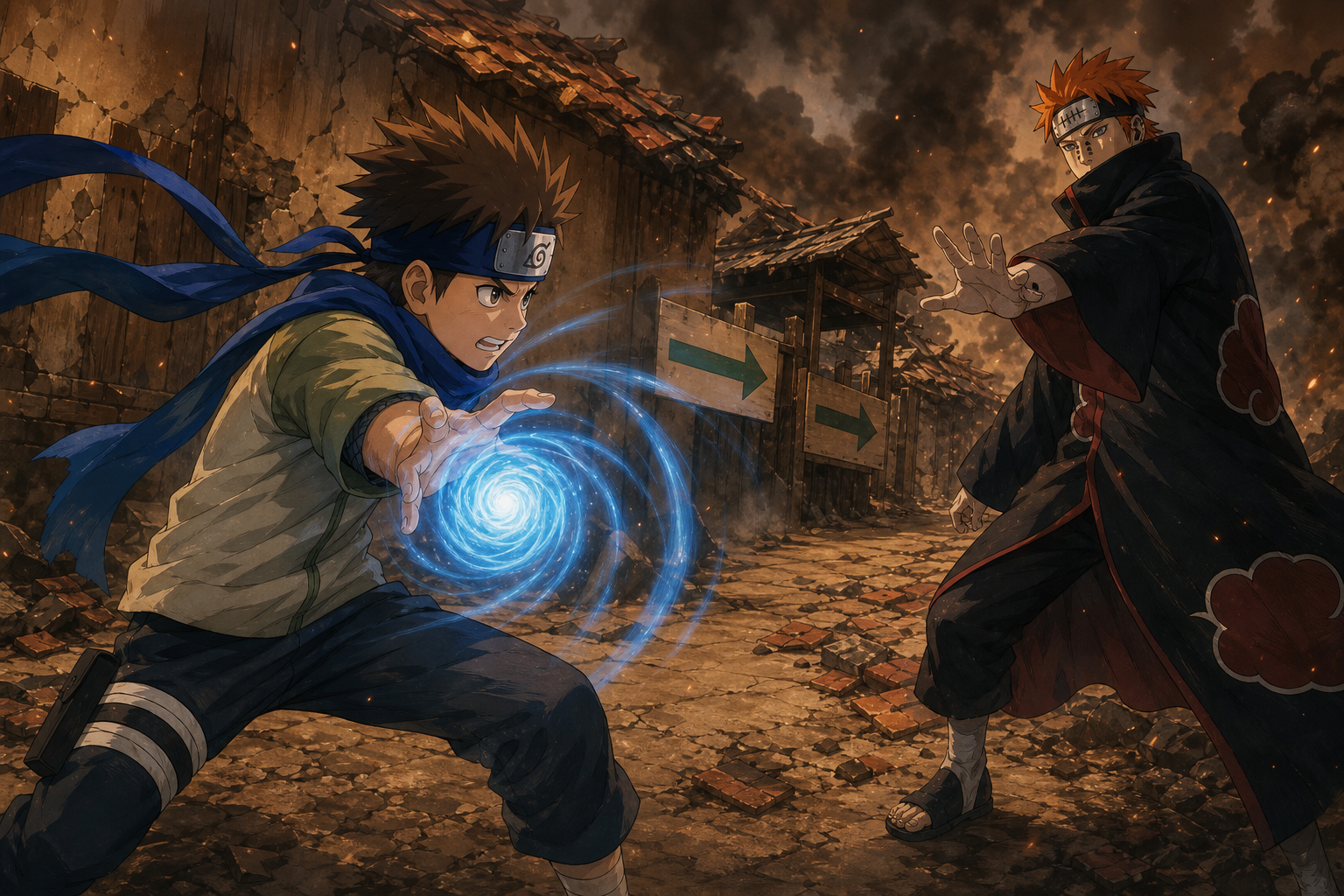
Surname is Sarutobi! Given Name, Konohamaru!
Konohamaru turns family legacy, Naruto’s teaching, and a genin’s duty into one brave answer when the Naraka Path threatens his village.
What happens
Konohamaru, Moegi, and Udon see the scale of the destruction across the Leaf Village. Although they are young genin, they do not wait for a more comfortable assignment. Each moves to help direct civilians toward safety.
Konohamaru's route brings him into danger when Pain's Naraka Path threatens Ebisu. The encounter forces him to decide whether the Sarutobi name is only a legacy he inherited or a responsibility he can express through action.
He remembers Naruto's instruction, creates an opening, and commits to a Rasengan against an enemy far beyond the level a genin would normally be expected to face.
The episode begins with evacuation
Before Konohamaru becomes a fighter, he is part of a rescue system. Directing frightened residents toward shelter may look small beside Pain's destruction, but survival depends on those ordinary routes remaining usable.
Moegi and Udon share the work rather than clustering around the most dramatic threat. Their separation allows Team Ebisu to cover more ground.
The choice recognizes that heroism during a disaster is often distributed. A clear direction given at the right moment can save someone who will never know which battle made it possible.
Genin duties are real duties
The three are still early in their careers, yet the village cannot place the crisis on hold until they are older. Their rank limits what should be demanded of them, but it does not make their contributions imaginary.
This distinction matters. The episode does not claim children should carry the burden of adults. It shows young shinobi responding when the adults' defenses have been stretched beyond their intended capacity.
Their courage grows inside a failure of safety, which makes it admirable and unsettling at the same time.
Ebisu protects his student
Ebisu stands between Naraka Path and Konohamaru because teaching creates obligations beyond instruction. He does not measure his student only by potential.
The instinct to protect Konohamaru is not proof that the boy is incapable. It is proof that Ebisu understands the cost of asking him to fight this enemy.
That protection gives Konohamaru a model of adulthood based on responsibility rather than prestige. The lesson reaches him even before any words do.
The Sarutobi name carries expectations
Konohamaru grew up as the Third Hokage's grandson, surrounded by people who recognized his family before they recognized him. The name provided status while also making individuality harder to establish.
His title announces that tension directly. “Surname is Sarutobi” acknowledges the history he cannot remove. “Given name, Konohamaru” insists that inheritance does not finish the definition.
He honors the family not by imitating every choice, but by accepting responsibility in his own circumstances.
Naruto taught him a method and a posture
Naruto's influence is visible in the Rasengan, but the deeper inheritance is how Konohamaru approaches impossible odds. He refuses to let another person's judgment become the final statement about his capacity.
Naruto did not teach him that confidence guarantees victory. He taught him to train until confidence has technique behind it.
That difference keeps the moment from becoming empty bravado. Konohamaru has practiced something difficult and now chooses the dangerous moment when that work may matter.
A shadow clone creates agency
The shadow clone is more than a familiar trick. It lets Konohamaru shape the encounter rather than responding only to Naraka Path's pressure.
A clone can misdirect attention, conceal position, and buy the fraction of time required to form Rasengan. Against a stronger enemy, that fraction becomes the entire plan.
Konohamaru cannot match Pain's experience or raw power. He can still create a problem Pain did not expect from someone dismissed as a child.
Rasengan proves continuity
Rasengan connects Konohamaru to Naruto, Naruto to Jiraiya, and Jiraiya to Minato. The technique carries a lineage of teaching rather than a biological inheritance.
That lineage complements the Sarutobi name. Konohamaru's identity is built from family, chosen mentors, teammates, and personal work.
When he uses Rasengan, he does not stop being a Sarutobi. He demonstrates that legacy can expand through relationships instead of remaining sealed inside a family tree.
Naraka Path expects obedience through fear
Naraka Path's interrogation relies on overwhelming terror. Its power turns a demand for information into a threat against the victim's life.
Konohamaru interrupts that structure. He cannot erase the danger, but he can refuse the assumption that fear will leave the enemy uncontested.
His attack matters because it restores choice to a scene designed to remove it. Even a brief interruption can allow someone else to survive or move.
Konohamaru is not Naruto's copy
The visual echo is intentional, yet Konohamaru's circumstances are different. Naruto grew up denied by the village; Konohamaru grew up overdefined by a celebrated name.
Both want to become Hokage, but the desire answers different wounds. Naruto seeks acknowledgment, while Konohamaru seeks an identity that belongs to him.
Their shared techniques do not collapse those differences. Mentorship gives Konohamaru tools, not a replacement personality.
Moegi and Udon remain part of the achievement
The episode's most memorable confrontation belongs to Konohamaru, but Team Ebisu's work begins collectively. Moegi and Udon continue helping civilians while he faces a separate threat.
Their less visible contribution prevents the title from becoming a claim that only combat counts. A village is protected through many simultaneous forms of competence.
Konohamaru can take his risk because others are still carrying the evacuation work that brought them into the streets.
Courage does not erase vulnerability
Konohamaru's success should not be confused with safety. He remains young, exhausted, and surrounded by opponents whose full system Konoha barely understands.
The Rasengan is a breakthrough, not a declaration that he can replace senior defenders. Its meaning lies in doing something real within his reach.
That boundary makes the scene stronger. Courage is not proof that danger was appropriate; it is the response he finds when danger arrives anyway.
Konohamaru learns that a famous name cannot evacuate one civilian
The Sarutobi legacy carries history, access, and expectation. None of those abstractions can guide a frightened person toward shelter. Konohamaru has to show up, give clear directions, and take responsibility for the route.
Disaster strips prestige down to usefulness. The name matters only through what he chooses to do with the access and training attached to it.
Moegi and Udon practice leadership without waiting for promotion
They read the street, help civilians, and continue working after the team separates. Leadership appears through attention and follow-through rather than a new rank.
Their competence protects Konohamaru’s scene from becoming a lone-boy fantasy. His teammates are also growing into people the village can depend on.
Ebisu refuses to hand a child to an interrogator
Naraka Path demands information and threatens death. Ebisu could imagine surrender as practical because Pain’s real target is Naruto. He refuses that moral shortcut.
Protecting Konohamaru and Naruto at once asserts that one younger life cannot be traded to reduce danger around another.
Fear gives Konohamaru information
He sees the difference in strength and understands that a direct charge would fail. Fear narrows his attention toward concealment, timing, and the one technique capable of producing real impact.
Courage works because he listens to fear without allowing fear to make the final decision.
The shadow clone proves he studied Naruto’s process
Konohamaru does not copy only the Rasengan’s finished appearance. He uses duplication, misdirection, and close-range timing to create the conditions the technique needs.
Learning becomes visible in the sequence. He remembers how Naruto solves structural problems, then adapts that thinking to his smaller chakra reserve and immediate terrain.
The Rasengan carries chosen lineage beside blood lineage
Hiruzen’s history reaches Konohamaru through family. Naruto’s teaching reaches him through friendship, rivalry, and deliberate practice. Neither route cancels the other.
His identity becomes stronger because he can choose what to carry from both. A family tree is one source of inheritance, not the complete map.
Hiruzen’s legacy includes failures Konohamaru should not inherit blindly
The Third Hokage protected Konoha and loved his grandson. His administration also allowed secrecy, isolation, and political compromises that harmed Naruto and other children.
Honoring Hiruzen should include learning from those failures. Konohamaru can defend the village while demanding a version of leadership that sees neglected children before they become crises.
Naruto gave Konohamaru recognition without deference
Adults often saw the Hokage’s grandson and adjusted their behavior around the title. Naruto saw an annoying kid, a rival dreamer, and eventually a student worth serious effort.
That honest recognition helped Konohamaru build an identity not dependent on ceremonial respect. The Rasengan carries that freedom into battle.
The Naraka Path underestimates developmental time
Pain sees a child and assumes limited threat. He does not see the hours of clone practice, chakra control, failure, correction, and mentoring behind the small body.
Oppression often mistakes visible age or rank for the complete record of what someone has learned.
One defeated Path changes the information landscape
Konohamaru does not end Pain’s assault. He proves that a body can be damaged through a well-timed attack and gives survivors another encounter to report.
Small tactical wins matter when a village is assembling knowledge from many streets. His result joins Kakashi’s interval and Shizune’s receiver analysis.
Ebisu must let pride coexist with alarm
Watching Konohamaru succeed validates training and personal growth. The same scene confirms how close a student came to death against an enemy far beyond his assignment.
A responsible teacher celebrates the skill and still investigates how to prevent the same exposure from becoming routine.
Konohamaru’s declaration names himself before the enemy can
Pain sees leverage, witness, child, or obstacle. Konohamaru answers with surname and given name, refusing to let the attacker define the terms of his presence.
Naming becomes agency. He carries family history while insisting the individual making this choice has a name of his own.
The scene complicates the idea of inherited will
Inherited will can become propaganda when institutions ask children to absorb sacrifice without questioning why adults failed. Konohamaru’s choice feels different because Naruto’s teaching gave him tools and Ebisu’s protection acknowledged his vulnerability.
He is not pushed forward as replacement labor. He enters the fight after witnessing care and choosing to return care.
Victory needs medical and emotional follow-through
A successful Rasengan does not make Konohamaru uninjured or ready for another Path. Adults need to secure the area, assess him, locate his team, and explain the wider situation.
Coming of age should not become an excuse to withdraw support the moment a young person demonstrates competence.
Team Ebisu shows three different ways to serve
Moegi and Udon keep evacuation moving. Ebisu shields a student and protects information. Konohamaru confronts the immediate attacker.
The team succeeds through distributed roles rather than one hierarchy of bravery. Combat is memorable, but civilians survive because quieter work continues.
RaeRae reaction
I love that this episode gives Konohamaru a coming-of-age moment without pretending he suddenly has Naruto's experience. He wins an opening through preparation, misdirection, and nerve. The gap in power remains visible, which lets the achievement feel earned.
The title is especially effective because it allows family pride and individual identity to coexist. Konohamaru does not have to reject Hiruzen's legacy to become his own person. He has to decide what the name asks of him now, then answer with choices nobody can make on his behalf.
Ebisu's role also matters. His willingness to shield Konohamaru shows that mentorship is not only about producing stronger students. It includes accepting responsibility for their vulnerability. Konohamaru's decision to fight comes after witnessing that care, not because no adult cared what happened to him.
“Surname is Sarutobi! Given Name, Konohamaru!” celebrates a young ninja becoming visible on his own terms. The Rasengan connects him to Naruto, but the person who chooses to use it here is unmistakably Konohamaru: a genin, a teammate, a grandson, and a protector beginning to understand how all those names can belong to one life.
The episode earns pride without hiding the systemic failure
Konohamaru deserves the thrill of landing Rasengan. Konoha still placed genin inside an invasion where one wrong movement meant death.
Both truths belong in the record. Admiration becomes more honest when adults also accept responsibility for the conditions requiring extraordinary courage.
The Sarutobi name becomes a verb through service
Family reputation can remain passive, attached to monuments and other people’s memories. Konohamaru makes the name active by guiding, protecting, learning, and risking himself.
His given name matters because the exact person choosing those actions deserves recognition beyond ancestry.
Naruto’s mentorship survives his absence
He cannot protect Konoha directly yet. His instruction, expectations, and stubborn belief in Konohamaru are already fighting inside the village.
That influence proves teaching is one way a person becomes present in places the body cannot reach.
RaeRae’s final word on Surname is Sarutobi! Given Name, Konohamaru!
Konohamaru does not become impressive by turning into a smaller Naruto. He combines the Sarutobi history he inherited, the Rasengan Naruto taught, the protection Ebisu demonstrates, and the nerve he built through his own practice.
The title is a declaration against every adult and enemy who saw the family before the child. Yes, his surname is Sarutobi. His given name still belongs in the sentence because he is the person making the choice.
Moegi and Udon matter because heroism does not begin only when a jutsu appears. They continue moving civilians through a collapsing village while Konohamaru’s route becomes a battle.
The Rasengan lands as proof of relationship. Minato’s invention, Jiraiya’s teaching, Naruto’s patience, and Konohamaru’s work travel across generations into one small opening. Pain controls dead bodies. Konoha survives because living people keep giving one another skills they can choose how to use.
Konohamaru’s dream of becoming Hokage gains an actual job description
Wanting the hat once meant escaping comparison with his grandfather and defeating Naruto in a rivalry. The invasion shows what leadership asks before ceremony. A Hokage must notice civilians, protect information, trust teams, and enter danger without making danger revolve around personal glory.
Konohamaru begins learning that lesson as a genin. The dream becomes heavier and more credible when he serves people who may never applaud him.
The title refuses the choice between family and individuality
Young characters are often told to reject a famous family or disappear inside the family legacy. Konohamaru does neither. He speaks the surname and given name together.
The full name acknowledges that identity grows through inheritance and personal action. He can love Hiruzen, judge Hiruzen’s failures, learn from Naruto, and still become a leader with his own methods.
Ebisu’s fear is evidence that he understands the stakes
A teacher watching a student confront the Naraka Path should feel alarm, not confidence polished into calm. Ebisu knows how young Konohamaru is and how little the village understands Pain.
His fear does not cancel trust in the student’s training. Fear keeps the cost visible so success never becomes proof the risk was harmless.
The Naraka Path loses because coercion narrows attention
Pain focuses on extracting information through terror. That confidence makes a younger observer seem irrelevant until Konohamaru creates the opening.
A system built around domination often sees only the person being controlled and the authority doing the controlling. Solidarity enters from the edge the system dismissed.
Rasengan gives Konohamaru force without giving him safety
The technique can damage a Path, but using Rasengan requires close range. Konohamaru must enter the exact space where a stronger enemy can kill him.
That condition keeps the moment tactical. A powerful skill creates one chance only after clone placement, concealment, timing, and courage have done their work.
Konoha should document this fight without recruiting more children into danger
Konohamaru’s observations about the Naraka Path, interrogation method, reaction time, and durability belong in the shared intelligence record. His success can help later defenders.
The report should not become propaganda encouraging genin to seek equally dangerous encounters. Learning from courage means reducing the need to repeat the same exposure.
Naruto’s best teaching appears in Konohamaru’s independence
A controlling mentor would want a student to reproduce exact words, movements, and loyalties. Naruto gives Konohamaru technique and confidence, then leaves space for a decision Naruto never scripted.
The student proves the teaching worked by acting as himself. Independence is not a failure of influence. Independence is the result good influence should protect.
The episode therefore gives Konohamaru more than a cool attack. He becomes visible as a person located inside several relationships without being owned by any of them. Hiruzen gives him a name and complicated public history. Ebisu gives him instruction and immediate protection. Moegi and Udon share the evacuation labor. Naruto gives him a chosen lineage of technique and stubborn belief. Konohamaru turns all of that material into one decision under pressure. The decision remains dangerous, imperfect, and young. The decision is also his, which is why saying both parts of his name feels like a victory before Rasengan ever lands. The next responsibility belongs to the adults who survive. They must praise Konohamaru without turning his risk into a standard childhood should meet. They must reunite Team Ebisu, assess injuries, record what the Naraka Path can do, and explain why the village defenses allowed genin to face that body alone. Konohamaru earned recognition. Konoha did not earn permission to rely on him this way again. A community honors young courage by building safer conditions around the next choice, not by romanticizing the moment danger left a child with no comfortable option. His surname connects him to leadership. His given name reminds leadership exactly whose life carried the cost after this invasion finally ends.
RaeRae’s call
Konohamaru carries a famous surname, but the victory belongs to his own preparation, chosen mentor, teammates, and decision to protect the teacher who protected him.