
Power to Believe
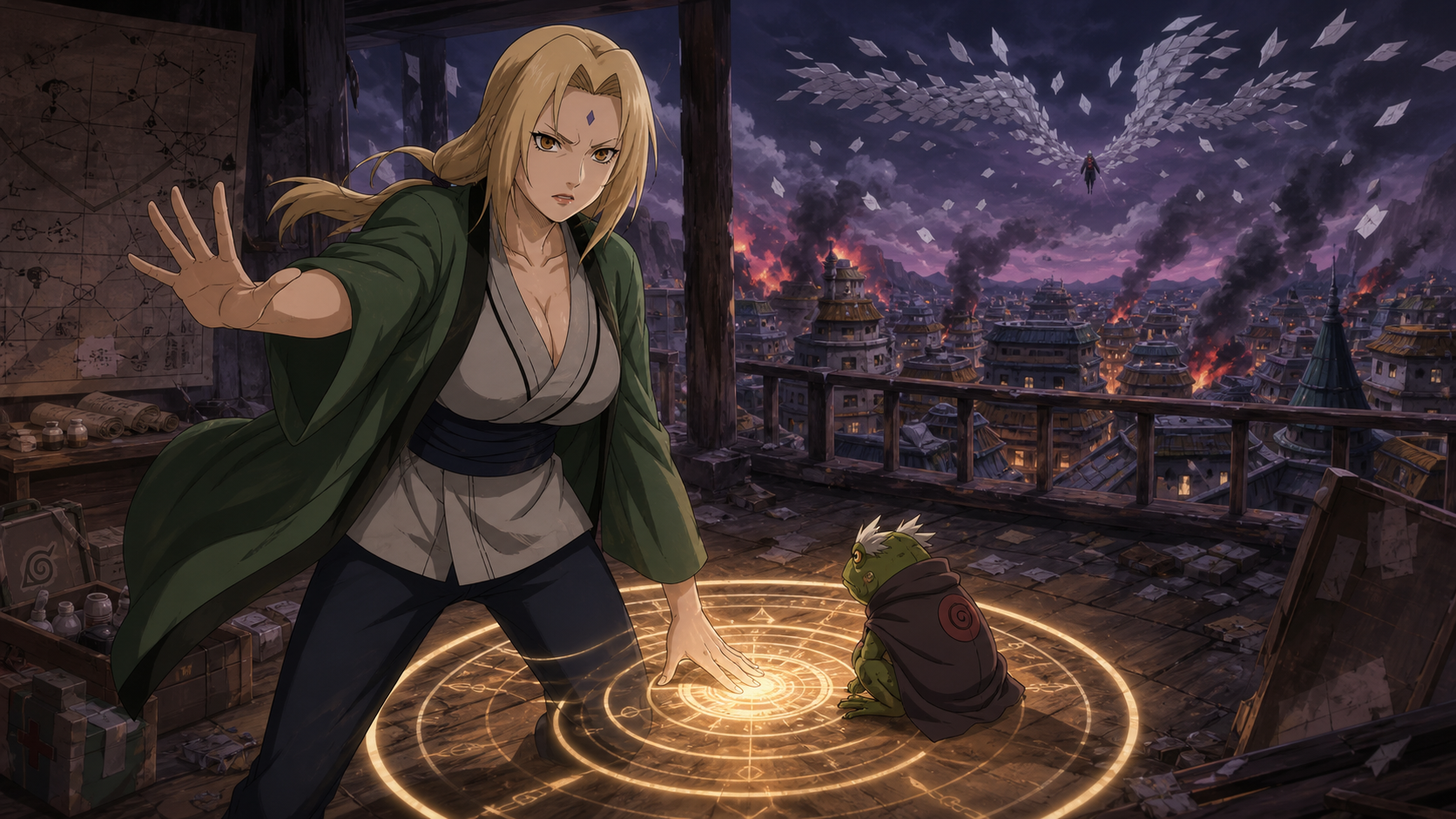
Tsunade contacts Fukasaku while Konoha burns, converting belief in Naruto into a command decision whose risks she must own.
What happens
Pain and Konan intensify their assault on the Leaf Village. Defenders are forced into simultaneous battles while civilians, medical teams, and intelligence units struggle to keep communication and rescue routes functioning.
Tsunade learns the scale of the Akatsuki attack and attempts to contact Fukasaku. Naruto is still training at Mount Myoboku, but the village can no longer treat his return as a distant possibility.
The decision carries risk. Calling Naruto brings Pain's target toward the center of the assault, yet leaving him away may deny Konoha the one defender training specifically to meet this enemy.
Belief becomes a command decision
The title does not describe comforting optimism. Tsunade must convert belief in Naruto into policy under pressure.
As Hokage, she cannot choose solely from affection. She must weigh Naruto's readiness, the village's losses, Pain's objective, and the danger of exposing the Nine-Tails.
Belief matters because the available evidence is incomplete. Leadership begins where certainty ends, but responsible belief still requires an honest accounting of risk.
Tsunade sees Naruto’s growth as evidence
Naruto has repeatedly changed the outcome of missions others considered lost. He has also grown through teachers, teammates, and failures rather than through destiny alone.
Tsunade's faith is therefore not blind. She has watched Naruto develop Rasengan, protect allies, confront Akatsuki members, and carry promises beyond what adults expected of him.
Trusting him now means treating that history as evidence of capability rather than continuing to define him by the danger sealed inside him.
Protection can become confinement
Keeping Naruto away protects him from Pain and protects the Nine-Tails from capture. It also prevents him from participating in the defense of his home.
The village has often made decisions about jinchuriki by treating their bodies as strategic assets first. Tsunade must avoid repeating that logic while still honoring the real stakes.
Protection becomes respectful only when it considers Naruto's agency and the person he has worked to become.
Contacting Fukasaku connects two battlefields
Fukasaku stands at the intersection of Jiraiya's intelligence, Naruto's training, and the village's emergency.
Contacting him does more than request a fighter. It creates a communication bridge between Mount Myoboku and Konoha, allowing each side to make decisions with current information.
The assault has fractured the village's systems. A small toad messenger becomes strategically important because survival depends on keeping distant allies inside the same picture.
Pain and Konan attack a network
The Akatsuki assault is designed to overwhelm more than individual defenders. Multiple threats disrupt patrols, communications, medical response, and command.
Konan's paper techniques extend surveillance and pressure across the environment while Pain's bodies create separate fronts. Konoha must respond as a network or be defeated as isolated units.
The episode's answer to distributed violence is distributed trust. Tsunade cannot fight every battle herself, so leadership means empowering people whose positions she cannot directly control.
The village’s faith is not unanimous
Naruto's status has changed, but fear around the Nine-Tails has not vanished. Some leaders may see summoning him as reckless exposure of the village's greatest weapon.
That disagreement makes Tsunade's choice meaningful. Belief is easy when everyone already accepts the person being trusted.
She acts inside a history that repeatedly denied Naruto full personhood. Calling him as a defender recognizes him as a shinobi of Konoha, not merely something Konoha must hide.
Naruto’s readiness remains unfinished
Naruto is making progress at Mount Myoboku, but training has not reached a comfortable stopping point. Pain does not wait for mastery to become neat.
The decision to call Naruto therefore accepts that real action may arrive before perfect preparation. That is different from pretending preparation does not matter.
Naruto will have to carry incomplete training into a complete emergency, relying on discipline, allies, and adaptation rather than a flawless technique.
Tsunade’s authority includes emotional courage
Tsunade has already lost people she loved to the shinobi world. Trusting Naruto means risking another person connected to those losses.
Her choice is not emotionally neutral. She believes in Naruto partly because Jiraiya believed in him, yet she cannot let grief make the decision for her.
The courage lies in allowing love and evidence to coexist. She does not need to become detached to lead responsibly.
Power to believe belongs to the community
Naruto's slogan has often sounded individual: believe in yourself, refuse surrender, keep a promise. This episode expands belief into something people extend toward one another.
Tsunade believes in Naruto. Fukasaku believes he can continue Jiraiya's path. The defenders believe their work can preserve enough of the village for help to matter.
No single belief guarantees victory. Together, they create the coordination that makes action possible.
Calling Naruto does not excuse the village from fighting
Hope for Naruto's return cannot become passivity. Every minute of training and travel has to be purchased by defenders already under attack.
Medics continue treating the wounded. Intelligence teams continue refining Pain's mystery. Shinobi continue protecting civilians and communication routes.
The village believes in Naruto by giving him something to return to, not by waiting for him to carry everyone alone.
Konohamaru turns belief into a decision before he feels ready
The younger shinobi faces the Naraka Path with every sensible reason to run. He lacks Naruto’s experience, Tsunade’s authority, and complete information about the enemy. He still chooses to protect people in front of him.
Belief becomes practical when Konohamaru acts on what Naruto taught him: rank and fear do not decide whether a person can take responsibility.
Ebisu’s protection shows what a teacher owes a student
Ebisu steps into danger because Konohamaru is under his care. The choice is not proof that the student is useless. A teacher should absorb risk while a younger person is still learning how to judge risk.
Konohamaru’s later action extends that protection rather than making Ebisu’s sacrifice unnecessary. Both choices belong to the relationship.
The Naraka Path turns questioning into bodily terror
Pain demands Naruto’s location and uses the King of Hell to make refusal physically horrifying. The technique converts information gathering into a spectacle of domination.
The victim receives no meaningful choice. Pain treats knowledge as property he can extract from a body, repeating the same logic of coercion that shaped so many shinobi institutions.
Refusing to betray Naruto is not abstract loyalty
People inside Konoha understand that silence may bring death. Their refusal rests on a changed relationship with Naruto, not on a slogan about village secrecy.
The child once treated as a threat has become somebody residents protect because he protected them, noticed them, and refused to let their worst judgment become the final truth.
Konohamaru’s Rasengan is inheritance with a visible source
Naruto taught him the technique through patience, rivalry, and an older-brother bond neither boy needed to name formally. When Konohamaru forms the Rasengan, the scene carries Naruto into Konoha without summoning him.
The technique proves that teaching multiplies presence. Naruto is absent, yet knowledge he shared becomes defense in another person’s hands.
A young fighter’s courage does not excuse adults from protecting him
Konohamaru succeeds, but the village should not build policy around children repeatedly saving adults. His bravery deserves recognition alongside a review of how he reached an enemy this dangerous without stronger backup.
Celebrating competence must not normalize preventable exposure. Heroism and institutional failure can appear in the same scene.
The episode gives Konoha evidence that Naruto already became a teacher
Adults often speak about Naruto as a student still preparing for future responsibility. Konohamaru’s Rasengan reveals that Naruto has already passed knowledge, confidence, and a moral example to someone younger.
Shikamaru’s words about the next generation are becoming concrete before Naruto returns from Mount Myoboku.
Tsunade’s belief travels through people Naruto changed
Her decision to call Naruto rests on his record, but his record includes more than defeated enemies. Konohamaru acts differently because Naruto took him seriously when adults saw only the Hokage’s grandson.
The village’s faith therefore grows from relationships Naruto built one person at a time. Institutional trust follows evidence that began in ordinary encounters.
Pain misreads fear as the complete measure of a community
His interrogation method assumes enough suffering will make every bond negotiable. Fear certainly changes behavior, and nobody refusing him is fearless.
The mistake lies in believing terror erases every other motive. Loyalty, shame, love, duty, memory, and anger can remain active inside fear.
The assault reveals Naruto’s social power before his combat power arrives
Pain wants the Nine-Tails and expects Naruto’s absence to weaken Konoha. Instead, the absent shinobi appears through choices made by people who know him.
Residents protect his location. Konohamaru uses his technique. Tsunade commits to his return. Naruto’s influence is already operating across the battlefield.
The messenger system is small infrastructure carrying enormous stakes
Contact with Mount Myoboku depends on specific summons and trusted communication. One broken link can leave Naruto unaware while Konoha collapses.
Protecting messenger routes therefore becomes part of defense. Spectacular power matters only when information reaches the person capable of using that power at the correct time.
Danzō’s interference exposes a competing definition of protection
Danzō believes hiding Naruto and preserving the Nine-Tails serves Konoha’s future. His secrecy and willingness to control communication treat Naruto as strategic property.
Tsunade’s position carries risk, but her trust recognizes Naruto as a shinobi with agency. The conflict is not faith against reason. Two political visions are deciding who gets to choose for Naruto.
Killing a messenger is an attack on informed consent
If Naruto never receives the call, he cannot decide whether to return. Blocking information manufactures the appearance of protection while removing the protected person’s voice.
Control often hides inside claims that somebody else should not have to carry a dangerous choice. The person controlling the message then makes the choice alone.
Katsuyu turns Tsunade’s chakra into distributed care
Tsunade cannot stand beside every wounded resident. Katsuyu divides, communicates, shields, and carries medical chakra across the village.
The technique answers Pain’s distributed violence with distributed treatment. Leadership reaches people through a network built to preserve bodies rather than use them.
Belief requires preparation or becomes gambling
Tsunade does not merely hope Naruto will win. She continues medical response, intelligence work, evacuation, and defense while seeking contact.
Trust in one fighter remains responsible only when the village keeps creating the conditions that allow his return to matter.
RaeRae reaction
I appreciate that the title frames belief as power but the episode makes that power administrative, tactical, and risky.
Tsunade cannot simply announce faith in Naruto and feel inspired. She has to contact Fukasaku, coordinate the defense, and accept responsibility for what happens if Naruto returns before training is complete.
Her choice also matters because the village spent years treating Naruto as a threat to manage. Calling him now as a protector acknowledges growth that institutions are often slow to recognize.
“Power to Believe” works because belief does not replace the work already happening across Konoha. It connects that work to Naruto's training and Jiraiya's legacy. The village is not saved by faith alone. Faith lets people commit to one another before certainty arrives, and that commitment is what keeps a response possible while Pain tries to break every connection at once.
Konohamaru’s victory is small enough to stay believable
He lands one meaningful technique against one Path under specific circumstances. The moment does not turn him into Naruto’s equal or solve the invasion.
The limited victory matters because it preserves scale. A younger shinobi can change one encounter without carrying the entire village.
Ebisu sees the result of treating a student seriously
Konohamaru is often surrounded by assumptions tied to his grandfather. Naruto gave him direct challenge instead of inherited prestige. Ebisu’s own teaching later added discipline and care.
The Rasengan joins those influences. Growth belongs to a network, even when one child makes the decisive move.
The village believes in Naruto because Naruto believed in villagers first
He repeatedly saw possibility in people after institutions had reduced them to labels: failure, monster, enemy, coward, or spoiled grandson.
Now those people return the practice. They see a defender where Pain sees a container and old Konoha once saw a threat.
RaeRae’s final word on Power to Believe
The title earns its place through Konohamaru more than any inspirational speech. A frightened child remembers what Naruto taught, protects his teacher, and uses the Rasengan to create one real answer inside an invasion far larger than him.
Tsunade’s belief operates at another scale. She must decide whether Naruto has earned the right and responsibility to defend his home. Calling him carries danger. Refusing to call him would preserve his body by denying the person he has become.
Danzō exposes the difference. He calls control protection and blocks information so Naruto cannot choose. Tsunade accepts uncertainty, keeps the village fighting, and tries to bring Naruto into the decision.
Belief has power because relationships already did the work. Naruto taught Konohamaru. Jiraiya and Fukasaku taught Naruto. Tsunade watched Naruto grow. Konoha’s defenders protect the boy who learned to protect them. Faith coordinates that evidence before anyone knows how the battle will end.
The villagers’ silence rewrites Naruto’s childhood in public
Pain asks people to trade Naruto for safety. Years earlier, some of those same streets treated Naruto as the source of danger. The refusal shows how thoroughly daily relationships have changed the village’s moral calculation.
That change does not erase the years of neglect. The village cannot claim credit for Naruto’s loyalty without admitting how often he had to create belonging through his own labor.
Konohamaru protects the teacher who once protected his education
Ebisu can be pompous, rigid, and tied to status, but he takes responsibility for Konohamaru’s safety. Their bond has grown beyond a tutor assigned to the Hokage’s grandson.
Konohamaru’s intervention returns care without converting the relationship into debt. He acts because Ebisu matters and because Naruto taught him that younger does not mean powerless.
The Rasengan carries Minato, Jiraiya, Naruto, and Konohamaru
The technique crosses generations through direct teaching and adaptation. Minato created the form. Jiraiya passed it to Naruto. Naruto passed it to Konohamaru. Each relationship changes what the technique means.
Against the Naraka Path, Rasengan becomes evidence that knowledge survives through people Pain underestimated. A lineage built through teaching confronts a system built from controlled corpses.
Danzō mistakes possession for stewardship
He frames the Nine-Tails as a resource the village must preserve, then treats Naruto’s ignorance as a necessary security condition. That logic centers the asset and erases the person.
Stewardship would give Naruto accurate information, explain the competing risks, and support his decision. Possession blocks the message and calls the silence protection.
Tsunade accepts accountability for trust
Believing in Naruto cannot mean blaming him if the plan fails. Tsunade owns the decision to contact Mount Myoboku because command authority includes responsibility for outcomes.
That ownership separates trust from manipulation. Naruto is not being told to prove everybody right or carry the Hokage’s reputation. He is being recognized as one defender inside a larger response.
Katsuyu keeps leadership physically connected to ordinary people
Each fragment carries Tsunade’s chakra, information, and protection into spaces she cannot personally reach. The technique makes command less distant.
Residents do not receive only orders from a tower. They receive a living extension of medical care that can hear, report, and respond. The network treats survival as shared work.
The episode asks what belief costs the believer
Konohamaru risks his body. Ebisu risks his life. Villagers risk punishment by refusing information. Tsunade risks Naruto, Konoha, and her authority. Fukasaku risks sending an incompletely trained student into war.
Belief without cost would be decoration. Every important act here commits someone to consequences that cannot be guaranteed in advance.
Naruto’s absence reveals the durability of his influence
A fragile hero story collapses whenever the hero leaves the frame. Konoha does not. People continue applying lessons, protecting one another, and making decisions shaped by Naruto’s earlier presence.
That durability proves his relationships are not applause gathered around power. They have become habits other people can carry into danger.
The episode also refuses the fantasy that faith removes fear. Konohamaru is afraid. Tsunade knows the risk. Civilians understand what Pain can do. Courage appears because fear receives a direction through loyalty, memory, and responsibility. Nobody needs to feel certain before acting. They need enough evidence to decide who they will protect and enough trust to accept the cost. That is the power the title names. Belief does not bend reality around Naruto. Belief keeps human connections functioning while Pain tries to turn every connection into leverage. Konohamaru’s small victory makes the argument visible at street level. Pain expects a child to become compliant after witnessing an adult suffer. Konohamaru instead remembers another young person who refused to let adults define the boundary of his courage. The Rasengan does not end the assault, and the child should never have needed to use that technique against an enemy of this scale. The moment still proves that teaching creates choices an oppressor cannot fully predict. Naruto gave Konohamaru knowledge without demanding ownership of the result. Pain controls bodies and demands information, yet control produces obedience only while fear remains stronger than every relationship around the victim. Konoha’s answer grows from a different model. Teachers share skills. Students adapt them. Leaders communicate trust. Medics distribute care. Residents protect a person who once had to beg them for recognition. The network remains imperfect, scarred, and politically divided. The network is also alive, which means belief can travel farther than Pain’s command. That network is why Naruto can return as a member of Konoha instead of merely its weapon.
RaeRae’s call
Belief is not wishing for Naruto to fix everything. Belief means sharing knowledge, preserving choice, and acting on the relationships he built before he could return.