
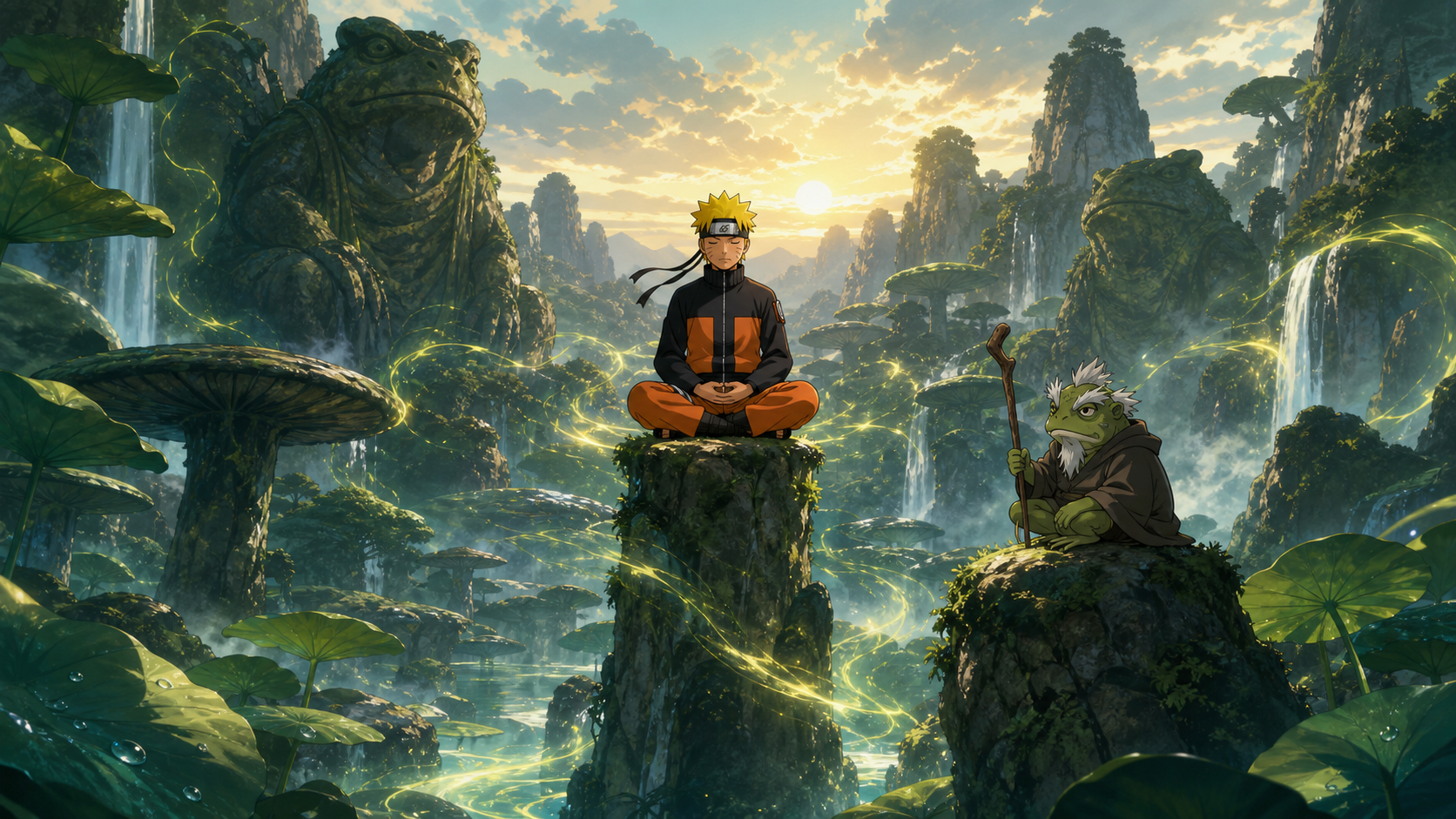
The First Challenge
Naruto begins Sage training with the lesson least suited to his instincts: becoming still enough to enter nature’s balance without forcing it.
What happens
Naruto travels to Mount Myoboku and begins Sage Jutsu training under Fukasaku. The first challenge sounds almost absurdly simple: do not move.
Fukasaku explains that Sage power requires Naruto to draw nature energy into himself. That process takes time, and any unnecessary motion interrupts the balance between the energy of his body, his spirit, and the world around him.
Naruto has built his identity through motion, repetition, and refusal to stop. His first step toward a greater power therefore demands the opposite discipline.
Stillness is not inactivity
Naruto initially understands training through visible effort. Running, striking, forming clones, and repeating a technique all produce evidence that work is happening.
Sage training removes that evidence. Naruto must sit still while performing an internal task more precise than ordinary movement.
The challenge reframes stillness as active attention. He is not waiting for power to arrive. He is learning to notice and admit an energy that constant motion would prevent him from sensing.
Nature energy cannot be forced
Naruto is accustomed to generating chakra from within and directing it toward a result. Nature energy exists outside him.
That distinction changes the relationship between effort and control. He cannot dominate the landscape into giving him power. He must become receptive enough to participate in what is already present.
Sage training is therefore not simply a larger chakra supply. It is a different agreement with power, one based on balance rather than extraction.
Fukasaku teaches through exact limits
Fukasaku's first instruction is concise because the danger is precise. If Naruto gathers too little nature energy, nothing changes. If he gathers too much or loses the balance, the transformation can consume him.
The rule “don't move” creates a boundary Naruto can test. It does not explain every stage at once, but it establishes the bodily condition needed for everything that follows.
Fukasaku teaches by narrowing the problem. After the enormous mystery of Pain, one exact challenge gives Naruto a place to begin.
Grief changes the purpose of training
Naruto has trained for recognition, rivalry, protection, and the promise to bring Sasuke home. This training begins immediately after Jiraiya's death.
That timing gives every exercise emotional pressure. Naruto wants the strength to face Pain, but revenge cannot be the only meaning of Sage Jutsu if he intends to carry Jiraiya's hopes.
Stillness forces Naruto to remain with that conflict. He cannot outrun grief by turning it into endless physical exertion.
Mount Myoboku makes the environment a teacher
The landscape is not decorative. Its plants, water, stone, and living creatures are the source Naruto must learn to perceive.
Konoha training often treats terrain as an obstacle or tactical advantage. Mount Myoboku asks Naruto to experience terrain as an active field of energy.
The place teaches alongside Fukasaku. Its scale reminds Naruto that nature energy is not an extension of his will; he is one small body trying to enter a much larger balance.
Naruto’s impatience becomes useful data
Naruto's difficulty staying still is predictable, but it is not merely comic failure. Every interruption reveals how much unconscious motion organizes his attention.
He learns where tension gathers, how quickly his focus reaches for an external target, and how effort can become noise.
The impatience identifies the exact habit Sage training must transform. Naruto does not need to lose his drive. He needs to discover a form of drive quiet enough to listen.
Power begins with proportion
Fukasaku describes Sage chakra as a balance among physical energy, spiritual energy, and nature energy. The concept makes proportion more important than raw amount.
Naruto's usual answer to a difficult technique is often more clones, more attempts, or more chakra. Here, “more” without balance is dangerous.
The training introduces maturity through measurement. Strength is not possessing the largest force; it is holding several forces in the correct relationship.
The first challenge honors Jiraiya’s path
Jiraiya trained at Mount Myoboku and never reached a perfectly balanced Sage transformation. Naruto enters the same tradition without being asked to become an exact copy of him.
Following the master's path means encountering similar limits and learning from them. It does not mean reproducing every result.
Fukasaku can pass along what Jiraiya learned, including where he struggled. Naruto's inheritance becomes a starting point that may allow the student to travel farther.
Stillness prepares Naruto for Pain’s complexity
Pain's mystery involves bodies, signals, perception, and an unseen organizing intelligence. Naruto cannot defeat that system through impulse alone.
Sage training develops attention as much as force. Learning to sense energy beyond his body may eventually let Naruto perceive threats ordinary vision misses.
The first challenge therefore answers both emotional and tactical needs. Naruto must become capable of staying present with grief and with a battlefield whose truth is distributed beyond one visible opponent.
Fukasaku begins with informed consent about the danger
Nature energy can strengthen Naruto, but imbalance can transform him into a toad and eventually leave him unable to return. Fukasaku explains the risk before celebrating the reward. That order matters.
Naruto chooses the training while understanding that failure has physical consequences. Dangerous instruction becomes more ethical when the student knows the rules, the warning signs, and the teacher’s plan for intervention.
The oil is a training aid, not a shortcut
The special oil helps Naruto feel nature energy by drawing the energy toward him. The aid does not remove the need for control. The oil makes the invisible process legible long enough for his body to recognize the sensation.
Good teaching often uses temporary support that can later be removed. The tool creates access to a difficult skill without pretending access and mastery are identical.
Fukasaku’s stick carries an uncomfortable safety lesson
He strikes Naruto whenever the transformation goes too far, using the staff to knock nature energy out before the change becomes permanent. The comedy should not hide the purpose. A teacher is monitoring a dangerous threshold in real time.
The method looks harsh, yet the episode establishes the rule and the rescue function. Fukasaku does not punish failure. He interrupts a biological emergency.
Naruto needs feedback faster than pride can rewrite the attempt
His face begins changing before he fully understands what the imbalance feels like. Immediate correction connects the internal mistake to a visible consequence. Waiting until later would force him to reconstruct sensation from memory.
Fast feedback helps because Naruto learns through repetition. Each attempt becomes a clearer comparison between balance, shortage, and excess.
Shadow clones turn one student’s practice into parallel research
Naruto’s greatest learning tool is not simply extra muscle. Clones allow him to test more attempts, gather more sensations, and return accumulated experience to the original body.
The method fits him because he does not need to imitate Jiraiya’s pace. He applies a technique developed through his own history to a tradition older than he is.
Parallel practice still multiplies risk
Every clone exposed to nature energy can make a mistake, and every released clone sends experience back at once. More attempts accelerate learning while increasing the amount Naruto must process.
Fukasaku therefore remains essential. Innovation does not cancel supervision. A clever student can create a faster route that requires an equally careful safety plan.
Stillness confronts Naruto’s survival habit
Movement has protected him from loneliness, fear, and helplessness. He runs toward people, trains through humiliation, and turns emotional pain into a task. Those habits saved him more than once.
Sage training asks whether a useful habit has become automatic. Naruto must learn that remaining still does not mean surrendering to grief or danger.
Nature energy refuses the fantasy of self-made power
Naruto cannot claim he created every part of Sage chakra alone. The world supplies one component. Fukasaku supplies knowledge. Jiraiya’s path supplies precedent. Clones supply accumulated practice.
His achievement will remain his, but the achievement is relational. Strength grows through environment, teaching, inheritance, and personal labor held together.
Mount Myoboku changes scale on purpose
Giant statues, enormous plants, strange food, deep oil pools, and towering stone points make Naruto look small. The setting challenges the heroic habit of placing the protagonist at the visual center of everything.
He enters a living system that existed before him and will continue after him. Sage training begins with accepting that scale.
The stone pinnacle makes concentration physically honest
Sitting still on the ground is difficult for Naruto. Sitting still above a dangerous fall removes casual movement from the equation. The exercise makes balance visible through the body.
Fukasaku is not creating danger for drama alone. The height gives Naruto immediate information about every shift in posture and attention. He cannot fake calm while his muscles keep correcting unconsciously.
Jiraiya’s imperfect Sage Mode leaves room for Naruto’s own mastery
Jiraiya reached tremendous power without perfect balance. That record protects Naruto from two bad lessons: that imperfection makes training worthless, or that honoring a master requires stopping at the master’s limit.
A student can respect the road already traveled and still discover a better method. Surpassing Jiraiya would extend the teaching rather than erase the teacher.
The food joke carries cultural entry into another community
Naruto finds the meals strange because Mount Myoboku has its own bodies, tastes, and customs. He is the visitor. His reaction supplies comedy, but the frogs are not required to make their home familiar for him.
Learning Sage Jutsu includes accepting hospitality and discomfort inside a culture that holds the knowledge he needs.
Training after death can become self-punishment
Naruto could use exhaustion to avoid mourning or treat pain as repayment for surviving Jiraiya. Fukasaku’s structured lessons push against that impulse. Each exercise has a purpose, limit, and observable result.
Discipline becomes protective when the plan prevents grief from turning every hour into punishment disguised as dedication.
Fukasaku teaches the student Jiraiya left behind
He carries his own loss into the training. Naruto is not only a promising shinobi. He is the young person Jiraiya loved and the remaining connection to years of shared work.
That emotional bond could make Fukasaku overprotective or reckless. Instead, he combines urgency with instruction, allowing Naruto to risk growth inside monitored limits.
The first challenge prepares a different kind of battlefield attention
Pain’s shared vision punishes fighters who focus on one visible threat. Sage sensing can widen Naruto’s awareness beyond ordinary sight and help him read a field where information travels between bodies.
The training therefore joins inner balance to tactical survival. Stillness teaches the perception required for movement later.
RaeRae reaction
I love that Naruto's first Sage challenge is “don't move.” It is almost offensively well chosen for him.
Naruto has survived by refusing stillness: if the world rejects him, he trains; if someone leaves, he chases; if an obstacle appears, he multiplies himself until effort overwhelms it. Fukasaku introduces a power that disappears when Naruto uses movement to avoid attention.
Mount Myoboku also makes the lesson beautiful rather than punitive. The world around Naruto is alive with energy, and his task is not to conquer it. He has to become quiet enough to join it.
“The First Challenge” turns patience into courage. Naruto is not abandoning the urgency created by Jiraiya's death. He is choosing not to let urgency control the shape of his growth. The first victory is not a new attack. It is one moment in which Naruto can remain exactly where he is and feel that the world is still moving with him.
Naruto’s urgency becomes commitment instead of panic
He wants to return immediately with enough power to answer Jiraiya’s death. Fukasaku gives that urgency a sequence: sense, balance, repeat, stabilize, then advance.
A sequence protects Naruto from confusing speed with readiness. Commitment means staying with the slow step because the slow step makes later action possible.
The lesson is humility without humiliation
Naruto fails repeatedly and looks ridiculous during partial transformation. Fukasaku corrects him without declaring him incapable. Failure remains information about balance.
Humility grows because Naruto encounters a system he cannot bully. Humiliation would teach only shame. The episode keeps the difference visible through steady instruction and continued opportunity.
The environment gives power and sets the boundary
Nature energy is available, but availability does not mean unlimited use. Naruto must take only the proportion his body can hold alongside physical and spiritual energy.
That rule opposes extraction. The strongest result comes from relationship and measure, not from draining everything within reach.
RaeRae’s final word on The First Challenge
Of course Naruto’s first Sage lesson is to sit down and stop moving. The assignment targets the exact habit that made him resilient and now threatens to keep him from learning another way to be strong.
Fukasaku does more than hand him a dangerous technique. He explains the cost, supplies a temporary aid, watches for the point of no return, and corrects the transformation before Naruto loses himself. That is teaching with responsibility.
The clone method keeps Naruto’s own intelligence at the center. He respects Jiraiya’s path without copying Jiraiya’s process. The student brings an old personal technique into a new discipline and builds a route suited to his mind.
Stillness does not make Naruto passive. Stillness allows him to notice a world larger than grief, vengeance, and his own chakra. The first real victory is accepting that power can enter through attention rather than force.
The training separates surrender from receptivity
Naruto has good reason to distrust any lesson that sounds like yielding. Adults once expected him to accept isolation, secrecy, and fear without complaint. Sage training asks for something different. He is not surrendering authority over his body. He is choosing to become receptive to energy while maintaining exact control over the proportion.
That distinction protects the moral center of the lesson. Balance should never become an excuse for obedience to harm. Naruto listens to nature and Fukasaku because the process is explained, chosen, monitored, and open to correction.
Patience becomes measurable through the body
People tell impatient children to calm down as though calm were a personality they either possess or lack. Fukasaku breaks patience into physical practice. Naruto can notice breath, muscle tension, sensory noise, chakra proportion, and the impulse to move.
That approach makes patience teachable. Naruto does not need to become a different person overnight. He needs repeated moments where stillness lasts slightly longer and balance returns slightly faster.
The risk of becoming stone gives imbalance a permanent consequence
The toad transformation is funny until Fukasaku explains the final stage. Too much nature energy can erase Naruto’s ability to return to human form and leave him as stone. The statues around Mount Myoboku are not decoration. They are a record of students who crossed the boundary.
Visible consequences make the school’s responsibility impossible to ignore. Every teacher knows what failure can cost, so safety cannot depend on vague encouragement.
Jiraiya’s imperfect face becomes evidence of difficulty, not shame
His Sage transformation retained toad features because he never achieved the exact balance Naruto now seeks. The difference should not be used to mock him after death. Jiraiya reached a rare level under dangerous circumstances and used that power to protect others.
Naruto can aim for greater precision while respecting the achievement that made his own instruction possible. Surpassing a teacher should include gratitude for the platform the teacher built.
Clone learning turns repetition into shared memory
Each clone sits with a separate attempt, but the released experience returns to one Naruto. The process resembles the decryption room from the previous episode. Many perspectives work in parallel, then combine inside a larger understanding.
Naruto’s signature technique therefore becomes more than numerical advantage. Shadow clones create a learning community made from his own chakra, each version contributing failure, sensation, and adjustment to the next round.
The first challenge is also the first boundary against reckless revenge
If Naruto rushed back to Konoha with uncontrolled nature energy, grief would have given him power without judgment. Fukasaku’s lesson makes readiness depend on balance rather than desire.
The requirement slows the revenge timeline. Naruto cannot face Pain responsibly until he can hold enormous force without allowing urgency to distort the proportion. That bodily discipline anticipates the moral discipline the confrontation will later demand.
Mount Myoboku offers belonging through work
The frogs do not welcome Naruto by pretending he already understands their world. They feed him unfamiliar food, explain their rules, correct his mistakes, and expect serious effort. Belonging grows through participation.
That form of welcome fits Naruto. He has always trusted communities more when people give him a real role instead of ceremonial praise. The mountain treats him as a student whose choices matter.
By the end of the first lesson, Naruto has not defeated Pain, finished mourning, or mastered Sage Jutsu. He has done something quieter and necessary. He has accepted instruction from people who loved Jiraiya, entered a landscape Jiraiya once entered, and begun building strength without allowing grief to choose every movement. That foundation gives later power emotional and ethical weight. Naruto is not collecting a convenient upgrade. He is learning how to remain himself while receiving more of the world than his body has ever held. Fukasaku also gives Naruto something grief had temporarily removed: a next task small enough to attempt. Sitting still does not answer Jiraiya’s death, yet the exercise returns choice to the hour in front of him. Naruto can notice one breath, one imbalance, one correction, and one successful moment without deciding the meaning of his entire future. That manageable scale is part of responsible teaching. Fukasaku keeps the larger danger visible while allowing Naruto to build readiness through steps his mind and body can actually complete today.
RaeRae’s call
Naruto cannot overpower nature into making him a Sage. He has to listen, balance what the world offers, and let disciplined stillness become a new form of courage.