
RaeRae Reacts · One Piece Episode 59
Nelson’s Chained-Fleet Trap
One Piece Episode 59 turns Nelson’s chained encirclement into a child-protection and animal-welfare crisis when Eric betrays command and Ryu takes flight.
Episode information
Japanese title: Luffy Kanzen Houi! Teitoku Nelson no Hisaku (1 Jikan SP Kouhen)
English title: Luffy Completely Surrounded! Admiral Nelson’s Secret Strategy
Japanese broadcast: February 21, 2001
Saga: East Blue
Script: Junki Takegami
Episode direction: Junichi Fujise
Animation direction: Yuji Hakamada
Art: Miyuki Sato
The Going Merry returns toward Warship Island
Episode 59 brings the crew back with new evidence that the Dragon’s Nest may be tied to the place they left. The route now carries Ryu, Apis, Eric’s pursuit, and Nelson’s fleet toward one community.
Homecoming has become a convergence of rescue, exploitation, military force, and sensitive habitat information.
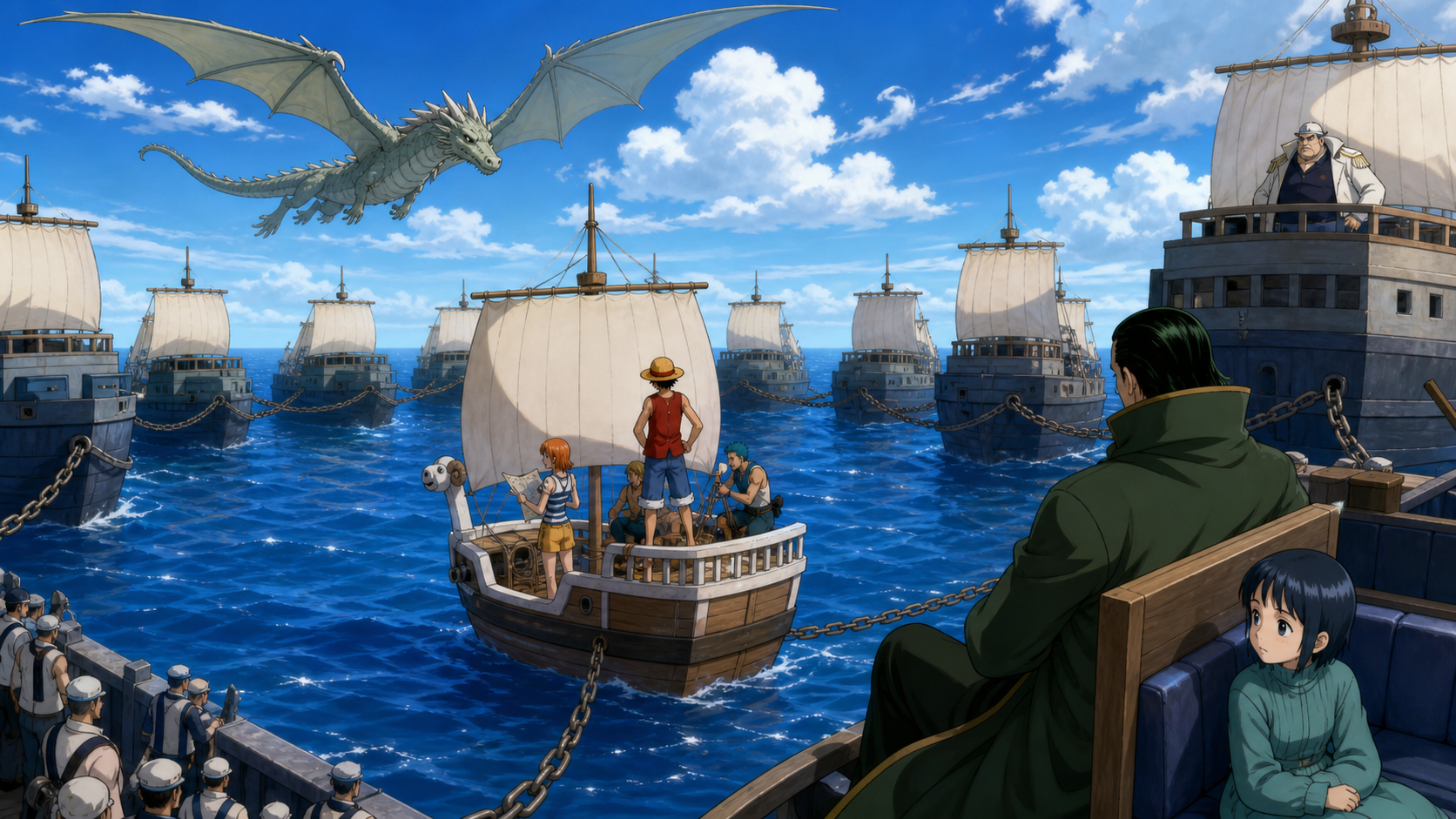
Nelson deploys a chained encirclement
Marine ships connect in a ring intended to close every route around the Going Merry. The formation converts several vessels into one moving barrier.
The formation can restrict escape while creating severe navigation, collision, fire, and emergency-access hazards for everyone inside and outside the chain.
Chains alter how each ship handles. Wind, wave, current, rudder changes, and engine or sail force no longer affect one vessel independently. Uneven movement can snap links, pull hulls sideways, or drag crew overboard.
Commanders need shared speed, tension monitoring, release points, and signals understood by every ship.
A formation without emergency release is a trap. If one vessel catches fire, loses steering, takes on water, or needs medical evacuation, rigid connection spreads danger. Quick-release hardware and trained teams should exist at intervals.
Containment goals do not justify sacrificing the fleet’s own crews.
The ring can harm civilian traffic. Fishing boats, ferries, residents, and wildlife may enter the area without understanding the chain. Clear warnings and safe corridors are required.
Warship Island should not be isolated from emergency supplies because Nelson wants a tactical spectacle.
The Going Merry is physically outmatched. A small wooden ship cannot trade sustained force with an encircling fleet. Luffy’s strength and the crew’s combat skill do not change hull limits.
The objective should be finding a controlled opening, not defeating every vessel.
Nami needs the chain’s geometry. Link spacing, ship headings, windward gaps, current, chain depth, and tension changes may reveal a route. A barrier designed for uniform movement can become vulnerable when one unit lags.
Her analysis needs uninterrupted observations and no unplanned impacts from crewmates.
Usopp can identify weak coordination. He can watch signal delays, distracted crews, loose lines, and ships struggling to maintain position. His role is information and precise disruption only where necessary.
Breaking a chain blindly could send heavy links through people or hulls.
Nelson orders artillery
Cannon fire inside a dense ship formation risks crossfire, ricochet, fire, splinters, chain failure, and injury to Apis and Ryu. The target vessel also carries people the Marines may claim they intend to recover alive.
The tactic is inconsistent with a preservation objective.
Fire around Ryu reveals exploitation
If dragon remains are valuable, killing or injuring the animal through bombardment may still serve people seeking bones. That conflict makes welfare claims unreliable.
Any legitimate rescue operation would establish a no-fire zone around the child and animal.
The crew should use defensive movement. Reduce exposed profile, avoid broadside alignment, secure fire response, keep Ryu below protective cover where possible, and time motion between volleys. Do not place Apis at a rail to communicate under fire.
Escape requires preserving the ship long enough to use an opening.
Ryu needs sound and vibration protection. Cannon shock can worsen stress, disorientation, hearing damage, and breathing difficulty. Padding, cover, calm communication, and distance from impact matter.
Apis can reassure him from a safe position without becoming responsible for his medical stability.
Eric approaches in a smaller boat
A narrow craft can move through gaps the fleet and Merry cannot use. Nelson may see Eric as a retrieval specialist, while Eric sees access to Ryu as a chance to claim the prize.
The contractor’s mobility becomes a security vulnerability inside the admiral’s own formation.
Nelson’s distrust was justified but unmanaged. Knowing Eric is unreliable should have led to limited access, supervision, clear authority, and contingency plans. Suspicion without controls changes nothing.
Leadership is responsible for predictable betrayal by a person Nelson empowered anyway.
Eric seizes Ryu and Apis
Taking both the animal and child separates them from the crew, reduces their ability to refuse, and gives him leverage over each. Transport in a small boat creates fall and capsize risk.
The rescue priority becomes immediate protection rather than property recovery.
Apis is not an accessory to Ryu. Eric may want her because she can communicate or because Ryu responds to her. That does not make her part of the animal’s capture package.
She is a child with independent rights and safety needs.
Eric assaults Apis
The official account describes him throwing her against the boat. The act is physical violence against a child and should be documented plainly without replaying the assault as spectacle.
Medical assessment is necessary even if she gets up quickly. Head, neck, back, internal, and psychological effects may not be immediately visible.
Do not ask Apis to minimize the harm. Adults may focus on Ryu’s response and overlook what happened to her. She should receive privacy, a trusted support person, and control over how the event is described.
Her ability to continue helping does not prove she is uninjured.
Eric’s betrayal of Nelson is operationally predictable. Once he has Ryu, the admiral becomes a competitor rather than employer. Eric’s allegiance was always tied to personal gain.
The incident shows why trafficking operations are unstable even among perpetrators.
Nelson cannot claim surprise as innocence. He deployed force to obtain the dragon and accepted Eric’s methods. Losing control of the contractor does not erase the admiral’s responsibility for creating access.
Accountability should include command authorization, not only the person who defected.
Ryu rises after Apis is hurt
The elderly dragon’s response shows awareness, attachment, and willingness to protect her. He uses remaining strength despite prior frailty.
The emotional meaning is powerful, but emergency exertion may carry severe physical cost.
Protective action is not proof of full recovery. Adrenaline or urgency can temporarily mask weakness. Ryu may fly or strike once and still require immediate rest and assessment.
The crew should not assume renewed ability makes the cart and padding unnecessary.
Ryu removes Eric from control
His movement interrupts the assault and creates space for rescue. The goal is stopping harm, not inflicting revenge beyond what is necessary.
Once Eric is separated, the crew should secure Apis and prevent further access rather than chase him for punishment.
The roar communicates more than anger. The roar may signal distress, warning, recognition, or a call to other dragons. Apis’s interpretation can help, but she should not be pressured while injured.
The sound may also affect wildlife and crews across the fleet.
Ryu spreads his wings
Flight changes the containment problem because ships and chains control water routes, not open air. Nelson’s formation becomes less relevant to the animal the formation was designed to capture.
The moment demonstrates the danger of building tactics around an incomplete understanding of a living being.
Takeoff from a boat is hazardous. Wing clearance, mast, lines, chain, spray, balance, and deck load can cause injury. Everyone should move out of the arc and release obstructions.
Do not grab the dragon or attach a rider without consent and proper support.
Apis should not be carried unsecured. If Ryu attempts to take her with him, the transfer needs a safe harness or supported position. A child clinging to an elderly flying animal under stress faces fall risk.
The crew should prioritize boat-to-ship rescue unless Ryu clearly offers a safer supported method.
The flight may reveal the nest. Ryu’s direction can guide Nelson, Eric, and every observing ship toward sensitive habitat. The crew should create visual obstruction or diversion if the crew can do so without endangering him.
Freedom from the boat is not freedom from surveillance.
The Marine fleet must cease fire
Artillery near an airborne dragon and child creates unacceptable risk. Command should order immediate hold, track without shooting, and prioritize recovery of people in the water.
Officers can refuse manifestly dangerous fire orders and document them.
The chain formation needs to open. A medical and wildlife emergency requires an exit corridor. Selected ships should release connections in a controlled sequence while monitoring tension.
Opening one safe gap is better than forcing the Merry to break through heavy links.
The Straw Hats need divided rescue roles
Nami finds the gap, Usopp monitors Eric and signals, Sanji prepares first aid, Zoro protects the deck, and Luffy supports extraction without grabbing Apis unpredictably.
Clear roles prevent everyone from reaching toward the same unstable boat.
Sanji should prepare child-appropriate care. Blanket, water, quiet space, basic first aid, and food only after medical screening can help. He should keep language calm and age-appropriate.
No romanticized or flirtatious behavior belongs anywhere near Apis.
Nami should record the assault and betrayal. Time, location, witnesses, ship positions, Eric’s actions, Nelson’s orders, and Apis’s condition may matter later. The child’s detailed statement can wait until safe.
Adult observations should be recorded separately to avoid contaminating her account.
Ryu’s welfare after flight is urgent. Watch wing symmetry, breathing, altitude, coordination, landing options, and fatigue. Identify a clear low-stress landing area away from chains and guns.
Apis can communicate only if she feels able after care.
Landing may be harder than takeoff. An elderly dragon may have limited braking or leg strength. Clear obstacles, reduce noise, and avoid crowding the destination.
Padded support should be ready if he returns to the ship or shore.
The crew should not follow blindly. Ryu may know where he is going, while the Merry still faces chains, weather, draft, and pursuit. Nami needs a viable route rather than steering directly under him.
Maintain visual contact without creating collision or exposing the nest more clearly.
Warship Island residents need advance warning. A fleet, dragon, and pirates may arrive together. Trusted signals can prompt shelter, medical readiness, and restricted access to sensitive areas.
Public alarm should not include nest coordinates.
Nelson’s strategy fails through its own assumptions
The admiral treats ships, chains, cannons, Eric, Apis, and Ryu as controllable pieces. Eric defects, the dragon flies, and the child remains an independent person.
Control systems collapse when they ignore agency.
Junki Takegami makes the formation a moral diagram
Takegami’s script places a small ship and vulnerable passengers inside a literal ring of institutional force. Eric then crosses the ring and betrays the commander who enabled him.
Ryu’s flight breaks both physical and conceptual containment.
Junichi Fujise keeps the sea geometry readable. Fujise’s direction shows ship spacing, chains, Merry, small boat, command vessel, and open air. Viewers understand why each movement changes risk.
The formation remains impressive without becoming abstract.
Yuji Hakamada gives Ryu’s movement physical cost. The animation direction emphasizes effort in rising, wing extension, balance, and air capture. The dragon’s age remains visible inside the reversal.
Apis’s safety stays emotionally connected to the motion.
Miyuki Sato contrasts rigid fleet and living flight. Repeated ships and chains create mechanical order below while Ryu opens irregular organic wings above them. The image explains why Nelson’s secret strategy was never complete.
Open sky becomes the route the admiral failed to govern.
RaeRae’s real-time reaction
A ring of chained ships firing inward while a child and elderly dragon are inside is not a rescue strategy. The formation is containment designed by someone who counts bodies as inventory.
Ryu standing up for Apis is powerful, but I need medical care for both of them the second there is space. Flight under emergency stress is not the same as recovery.
The moment that lands. Ryu rises after Eric harms Apis, roars, and opens wings the fleet did not plan around. The person Nelson treated as cargo becomes the agent who breaks the operation.
The reversal belongs to relationship, not immortality.
What should happen next. Cease fire, open the chain safely, rescue Apis, separate Eric from the child and dragon, assess injuries, establish a landing zone, and record command actions. Keep civilians and unnecessary vessels away.
The Straw Hats should protect Ryu’s route without leading every observer directly to the nest.
What accountability requires. Investigate Eric’s assault and trafficking attempt, Nelson’s blockade and artillery orders, custody of Apis, and treatment of Warship Island residents. Preserve fleet logs and witness accounts.
Do not reduce the case to a rogue contractor when command designed the operation.
Bottom line
Episode 59 traps the Going Merry inside Nelson’s chained fleet and then shows why control built on exploitation fails. Eric takes Ryu and Apis, betrays the admiral, and assaults the child. Ryu rises to protect her and opens his wings above a formation built only to control the sea.
RaeRae rating: 9.3/10. The flight is liberation and medical risk at once. Apis needs care, Ryu needs support, and Nelson’s strategy deserves scrutiny because every predictable harm began before Eric defected.