
Following the Master’s Shadow
Naruto follows Jiraiya’s absence through familiar streets until Iruka sits beside him and makes grief shareable without demanding recovery.
What happens
Naruto wanders through the Leaf Village after learning that Jiraiya died. Familiar streets no longer feel ordinary because almost every part of his life in Konoha can lead back to a memory of his master.
He cannot reason himself out of the loss. The man who trained him, traveled with him, embarrassed him, protected him, and believed in him will not return.
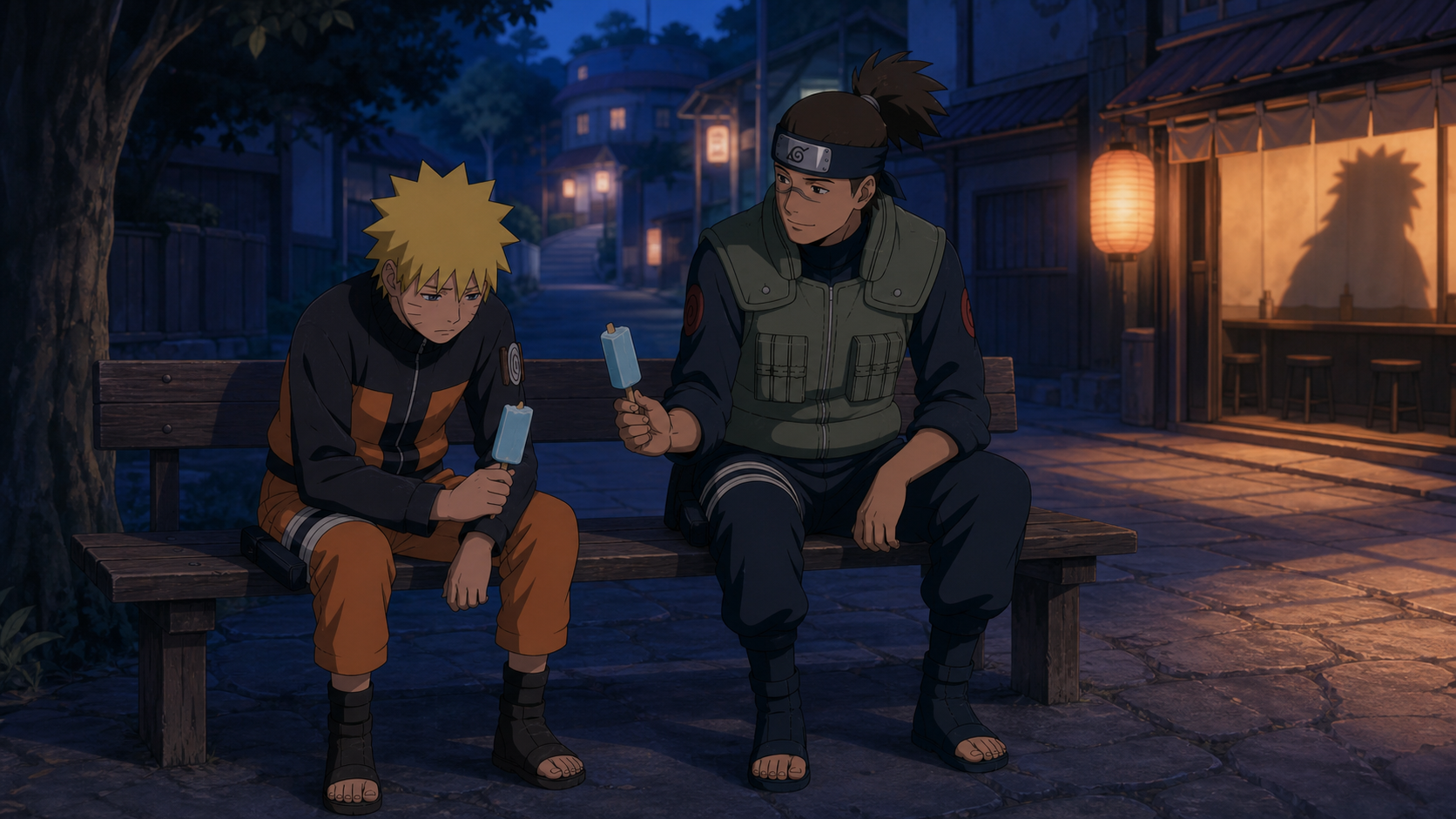
Iruka eventually reaches Naruto without demanding that he recover. Sitting beside him and sharing a twin ice pop, Iruka reminds Naruto that Jiraiya saw him not merely as a student but as someone precious, a grandson in spirit and a possible bearer of his hopes.
Grief turns the village into an archive
Naruto's wandering is not aimless in the simple sense. The streets keep presenting traces of Jiraiya.
A shop, a path, or an ordinary pause can become evidence of a life that used to occupy the same place. Memory attaches itself to the environment before Naruto chooses to remember.
The village remains busy around him, but grief produces a different map. Naruto is no longer moving from destination to destination. He is moving between places where absence becomes visible.
The loudest character has no words for this
Naruto usually meets pain with speech and motion. He argues, promises, trains, and declares what he will change.
Jiraiya's death removes those familiar responses. There is no rescue to organize and no opponent standing in front of him. Naruto cannot transform the fact through determination.
His quiet is therefore not a failure of strength. It is the honest limit of his usual tools. Some losses must first be felt before they can become purpose.
Memory refuses to stay chronological
Naruto does not process Jiraiya by assembling a neat biography. He returns to impressions: foolish behavior, difficult training, moments of protection, and the confidence Jiraiya placed in him.
Grief collapses time. A recent goodbye can sit beside the first day of training, and a joke can hurt as sharply as a solemn promise.
The episode respects that disorder. Naruto is following his master's shadow, but the shadow appears wherever memory places it rather than along one straight path.
Iruka does not try to replace Jiraiya
Iruka understands that support is not substitution. He cannot become the missing master, and he does not compete with the importance Jiraiya held.
Instead, he sits beside Naruto and helps name what the relationship meant. That distinction matters. Grief becomes lonelier when comfort treats the lost person as a role someone else can fill.
Iruka offers continuity without replacement. Naruto still has people who love him, and that truth can coexist with the fact that one irreplaceable person is gone.
The twin ice pop makes grief shareable
The ice pop is a small object, almost comically ordinary beside the scale of Naruto's loss. That is why it works.
Iruka does not bring a speech large enough to match Jiraiya's death. He brings something designed to split between two people.
The gesture gives Naruto no obligation to explain himself. It turns companionship into a physical fact: one bench, two halves, another person willing to remain during the silence.
Jiraiya's faith reaches Naruto through someone else
Iruka tells Naruto how deeply Jiraiya valued him. Naruto knew his master believed in his potential, but grief can make love difficult to access from memory alone.
Hearing that belief reflected by another person gives it new weight. Jiraiya's affection is no longer only something Naruto fears he imagined or failed to repay.
The people who survive can carry messages across an absence. Iruka cannot speak for every part of Jiraiya, but he can return one essential truth: Naruto mattered to him beyond utility, prophecy, or training.
Being the chosen student is not a demand to stop hurting
Naruto will inherit Jiraiya's hopes, intelligence, and unfinished struggle against Pain. The episode does not immediately turn that inheritance into a motivational assignment.
If legacy appears too quickly, it can pressure the grieving person to perform strength for the dead. Naruto first needs permission to be the student who lost his master.
Iruka's comfort helps because it places love before duty. Naruto can eventually carry Jiraiya's dream because he was loved, not because grief has made him indebted.
The master’s shadow is not only sorrow
The title suggests Naruto walking behind someone who is no longer physically present. A shadow can represent absence, but it also proves that a life affected the space around it.
Jiraiya's influence exists in Naruto's habits, convictions, ridiculous memories, and refusal to abandon people. Following that shadow does not mean copying every choice Jiraiya made.
It means recognizing the direction his life made visible and deciding how to continue beyond the point where the teacher stopped.
Naruto’s next step begins with being seen
The episode asks what can help Naruto get back on his feet. The answer is not a tactical briefing or a demand for revenge.
It is Iruka seeing the boy beneath the expected hero. Naruto has often been praised for endurance, but endurance without care can become another form of abandonment.
Iruka does not praise Naruto into standing. He sits down with him. That choice makes the eventual movement honest because Naruto is not forced to leap over grief to satisfy everyone else's need for him.
Naruto needs privacy without being abandoned
Friends notice that Naruto is hurting, yet attention can feel like another demand when grief is fresh. He should not have to explain every silence, reassure every worried person, or perform recovery because the village feels uncomfortable watching him struggle.
Privacy becomes dangerous only when everyone uses privacy as an excuse to disappear. Iruka finds the middle ground. He approaches gently, stays available, and does not turn Naruto’s pain into a public scene.
Shikamaru refuses the idea that grief cancels responsibility forever
Shikamaru knows what losing Asuma did to him. He also knows recovery did not arrive as a clean emotional finish. Work, memory, anger, friendship, and responsibility moved together until he could act without pretending the loss had vanished.
His challenge to Naruto is useful because the challenge comes from lived grief, not impatience. Shikamaru is not asking Naruto to stop loving Jiraiya. He is reminding Naruto that younger people may someday need the same steadiness their teachers gave them.
That future-child argument works because Naruto already protects the next person
Naruto’s promises have always reached beyond his own pain. He fights for Sasuke, Konohamaru, Gaara, and strangers who recognize the loneliness he once carried. Shikamaru points toward that existing instinct rather than inventing a new duty.
The argument gives grief a horizon. Naruto can remain heartbroken while accepting that Jiraiya’s care changed what he is capable of giving someone else.
Legacy should travel through practice, not worship
Following Jiraiya’s shadow cannot mean treating every choice he made as sacred. He failed people, crossed boundaries, avoided responsibilities, and carried ideas he never managed to complete. Love does not require editing those contradictions out of the record.
Naruto honors him best by keeping the courage, curiosity, humor, and refusal to abandon peace while correcting the habits that caused harm. A living legacy should be able to learn.
The village remembers a legend while Naruto remembers a person
Konoha can list Jiraiya’s rank, missions, intelligence, students, and role among the Sannin. Naruto remembers stolen money, terrible supervision, exhausting training, shared meals, and moments when Jiraiya’s belief arrived before Naruto believed in himself.
Both records are true. The personal record explains why public praise can sound thin to somebody who knew the dead person in ordinary life.
Food becomes a relationship language again
Naruto has often received care through ramen, shared snacks, and somebody choosing to sit near him. The twin ice pop belongs to that history. Iruka offers comfort in a language Naruto already trusts.
The food does not symbolize everything. The practical act still matters: one person notices another person alone, buys something small, divides the portion, and remains for the difficult silence.
Iruka speaks about Jiraiya without claiming access to Jiraiya’s mind
Comfort can become dishonest when a survivor invents certainty about what the dead person would say. Iruka stays close to what he knows. Jiraiya valued Naruto, believed in Naruto, and treated him with family-level affection.
Those claims rest on witnessed behavior. Naruto can accept them without pretending Iruka has delivered a message from beyond death.
Crying does not interrupt Naruto’s development
Shonen stories sometimes treat tears as the corridor between weakness and a stronger transformation. Naruto’s grief deserves more respect. Crying is part of recognizing the size of the bond and the permanence of the loss.
He does not earn Sage Mode by suffering correctly. Training will matter because he chooses to continue, not because tears become payment for power.
Jiraiya’s shadow includes Minato even before Naruto knows the full map
Jiraiya taught Naruto’s father and later taught Naruto. That chain carries love, technique, political hope, and unfinished questions across generations. Naruto has inherited connections he does not fully understand yet.
The missing family history makes Jiraiya’s role even larger. He connected Naruto to a past the village kept strangely distant, even when neither man spoke every truth aloud.
Tsunade and Naruto grieve different versions of the same impossible man
Tsunade knew Jiraiya across decades of war, rivalry, affection, foolishness, and repeated departure. Naruto knew him during the years when training and travel turned a neglected child into a young shinobi with a wider world.
Their pain should not compete. Shared loss becomes richer when people are allowed to remember different relationships without ranking who has the right to hurt most.
The episode avoids making Iruka a miracle cure
Naruto does not stop grieving because Iruka says the perfect sentence. The conversation changes what Naruto can hold alongside grief. Love, responsibility, and the existence of other bonds return to view.
That shift is enough. Human support often works by making the next hour possible, not by solving the entire emotional future on one bench.
The master’s shadow points forward because light still exists behind Naruto
A shadow is evidence of interruption, but a shadow also depends on light. Jiraiya’s absence shapes Naruto because Jiraiya’s presence changed him first.
The title therefore holds sorrow and direction together. Naruto can follow what remains without pretending the person himself remains reachable.
Konoha owes Naruto more than praise for recovering
The village will celebrate when Naruto trains, decodes danger, and stands against Pain. Praise after usefulness cannot replace support during collapse. People must keep checking on him when he offers no strategic value.
Iruka models that duty. He arrives because Naruto is hurting, not because Naruto has completed the emotional step required for the next mission.
Grief makes Naruto more capable of hearing Pain later
The loss does not automatically produce wisdom. Naruto could easily convert sorrow into vengeance. His willingness to remain with grief, accept support, and remember Jiraiya as a person creates another possibility.
When Pain eventually speaks about loss, Naruto will not answer from theory. He will know the temptation to make another person’s suffering pay for his own.
RaeRae reaction
This episode understands that the village itself can become painful after a death. Naruto is surrounded by home, yet home keeps showing him where Jiraiya is missing.
The twin ice pop scene works because Iruka offers exactly enough. He does not explain death, announce a grand destiny, or tell Naruto to be strong. He shares an object and remains close.
I also love that Jiraiya's faith reaches Naruto through another teacher. It shows how care can travel through a community after the person who began it is gone.
“Following the Master's Shadow” gives Naruto room to be heartbroken without treating him as broken. Jiraiya's legacy will eventually become action, but this episode starts with love, memory, and a bench. Naruto rises not because grief has ended, but because someone helps him understand that the bond inside the grief is still real.
Shikamaru and Iruka offer two kinds of care
Shikamaru gives Naruto a future-facing challenge. Iruka gives him present-tense companionship. One reminds him that responsibility continues. The other makes continuation emotionally possible.
Naruto needs both, and neither man should be treated as having the single correct response. Grief changes minute by minute. Good community care has more than one doorway.
The bench scene works because nobody is performing for a crowd
Naruto has spent much of his life demanding that the village witness him. Here, care arrives outside applause, rank, and public recognition. Iruka does not need anyone to see him being kind.
The privacy allows Naruto to be a grieving student instead of Konoha’s future hero. That distinction gives the scene its tenderness.
The next movement belongs to Naruto
Iruka can sit beside him. Shikamaru can name the future. Fukasaku can bring Jiraiya’s knowledge. None of them can choose Naruto’s relationship to the loss.
Agency returns when Naruto decides to stand, learn, remember, and eventually face Pain. Support creates room for that decision without stealing ownership of the decision.
RaeRae’s final word on Following the Master’s Shadow
This episode understands that Naruto does not need a grand speech large enough to defeat death. He needs somebody who knows when to sit down. Iruka shares a cheap frozen treat, names Jiraiya’s love without pretending to replace him, and allows Naruto’s tears to remain part of the conversation.
Shikamaru adds the harder truth. Teachers leave work inside their students, and those students eventually become responsible for the people coming behind them. That future does not cancel grief. The future gives grief somewhere to travel.
Jiraiya’s shadow contains every contradiction Naruto loved: discipline and irresponsibility, wisdom and foolishness, distance and fierce belief. Following that shadow should never mean copying the man whole. Naruto can carry what saved him and refuse what caused damage.
The twin ice pop remains the receipt. Naruto once shared ordinary time with Jiraiya, and ordinary time became family. Iruka cannot restore the missing half. He can make sure Naruto does not have to hold the remaining half alone.
Ramen cannot carry every memory, and that is why the ice pop matters
Ichiraku often represents Naruto’s safest version of home. Teuchi and Ayame feed him without making belonging conditional. Jiraiya’s memory appears through another food because their relationship had its own ordinary rituals. The twin ice pop is portable, childish, inexpensive, and built to be divided.
That specificity keeps grief from becoming generic sadness. Naruto is not mourning every kind adult in one blended emotion. He is mourning the person who stood beside him during particular afternoons, complained, joked, trained him, and took the other half.
Iruka remembers what public recognition arrived too late to repair
Konoha now sees Naruto as brave and valuable. Jiraiya believed in him while much of the village still measured him through the Nine-Tails. Iruka knows the difference because he also chose Naruto before approval became easy.
The two teachers offered recognition at different stages, and their care helped Naruto survive long enough to become visible to everyone else. Public celebration cannot replace those early decisions. The village should remember who stood near the lonely child before the hero made association flattering.
Becoming a teacher does not require Naruto to stop being a student
Shikamaru’s words about the next generation point toward adulthood, but growth does not erase Naruto’s need for guidance. He can carry younger people later and still miss Jiraiya, seek Kakashi’s advice, learn from Fukasaku, and rely on Iruka.
The healthiest inheritance is not a chain where each student loses support the moment responsibility begins. People can teach and be taught at the same time. Naruto’s future strength should include the ability to receive care without treating dependence as failure.
Jiraiya’s unfinished peace project becomes personal work
Jiraiya searched for an answer to hatred across wars, villages, students, prophecy, and repeated disappointment. Naruto inherits no complete method. He inherits a question backed by the cost of a life.
That uncertainty is harder than receiving a final command. Naruto must test Jiraiya’s hope against Nagato’s history and his own desire for revenge. Following the master’s shadow means entering the unresolved argument, not repeating a slogan about peace.
The episode protects the difference between moving and moving on
Naruto will get up, train, decode the threat, and return to action. None of those movements means Jiraiya has become a closed chapter. Grief will surface through later choices, memories, anger, humor, and the way Naruto mentors other people.
Moving on suggests leaving the relationship behind. Naruto instead moves with the relationship changed by absence. The distinction allows strength without emotional amnesia.
That is why this quiet chapter belongs inside the Pain story rather than outside the action. The coming confrontation will test whether Naruto can carry unbearable loss without demanding that another person inherit the same wound. The bench, the tears, Shikamaru’s challenge, and Iruka’s presence prepare that moral fight long before Sage Mode prepares Naruto’s body. Jiraiya cannot witness the answer Naruto eventually gives Pain, and that absence remains unfair. Still, the answer grows from lessons Jiraiya planted and relationships other people protect after his death. Iruka keeps Naruto connected to love. Shikamaru keeps responsibility visible. Fukasaku keeps the final evidence from disappearing. Naruto brings those gifts together without pretending any one of them replaces his master. His next step therefore belongs to a community as well as a legacy. The village failed Naruto through isolation when he was young. In this moment, three adults and one grieving friend begin showing what a better response can look like after the funeral ends.
RaeRae’s call
Iruka does not drag Naruto out of grief. He sits inside the grief with him, names the love Jiraiya left behind, and lets Naruto choose the next step.