
RaeRae Reacts · One Piece Episode 57
The Legendary Lost Island
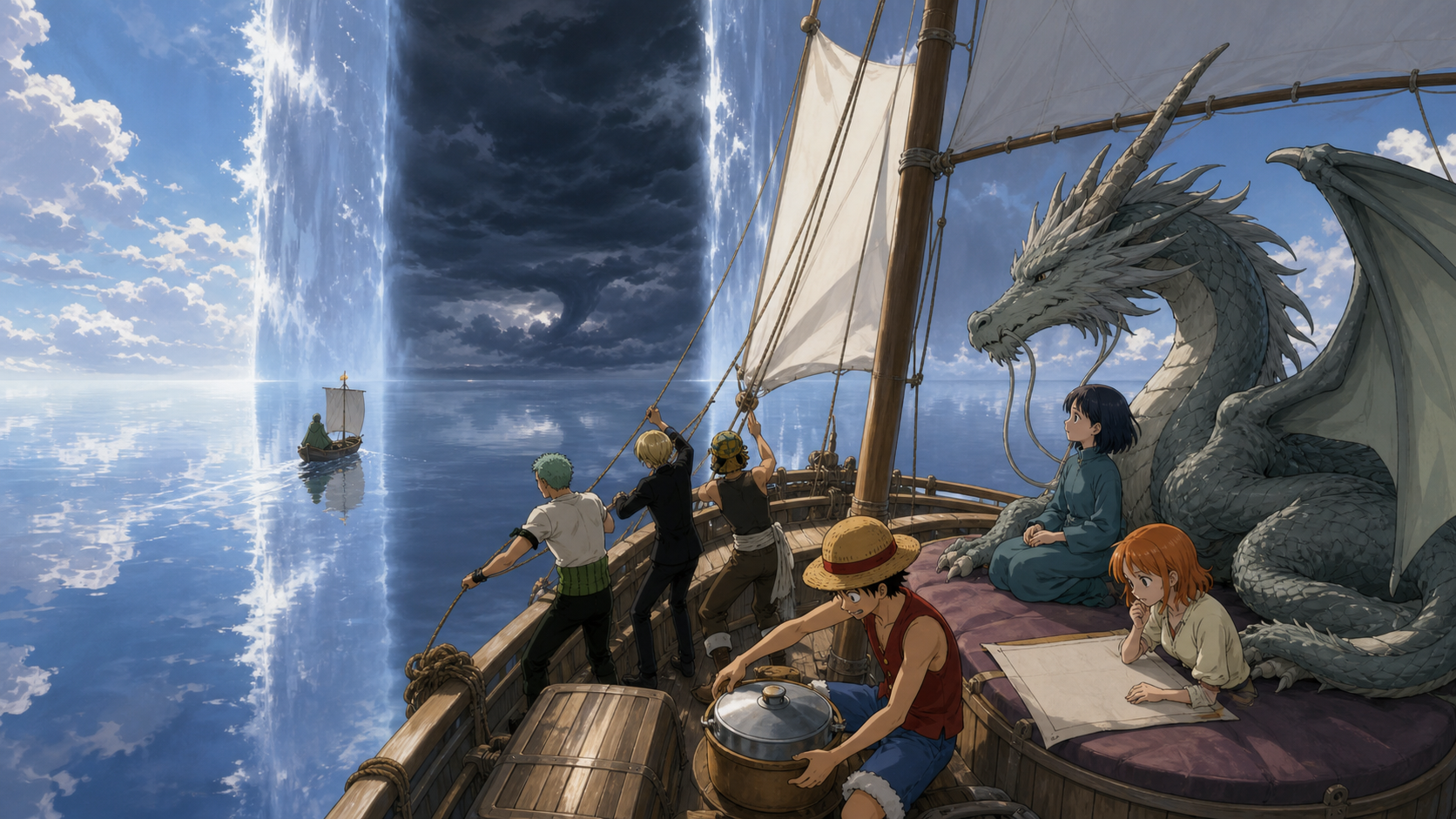
One Piece Episode 57 turns Ryu’s recovered memory into sensitive route evidence through Eric’s surveillance, a mirror wall, and a dangerous storm crossing.
Episode information
Japanese title: Zekkai no Kotou! Densetsu no Lost Island
English title: A Solitary Island in the Distant Sea! The Legendary Lost Island
Japanese broadcast: February 7, 2001
Saga: East Blue
Script: Junki Takegami
Episode direction: Yoko Ikeda
Animation direction: Kazuo Takigawa
Art: Kunihiro Chida
Eric chooses surveillance over immediate attack
Episode 57 follows the Going Merry after Warship Island while Eric remains behind the ship. He reasons that tracking Ryu will lead him to Lost Island and the dragon remains he wants.
The decision turns the crew’s rescue route into involuntary location data.
Following is a conservation breach. Eric does not need to capture Apis or Ryu immediately if their movement reveals habitat. Covert observation can create the same final harm as direct force.
The crew must treat surveillance detection as part of animal protection, not only personal security.
A distant boat can still be a threat. Small wakes, repeated silhouettes, sail behavior, and matching turns may indicate a tail. Nami and Usopp should compare observations without announcing suspicion through obvious maneuvers.
One sighting is not proof. A pattern supports action.
Counter-surveillance should avoid exposing the destination. Changing speed, making a neutral loop, using weather cover, and assigning stern watch can test whether the vessel mirrors them. False routes should not endanger unrelated islands.
Communication about the tail should remain limited so captured notes cannot reveal Lost Island.
Nelson does not trust Eric
The admiral understands that a contractor or subordinate motivated by immortality may keep the prize for himself. Nelson’s suspicion reflects a conflict of interest inside the operation.
Distrust does not make Nelson protective of Ryu. The distrust may simply mean he wants control of the same exploitation.
Competing pursuers increase danger. Eric and Nelson can interfere with one another while converging on Apis, Ryu, Warship Island, and the Straw Hats. Each may escalate to prevent the other from gaining advantage.
Residents need protection from being treated as sources by both sides.
Nelson moves toward Warship Island. Returning forces to the community after the dragon has left can produce searches, coercive questioning, detention, and retaliation. The island may know less than officers assume.
Bokuden and residents need a coordinated response that protects people without inventing information.
Residents should not be punished for lacking coordinates. Oral history, Apis’s ability, and Ryu’s memory do not provide every resident with a usable map. Authorities should not treat uncertainty as obstruction.
Independent witnesses and records can help document abusive questioning.
Ryu remains an elderly passenger
After cart transport and ship loading, the dragon needs rest, padding checks, water, food appropriate to his species, and observation for delayed strain.
The urgency to reach Lost Island should not erase cumulative travel effects.
Memory may be inconsistent under stress. Ryu’s age, fatigue, unfamiliar surroundings, and physical condition may affect recall. A remembered image can be meaningful without functioning as precise navigation.
Apis should communicate uncertainty rather than feel pressured to produce coordinates.
The meal accident is preventable
Luffy overturns a large pot onto the raised part of Ryu’s head. The surprise appears to trigger a memory of Lost Island, but the event should not be celebrated as a diagnostic technique.
Hot, heavy, or messy food can cause burns, distress, aspiration risk, and contamination.
Galley items need secure storage. Lidded pots, nonslip surfaces, low carrying routes, clear walkways, and verbal warnings reduce spills aboard a moving ship. Large meals should not be carried above resting passengers.
Sanji should review how the pot left controlled kitchen space.
Ryu needs immediate assessment after the spill
Check temperature exposure, skin or scale irritation, eyes, breathing, startle response, and whether food entered sensitive areas. Clean gently with appropriate water and avoid forcing movement.
The recovered memory can be recorded after welfare is stable.
A shock-linked memory is still evidence with limits. Ryu recalls location information after surprise. The timing does not prove that physical shock was necessary or that repeating the shock would improve recall.
Record exactly what Apis understood, including landmarks, direction, sequence, and confidence.
Do not contaminate the account through leading questions. Adults should ask open prompts and allow pauses. Suggesting a mirror, storm, island shape, or desired route can blend crew expectations with Ryu’s memory.
Apis should be able to say she is unsure.
Nami must convert memory into a testable route
Compare the account with charts, sun, current, weather, depth, sea color, birds, and known hazards. Identify the next landmark rather than plotting an entire route from one recollection.
Navigation should progress through confirmed checkpoints.
The mirror wall appears at sea
A reflective barrier creates a visual boundary unlike ordinary weather. The barrier may be mist, current, optical effect, unusual water, or a phenomenon the crew lacks language to classify.
Calling the barrier legendary does not explain the barrier’s material behavior.
Reflection disrupts distance judgment. Mirrored sky and sea can hide horizon, obstacles, waves, and orientation. Lookouts may mistake reflections for open routes or duplicate vessels.
Rope soundings, slow speed, multiple viewpoints, and marked heading reduce sensory error.
Do not touch the barrier without testing. Use expendable line, temperature observation, wind indicators, sound, and small samples where safe. Keep people behind the rail and avoid extending limbs into an unknown surface.
Luffy’s curiosity should not become the ship’s instrument plan.
The passage confirms a feature, not the whole legend
Finding the mirror wall supports part of Ryu’s memory and Bokuden’s account. The feature does not prove the location of Lost Island, the Dragon’s Nest, or immortality medicine.
Evidence should update claims in pieces.
Eric benefits from the crew’s testing. A follower can watch the safe route, timing, and reaction without bearing the risk of discovery. The Straw Hats may unintentionally perform reconnaissance for him.
Before crossing, they should attempt to confirm whether the tail remains.
A false passage could separate the pursuer. If multiple reflective openings exist, the crew might delay, obscure, or alter timing. Any tactic must remain safe for Ryu and avoid trapping Eric in a lethal hazard without warning.
Conservation security does not require summary punishment.
The storm begins beyond the wall
Passing through the reflective boundary leads into severe weather. The calm approach may have concealed pressure, wind, and wave conditions on the other side.
The crew needs to transition instantly from investigation to storm operations.
Reefing should occur before entry. If dark weather is visible through the barrier, reduce sail, secure cargo, close hatches, assign lines, and move Apis and Ryu to protected positions before crossing.
Preparation on calm water is safer than adjustment inside gusts.
Ryu’s padded space must remain stable
Storm roll can shift a large body even when the deck platform seemed secure in calm conditions. Check anchors, padding, drainage, wing clearance, and escape access.
Straps should stabilize supports without binding the animal.
Apis should not stand exposed beside Ryu. She can reassure him from a protected, tether-safe position with an adult nearby. Her desire to help does not make the rail or open deck appropriate during the storm.
Communication can continue without physical proximity at every second.
Nami needs uninterrupted command
During the crossing, one navigator should issue helm and sail commands. Questions, arguments, food, and pursuit concerns must route through assigned roles.
Command clarity protects everyone, including the person being followed.
Usopp should monitor both ship and tail. He can observe stern conditions, rigging strain, and signals from the pursuing boat, but storm survival takes priority over perfect surveillance.
Any sighting should be reported concisely without abandoning a loaded line.
Zoro and Sanji need deck roles beyond combat. Zoro can secure heavy equipment and support lines. Sanji can protect galley hazards, manage food and water, and assist passengers.
A dangerous voyage requires every specialist to contribute outside the identity of fighter.
Luffy needs to follow the navigator. The captain may want to push forward or confront Eric. In a storm, unscheduled movement can unbalance the ship and distract crew.
Leadership means obeying technical command when another crewmate owns the domain.
Lost Island may be seasonally hidden
Mirror and storm phenomena could relate to tides, temperature, pressure, migration, or timing. The route may not remain open or repeat reliably.
Precise publication could still draw hunters who are willing to wait.
Route notes need restricted access. Nami’s chart, Usopp’s observations, Apis’s translations, and Bokuden’s history together create sensitive habitat information. Store copies securely and avoid names that advertise the destination.
If capture appears likely, the crew needs a plan to protect or destroy only the sensitive copy without losing essential navigation.
The pursuit changes the ethical threshold
Reaching Ryu’s destination may lead Eric directly to other dragons. Continuing with a known tail could cause more harm than pausing or diverting.
The crew should reassess at each checkpoint rather than treat the promise as irreversible.
Ryu’s wishes must include the risk to others. If Apis can explain that a pursuer may follow, Ryu can express whether return remains desired. Consent is more informed when consequences for the Dragon’s Nest are included.
The final decision should balance his welfare with habitat protection.
Nelson’s distrust offers a potential delay. If Eric and Nelson monitor one another, their conflict may slow pursuit. The Straw Hats should not count on that conflict or reveal themselves to manipulate the rivalry without a clear plan.
Uncontrolled competition can escalate unpredictably.
The crew needs an emergency evidence log. Record the spill, Ryu’s condition, recovered memory, mirror wall, storm timing, tail sightings, and route changes. Distinguish direct observation from interpretation.
Accurate notes support later debrief and protect Apis from being blamed for adult decisions.
Junki Takegami turns memory into geography
Takegami’s script links an accidental stimulus to a route clue, then gives the clue a visible feature and new hazard. Each apparent answer produces another verification problem.
Eric’s tail ensures discovery has conservation stakes.
Yoko Ikeda uses reflection to destabilize certainty. Ikeda’s direction makes the mirror wall beautiful and difficult to read. The crew sees itself, sky, sea, and passage at once.
The visual boundary separates calm preparation from storm exposure.
Kazuo Takigawa makes the ship respond in layers. The animation direction shows sail, line, pot, dragon, clothing, and water reacting to different changes. Ryu’s scale remains physically present without turning him into cargo.
Storm motion becomes a system problem.
Kunihiro Chida gives the route mythic restraint. Silver reflection, dark weather, blank horizon, and a small following boat create mystery without exposing Lost Island itself. The environment holds information back.
That restraint fits a habitat threatened by discovery.
RaeRae’s real-time reaction
I am relieved Ryu remembers a route clue, but I am not giving the cooking-pot accident any credit as a method. Secure the galley, check the dragon, then write down exactly what he recalled without feeding him the answer.
The mirror wall is proof of one landmark, not proof that every immortality rumor is true. Eric following them is the reason those distinctions matter.
The moment that lands. The Merry crosses a surface that looks like reflected sky and immediately meets a storm. The crew moves from wonder to survival without enough time to settle what the crew saw.
Legend becomes real in fragments, and each fragment carries a new risk.
What the crew should do inside the storm. Follow Nami’s commands, reduce sail, secure Ryu and Apis, monitor hull and rigging, keep the galley locked down, and maintain a concise stern watch. Do not engage Eric unless he creates an immediate collision or attack threat.
Identify the next safe holding area and reassess whether continuing protects or exposes the dragons.
What Warship Island should do. Prepare for Nelson’s arrival, protect Bokuden and residents, document searches, avoid inventing coordinates, and separate public oral history from restricted habitat details.
Community safety does not depend on knowing the crew’s current location.
Bottom line
Episode 57 makes Ryu’s fragile memory operational. A preventable meal spill triggers a location clue, the Going Merry finds a reflective wall at sea, and a storm waits beyond the mirror wall while Eric follows to turn the dragon’s return into a path toward exploitable remains.
RaeRae rating: 9.1/10. The route is not just mystery. The route is sensitive conservation data. Every landmark must be verified, every passenger protected, and every new piece of evidence weighed against the danger of leading a hunter home.