
Somber News
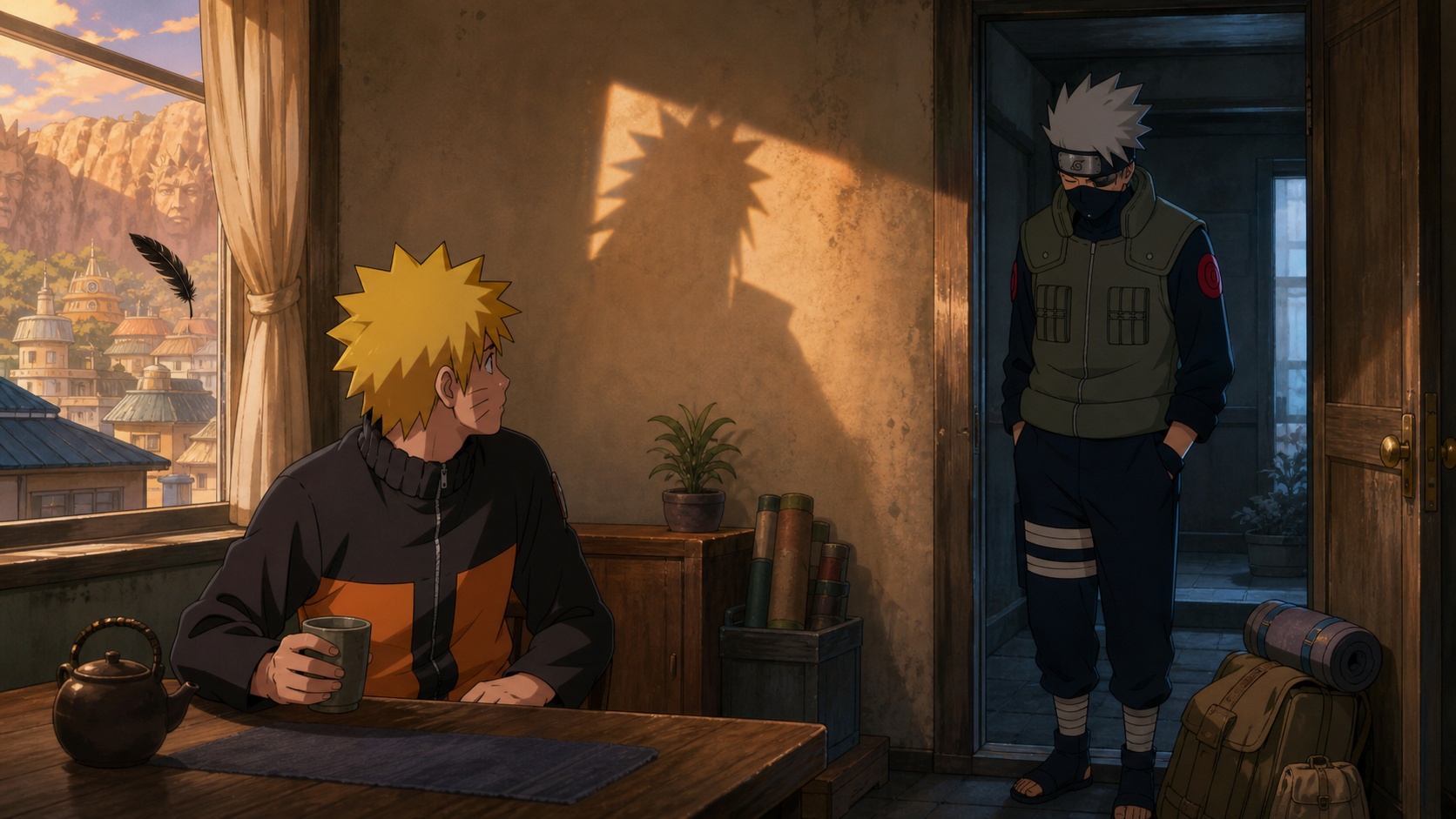
Naruto returns with unanswered questions about Itachi when Kakashi arrives carrying the fact Naruto cannot fight or change: Jiraiya is dead.
What happens
Naruto returns from the mission and finds his thoughts circling back to his strange encounter with Itachi. Itachi is now dead, but the question remains: why did he seek Naruto out, and what was he trying to leave behind?
Before Naruto can resolve that uncertainty, Kakashi arrives unexpectedly. His visit shifts the episode from distant questions about Itachi to immediate loss. Naruto learns that Jiraiya died during his investigation of Pain.
The news does not arrive as a battle or a final exchange. It arrives after the fact, when nothing Naruto says or does can change the outcome.
The mission ends before Naruto catches up
Naruto returns physically, but his mind is still moving through unfinished events. The encounter with Itachi has no clear conclusion, and the previous mission has only just released its hold on him.
That unsettled state matters because grief does not wait for a clean emotional opening. Kakashi's arrival gives Naruto another truth before he has organized the last one.
The episode understands that devastating news often lands inside ordinary transition. Travel gear is set down, a familiar person appears, and the shape of the future changes before the room itself looks different.
Itachi leaves a question instead of closure
Naruto knows Itachi is dead, yet death does not simplify their encounter. It makes the missing explanation permanent.
Itachi approached Naruto with purpose. Naruto can sense that the exchange mattered without understanding what Itachi expected him to do with it. That uncertainty keeps Sasuke's brother present even after the fight at the Uchiha hideout has ended.
The question also prepares Naruto for the larger problem ahead. People can leave intentions, warnings, and responsibilities that the living must interpret without access to the person who formed them.
Kakashi carries news he cannot soften
Kakashi's visit is abrupt because there is no graceful way to deliver what happened. He knows Naruto's bond with Jiraiya, and he knows the information will create pain that explanation cannot prevent.
His role here is not to solve grief. It is to refuse avoidance. Naruto deserves the truth even though the truth will wound him.
Kakashi also understands the loss personally. Jiraiya belonged to the network of teachers and protectors that shaped the village. Delivering the news requires Kakashi to hold his own reaction while making room for Naruto's.
Jiraiya dies away from the student he trained
Naruto did not witness Jiraiya's final battle. He cannot measure the danger, argue against the decision, or offer help.
That absence creates a particular helplessness. Naruto's defining instinct is to act, especially when someone he loves is threatened. Here, action has been removed from the timeline.
The episode does not give him an enemy standing in front of him. It gives him a fact. For someone who survives by turning pain into movement, stillness may be the harder confrontation.
Somber news is smaller than the loss
The title is restrained almost to the point of understatement. “Somber News” describes the delivery, not the emotional scale of what has happened.
That restraint fits the episode. Jiraiya's death has already occurred elsewhere. What remains is the quiet transmission of information from one person to another.
The ordinary phrase also reflects how institutions speak about extraordinary human cost. Missions produce reports and intelligence. Naruto receives the death of his teacher inside that official movement of information, but no report can contain the relationship it ends.
A mentor leaves both love and work behind
Jiraiya was never only Naruto's instructor. He was a guardian, a source of embarrassment, a traveling companion, and one of the first adults to invest in Naruto's future without treating the Nine-Tails as the whole of him.
His death therefore removes more than access to training. It removes a person who could translate the world for Naruto while believing he might transform it.
At the same time, Jiraiya's investigation leaves intelligence the village will need. The personal loss and the strategic inheritance arrive together, forcing Naruto toward responsibilities he has not yet had time to accept.
The episode changes the meaning of Pain
Until this point, Pain is an Akatsuki threat connected to a larger organization. Jiraiya's death makes that threat intimate.
Naruto will not approach the coming conflict as a detached village assignment. Pain is now tied to the absence of his master.
That connection creates danger as well as motivation. Grief can sharpen purpose, but it can also make revenge feel identical to justice. Naruto's future growth will depend on whether he can honor Jiraiya without reducing his teacher's legacy to retaliation.
Kakashi's presence links generations
Kakashi was shaped by Minato, and Naruto was shaped by Jiraiya, who also taught Minato. Their lives are connected through a chain of teachers that is neither orderly nor complete.
When Kakashi enters with the news, he stands inside that chain. He cannot replace Jiraiya, but he can keep Naruto from receiving the loss alone.
The moment quietly shows what survives when a master dies: not a perfect continuation, but other people who remember the same person from different positions.
Naruto cannot solve this with optimism yet
Naruto's optimism is often powerful because it creates possibility where others see none. This news does not require immediate hope.
Trying to turn Jiraiya's death into inspiration too quickly would make grief another obstacle Naruto is expected to defeat on schedule. The episode begins a different process by allowing the information to be heavy.
Before Naruto can carry Jiraiya's ideals forward, he has to experience the fact that Jiraiya will not walk beside him again.
Grief enters through administration before Naruto can call the loss personal
Tsunade, Kakashi, Shikamaru, and the intelligence team already know that Jiraiya’s death has strategic consequences. Konoha needs the message hidden in his final code. Pain remains active. Every hour matters. Naruto receives the same event through another doorway because the dead man was his teacher.
The village cannot choose between those realities. Somebody must decode the warning, and somebody must recognize that Naruto has just lost family. Treating him only as a future weapon against Pain would repeat the habit Jiraiya helped him survive.
Tsunade’s composure is labor, not absence
Tsunade sent Jiraiya toward danger after a conversation where both of them understood the risk. Now she has to lead the village, protect the intelligence he died to deliver, and live with the private knowledge that their last ordinary exchange became final.
Her position does not remove grief. Leadership forces her to perform tasks while grief is still forming. The audience should not mistake a controlled face for an untouched person.
The coded message proves Jiraiya was thinking beyond survival
Jiraiya knows he may not escape. He still spends the last strength available to him on information that other people can use. That choice is not glamorous once the battle music ends. The message arrives as marks that require memory, collaboration, and patience.
His final act trusts the living to finish work he cannot explain. The code therefore carries both intelligence and relationship. Konoha must know how Jiraiya thought before Konoha can understand what he wrote.
Shikamaru belongs in the room because intelligence is communal
No lone genius should decode a dead man’s warning by staring harder than everyone else. Shikamaru brings pattern recognition, but the solution also depends on details from Jiraiya’s habits, books, travel, and personal history.
The investigation becomes a model for how a village should handle inherited knowledge. Expertise remains specialized, evidence stays visible, and different people contribute pieces without pretending one mind contains the entire answer.
Naruto’s anger needs somewhere to go
Naruto has survived rejection by turning pain into motion. Training, missions, rivalry, and promises give his body a direction. Jiraiya’s death blocks that familiar response because the decisive action happened while Naruto was elsewhere.
Anger appears because anger can move when grief feels too large and shapeless. That does not make the anger false. Naruto needs time before anyone asks him to make the anger useful.
The popsicle memory carries more truth than a formal eulogy
Jiraiya and Naruto shared meals, jokes, travel, arguments, and training. Their bond lives in small physical memories rather than a neat list of accomplishments. Food becomes painful because ordinary pleasure once included another person.
The remembered half of a treat says what public praise cannot. Jiraiya occupied space beside Naruto. Death turns that shared habit into an empty place Naruto can see and almost touch.
Iruka recognizes the child underneath the shinobi rank
Naruto is a capable ninja, a jinchuriki, and one of Konoha’s strongest young fighters. None of those roles cancel the younger person who has lost another adult he trusted. Iruka sees that layer because he knew Naruto before the village learned to celebrate him.
Comfort matters here because Iruka does not demand a heroic response. He reminds Naruto that grief and inheritance can exist together without requiring Naruto to skip the grief.
Jiraiya gave Naruto recognition before Naruto could return the favor
Adults often approached Naruto through fear, duty, or the Nine-Tails. Jiraiya could be irresponsible and ridiculous, but he also invested years of attention in Naruto’s growth. He taught skills, shared the road, and treated the future Hokage dream as a serious possibility.
That recognition changed Naruto’s sense of who he could become. The loss therefore threatens more than affection. Naruto has lost one of the witnesses who knew how hard the transformation was.
The episode lets Naruto behave badly without making grief a moral failure
He snaps, withdraws, and resists the language other people offer. Those reactions are not polished, because real grief does not arrive with correct dialogue and considerate timing.
Friends can give him boundaries later if anger harms them. The first response should still make room for shock. Naruto should not have to perform gratitude for comfort before he can understand the sentence Kakashi delivered.
Fukasaku brings the terrible authority of a witness
Kakashi can report that Jiraiya died. Fukasaku knows how Jiraiya fought, what he discovered, and how the final moments unfolded. That difference matters to Naruto, who has been trapped outside the event.
A witness cannot give Naruto the goodbye he missed. Fukasaku can protect Jiraiya from becoming an abstract casualty inside a village report.
Pain becomes personal before Naruto understands Pain’s history
Jiraiya’s killer now has a face in Naruto’s mind, but the moral history remains hidden. Naruto does not yet know Nagato, Yahiko, Konan, Ame, or the wars that shaped them.
The gap creates the next challenge. Revenge offers a simple answer while Jiraiya’s work points toward a harder investigation of violence, responsibility, and peace.
Vengeance would honor Naruto’s wound but betray Jiraiya’s question
Naruto has every emotional reason to want Pain destroyed. Jiraiya still died searching for an answer to the cycle that keeps producing enemies, grieving students, and retaliatory missions.
Honoring him cannot mean pretending anger disappeared. Naruto must eventually decide whether anger will repeat the cycle or help him understand where the cycle can be interrupted.
Konohamaru’s grief belongs in the larger family map
Jiraiya’s death touches more than one student. He was connected to Hiruzen, Minato, Tsunade, the toads, the village, and generations of shinobi who knew different versions of him.
Naruto’s pain deserves focus without turning Jiraiya into a person who existed only for Naruto’s development. Shared mourning reveals the size of the life that ended.
The village needs to support Naruto without converting him into the next plan
Training at Mount Myoboku will matter. So will the intelligence hidden in the code. Neither task should erase the duty to care for Naruto as a grieving young person.
A healthy institution would provide information, time, food, companionship, and choices before demanding greater power. Konoha too often offers care and military need in the same breath.
RaeRae reaction
The abruptness is what hurts. Naruto returns with one unresolved dead man's question in his head and is immediately confronted with another dead man's absence. There is no emotional reset between them.
Kakashi's arrival feels compassionate precisely because he does not pretend the news can be made manageable. He comes, tells the truth, and remains present for the moment after it.
I also appreciate how the episode shifts away from spectacle. Jiraiya's final battle was enormous, but Naruto receives its consequence in a room. That scale is honest. The worst news in a person's life can enter through a doorway without changing the light outside.
“Somber News” begins Naruto's grief before it becomes training, strategy, or resolve. Jiraiya has left information and a legacy, but Naruto first loses the person. The episode's restraint protects that distinction, and it makes the silence after Kakashi arrives feel heavier than another explosion ever could.
The quiet direction protects Jiraiya from becoming spectacle twice
His battle already gave the audience action, horror, and sacrifice. Episode 152 does not replay that death until emotion becomes entertainment. The camera stays with the people forced to continue after the body is gone.
That restraint creates room for faces, pauses, unfinished sentences, and ordinary objects. Grief becomes physical without another explosion.
Information cannot replace a goodbye
Naruto will learn how Jiraiya died and what he discovered. Facts can answer practical questions, correct imagined versions of the event, and help the village prepare. Facts cannot create the final conversation Naruto did not receive.
The distinction matters because investigators sometimes treat complete information as emotional closure. A solved timeline still ends with absence.
Iruka offers continuity when Naruto’s world feels broken
Iruka cannot replace Jiraiya. He does something more honest by remaining Iruka: the first teacher who recognized Naruto’s loneliness and chose to sit with him.
His presence reminds Naruto that one bond ending does not erase every bond still alive. The reminder does not cancel pain. It gives pain somewhere safe to exist.
Jiraiya’s legacy includes every contradiction Naruto loved
He was brave, perceptive, invasive, funny, irresponsible, loyal, and capable of extraordinary patience when a student truly needed him. Cleaning him into a flawless dead mentor would flatten the relationship.
Naruto grieves the complete person, including the habits that irritated him. Affection often becomes most visible through details no official memorial would include.
RaeRae’s final word on Somber News
This episode hurts because Naruto cannot punch the sentence Kakashi brings into the room. Jiraiya is already gone. Naruto has no battlefield route back to him, no promise that can reverse the outcome, and no final conversation waiting after the mission report.
Konoha immediately needs what Jiraiya learned, but Naruto needs room to mourn the man before becoming the next answer to Pain. Both needs are real. Only one of them recognizes Naruto as a person instead of a strategic resource.
Iruka understands the difference. He does not offer a perfect explanation or demand instant resolve. He stays close enough for Naruto to remember that grief does not have to be solved alone.
Jiraiya’s final code will move the plot. The shared popsicle carries the emotional truth. Naruto did not lose an idea called mentorship. He lost the loud, infuriating, generous man who once occupied the other half of an ordinary afternoon.
The episode makes room for mourning before the revenge machinery starts
Naruto lives in a military village where every death can become a briefing, a security response, a training requirement, or a reason to send somebody else into danger. Jiraiya’s death will become all four. Somber News pauses before that machinery takes over. The pause matters because Naruto’s relationship with Jiraiya cannot be reduced to the useful information left behind.
The village knows Naruto may be essential to defeating Pain. That fact creates an obligation to protect him from being rushed into action while shock controls his judgment. Training can give grief direction later. Immediate deployment would turn grief into another resource Konoha expects a young person to supply.
Shared memory keeps Jiraiya human
Fukasaku remembers the final battle. Tsunade remembers a lifelong friend and the conversation before he left. Kakashi remembers a legendary shinobi inside the village’s history. Iruka understands what Jiraiya meant to Naruto. Each person holds a different piece, and none of those pieces should become the official replacement for the others.
Naruto needs access to that wider memory because grief can trap someone inside the final absence. Stories about Jiraiya’s mistakes, loyalties, jokes, research, students, and impossible confidence can return dimension to a man whose death currently fills every available thought.
The next lesson cannot begin until Naruto names what ended
Sage training will connect Naruto to Jiraiya’s path, but technique is not the same as inheritance. A new skill cannot repay the debt, finish the relationship, or prove that Naruto deserved the teacher who chose him.
The real inheritance begins when Naruto decides which parts of Jiraiya’s unfinished work he will carry and which failures he will refuse to repeat. That decision needs grief, evidence, anger, and time. Somber News does not force the answer before Naruto has even absorbed the question.
The episode’s restraint gives him that first honest space. Nobody wins the room. Nobody repairs the loss. People bring truth, food, memory, and presence, then allow the silence to remain difficult. That is care without performance, and Naruto needs exactly that before the story asks him to stand again. That pause also protects Jiraiya from becoming a ladder Naruto climbs toward greater power. He was a person before he was a legacy, and Naruto’s sorrow confirms the relationship mattered outside battle. The next victory may use what Jiraiya taught, but no victory can turn his death into a fair price for Naruto’s growth or peace.
RaeRae’s call
Konoha needs Jiraiya’s intelligence, but Naruto first needs permission to lose his teacher. Strategy can wait long enough to recognize the human cost already sitting in the room.