
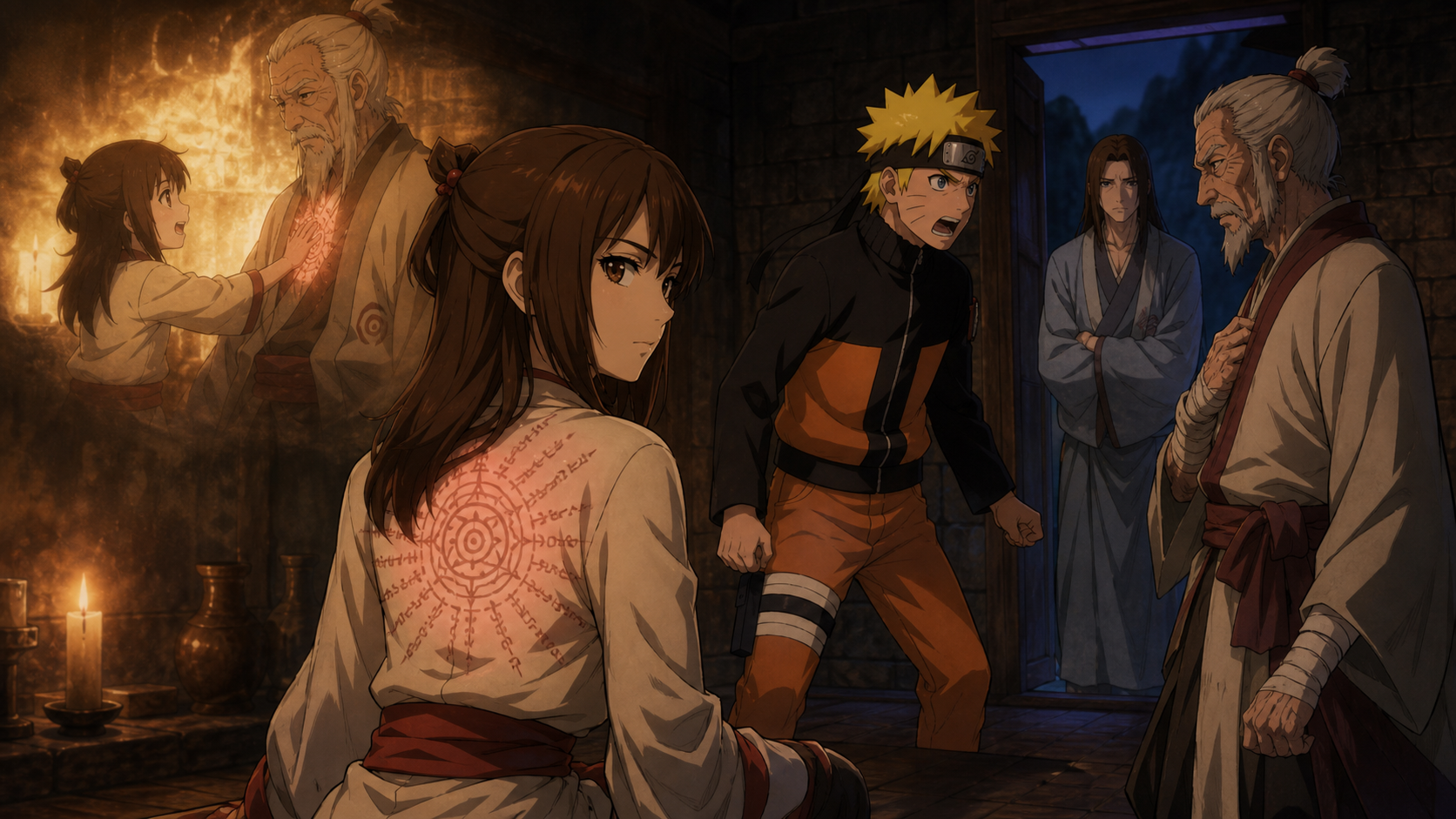
Heir to Darkness
Naruto sees a weapon sealed inside Hotaru; her own wish forces him to distinguish agency from the pressure that made danger look like purpose.
What happens
Hotaru is brought back to the Mount Katsuragi fort, where Naruto learns the Tsuchigumo forbidden jutsu is not merely a scroll or secret formula. It was embedded inside Hotaru's body.
Naruto reacts with immediate anger and demands that Tonbei explain why a young person was made to carry power dangerous enough to threaten an entire region. His outrage assumes the procedure was another adult decision imposed on a successor.
Tonbei reveals that Hotaru herself asked to receive the jutsu. She wanted to preserve En no Gyoja's legacy and believed carrying it would give purpose to the succession others had already attached to her.
That choice does not remove the danger. It complicates responsibility. Naruto must recognize Hotaru's agency while still questioning whether isolation, grief, clan expectation, and lack of alternatives made the decision as free as the word “wish” suggests.
Naruto sees a weapon placed inside a person
Naruto's anger is grounded in experience. He knows what it means for adults to seal destructive power into a child's body and then let the child absorb the fear that decision creates.
The discovery collapses any safe distance between Hotaru and the forbidden jutsu. Enemies are not pursuing information she can abandon. They are pursuing her body as the location of the technique.
That makes every promise of protection more urgent and every failure more personal. Hotaru cannot put the inheritance down without consequences.
Naruto's first response therefore centers the injustice of turning a life into storage for institutional power.
Consent can exist inside pressure
Tonbei's explanation prevents a simple repetition of Naruto's own sealing. Hotaru requested the procedure. Her decision deserves to be taken seriously.
But consent does not occur outside context. Hotaru is En no Gyoja's granddaughter, a successor whose community has tied identity to a forbidden legacy. She has experienced loss, isolation, and the belief that proving herself may restore belonging.
Those conditions do not make her choice fake. They shape what choices seemed available and what she believed she needed to become worthy.
The episode is strongest when it allows both truths: Hotaru chose, and the world around her made carrying danger look like a path toward recognition.
Tonbei keeps the promise and the secret
Tonbei acts as guardian of Hotaru, the fort, and En no Gyoja's intentions. Those responsibilities pull him in different directions.
Protecting the secret may have seemed necessary to prevent theft. Protecting Hotaru required honesty about the physical and political consequences of what she carried.
Naruto's confrontation forces the hidden arrangement into the open. A secret that depends on one person's body cannot remain only clan property once outsiders are attacking that person.
Tonbei's loyalty is genuine, but loyalty can preserve harmful structures when it refuses outside scrutiny.
An heir can inherit darkness by trying to preserve light
The title “Heir to Darkness” does not mean Hotaru chose evil. She wanted to honor her grandfather and prevent the clan's defining achievement from disappearing.
The darkness lies in the form of the inheritance: a technique with catastrophic potential embedded in a successor already separated from ordinary life.
Hotaru reaches toward legacy because it offers continuity with someone she lost. The same act gives enemies a reason to hunt her and allies a reason to make decisions around her.
Good intention and dangerous consequence are not opposites here. They are joined inside the seal.
Utakata sees another body under institutional claim
Utakata's presence adds a perspective Naruto does not yet fully understand. His own past involves a village, a master, and sealed power managed through choices that felt like betrayal.
Seeing the jutsu inside Hotaru may intensify both his protectiveness and his reluctance to become responsible for training her. Teaching is no longer only about techniques. It would mean engaging directly with a seal whose danger resembles the control he fled.
Hotaru wants him because he treats her as more than clan property. Utakata may fear that accepting the role would place him inside the same system of power management he rejects.
Their connection becomes deeper precisely because it is more difficult.
Naruto has to revise without becoming passive
Learning that Hotaru consented could end Naruto's objection if consent were treated as a complete defense. Instead, he has reason to keep asking whether she understood the risk and whether safer options exist.
Respecting agency does not require silence. It requires directing questions toward conditions and alternatives rather than denying the person who chose.
Naruto's challenge is to move from “this was done to you” toward “why did this feel necessary, and what do you want now?”
That shift is part of his growth. Empathy is not only recognizing your own story in someone else. It is noticing where their story differs.
Power makes Hotaru visible and unseen
The forbidden jutsu makes Hotaru important to clans, attackers, villages, and protectors. At the same time, that attention can obscure her ordinary needs.
People discuss whether the technique should be preserved, removed, controlled, or stolen. Fewer discussions begin with the kind of life Hotaru wants beyond carrying it.
Her wish for a master may partly answer that absence. A true teacher would be expected to see a student rather than only a seal.
Whether Utakata can accept that expectation remains unresolved, but the need behind it becomes clearer.
Naruto’s anger begins with recognition and risks becoming projection
He sees destructive power sealed inside a young body and immediately recognizes the structure that shaped his childhood. That recognition catches a real danger adults normalized.
Hotaru’s history differs because she requested the procedure. Naruto must keep the moral alarm while making room for facts that do not match his experience exactly.
The seal turns Hotaru into a location other people can invade
The forbidden jutsu is not stored in a vault she guards. Her body is the vault. Attackers seeking the technique must reach, control, or injure her to access it.
Bodily autonomy and information security become the same problem, which is precisely why consent needed extraordinary care.
Hotaru’s request matters even when the conditions were unfair
Dismissing her choice would repeat the habit of adults speaking over her. Treating the word choice as the end of inquiry would ignore grief, isolation, loyalty, and clan expectation.
Respect asks what she knew, which alternatives were visible, who could say no safely, and whether she can change her mind now.
Consent is a process, not one remembered yes
A dangerous inheritance inside the body requires ongoing information, review, support, and a route to removal. Hotaru’s earlier request cannot authorize every future consequence automatically.
People grow, circumstances change, and risks become clearer. Agency includes the right to reconsider.
Purpose can become coercive when belonging depends on it
Hotaru may believe carrying En no Gyoja’s legacy makes her worthy of the successor title and the community attached to it.
If the only respected future offered to her requires accepting catastrophic danger, choosing that future does not prove the surrounding system was generous.
Tonbei protects a promise while failing to distribute its burden
He honors En no Gyoja and cares for Hotaru. Secrecy concentrates knowledge and responsibility in too few people.
When one guardian is injured or absent, the successor remains exposed because the community never built a transparent network around her safety.
The clan’s vault logic resembles jinchuriki containment
Both systems place feared power inside a person and then organize social policy around monitoring, protecting, or using the carrier.
The person becomes essential and isolated at once. Naruto recognizes the pattern because he lived its consequences without choosing the seal.
Hotaru’s choice does not make those consequences less physical
Enemies still hunt her. The technique can still harm a region. Removal may still endanger her. A voluntary beginning does not make later pain symbolic.
Adults remain responsible for reducing harm rather than using consent as permission to step away.
Utakata sees why mentorship feels dangerous from both directions
Teaching Hotaru could help her understand and control the seal. It could also place him in the role of authority managing another person’s internal power.
His history with Harusame makes that authority terrifying. Refusal may be fear of repeating harm, not indifference to Hotaru.
Naruto can challenge the structure without declaring Hotaru mistaken
He can ask why carrying the jutsu seemed necessary, whether she still wants it, and which supports were missing. Those questions honor the person making the choice.
Outrage becomes useful when it targets inadequate conditions rather than the survivor’s interpretation of her own life.
RaeRae reaction
Naruto's anger is exactly what I expected, and I appreciate that the episode does not let his personal parallel settle the issue. Hotaru was not simply chosen by adults in the same way he was.
Her consent matters. So does the loneliness and inherited expectation surrounding it. The difficult conversation is not whether she “really” chose, but whether the people around her gave her enough support to imagine a worthy future without turning her body into the clan's vault.
Tonbei's loyalty feels tragic rather than malicious. He honors En no Gyoja and protects Hotaru, yet the secrecy built around those duties helps make her more isolated.
“Heir to Darkness” is a sharp title because Hotaru reaches for the inheritance out of love and determination. The darkness is not inside her character. It is the structure that teaches a young successor she must carry catastrophic power to prove the legacy, and herself, deserve to continue.
An heir should inherit authority alongside responsibility
Hotaru carries the consequences, so she needs meaningful control over training, disclosure, protection, and any plan to remove or preserve the technique.
Succession without decision-making power is ceremonial blame.
The title places darkness in the inheritance, not the girl
Hotaru acts from love, pride, grief, and a desire to protect what her grandfather valued. None makes her morally dark.
The darkness is a system where legacy survives by occupying a young body and making that occupation the condition of importance.
Preserving history does not require preserving every method
Hotaru can honor En no Gyoja by remembering why he restrained the technique, not merely by maintaining its availability.
Sometimes the most faithful successor is the person willing to end a dangerous practice after understanding what it cost.
Removal should be discussed without becoming another imposed procedure
Naruto may want the seal gone because he sees its danger. Hotaru may experience removal as loss of purpose, family connection, or bodily control.
Any solution must include her informed participation or rescue will repeat the violation it claims to correct.
Utakata’s presence offers expertise and a warning
As a jinchuriki wounded by attempts to manage sealed power, he understands the bodily and relational stakes. His experience could help Hotaru ask better questions.
It should not make him the sole authority over what she chooses.
Tonbei’s loyalty needs accountability to the living successor
Serving En no Gyoja’s memory is not enough if Hotaru bears the current risk. The dead founder cannot be the only person whose intention governs the arrangement.
Tradition earns continuation through care for those required to carry it.
Power makes Hotaru visible to everyone except herself
Attackers see a weapon, retainers see a legacy, Naruto sees another sealed child, and Utakata sees a dangerous echo of his past.
Each perspective catches something real. Hotaru still needs room to define a self not exhausted by what others recognize.
The episode asks whether a wish can survive new information
Perhaps Hotaru chose before understanding the full danger or before seeing how isolation would shape her life. Learning more may confirm the commitment or change it.
A respected wish remains open to revision. A coerced role demands consistency.
Naruto has to learn that similarity is an invitation, not ownership
His experience lets him notice dangers other people normalize. It does not give him the right to replace Hotaru’s account with his own.
Empathy matures when recognition begins a question instead of ending it. Their sealed powers connect them, but consent creates a meaningful difference.
Hotaru may have chosen the seal to stop feeling replaceable
Succession promises a role nobody else can occupy. For someone isolated from ordinary belonging, dangerous uniqueness may feel safer than being unnecessary.
That emotional context deserves care. A person should not need to become irreplaceable as a weapon to trust that a community will keep them.
The clan gains continuity while Hotaru absorbs uncertainty
Embedding the jutsu ensures the inheritance survives in a guarded body. The clan can say its legacy continues.
Hotaru lives with pursuit, secrecy, possible detonation, and the fear that people value continuation more than her future. Benefits and costs fall on different subjects.
Ongoing consent requires a real ability to say no
If removal would mean rejection by the clan, loss of identity, or betrayal of her grandfather, reconsideration carries punishment beyond the procedure itself.
A choice remains meaningful only when changing it does not erase the person’s right to care and belonging.
Utakata can help separate control from education
His history makes him sensitive to authorities reaching toward sealed power without sufficient trust. He may teach Hotaru how to identify boundaries before teaching any technique.
That lesson could make mentorship protective rather than managerial, provided he communicates instead of disappearing.
The seal intensifies every ordinary relationship
A friend becomes a possible target. A teacher becomes a possible technician. A guardian becomes a keeper of secrets. A village becomes a security perimeter.
Hotaru deserves relationships that can contain knowledge of the seal without letting it define every interaction.
Dangerous knowledge should have collective safeguards
One successor and one injured retainer cannot carry the entire ethical and tactical plan. Secrecy created a brittle structure enemies can break by reaching two people.
Distributed oversight, trusted records, emergency plans, and independent advocates would protect Hotaru without broadcasting the technique to opportunists.
The body should never become the cheapest storage solution
Embedding power may prevent theft from a building, but it transfers every attack to a human target. Efficiency for the institution becomes permanent danger for the carrier.
Any defense of the decision must confront that transfer honestly rather than praising sacrifice in abstract language.
Hotaru’s future needs ordinary ambitions too
She should be allowed to want friendship, travel, study, love, boredom, and a home beyond managing the clan’s forbidden achievement.
A responsible support system makes room for a life where the seal is one fact, not the entire plot assigned to her.
I keep returning to Naruto’s first anger because the instinct underneath it is loving. He sees a body turned into storage and refuses the calm language adults use around sacrifice. The correction he needs is not less outrage. It is a wider target. Hotaru is not the problem for choosing inside a narrow world. The problem is the world that made carrying danger look like the clearest route to purpose, family continuity, and respect.
Tonbei deserves compassion without exemption. He did not invent the legacy or the enemies pursuing it, and he appears to care deeply for Hotaru. He still participated in an arrangement that concentrated catastrophic risk inside her and protected the arrangement through secrecy. Good guardians need scrutiny precisely because affection can convince them their own judgment is enough.
Utakata’s role should be advisory before it becomes instructional. His experience with sealed power can help Hotaru recognize coercion, ask what removal means, and distinguish a teacher’s guidance from institutional possession. He cannot answer every technical question alone, and his trauma should not become another hidden rule she must learn by being abandoned.
The story earns Hotaru’s agency when it lets her decision remain changeable. She can be proud of choosing the seal and later decide the cost is too high. She can preserve her grandfather’s ethics by destroying the mechanism. She can keep it under stronger safeguards. None of those futures should determine whether she deserves community.
An heir becomes more than a container when inheritance includes the authority to judge the inheritance itself. Until Hotaru has information, alternatives, and support independent of the technique, the darkness belongs to the structure around her, not to the girl trying to make meaning inside it.
That distinction matters for Naruto. He spent years insisting that the Nine-Tails did not define his character, yet he never had the power to reconsider the seal itself. Seeing Hotaru choose what he never chose could tempt him to call her decision wrong because it hurts to imagine anyone accepting a burden like his. Respecting her does not require pretending the situations are identical. It requires believing she can speak with authority about her motive while still deserving questions, safeguards, and options. Shared pain should make Naruto a listener, not the judge. The episode lets his anger open the hidden arrangement. Growth means allowing Hotaru’s answer to change what he does with the truth once it is open.
RaeRae’s final word on the heir to darkness
Naruto is right to be furious that a young person’s body became storage for catastrophic power. He is not automatically right about Hotaru’s experience of the decision.
Her yes matters. The conditions around it matter too. Love for a grandfather, hunger for belonging, and lack of visible alternatives can shape a voluntary choice without turning it into a lie.
Tonbei’s care is real, but secrecy left Hotaru isolated and the safety plan fragile. Loyalty to the founder cannot outrank accountability to the living successor.
The best future is not one where Naruto, Utakata, or the clan decides for her again. Hotaru needs full information, several trusted teachers, real alternatives, and permission to change her mind without losing the right to belong.
RaeRae’s call
Hotaru chose the seal, and respecting that choice means examining the pressure around it, giving her ongoing authority, and preserving her right to reconsider without losing her identity or community.