
RaeRae Reacts · One Piece Episode 51
Sanji vs. Chef Carmen
Sanji and Carmen face a professional cooking contest shaped by food safety, fair judging, fish provenance, and responsible use
Episode information
Japanese title: Honoo no Ryouri Battle? Sanji vs. Bijin Chef
English title: Fiery Cooking Battle? Sanji vs. the Beautiful Chef
Japanese broadcast: December 6, 2000
Saga: East Blue
Script: Michiru Shimada
Episode direction: Munehisa Sakai
Animation direction: Kazuya Hisada
Art: Miyuki Sato
Carmen arrives with a professional record
Episode 51 introduces Carmen as a chef who has challenged respected cooks across East Blue and won. Her ambition is not a decorative trait attached to appearance. That ambition is built through repeated work, public evaluation, and a deliberate effort to become the sea’s leading cook.
The episode should evaluate her through technique, judgment, leadership, and food rather than reduce her to “the beautiful chef.”
Beauty framing can erase labor. Calling attention to Carmen’s looks before her skill encourages viewers and competitors to treat professional achievement as surprising or secondary. Sanji is especially vulnerable to responding to women through attraction rather than equal standards.
Respect begins with her name, record, stated goal, and choices in the kitchen.
Carmen searches for Baratie’s sous-chef
She has heard that the restaurant’s second-in-command is the strongest cook she has not defeated. That reputation follows Sanji into Loguetown even though he has left Baratie.
A former title can establish experience without making him permanently available for challenges.
Sanji can decline a contest. He is shopping for crew provisions under time pressure in a Marine-controlled port. Carmen’s ambition does not create a right to his labor, attention, recipes, or risk.
Participation should be voluntary, with clear rules and enough time to protect the crew’s actual needs.
A challenge needs agreed terms. Before cooking begins, both chefs should know the ingredient, time limit, equipment, judging method, sanitation standards, prize terms, tie procedure, and grounds for stopping.
Surprise may create drama, but ambiguity creates unfairness and food-safety risk.
The annual contest belongs to Loguetown
The event is not merely a private duel between two traveling personalities. Organizers, market workers, fishers, vendors, judges, residents, and other contestants give the contest a local purpose and cost.
Carmen and Sanji should enter without displacing registered participants or rewriting rules around their rivalry.
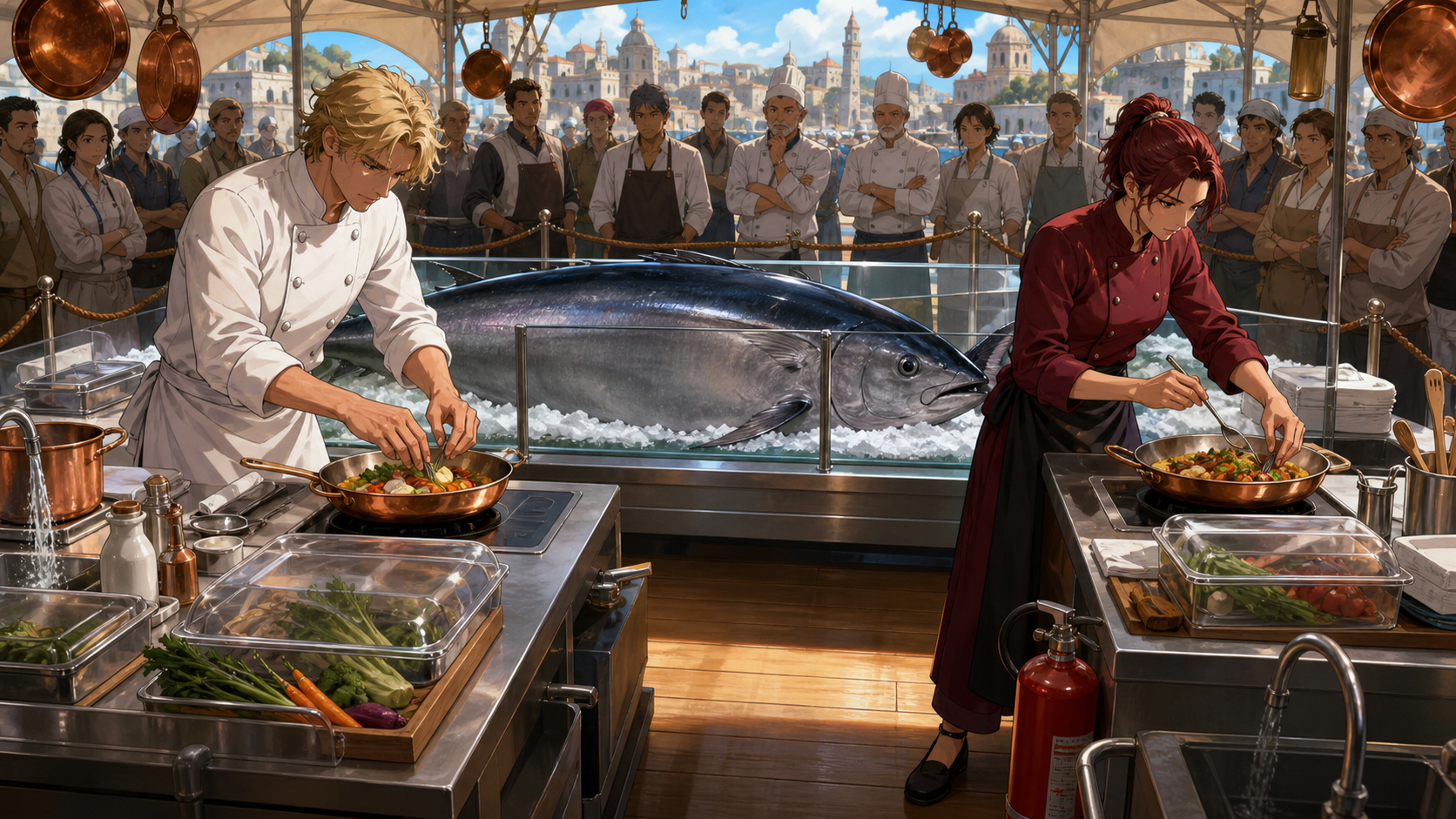
The prize is an elephant bluefin tuna
The enormous fish is called a jewel of the sea and carries culinary prestige. Its size makes cold-chain control, safe lifting, traceability, and full-use planning essential.
A rare ingredient should not become a disposable symbol of victory.
Provenance needs to be documented. Organizers should know who caught the fish, where, when, by what method, under which local rules, and how the catch remained chilled. The animal’s rarity raises sustainability questions as well as quality claims.
Prestige does not excuse illegal harvest or ecological harm.
The fish must remain cold. A large tuna can warm unevenly during display, transport, and breakdown. Clean crushed ice, drainage, shade, time controls, and temperature checks protect diners.
Visual spectacle should never require leaving a perishable ingredient in unsafe conditions.
Separate stations protect fairness
Carmen and Sanji need equivalent workspace, heat, water, tools, storage, lighting, and access to common ingredients. Physical separation reduces interference and cross-contamination.
Judges should document any meaningful equipment difference before scoring.
Handwashing is part of technique
Clean hands, tied hair, closed clothing, safe shoes, sanitized surfaces, and separate raw and ready-to-eat tools are not less artistic than knife work. They are professional competence.
A fast dish that makes people ill is not successful cooking.
Fire needs active control. The title promises a fiery battle, but flames must remain contained beneath stable cookware. Fuel, ventilation, extinguishers, burn protection, and clear aisles matter.
Flambé or dramatic heat should never be used solely to impress a crowd at the cost of control.
Knife skill is not performance with weapons. Both chefs may work quickly, but blades should remain at the station, pointed down during transport, and used on stable boards. Spectators need distance.
Speed counts only when precision and safety remain intact.
Judging criteria should be published
Taste, texture, temperature, seasoning, ingredient respect, technical difficulty, sanitation, resource use, presentation, and service timing can all matter. Their relative weight should be known before cooking.
Undefined judging invites popularity, gender bias, and spectacle to replace food quality.
Blind tasting would reduce reputation bias. If judges know which plate belongs to the famous Baratie sous-chef or undefeated challenger, expectations can influence perception. Numbered plates and consistent service conditions improve fairness.
Blindness cannot remove every bias, but the practice limits one obvious source.
Carmen’s record should invite serious attention
Winning prior challenges means she has adapted to different kitchens, opponents, and ingredients. Sanji should not assume attraction, confidence, or theatrical presentation makes her less technical.
He needs to observe the food and workflow rather than respond to a stereotype.
Sanji’s Baratie training gives him service discipline
He learned in a restaurant where hunger, scarcity, paying guests, conflict, and limited supplies intersected. His cooking identity includes feeding people, not only defeating chefs.
The contest tests whether he can preserve that ethic inside a public rivalry.
Competition can improve craft
A skilled opponent may reveal a new preparation, timing strategy, flavor balance, or way to use a difficult cut. Learning does not require losing ambition.
The best outcome allows both chefs to leave with more information than they brought.
Competition can also encourage waste. Oversized portions, discarded trim, repeated failed plates, and decorative excess may look impressive while disrespecting the ingredient. Contest rules should require a waste plan.
Edible trim can become stock, staff meals, preserved food, or community portions when handled safely.
The whole fish needs a use map
Before cutting, organizers should assign loin, collar, belly, bones, skin, and other usable portions. Different cooks can prepare different parts under supervision.
No single winner should remove an enormous prize without the equipment or storage to prevent spoilage.
The prize can provision the Going Merry. Sanji needs food for the Grand Line, so winning has practical value beyond status. The crew still has limited cold storage and cannot safely carry more fresh fish than the galley can process.
He should preserve portions and share surplus locally rather than turn victory into waste.
Carmen’s goal is larger than one result
Defeating or losing to Sanji cannot definitively establish the best chef in East Blue. One ingredient, one day, one judging panel, and one format measure a narrow performance.
Professional growth continues through service, study, leadership, and repeated results.
Sanji should not patronize Carmen
Compliments about appearance, exaggerated deference, or refusal to compete seriously can all deny her the equal challenge she requested. Respect requires honest standards.
He can be courteous without turning her into a romantic role.
Carmen should not treat refusal as fear. If Sanji prioritizes crew departure or food shopping, that choice would not prove inferiority. Consent to competition must remain free from reputational coercion.
Ambition does not authorize endless pursuit of a named rival.
Judges need conflict disclosures. Anyone connected to Baratie, Carmen’s prior competitions, sponsors, vendors, or the fish supplier should disclose that relationship. A replacement judge may be appropriate.
Public confidence depends on a process that can be explained after the result.
The crowd needs a safety boundary. Ropes or barriers should keep spectators away from flames, knives, hot pans, wet floors, and raw seafood. Children need adult supervision.
Emergency access must stay clear even when the final plating draws everyone forward.
Contest staff are not invisible. Dishwashers, porters, fish handlers, fire monitors, cleaners, and runners make the event possible. Their labor deserves safe conditions, breaks, recognition, and compensation.
Celebrity chefs should not receive credit for work others perform without acknowledgment.
Food should reach people promptly. Judging portions need consistent temperature and service timing. Remaining safe food should have a documented distribution plan rather than sit as display.
Hunger exists in port cities even during festivals. Community service can be part of responsible contest design.
The fishers’ knowledge matters. People who caught and transported the tuna understand the catch’s condition and the sea where the animal lived. Their input can inform handling, seasonality, and whether the catch is unusual in a concerning way.
Culinary prestige should not erase ecological and maritime labor.
Sanji’s crew role changes the meaning of victory. He is no longer cooking only under Zeff’s restaurant structure. His decisions affect a small ship with no large staff or pantry.
Winning should produce a provisioning plan, not just another story about the chef.
Nami should approve storage costs. Ice, containers, salt, fuel, spices, and preservation materials use crew funds and space. Sanji controls culinary judgment while shared resources require crew agreement.
Neither expertise should cancel the other.
Usopp can help with preservation equipment. His tools and improvisation may support racks, sealed containers, temperature checks, or repairs. Assistance should follow Sanji’s food-safety requirements.
Collaboration lets a contest prize become durable crew capacity.
Zoro should keep swords away from the kitchen. New blades and food-preparation zones should remain separate. A sword is not an acceptable substitute for a sanitized kitchen knife, regardless of sharpness.
Storage discipline protects both the blades and the food.
Luffy’s appetite needs boundaries. He may want to sample everything immediately. Contest portions, judged plates, cooling food, and crew provisions cannot be eaten before staff release them.
Sanji should establish tasting rules and protect food intended for later travel.
Professional praise should be specific. Carmen and Sanji can identify seasoning, temperature, texture, knife work, timing, or ingredient use they respect. Specific feedback supports learning.
Calling a dish simply beautiful or passionate can hide the actual craft.
A loss should not become humiliation. The lower-scoring chef deserves the score breakdown, opportunity to ask procedural questions, and ownership of recipes and tools. The crowd should not treat one result as permission to mock a career.
Competition is legitimate when participants retain dignity.
A win should not create ownership. The victor does not own the other chef’s techniques, staff, image, or future availability. Publicity should use names and likenesses only under event terms they accepted.
The prize transfer should be documented with safe custody.
The episode broadens Loguetown beyond Marine pursuit
While Smoker and the bounty create danger, the city also contains festivals, markets, culinary communities, and careers unrelated to Luffy. Sanji enters a local institution rather than waiting for the captain’s conflict.
The world remains active on multiple scales.
Michiru Shimada gives Sanji a noncombat challenge. Shimada’s script tests identity through the craft that defines Sanji more deeply than kicking. Carmen’s ambition creates stakes without requiring either chef to become a villain.
The prize connects personal competition to crew logistics.
Munehisa Sakai makes parallel work readable. Sakai’s direction places two stations in visual conversation. Viewers can compare preparation, timing, and reactions without reducing the contest to one montage.
The fish remains central enough that ingredient responsibility cannot disappear behind personality.
Kazuya Hisada treats cooking as physical skill. The animation direction gives weight and rhythm to chopping, stirring, lifting, heat control, and plating. Carmen and Sanji move differently while both appear competent.
Professional clothing and focused posture keep the work from becoming sexualized performance.
Miyuki Sato turns the market into a working kitchen. The art integrates clean water, cold storage, copper cookware, ingredients, barriers, judges, and staff. The contest looks like organized food production rather than magic plates appearing from nowhere.
That infrastructure makes standards visible.
RaeRae’s real-time reaction
Carmen has beaten chefs across East Blue and came looking for Baratie’s sous-chef. I need everyone to say that before they say she is beautiful. Her record is the reason Sanji should take the challenge seriously.
The elephant tuna is gorgeous, but a fish that size needs ice, traceability, a full-use plan, and more storage than the Going Merry can improvise after the trophy photo.
The moment that lands
Sanji and Carmen recognize one another through the food rather than through reputation alone. The contest works when the plate becomes evidence of thousands of smaller decisions.
Respect arrives through craft, not through a gendered surprise that both people can cook.
What organizers should do after judging. Publish the score categories, address any protests, document prize transfer, maintain the cold chain, distribute edible food safely, and compensate staff. Record the fish’s provenance and total use.
Clean stations, control waste, and preserve recipes as each chef’s work unless sharing terms say otherwise.
What Carmen should take forward. Specific feedback, recognition of her record, ownership of her techniques, and freedom to pursue the next professional goal without being defined by one rival. If she lost, identify what the result actually measured.
Her career does not become Sanji’s subplot simply because they met.
What Sanji should take forward. A provisioning plan, preserved fish that fits ship capacity, new culinary information, and respect for a peer. He should report time, cost, storage, and departure impact to the crew.
Winning or losing matters less than whether people are fed safely and the ingredient is honored.
Bottom line
Episode 51 uses an annual Loguetown cooking contest to introduce Carmen as a chef with a real East Blue record. Her challenge to Sanji and the elephant bluefin prize test craft, ambition, food safety, fairness, sustainability, and whether rivalry can remain respectful.
RaeRae rating: 8.9/10. The best cooking battle is not fire and posing. The strongest contest shows two professionals making disciplined choices under the same rules, then using an extraordinary ingredient without wasting the labor or life that brought the catch to the table.