
RaeRae Reacts · One Piece Episode 50
Usopp vs. Daddy Masterson
Usopp’s false bounty claim turns a sold pair of goggles into a test of truth, parental responsibility, firearm safety, and earned skill
Episode information
Japanese title: Usopp vs. Kozure no Daddy Mahiru no Kettou
English title: Usopp vs. Daddy the Parent! Showdown at High Noon
Japanese broadcast: November 29, 2000
Saga: East Blue
Script: Michiru Shimada
Episode direction: Katsumi Tokoro
Animation direction: Masayuki Takagi
Art: Tomoko Yoshida
Usopp finds the goggles he wants after they are sold
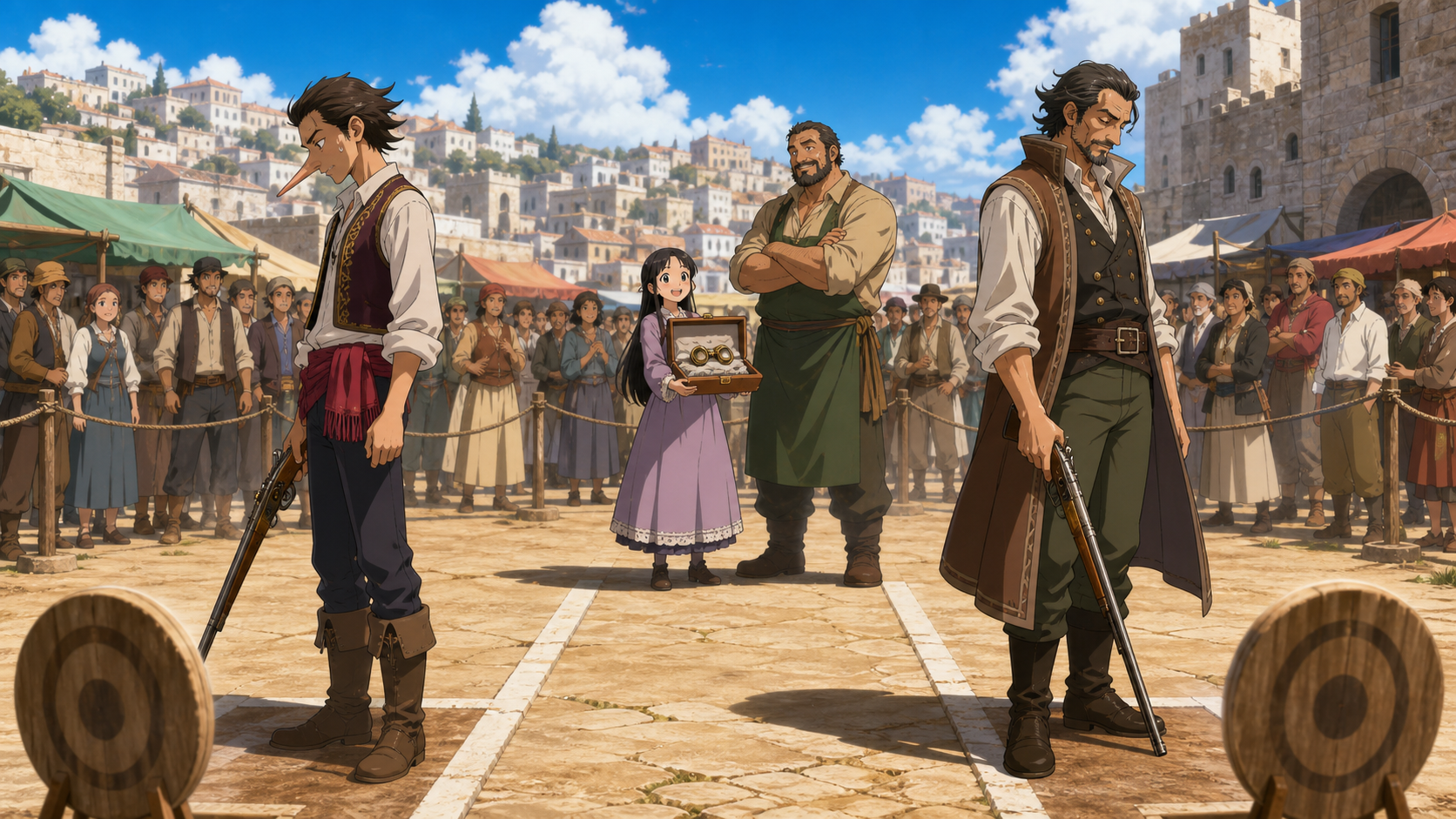
Episode 50 begins with a simple market conflict. Usopp wants a pair of sniper goggles, but a young girl named Carol has already bought them as a birthday present for her father.
The order of the transaction matters. Desire, expertise, or crew need does not give Usopp a claim to property another customer purchased first.
Carol’s purchase deserves ordinary respect
She selected, paid for, and intends to give the goggles. A child should not have to defend a completed transaction against an older stranger using pressure or status.
The shopkeeper also has a duty to protect customer property and avoid reopening a sale because another buyer becomes loud.
Usopp turns disappointment into intimidation
Rather than accept the loss and look for another option, he exaggerates his importance. The response shifts a retail inconvenience into a power contest with a child.
Embarrassment can explain the impulse to save face. That embarrassment does not make the conduct harmless.
The thirty-million-berry claim is false
Usopp presents Luffy’s bounty as though the bounty belongs to him. His background appearance on the notice gives the lie a fragment of visual plausibility.
Borrowing another person’s wanted status may attract fear, hunters, Marines, or retaliation. The false claim creates risk beyond the immediate attempt to obtain goggles.
A lie can be dangerous even when nobody believes the claim. Carol may recognize bluster, but bystanders can repeat the statement without context. A rumor linking Usopp to a large bounty could travel through the same circulation system examined in Episode 45.
Retraction should be as public as the original boast where feasible.
Carol’s father is Daddy Masterson
Daddy is known across East Blue as an exceptional gun user and bounty hunter. He also shares a professional history with Smoker as a former colleague.
Those identities give him capability and context. They do not grant unlimited authority to threaten someone who argued with his daughter.
Parental protection needs proportionality. Daddy should first confirm whether Carol is safe, ask what happened, preserve the purchased gift, and separate the parties. An adult’s anger can make a child feel responsible for escalation.
Protection succeeds when the response reduces danger rather than stages a larger confrontation around the child.
Carol should not become evidence in an honor dispute. Her account matters, but she should not be pressured to repeat the account before a crowd or choose how her father punishes Usopp. The responsibility for adult conduct belongs to adults.
She needs privacy, reassurance, and a clear statement that the conflict is not her fault.
Daddy identifies the gap between image and skill
Usopp’s bounty boast suggests a level of confidence and public danger that his behavior does not support. Daddy can test claims through observation without immediately turning the market into a duel.
A trained professional should know that frightened posturing often calls for de-escalation, not humiliation.
Usopp’s poor first showing exposes performance. When confronted by a superior marksman, he loses the protection of his story and struggles. The embarrassment is painful because he wants bravery to be visible before he consistently feels brave.
Failure reveals a gap to work on. One failed showing does not prove he lacks every relevant ability.
Public humiliation is not instruction. A crowd may enjoy seeing a liar exposed, but shame can push someone toward more desperate risk rather than honest learning. Daddy should correct the false claim and protect Carol without making degradation the goal.
Accountability focuses on impact, repair, and changed behavior.
A firearm duel in a market is unacceptable risk
Even expert shooters cannot control every ricochet, obstruction, startled movement, equipment failure, or person entering a sightline. A public street is not a safe range.
Personal consent between two participants cannot authorize danger to Carol, vendors, residents, or property.
High noon creates visibility, not safety. Bright light may improve sightlines, but heat, glare, crowds, shadows, wind, and reflective surfaces still affect conditions. The dramatic time does not substitute for a controlled environment.
A real test needs a secured backstop, marked lanes, range supervision, protective equipment, and a cease-fire process.
Daddy’s expertise increases his responsibility. The more skilled and respected he is, the more bystanders will assume his conduct is safe or worthy of imitation. He should model restraint, verification, and range discipline.
Reputation is not only a privilege. Daddy’s reputation raises the impact of example.
Smoker’s former colleague operates outside Marine command. Daddy’s past connection may give him knowledge of procedure and local enforcement. As a bounty hunter, he should not present himself as currently authorized to use Marine powers he does not hold.
Clear role boundaries protect residents from confusing private reward work with public law enforcement.
Bounty hunting needs documentation. Before attempting capture, a hunter should verify the target, current notice, jurisdiction, reward terms, and lawful transfer process. Usopp’s self-incriminating lie is not a substitute for official identification.
A background figure on Luffy’s poster is not proof that Usopp has the same bounty.
Daddy’s history with Yasopp changes the encounter
Usopp’s father once defeated Daddy in a shooting contest. That history gives Daddy a reference point for the talent and composure associated with Yasopp.
Usopp should not be required to reproduce his father’s performance to deserve respect or safety.
Inherited reputation can become pressure. Learning that a parent is admired may inspire Usopp and intensify fear of falling short. He already uses stories to bridge the gap between the person he is and the person he wants to become.
Mentorship should help him build his own standards rather than live as evidence of Yasopp’s legacy.
Yasopp’s choice affected more than the duel. Daddy remembers being spared and redirected toward Carol. The story can frame mercy as meaningful without simplifying the costs of pirate absence, risk, or family separation.
One generous moment does not resolve every question about either father’s responsibilities.
Carol is central to Daddy’s values
His relationship with his daughter shapes what survival and work mean to him. That bond should encourage him to avoid reckless confrontations that could leave her without care.
Parenthood is not a weakness in a marksman. Parenthood is a reason to plan beyond personal pride.
Usopp’s fear contains useful information
He recognizes Daddy’s superior control and the possibility of serious harm. Fear signals that the conditions are unsafe and that the original boast cannot protect him.
Courage should use that information, not erase the warning.
Honesty is the first repair
Usopp should admit that the bounty is Luffy’s, that he wanted the goggles, and that he pressured Carol after she bought them. Specific truth makes repair possible.
A vague claim that he was joking would minimize the power he tried to borrow.
The goggles remain Carol’s decision
Daddy may later choose to give, share, trade, or decline the gift, but Usopp cannot receive them merely because he demonstrates skill. Carol purchased them for a purpose.
Any transfer requires her voluntary agreement without pressure from a crowd or her father.
Usopp can find other equipment. Loguetown contains shops, craftspeople, lenses, frames, tools, and materials. He can search for another pair, commission one, or adapt existing gear.
Scarcity of a preferred item is not justification for taking a child’s gift.
A fair contest should use inert targets. If Daddy and Usopp want to compare precision, the event should move to a controlled range with unloaded checks, clear commands, protected observers, and targets against a safe backstop.
The goal should be skill assessment, not forcing surrender through fear.
Target choice matters. Small, distant, or moving targets can demonstrate accuracy without placing living beings at risk. Never use a person, carried object, animal, or occupied structure as the test.
Difficulty can be increased through distance, time, or environmental measurement rather than danger to bystanders.
Usopp’s observation is a real strength
He notices angles, wind, movement, distraction, and improvised opportunities. Those skills helped him protect Kaya, challenge Chew, and support the crew.
Daddy can recognize this capacity without validating the false bounty story.
Precision needs consistent mechanics. Breathing, stance, trigger control, sight alignment, follow-through, equipment condition, and judgment under stress all affect a shot. Talent becomes reliable through practice and safety habits.
One dramatic success should begin training, not end the process.
The father comparison should not define Usopp’s future. Yasopp’s reputation may open Daddy’s attention, but Usopp’s choices in the present determine whether trust grows. He can honor a family connection while building a different style and ethical standard.
Being Yasopp’s son is context, not qualification.
Daddy can mentor without recruiting. He may offer technical advice, range discipline, or an honest evaluation. That does not obligate Usopp to become a bounty hunter, Marine, or copy of his father.
Short mentorship works best when boundaries and purpose are explicit.
Carol should see accountability modeled. Usopp needs to apologize directly, and Daddy needs to show that protection does not require uncontrolled violence. The shopkeeper should confirm her purchase remains secure.
A child learns more from adults repairing conflict than from watching one adult dominate another.
The crew needs to know about Usopp’s claim. Using Luffy’s bounty can affect the entire group if word spreads. Usopp should report what he said, who heard the claim, and whether Daddy or others recognized the connection.
Concealment to avoid embarrassment would leave the crew unable to assess port risk.
Luffy’s public identity is already becoming communal currency. Usopp uses the bounty as social power even though he did not earn or consent to its consequences. This proves that a public reputation can be borrowed by associates.
The captain should discuss how crew members reference the notice and what false claims are unacceptable.
The episode gives Usopp a chance to choose substance
He begins by performing danger through a lie. Daddy’s challenge strips that performance away and forces him to decide whether he will act from actual observation, care, and skill.
Growth occurs when he stops needing the false status to take a real shot.
Michiru Shimada builds the conflict from one small entitlement. Shimada’s script starts with sold goggles and follows the escalation through intimidation, identity, family history, and skill. The larger duel remains connected to Usopp’s refusal to accept a simple no.
That causal chain keeps the character lesson specific.
Katsumi Tokoro uses open space to expose posture. Tokoro’s direction places Usopp and Daddy where distance, stance, and sightlines are visible. Usopp cannot hide uncertainty behind a crowded close-up.
Carol’s presence keeps the parental stakes inside the frame.
Masayuki Takagi distinguishes confidence from control. The animation direction gives Daddy efficient, economical movement while Usopp’s early gestures overstate certainty. As Usopp focuses, unnecessary motion decreases.
Skill development becomes visible through the body before the outcome.
Tomoko Yoshida grounds the showdown in a living town. Market stalls, stone, spectators, sun, and distance remind viewers that the conflict occurs around ordinary people. The setting resists becoming an empty arena.
That context makes firearm discipline a real concern rather than background realism.
RaeRae’s real-time reaction
Carol bought the goggles first. That should have ended the argument. Usopp borrowing Luffy’s thirty million to scare a child is exactly the kind of lie that stops being funny because the world now has real bounty hunters.
Daddy can reveal the gap between boasting and skill without putting his daughter beside a public duel. Move the test, clear the range, and let Usopp prove what he can actually observe.
The moment that lands
Daddy connects Usopp to Yasopp and recognizes that fear does not eliminate potential. The encounter stops being only punishment for a lie and becomes a question about what Usopp will do when performance is unavailable.
That is the version of inherited legacy I can use: not guaranteed greatness, but an invitation to choose honest practice.
What Usopp should do next. Apologize to Carol and the shopkeeper, retract the false bounty claim, compensate any disruption, and leave the goggles with their owner. Tell the crew exactly what happened.
Acquire alternative equipment through a legitimate sale. Seek controlled training and record what he learned about stance, wind, distance, and judgment.
What Daddy should do next. Confirm Carol is comfortable, avoid tying her gift to the outcome of a duel, and explain why Usopp’s behavior was wrong without making humiliation the lesson.
If he offers a skill test, use a closed range, inert targets, verified equipment, a safety supervisor, and no live audience inside the exclusion zone. Keep bounty work separate from personal pride.
What Carol should receive. Her purchased gift, a sincere apology, and freedom from responsibility for the adults’ choices. She should not be asked to forgive immediately or surrender the goggles to prove generosity.
Her safety and agency are more important than completing either marksman’s emotional arc.
Bottom line
Episode 50 starts with Usopp refusing to accept that Carol bought the goggles first. His false thirty-million-berry claim brings him into conflict with Daddy Masterson, whose history with Smoker and Yasopp turns a market lie into a test of reputation, parenting, skill, and courage.
RaeRae rating: 8.7/10. Usopp’s real ability becomes visible only after borrowed status fails. The responsible victory is not taking Carol’s gift or surviving humiliation. The responsible choice is truth, safe practice, and skill that belongs to him.