
RaeRae Reacts · One Piece Episode 48
Landfall at Loguetown
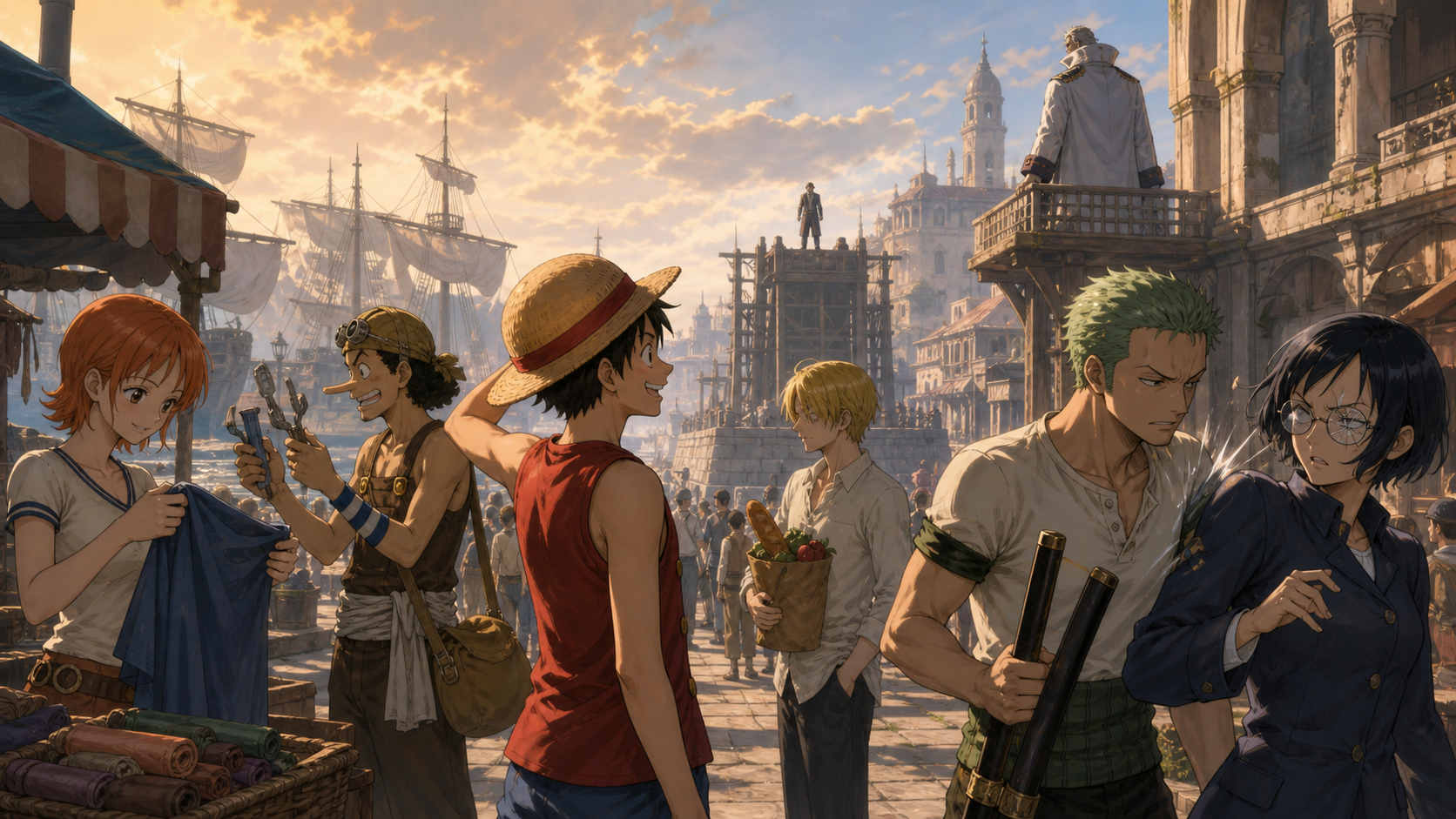
Loguetown becomes a practical and historic threshold through crew errands, Roger’s platform, Smoker’s surveillance, and Tashigi’s own identity
Episode information
Japanese title: Hajimari to Owari no Machi, Loguetown Jouriku (1 Jikan SP Zenpen)
English title: The Town of the Beginning and the End! Landfall at Loguetown
Japanese broadcast: November 22, 2000
Saga: East Blue
Script: Michiru Shimada
Episode direction: Junichi Fujise
Animation direction: Eisaku Inoue
Art: Yuri Sanami
Loguetown is a threshold, not an ordinary supply stop
Episode 48 brings the Going Merry to the last major East Blue city before the Grand Line. The crew needs clothing, tools, food, swords, information, and a chance to understand the route ahead.
The same city also holds the execution platform where Gold Roger died. Practical preparation and historical memory occupy the same streets.
A busy port changes the crew’s exposure. Luffy’s bounty is circulating, and Loguetown has an active Marine presence. Crowds offer anonymity but also multiply witnesses, cameras, informants, and accidental recognition.
Splitting up makes errands efficient while reducing mutual support if one person is identified or detained.
The crew needs a reunion plan before separating
Each member should know the ship’s berth, fallback meeting points, departure signal, time limit, and what to do if the harbor is blocked. One compromised route should not trap everyone.
Nami should not have to invent the entire plan alone simply because navigation is her specialty.
Nami looks for clothing
Clothes are operational equipment at sea. Weather, movement, laundering, repair, storage, modesty, and local norms affect what is practical.
Nami choosing her own clothing after years under Arlong also carries ordinary bodily autonomy. The crew should respect her budget and choices without commentary that turns shopping into sexual spectacle.
A clothing purchase needs route context. The Grand Line may bring temperature shifts, rain, wind, and limited access to replacement goods. Durable layers and repair supplies can matter more than one attractive outfit.
The team should pool information about expected conditions without dictating personal style.
Usopp searches for equipment
His weapons rely on ammunition, elastic components, tools, and materials that can fail under salt, humidity, impact, or repeated use. Loguetown offers a chance to standardize and repair before the next crisis.
Purchases should include storage and safety measures, not only more powerful projectiles.
Equipment choice should follow mission limits. Usopp needs tools for signaling, rescue, line throwing, distraction, measurement, and repair alongside combat use. Versatility reduces pressure to solve every problem through escalation.
He should document what each item does so another crewmate can assist in an emergency.
Sanji looks for ingredients
Food planning is medical and logistical work. The crew needs enough water, preserved staples, fresh produce, protein, and micronutrient variety for an uncertain voyage.
Sanji’s expertise should shape purchasing, while budget and storage capacity remain shared constraints.
Attraction should not override procurement. The official synopsis jokes that Sanji seeks beautiful women as well as ingredients. Attraction is not consent to interrupt, follow, evaluate, or pressure strangers.
He can enjoy a lively city while treating vendors and residents as people with work and boundaries.
Zoro needs two replacement swords
Mihawk broke two blades at Baratie, leaving Zoro with Wado Ichimonji and a gap in the three-sword style he intends to continue. Replacement is not a cosmetic purchase. Balance, construction, condition, handling, and provenance affect safety.
He should not treat every available weapon as interchangeable because urgency is high.
Weapon shops create information asymmetry. A knowledgeable seller can identify quality and history that a traveler may miss. The same expertise can support honest guidance or exploit a customer who appears desperate.
Zoro needs to inspect blades, ask about defects, understand price, and avoid handling weapons around bystanders without permission.
Broken swords should have changed the crew’s planning. The loss at Baratie was foreseeable evidence that major opponents can destroy essential equipment. The crew should carry maintenance tools and discuss redundancy before entering the Grand Line.
Replacement after failure is necessary; learning from the failure makes the expense useful.
Luffy goes to the execution platform
He seeks the place where Gold Roger’s life ended and the Great Pirate Era began. The visit is personal research into a predecessor whose words shaped Luffy’s dream.
Historical curiosity does not grant permission to climb, disrupt public space, or ignore local restrictions.
The platform is both memorial and state site
Different people may see execution, spectacle, injustice, order, myth, tourism, or commercial opportunity. The city should not reduce the location to one celebratory narrative.
Respectful interpretation would include the human cost of public punishment and the political use of witnessed death.
Roger’s legacy is mediated through place. Luffy cannot speak to Roger. He encounters architecture, stories, crowds, and the meaning later generations attached to the event.
Standing in the same location may intensify commitment, but the location cannot provide direct confirmation of what Roger thought or intended beyond the record.
Beginning and end exist in the same square. Roger’s journey ended physically while his final words accelerated countless new journeys. Loguetown therefore holds an ending that became a beginning for people who never met him.
Luffy arrives at that threshold just before leaving the sea that formed his first crew.
Marine Headquarters alerts Smoker
Luffy’s bounty information reaches the Loguetown officer through an institutional communication channel. The city can prepare before the target announces himself.
This is the operational consequence of Episode 45’s paper circulation: information now shapes enforcement placement.
Smoker has both authority and discretion
He can assess sightings, deploy personnel, secure routes, protect civilians, and decide how aggressively to intervene. The uniform does not eliminate personal judgment.
Good enforcement requires verified identification, proportional tactics, and a plan that does not turn a crowded market into a battlefield.
A bounty does not remove civilian safeguards. Officers should not fire through crowds, provoke panic, block emergency access, or treat every companion and shopper as a lawful target. Capture goals remain constrained by public safety.
The city belongs to residents who did not choose to host a conflict between Marines and pirates.
Smoker’s reputation affects behavior before contact. A consistently effective local officer can deter some pirates and reassure residents. The reputation can also encourage subordinates to act confidently without questioning methods.
Institutional accountability should evaluate conduct, not rely on a strong commander’s personal image.
Zoro encounters Tashigi
The swordswoman resembles Kuina closely enough to shock him. The reaction is understandable because grief and memory can produce rapid pattern recognition before conscious thought catches up.
Resemblance does not make Tashigi a continuation, replacement, or message from the person Zoro lost.
Tashigi is entitled to her own identity
She has her own history, profession, values, abilities, relationships, and reasons for carrying a sword. Zoro should learn those through her conduct rather than compare every gesture to Kuina.
Projection can burden a stranger with emotions and expectations she never accepted.
Grief can explain behavior without excusing harm. Zoro may become distracted, blunt, defensive, or confused. He remains responsible for how he treats Tashigi.
If he needs distance to regulate the reaction, he should take that distance without making her responsible for comforting him.
The broken glasses are a concrete impact
In the collision, Tashigi’s glasses break. Regardless of intent, damaged corrective lenses can impair navigation, work, reading, depth judgment, and personal safety.
An apology should be paired with practical repair or replacement, not limited to embarrassment.
Corrective lenses are accessibility equipment. Glasses are not a disposable character prop. If Tashigi depends on them, leaving her without functional lenses in a crowded port creates a real access problem.
Zoro should ask what assistance she wants, cover reasonable cost, and avoid grabbing the frames or touching her face without permission.
Tashigi’s sword knowledge matters independently
She may help identify blades, discuss quality, or reveal a commitment to protecting notable swords from misuse. That expertise should not be treated as surprising because she resembles someone from Zoro’s childhood.
Professional respect begins by listening to what she actually knows.
Zoro should disclose enough to prevent confusion. He does not owe a stranger his entire grief history. A brief explanation that she resembles someone important could clarify his reaction if he can speak without making demands.
Disclosure is useful when the explanation takes responsibility rather than recruiting Tashigi into emotional labor.
The crew’s separate errands create separate vulnerabilities. Nami may face price manipulation or theft, Usopp unsafe equipment, Sanji distraction, Zoro weapon scrutiny, and Luffy direct recognition at a famous landmark. No single plan covers every risk.
Each person needs money limits, communication, and a threshold for abandoning the errand.
Money should be allocated transparently. Clothing, ingredients, tools, swords, port fees, and emergency reserves compete for finite funds. The crew should agree on essential versus optional spending before shopping.
Nami’s financial skill should not make her the target of blame for every disappointment.
The ship needs protection while everyone shops. A known vessel left unattended can be searched, sabotaged, seized, or watched. At least one person or trusted rotation should remain responsible for berth security.
If all five leave, they need tamper indicators and a plan for finding an alternate departure point.
Local laws need to be understood. Weapon carry, docking, commerce, public platforms, curfews, and Marine searches may operate differently in Loguetown. Ignorance can create avoidable conflict.
Learning the rules does not require agreeing that every law is just. Legal knowledge helps the crew predict consequences and choose deliberate responses.
The special-length broadcast expands the arrival. This episode formed the first half of a one-hour special in Japan. Its pacing allows the city, errands, historical site, and new Marine figures to establish several converging paths.
The structure creates pressure through proximity rather than rushing immediately into one battle.
Michiru Shimada organizes desire by destination. Shimada’s script gives each Straw Hat a concrete reason to enter the city. The errands express personality while building resources needed for the next phase.
Luffy’s historical destination and Smoker’s institutional response add stakes beyond shopping.
Junichi Fujise keeps the city navigable. Fujise’s direction distinguishes harbor, market streets, weapon shops, Marine spaces, and the execution square. Viewers understand how characters can be separate yet close enough for events to converge.
The city feels like a system of routes, not a collection of unrelated backdrops.
Eisaku Inoue makes resemblance emotionally immediate. The animation direction gives Zoro’s recognition a physical interruption before words provide an explanation. Tashigi remains active in the scene rather than becoming a silent image from his memory.
The broken glasses bring the encounter back to a present responsibility.
Yuri Sanami gives Loguetown lived history. Weathered stone, crowds, commerce, harbor traffic, Marine oversight, and the execution platform coexist. The city is not frozen around Roger’s death.
Its present economy and governance continue around a landmark that visitors interpret differently.
RaeRae’s real-time reaction
Every crew member naming one completely different errand is a reminder that “stock up” is not a plan until someone assigns money, time, and a meeting point. Luffy heading straight for the execution platform is emotionally obvious and operationally terrible.
Zoro seeing Kuina in Tashigi’s face hurts, but Tashigi should not have to carry that history. First fix the glasses. Then learn who she is.
The moment that lands
Zoro’s shock and the cracked lens happen in the same encounter. The episode puts private memory beside a practical harm in the present.
Grief deserves care, and Tashigi deserves repair. Neither truth cancels the other.
What the crew should do before nightfall. Complete essential purchases, check every item, regroup away from the most visible landmark, and confirm the ship has not been searched or watched. Record alternate exits and weather.
Share any Marine sightings, questions from vendors, suspicious followers, or equipment problems. Decide whether the risk level still permits remaining in port.
What Zoro should do next. Apologize to Tashigi, ask how she wants the glasses handled, pay for appropriate repair or replacement, and ensure she can move safely in the meantime. Do not use help as a reason to follow her against her wishes.
Notice the resemblance privately while evaluating Tashigi through her own words and actions. If the encounter destabilizes him, tell the crew enough to support safer decision-making.
What Smoker should do next. Verify the sighting, deploy without alarming crowds, keep force proportionate, and protect public routes. Brief officers that companions require individual assessment rather than guilt by proximity.
Preserve accurate records of contact so later reporting cannot erase either officer conduct or civilian impact.
Bottom line
Episode 48 turns Loguetown into a practical and symbolic threshold. The crew scatters for clothes, tools, food, and swords while Luffy seeks Roger’s execution platform. Marine information reaches Smoker, and Zoro’s encounter with Tashigi brings Kuina’s memory into a present relationship that requires care and boundaries.
RaeRae rating: 9.2/10. The city of beginning and end works because every route carries consequence. Before the Grand Line, the crew must learn that preparation includes supplies, history, privacy, accessibility, and a way to find one another again.