
Fate
Sasuke wakes after revenge inside Tobi’s version of history, where Itachi’s final protections turn certainty into dangerous doubt.
What happens
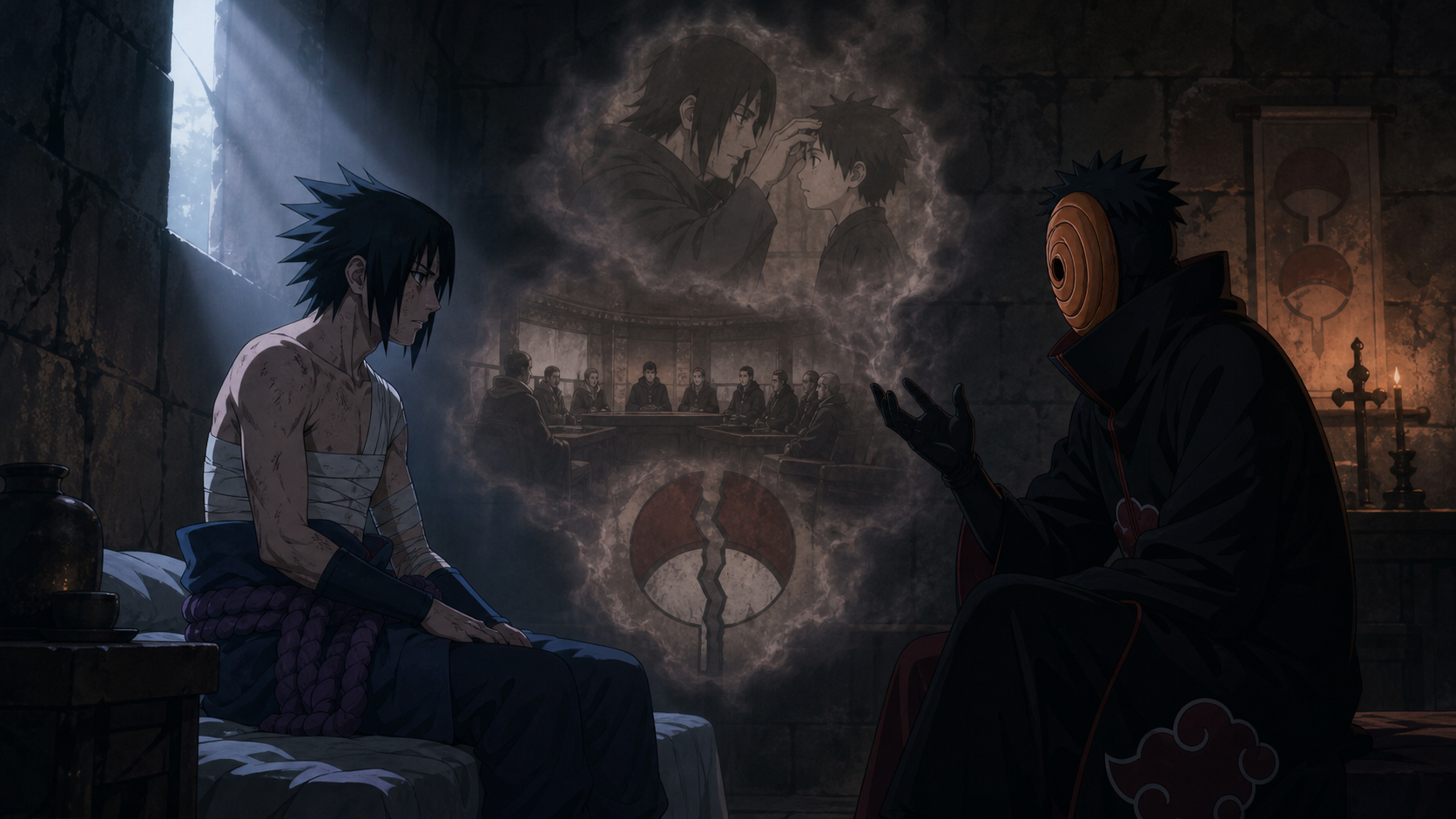
Sasuke wakes in an Akatsuki hideout after the battle with Itachi. His body is bandaged, his strength is limited, and the masked man who obstructed Naruto's team is waiting to control the first conversation he hears.
Tobi identifies himself as Madara Uchiha and says he helped Itachi on the night of the massacre. Sasuke rejects him and tries to use his Sharingan, triggering a hidden Amaterasu that Itachi implanted in Sasuke's eye to activate when it saw Tobi's Sharingan.
Tobi survives and interprets the trap as one final attempt by Itachi to protect Sasuke. He then begins dismantling the story Sasuke has believed for years, insisting that Itachi's cruelty concealed a life shaped by the Leaf Village, the Uchiha clan, and an impossible assignment.
Sasuke resists the claim, but he cannot dismiss the forehead touch, the removal of Orochimaru, or the fact that Itachi prepared a defense that would continue after his death.
Sasuke wakes inside someone else's explanation
The timing gives Tobi enormous power. Sasuke has just reached the goal that organized his life, but he has not had time to understand what the ending felt like or why Itachi's last gesture contradicted everything said during the fight.
Tobi places himself between experience and interpretation. He controls the room, chooses the starting point, and knows details Sasuke desperately wants.
That does not automatically make his account false. It makes the conditions of the telling dangerous. Sasuke is injured, isolated from Team Taka, and unable to compare Tobi's claims with another witness.
The episode is less a neutral revelation than a struggle over who gets to name the meaning of Itachi's death.
Amaterasu becomes a message from the dead
The sudden black flame is one of the strongest pieces of evidence Tobi offers. Itachi anticipated that Sasuke might face the masked Sharingan user and placed a technique in his brother's eye to respond.
The trap changes the emotional meaning of Amaterasu. During the duel it was an attack Sasuke had to escape. Here it operates as protection delivered after Itachi can no longer act directly.
It also proves that Itachi's final planning extended beyond winning or losing the fight. He expected his own death and prepared for the person likely to reach Sasuke afterward.
Tobi survives, but the flame forces him to acknowledge that Itachi was still attempting to shape Sasuke's safety from beyond the battle.
The mask changes before it comes off
Tobi does not need to remove the orange mask for his identity in the story to shift. The foolish Akatsuki junior disappears from his voice and posture as he claims the name Madara.
That change confirms what Episode 139 suggested: comedy was a role rather than a lack of intelligence. The same person who wasted Naruto's time now speaks with historical authority and calculated patience.
The mask becomes useful in a new way. Sasuke can see the Sharingan but cannot read the face around it, which allows Tobi to present emotion without exposing it.
He asks Sasuke to trust a hidden history while keeping his own identity physically concealed. That imbalance should remain visible even when his facts begin to explain Itachi's contradictions.
Fate is the story imposed on the brothers
Tobi frames the Uchiha as people caught in repeating structures of rivalry, loss, and sacrifice. The word “fate” makes those structures sound inevitable.
Sasuke has already been trapped by one version of inevitability: the surviving younger brother must grow strong, avenge the clan, and kill the murderer. That script carried him all the way to Itachi's body.
Now Tobi offers a replacement. Perhaps Itachi was not a selfish killer but a person forced into a role by institutions larger than either brother.
The danger is that exchanging one total story for another can still leave Sasuke without agency. He needs truth, but Tobi wants to decide what action the truth should produce.
Itachi's contradictions become evidence
Before this conversation, Sasuke could treat Itachi's occasional tenderness as manipulation. The final forehead touch makes that explanation harder to sustain.
The removal of Orochimaru is another contradiction. Itachi appeared to threaten Sasuke's eyes, yet used Susanoo to remove the man who intended to possess Sasuke's body.
The implanted Amaterasu adds a third piece. Itachi planned to destroy Tobi when Sasuke encountered him, which looks less like indifference than continued protection.
Tobi arranges these facts into a new portrait. Sasuke does not accept it immediately, but the old portrait can no longer contain everything he experienced.
Tobi uses truth as recruitment
Tobi's conversation has a strategic destination. A grieving Sasuke with no remaining purpose is unpredictable; a Sasuke whose grief has been redirected can become useful.
By identifying the Leaf and its leadership as forces behind Itachi's suffering, Tobi creates a path from private revenge to political revenge.
He also makes himself indispensable. If he alone possesses the hidden account, Sasuke must remain near him to hear the rest.
This is why the episode's quiet room can feel as dangerous as the battle. Tobi is not attacking Sasuke's body. He is offering a new enemy at the exact moment the old one has disappeared.
Sasuke wakes before he has even had the right to grieve
His body is bandaged, his brother is dead, and the purpose that organized years of survival has vanished. Tobi does not allow silence long enough for any of that to become Sasuke’s own thought.
The first voice after trauma gains disproportionate power. It can name the event before the survivor has language for it. Tobi arrives prepared to turn disorientation into dependence.
The room is staged as care while functioning as captivity
Sasuke has been treated, protected from immediate death, and given space to recover. Those actions look compassionate. He is also isolated with a masked participant in the massacre who controls the exits, the evidence, and the pace of disclosure.
Care without freedom can become another technique of control. Tobi meets physical need so he can claim interpretive authority.
Itachi’s implanted Amaterasu violates Sasuke while protecting him
The trap targets Tobi and confirms that Itachi anticipated danger. It also uses Sasuke’s eye as a delivery system without his knowledge or consent.
That contradiction should not be polished into uncomplicated love. Itachi protects his brother through another hidden decision made inside his body. The intention is care; the method repeats control.
A posthumous defense cannot explain itself
Amaterasu offers evidence of Itachi’s motive, but it cannot answer why he chose this safeguard, what he knew about Tobi, or why Sasuke was denied the warning while Itachi lived.
Tobi gets to translate the dead man’s action. That is exactly the danger Itachi feared, yet secrecy created the vacancy Tobi now occupies.
Tobi survives the flame and immediately authors its meaning
He does not merely evade the attack. He tells Sasuke what the attack proves: Itachi wanted to protect him. The conclusion may be accurate, but Tobi benefits from being the person who supplies it.
A manipulator’s most effective statement can be true. The manipulation lives in selection, timing, and the action attached to the truth.
Claiming Madara’s name is a demand for historical authority
Tobi presents himself not as another witness but as a founding figure whose life supposedly spans the clan’s modern tragedy. The name asks Sasuke to treat him as archive, survivor, and judge.
The mask makes verification impossible. Sasuke receives an enormous identity claim from a person withholding the ordinary evidence of a face.
Sasuke’s disbelief is intellectual self-defense
He has just learned that perception can be manipulated, appearances can be staged, and his brother spent years performing a role. Believing another masked stranger immediately would not be openness. It would be surrender.
Sasuke challenges the account because the source admits involvement and wants something. Skepticism is one of the few forms of agency still available in the room.
Tobi builds credibility from contradictions Sasuke already witnessed
He does not begin with village records. He points toward the forehead touch, the removed Curse Mark, and the defense implanted against him. These facts already trouble Sasuke’s old story.
Good manipulation enters through a real fracture. Tobi does not need to shatter certainty from outside when Itachi’s final actions have already cracked it.
The old revenge story was simple because somebody designed it that way
One brother killed the clan for power; the survivor must kill him. That explanation gave Sasuke a visible culprit and protected every institution outside the family from scrutiny.
Its simplicity was not proof. It was political convenience, enforced through Itachi’s performance and the village’s silence.
Tobi offers complexity with another simple destination
He expands the history by introducing the village, the clan conflict, and Itachi’s sacrifice. Then he begins steering those facts toward a new answer: redirect hatred toward Konoha.
The story becomes more complicated while the demanded action remains conveniently direct. Sasuke is invited to replace one enemy with another before he can investigate independently.
RaeRae reaction
I appreciate that Sasuke does not simply believe Tobi because the audience recognizes pieces of truth. His resistance is reasonable. The speaker is masked, admits involvement in the massacre, and has already manipulated both sides of the search.
At the same time, Itachi's implanted Amaterasu is difficult to explain away. It gives the conversation physical evidence before Tobi starts asking Sasuke to reconsider his entire life.
The episode understands that revelation is not only about facts. Timing, isolation, and the identity of the storyteller determine what a fact can do to someone.
Sasuke wakes expecting emptiness after revenge. Tobi fills that space immediately with a new history and a new direction for anger. “Fate” is unsettling because the truth may be real while the person delivering it is still using it as a weapon.
The episode exposes how institutions privatize their violence
The massacre was a conflict involving clan leadership, village surveillance, political fear, and state command. Sasuke received it as a private family crime committed by one deviant brother.
That conversion protected the village. Public decisions became personal evil, and the surviving child spent years punishing the visible instrument instead of questioning the system that used him.
Itachi carried the state’s secret inside a family relationship
Every affectionate memory now sits beside the possibility that Itachi was monitoring, protecting, deceiving, and preparing Sasuke for a future he chose alone.
The political mission did not remain at work. It entered the bedroom door, the forehead touch, the training promises, and the final duel. The state colonized brotherhood.
Calling that sacrifice does not erase who was sacrificed
Itachi surrendered reputation, family, health, and life. Sasuke lost parents, clan, safety, truthful memory, and the ability to choose his relationship to the village with informed consent.
A sacrifice made by one person can spend another person’s life. Naming Itachi’s burden must not make Sasuke’s involuntary cost invisible.
Fate is often power describing its own decisions as inevitable
The clan conflict did not descend from weather. Officials surveilled, separated, negotiated badly, threatened, ordered, and concealed. Clan leaders also made choices inside escalating fear.
Calling the result fate removes verbs from the people with authority. It turns a chain of preventable decisions into ancient tragedy nobody could have interrupted.
Sasuke needs evidence from people who do not need his obedience
Tobi may reveal accurate facts, but he is recruiting. Konoha hid facts to protect itself. Itachi arranged facts to control Sasuke’s path. Every available source has an interest.
Real agency would require records, multiple witnesses, time, safety, and the freedom to reach a conclusion no storyteller selected in advance.
The hidden history does not make the old pain imaginary
If Itachi acted under orders, Sasuke still experienced Tsukuyomi. If Itachi loved him, Sasuke still grew up alone. If the massacre prevented a wider conflict, murdered civilians remain murdered.
Context changes responsibility. It does not delete consequences. Any honest account must carry both.
Tobi understands that anger wants somewhere to go
Sasuke’s revenge has ended, but the emotional force behind it has not. Grief, humiliation, love, and rage remain active without a target.
Tobi gives that force a political route before it can become mourning, doubt, or withdrawal. Recruitment succeeds by offering movement when stillness feels unbearable.
Naruto is absent from the conversation but central to its stakes
Naruto raced toward Sasuke and was delayed by the person speaking now. Tobi ensured that loyalty could not interrupt his framing of the truth.
Sasuke wakes believing himself alone with the only person willing to explain. He does not know that friends were physically prevented from reaching him.
The episode makes knowledge feel physically dangerous
No punches are needed after the opening flame. Each new claim threatens the identity Sasuke constructed to survive. If Itachi was not the person he believed, then Sasuke must reevaluate every sacrifice made to kill him.
Truth can liberate, but forced revelation inside captivity can destabilize before it frees anything.
Tobi presents himself as the cure for a lie he helped sustain
He participated in the massacre, guarded the brothers’ duel, blocked Naruto’s rescue team, and retrieved Sasuke. Then he arrives as the generous person willing to explain what everyone else concealed.
That sequence is not neutral truth-telling. Tobi helps create the isolation that makes his account feel indispensable. He manufactures the wound and applies himself as the bandage.
The Sharingan trap makes inheritance carry an instruction
Sasuke’s eye does not merely hold clan ability. It briefly holds Itachi’s command about whom to burn. The body becomes an archive capable of acting before its owner understands the stored message.
That is emotionally perfect and ethically awful. Itachi leaves protection behind, but he also leaves one more order inside the brother whose life has already been organized by his commands.
A hidden protector can still produce visible harm
Learning that Itachi protected Sasuke does not erase the methods used to preserve the cover. Tsukuyomi, threats, abandonment, and engineered revenge shaped Sasuke’s development in ways a secret motive cannot undo.
Intent belongs in the judgment. So do effect, power, available alternatives, and the fact that Sasuke never agreed to become the endpoint of Itachi’s strategy.
Sasuke’s old certainty deserved to break, but not like this
The belief that Itachi killed for selfish power was false and politically useful. Sasuke needed access to the suppressed history. He deserved to receive it with time, corroboration, safety, and people committed to his welfare rather than his recruitment.
Instead, revelation becomes another ambush. The truth reaches him through the same pattern as every major power in his life: someone else chooses the moment and demands the next direction.
The word fate tests whether explanation will become excuse
Clan history, village fear, war memory, and inherited prejudice constrain Itachi. Those forces explain why his options looked narrow. They do not remove every decision he made within the narrowing.
If fate means context, it can deepen accountability. If fate means nobody could act differently, it protects everyone who benefited from declaring atrocity necessary.
Sasuke is being asked to rebuild identity while physically dependent
He cannot simply leave, verify records, or gather Team Taka around him. His body needs recovery, and Tobi controls the shelter. Material dependence makes intellectual resistance harder.
The scene understands that belief is never only a contest between arguments. Who controls food, safety, mobility, and access to other people shapes which account can be challenged.
What hurts most is that Sasuke has no emotionally safe answer available. If he rejects Tobi completely, he may reject evidence that explains Itachi’s final contradictions and the village’s responsibility. If he accepts Tobi completely, he hands another architect of violence control over what the evidence means. Skepticism cannot protect him forever because the facts demand investigation, but belief cannot protect him either when the speaker intends to direct the verdict.
That trap is why I refuse to describe Sasuke’s later anger as a sudden personality change. The foundation is being demolished while he is still lying in the rubble. His murdered family becomes a state secret. His hated brother becomes a protector and victim. His village becomes a possible author of the crime. His own eye reveals that Itachi planned around him after death. Any one of those discoveries could destabilize a person. Tobi stacks them together and offers revenge as the only available way to stand back up.
Sasuke needs room to say that Itachi loved him and harmed him, that Konoha contained people he loved and leaders who failed his clan, and that learning the truth does not obligate him to serve the man revealing it. Those sentences can coexist. Tobi’s power depends on making coexistence feel impossible. He wants grief converted into one clean allegiance before complexity gives Sasuke another choice. He deserves that freedom now.
RaeRae’s final word on fate
I believe Sasuke should hear the truth. I do not believe Tobi owns the right to deliver it as a recruitment package while Sasuke is injured, isolated, and grieving. Correct facts do not make coercive conditions ethical.
The implanted Amaterasu breaks my heart because it is Itachi in miniature. He sees danger accurately, plans brilliantly, and protects Sasuke through a secret placed inside Sasuke’s body. Love is present. Consent is not.
Sasuke’s resistance is one of the healthiest things he does in this room. He questions the source, rejects the identity claim, and refuses to let one startling piece of evidence rewrite his life instantly.
The tragedy is that every institution capable of offering an independent account chose silence. Tobi reaches him first because Itachi and Konoha left truth unattended. Fate did not create that opening. People with power did.
RaeRae’s call
Tobi gives Sasuke truths under coercive conditions and calls the result fate. The facts matter, but so do the masked speaker, the locked room, and the revenge he wants those facts to produce.