
The End
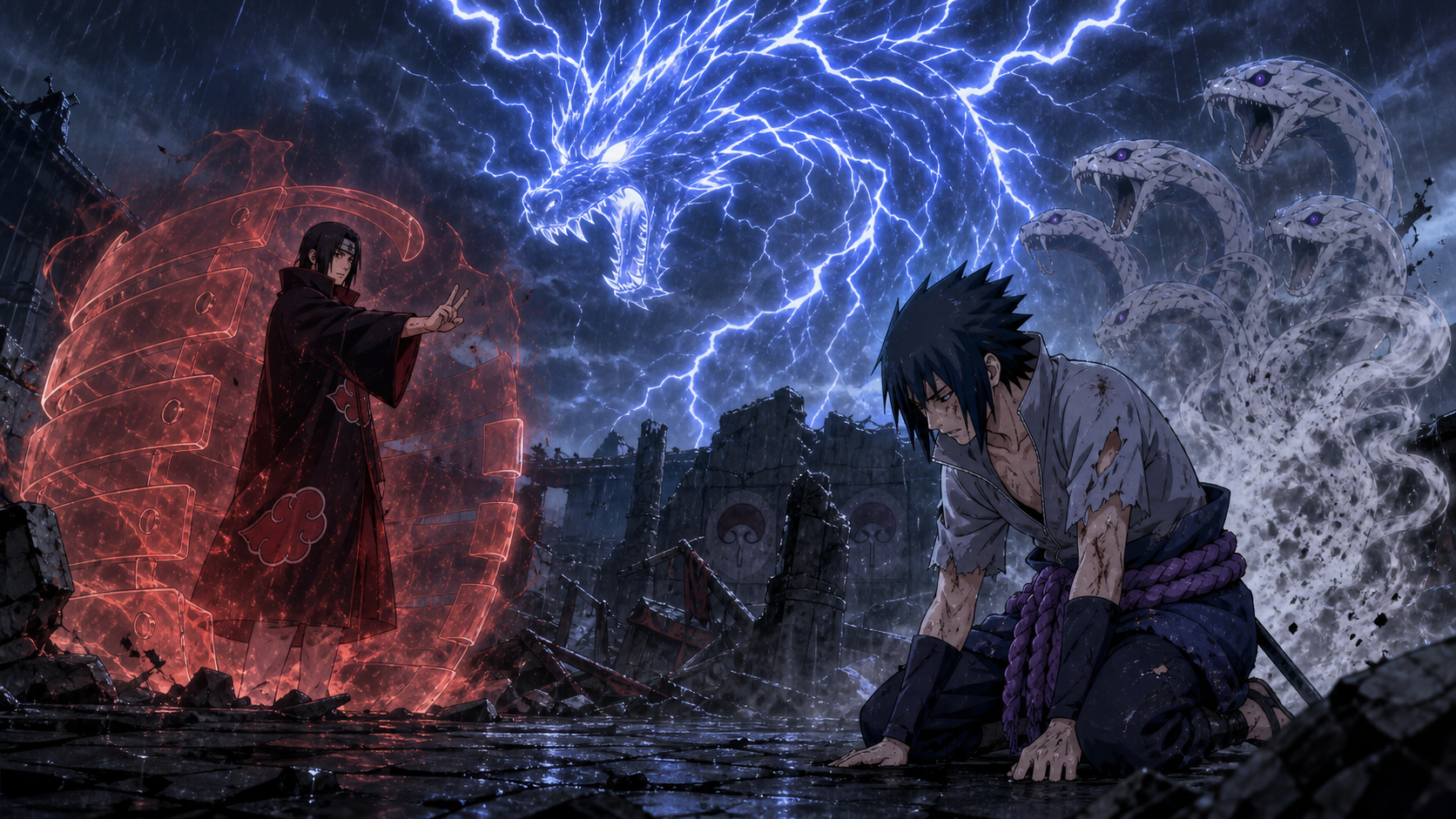
Kirin tears open the sky and Susanoo refuses the expected finish, but the brothers’ last moment arrives through silence and a familiar touch.
What happens
Sasuke and Itachi reach the point where their chakra appears nearly exhausted, but Sasuke reveals that his earlier Fire Style attacks were preparation. Their heat pulled moisture upward and built thunderclouds over the ruined hideout.
Using natural lightning instead of creating the entire attack from his own chakra, Sasuke guides Kirin down on Itachi. The strike destroys what remains of the battlefield, and Sasuke initially believes the revenge that shaped his life is complete.
Itachi survives by revealing Susanoo, an immense armored chakra guardian carrying extraordinary defensive and sealing weapons. Sasuke has little strength left, and the pressure allows Orochimaru to emerge from the Curse Mark in his eight-headed serpent form.
Itachi seals Orochimaru and removes the Curse Mark's presence from Sasuke. He then approaches his terrified, exhausted brother, reaches toward his eyes, and gives the familiar two-finger forehead gesture from their childhood. Itachi collapses and dies beside him.
Kirin is Sasuke's answer to exhaustion
Sasuke's final attack works because it was prepared across the entire fight. The flames that seemed like direct attempts to overpower Itachi also changed the sky above them.
That design reveals how Sasuke now thinks. He does not rely only on a larger reserve of chakra or a single secret technique. He creates conditions, waits for the environment to become useful, and then directs a force greater than either brother could casually produce.
Kirin turns the storm into stored consequence. Every earlier exchange contributed heat; every delay brought the clouds closer to readiness.
For a moment, the technique appears to solve the fight cleanly. Sasuke has used planning, observation, and nature itself to reach the ending he pursued for years.
Susanoo refuses the expected ending
Itachi's survival disrupts that apparent conclusion. Susanoo is not merely another stronger attack. It is protection shaped like an ancestral warrior, enclosing Itachi when his own body can barely remain upright.
The reveal changes the scale of the Mangekyo Sharingan again. Tsukuyomi governed perception, Amaterasu created inextinguishable flame, and Susanoo gives the eye a defensive body outside the user.
Yet the armor does not erase Itachi's weakness. He remains sick, nearly blind, and depleted inside it. The technique makes him harder to reach while making the cost of every remaining step visible.
Power and collapse occupy the same image. Itachi looks most mythic when he is closest to death.
Orochimaru leaves Sasuke's body
Sasuke's exhaustion weakens the control that kept Orochimaru suppressed. The eight-headed serpent emergence makes literal what has been true since the Curse Mark was placed: another person's ambition has been living inside Sasuke's pursuit of power.
Orochimaru offered strength while treating Sasuke as a future container. His return at the end of this family duel shows how thoroughly outside manipulation became entangled with Sasuke's private revenge.
Itachi's response is immediate. The Totsuka Blade seals Orochimaru, and the Curse Mark disappears from Sasuke.
The act complicates the role Sasuke assigned him. The brother who appears ready to steal Sasuke's eyes instead removes the person who intended to steal Sasuke's entire body.
The last approach changes every gesture
After the overwhelming techniques, the episode contracts into a few slow steps. Sasuke has no meaningful attack left. Itachi moves toward him with blood on his face and a hand raised toward the eyes he claimed to want.
The scene uses Sasuke's fear and the audience's expectations. Everything Itachi said about eternal sight makes the approaching fingers look like the final act of theft.
Then the hand changes direction. Itachi touches Sasuke's forehead as he did when they were children, a gesture that once postponed time together with the promise of “next time.”
Here there can be no next time. The familiar motion does not explain the massacre or absolve Itachi, but it reveals tenderness at the exact point when Sasuke expects violation.
Revenge ends without giving Sasuke an answer
Sasuke reaches the goal that organized his adolescence, but the result does not look like triumph. Itachi dies from a combination of illness, exhaustion, and the battle, leaving Sasuke standing beside a body that can no longer answer questions.
That silence matters. Sasuke wanted both punishment and meaning. He can interpret Itachi's collapse as victory, but the forehead touch creates a final contradiction he does not yet understand.
The episode refuses to turn revenge into emotional clarity. Removing the target does not remove the years of manipulation, grief, and unanswered history built around him.
Instead, Sasuke inherits a new uncertainty: why did the brother he hated spend his final strength approaching him with affection?
The battle's loudest moment is not its ending
Kirin tears open the sky. Susanoo rises from chakra. Orochimaru appears as a many-headed serpent and is sealed by a legendary blade. Any one of those images could have served as a conventional climax.
The actual ending is almost quiet. Two brothers stand close enough for a childhood gesture, and one falls.
That contrast is the episode's strongest choice. Spectacle shows what their pursuit of power has become, while silence returns the conflict to the relationship underneath it.
The title does not specify whose ending has arrived. Itachi's life ends, the Curse Mark ends, and Sasuke's revenge ends, but the consequences of all three are only beginning.
Kirin is not a miracle pulled from nowhere
Sasuke spends the earlier fire exchange changing the atmosphere, and the episode trusts viewers to recognize preparation after the reveal. He cannot create natural lightning with empty reserves, but he can guide a storm he deliberately helped build. That distinction makes the technique feel earned.
The move also tells us who Sasuke became away from Team 7. He studies systems, calculates conditions, and designs several exchanges ahead. Revenge narrowed his life, but it did not narrow his intelligence.
Borrowing nature exposes the limit of private power
Kirin overwhelms the scale of chakra either brother can comfortably generate. Sasuke wins access to that force through timing rather than ownership. The sky is not his possession. It becomes an ally because he understands cause and effect.
That approach contrasts with Orochimaru, Itachi’s false eye-theft story, and the village officials behind the massacre. They seek control through taking bodies, secrets, and authority. Sasuke’s strongest attack works through relationship with an environment he cannot own.
Susanoo makes Itachi’s self-image visible
The armored guardian surrounds a body already failing. It looks invincible from outside while hiding sickness, blood, and exhaustion inside. That is Itachi’s entire public life in one image.
He constructed a terrifying shell to contain the consequences of state violence and his own choices. The shell protected Konoha’s story, kept enemies distant, and gave Sasuke a villain to chase. It never healed the person trapped within it.
The Yata Mirror and Totsuka Blade turn defense into judgment
Susanoo does not merely block Kirin. Its weapons decide what can reach Itachi and what will be sealed away. The defense contains an authority to exclude, classify, and erase.
That power fits a man who has spent years controlling information. Itachi blocks the truth that might alter Sasuke’s path while sealing threats he considers unacceptable. His protection remains inseparable from his judgment about what Sasuke may know and carry.
Orochimaru emerging proves suppressed danger is not resolved danger
Sasuke forced Orochimaru down, but the Curse Mark kept the relationship inside his body. Exhaustion creates an opening for the predator to return. Control was necessary survival, not a cure.
The scene refuses the neat idea that Sasuke simply used Orochimaru and walked away. Exploitation leaves mechanisms behind. A survivor may feel independent until crisis weakens the defenses required to keep the old threat contained.
Itachi removes one violation while completing another plan
Sealing Orochimaru frees Sasuke from the Curse Mark’s immediate possession. That is real protection. It also happens without explanation or consent, during a duel Itachi engineered through years of terror.
I will give the act its value without turning it into proof of perfect brotherhood. Itachi helps Sasuke and manipulates Sasuke in the same final minutes. The contradiction is the character.
Sasuke’s fear at the wall is completely rational
Itachi has threatened his eyes, survived Kirin, manifested an impossible guardian, and kept walking after his body should have stopped. Sasuke is not weak because terror finally reaches his face. He understands the evidence available to him.
Viewers who know later revelations may see affection approaching. Sasuke sees the person who murdered his family extending fingers toward the body part he claimed to want. His interpretation is not a failure of insight. It is the result Itachi designed.
The forehead poke carries love and abandonment together
As children, the gesture meant affection paired with postponement. Itachi acknowledged Sasuke, then moved him away with the promise of another day. The tenderness was real. So was the repeated distance.
At death, the gesture cannot promise next time. It becomes apology, farewell, habit, and one final message Sasuke lacks the context to translate. Its beauty hurts because affection arrives without the truth required to make it legible.
A private gesture cannot settle a public crime
The forehead touch tells us something about Itachi’s feeling for Sasuke. It tells us nothing sufficient about the village surveillance, the coup, Danzo’s coercion, Hiruzen’s failures, or the massacre’s political beneficiaries.
Emotion can humanize the person who carried out violence. It cannot replace an account of the system that ordered and concealed it. The episode closes the brothers’ battle while leaving public responsibility untouched.
Itachi dies controlling the timing of every revelation
He chooses when Sasuke sees cruelty, power, weakness, protection, and affection. Even the final tenderness arrives as a surprise Itachi will never have to explain.
That control is tragic because it comes from fear that truth would endanger Sasuke or Konoha. It is also arrogant. Itachi assumes he alone can decide which reality his brother is strong enough to survive.
RaeRae reaction
I love how Kirin rewards everything Sasuke did earlier instead of appearing as an unrelated surprise. The storm makes his intelligence visible. Even near empty, he has been building toward a move that borrows its force from the world around him.
Susanoo then denies him the clean finish, but the episode does not use that reversal only to extend the fight. It creates the conditions for Itachi to remove Orochimaru, which quietly protects Sasuke at the moment Itachi looks most monstrous.
The forehead touch lands because the episode lets us fear the hand first. We remember Itachi's claim about taking Sasuke's eyes, while Sasuke remembers a brother who repeatedly promised attention later.
There is no satisfaction in the collapse, only shock and unfinished meaning. Sasuke achieved the outcome he demanded, but Itachi's final gesture makes the story less certain than it was before the battle began. “The End” closes the duel while opening the truth.
Revenge gives Sasuke an ending but not a future
For years, every skill had a destination: kill Itachi. Once the body falls, that organizing sentence disappears. Sasuke has achieved the task and lost the structure that told him why to wake up.
That emptiness is not poetic punishment for anger. It is the predictable result of a child being allowed to build an identity around one unresolved crime while every adult with relevant knowledge stayed silent.
The village left a child to investigate through violence
No trustworthy institution offered Sasuke records, testimony, accountability, or care. He pursued the only visible suspect because the system erased every other path to knowledge.
When revenge fails to provide truth, the story should not blame him for asking the wrong question. The adults removed the questions that might have led somewhere healthier.
Itachi’s death does not make his suffering evidence of innocence
His illness, exhaustion, and willingness to die reveal sacrifice. They do not erase agency. A person can be coerced by a state, love a sibling, suffer terribly, and still inflict choices that require accountability.
Reducing him to saint or monster wastes the moral pressure of the episode. Naruto gives us a damaged young man who became both weapon and decision-maker.
Sasuke is allowed to mourn someone he also hates
The final gesture creates emotional information before factual information arrives. His body can remember affection even while his mind holds the massacre. Those responses do not cancel each other.
Grief is not a courtroom verdict. Missing a brother does not declare that brother innocent, and anger does not prove love was absent.
Tobi will weaponize the unanswered space
Itachi leaves Sasuke with a contradiction and no explanation. Tobi is ready to become the next person who controls context, selects facts, and gives pain a political direction.
Secrets supposedly kept to protect Sasuke now make him easier to manipulate. When trusted people hide history, the first outsider offering receipts gains enormous power over the survivor’s next decision.
The title closes several prisons and opens another
Itachi’s life ends. Sasuke’s revenge mission ends. Orochimaru’s Curse Mark leaves his body. None of those endings produces freedom by itself.
Sasuke wakes into a new prison made of missing context. He no longer serves Orochimaru or hunts Itachi, but another narrator is waiting to tell him who deserves his rage.
Spectacle collapses into touch because the relationship was always the point
Kirin, Susanoo, and the hydra show how far the brothers traveled into mythic power. The forehead poke returns them to two children in a house before politics destroyed every ordinary possibility between them.
The small gesture defeats the giant techniques emotionally because it reveals what the battle could never settle: Itachi’s role was performed, but the affection beneath it was not simple fiction.
Kirin also answers the shame built into Sasuke’s childhood
Sasuke grew up watching adults describe Itachi as the effortless genius and himself as the child still trying to catch up. Kirin is not effortless. It is planned, assembled, timed, and directed through skills Sasuke had to develop after losing every safe place where learning should have happened.
That labor is not lesser than genius. The technique succeeds because he understands the battlefield as a changing system. He does not need to become Itachi’s mirror to challenge him. He creates a method that reflects his own patient, relentless mind.
Susanoo denies the fantasy that one perfect move can settle trauma
Sasuke pours years of preparation into an attack that should end the fight. Itachi rises anyway. That reversal feels cruel because trauma often creates the hope that one confrontation, confession, or victory will finally make the past stop moving.
The past does not cooperate. Even a spectacular success cannot force truth from someone committed to silence. Sasuke can destroy the hideout and still fail to break the story protecting Itachi’s real history.
Removing the Curse Mark does not return the years it occupied
Itachi frees Sasuke from Orochimaru’s physical foothold, and that matters enormously. Yet the removal cannot restore the choices Sasuke made while seeking enough power to kill his brother. Bodies can heal faster than identities reorganize.
Sasuke must eventually decide who he is without Orochimaru inside him and without Itachi ahead of him. Two controlling relationships end in the same room, leaving freedom that feels less like relief than vertigo.
The final touch makes the audience complicit in missing context
We know enough to recognize tenderness, but not enough at this moment to interpret the entire plan. Like Sasuke, we receive a gesture instead of an explanation. The episode makes us feel the temptation to use emotion as a shortcut around evidence.
I can cry at the forehead poke and still ask what Itachi believed it repaired. A farewell may communicate love, but it cannot tell Sasuke why his parents died, who gave orders, or why the truth was considered more dangerous than his hatred.
Sasuke collapsing after Itachi does not read as peace. His body reaches its limit after purpose holding it upright disappears. That detail protects the ending from becoming a victory pose. He cannot celebrate because the brother at his feet was never only an enemy, even when Sasuke lacked the evidence to name. The forehead touch awakens a memory before it supplies an answer. It reminds him that love existed, but love without honesty left him vulnerable to every person waiting to explain the silence for their benefit. That is the cruelty beyond the duel. Itachi may have removed Orochimaru and intended to remove himself as Sasuke’s obstacle, yet he could not remove the world that shaped both of them. Sasuke survives the room with his eyes, his body, and his intelligence intact. What he does not possess is a history. Until he gets one, the end belongs to whoever speaks next.
RaeRae’s final word on the end
I refuse to call this a satisfying revenge victory, because satisfaction requires knowledge Sasuke still does not have. He wins the battle and inherits a mystery shaped like the brother who just died.
Kirin proves Sasuke’s brilliance. Susanoo proves Itachi’s terrifying reserves. Sealing Orochimaru proves Itachi still acts protectively. The forehead poke proves affection survived. None of those facts excuses the years of psychological violence required to stage this ending.
My heart breaks for both brothers, but it does not break evenly in a way that erases power. Itachi knew the plan. Sasuke lived inside its manufactured reality. One chose the timing of the pain, and the other had to make life-or-death decisions without the missing truth.
The end is devastating because Itachi gets the farewell he designed while Sasuke receives another question. The body beside him is finally silent, and the people who benefited from that silence are still alive.
RaeRae’s call
The forehead touch is love, but it is not absolution. Sasuke ends his revenge exactly as Itachi planned and still deserves the truth that every powerful adult kept from him.