
RaeRae Reacts · One Piece Episode 45
Luffy Becomes Known to the World
Luffy’s first bounty becomes a study of public reputation, accidental exposure, Marine power, and the risks shared by his crew
Episode information
Japanese title: Shoukin Kubi! Mugiwara no Luffy Yo ni Shirewataru
English title: Bounty! Straw Hat Luffy Becomes Known to the World
Japanese broadcast: October 25, 2000
Saga: East Blue
Script: Junki Takegami
Episode direction: Yoko Ikeda
Animation direction: Hideaki Maniwa
Art: Kunihiro Chida
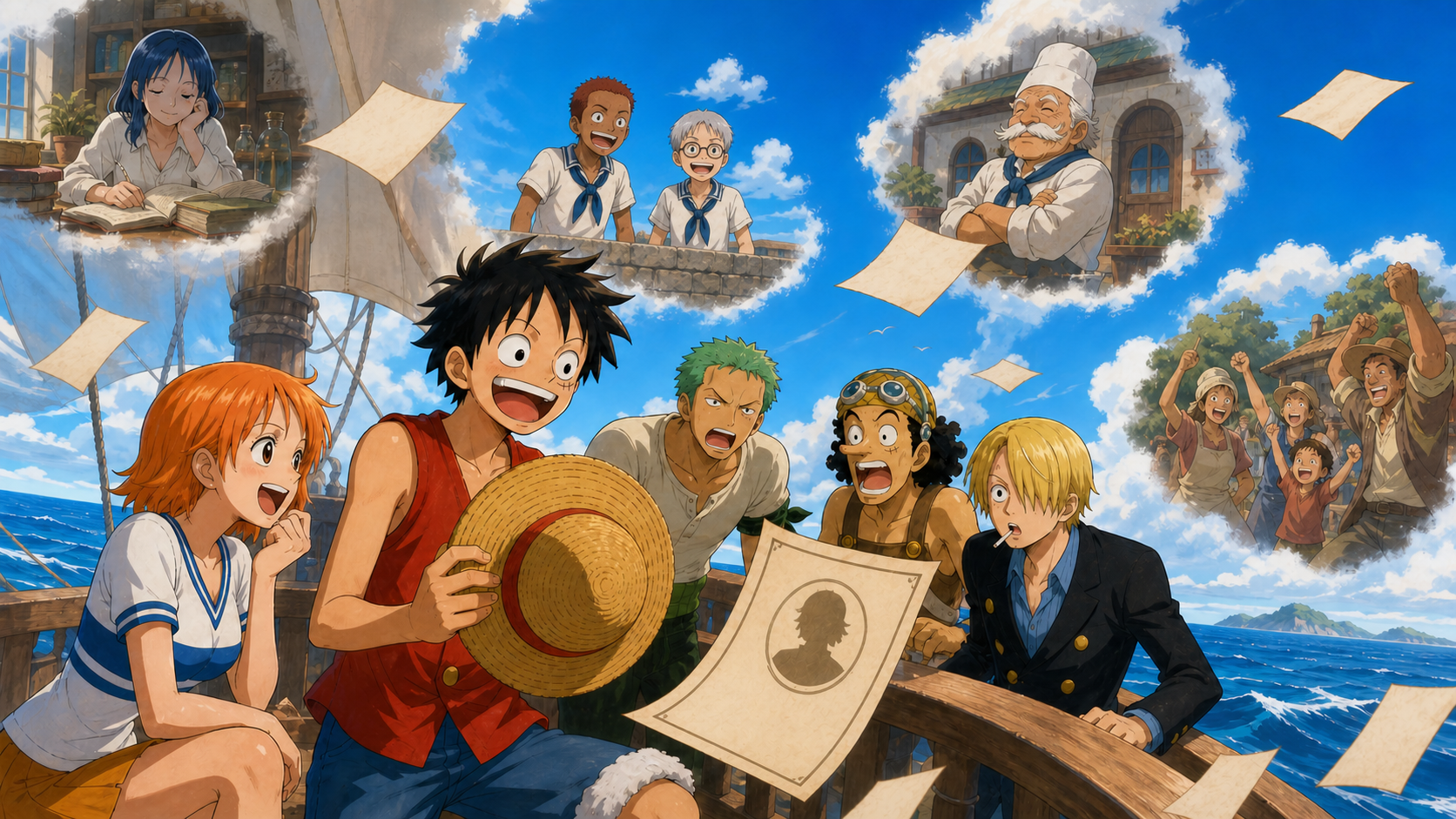
Nami discovers that the news has reached the ship
Episode 45 begins with a newspaper carrying more than distant headlines. A loose bounty notice identifies Luffy and assigns a thirty-million-berry reward. The crew’s local actions have entered a public system they do not control.
Nami understands immediately that this is not a souvenir. The paper changes how ports, authorities, hunters, rivals, and ordinary readers may interpret the ship before anyone aboard speaks.
The first bounty turns reputation into infrastructure
Rumors can fade or remain local. A mass-produced notice gives Luffy’s face, name, and price a route through newspapers, Marine stations, restaurants, villages, and commercial networks.
The document creates a repeatable decision prompt: recognize this person, treat him as dangerous, and receive money for capture. Its influence extends far beyond readers who know what happened at Arlong Park.
Thirty million berries communicates institutional priority
The amount tells the public that the state considers Luffy unusually significant for East Blue. The notice does not explain how the figure was calculated, which incidents were verified, or whose testimony shaped the assessment.
A number can look objective while hiding political judgment. Readers should not confuse precision with transparency.
A bounty is not a neutral biography
The notice compresses Luffy into a target. The document does not include Koby’s liberation from Alvida, Shells Town’s relief, Kaya’s survival, Baratie’s defense, or Cocoyashi’s freedom.
Those omissions do not automatically make every accusation false. They show that the document exists to mobilize capture, not to provide a complete public record.
Luffy experiences recognition as achievement. He has openly declared his intention to become Pirate King, so public notice feels like proof that the journey has started to matter. The bounty validates scale in a language the pirate world understands.
Excitement is consistent with his goal, but the crew must translate the practical consequences that the poster does not celebrate.
Recognition increases risk for everyone aboard
Ports may deny entry, suppliers may report them, opportunists may attack, and authorities may use force before learning who else is on the ship. Luffy’s face can expose the entire crew.
Shared risk requires shared planning. A captain cannot treat fame as personal when everyone travels on the same visible vessel.
Nami becomes the first operational reader. Her reaction brings logistics into a moment Luffy views emotionally. She can connect circulation to routes, provisions, money, concealment, and weather-dependent options.
The crew needs that perspective without making her solely responsible for every consequence of the captain’s public profile.
The photograph contains more than its intended subject
Usopp appears in the background of Luffy’s image. The accidental inclusion gives distant viewers information about association even though Usopp has no named bounty of his own.
Background visibility can create real exposure. A person does not need to be centered or identified for an image to affect safety.
Usopp did not consent to publication
Neither Luffy nor Usopp appears to have controlled the photograph, framing, or distribution. State authority turns the captured moment into a public enforcement tool without asking the people depicted.
The crew cannot reverse circulation, but they can recognize the privacy loss and adapt together.
Kaya recognizes Usopp
For Kaya, the small background figure confirms that Usopp is alive, traveling, and close to the dream he described. The image carries relational information the official notice did not intend to provide.
Her joy does not cancel the danger. Recognition may reassure friends while helping hostile readers connect identities and places.
Kaya has begun studying medicine. Her decision gives the Syrup Village aftermath its own forward movement. She is not frozen in the role of person Usopp left behind. Medical study requires sustained work, responsibility, and a life shaped by her choices.
Their goals can develop in parallel without one becoming a waiting room for the other.
Medical ambition answers vulnerability with capacity. Kaya’s illness and the attack on her home exposed how dependent she had been on others’ information and care. Studying medicine can expand her ability to understand health and support people around her.
That path should not be reduced to preparing for Usopp’s eventual injuries. Medical study belongs to her broader future.
Kaya needs privacy after recognizing him. Expressing public excitement could reveal a personal connection to someone shown beside a wanted pirate. Trusted friends should avoid spreading details about Usopp’s home, family, route, or relationship to Kaya.
A happy reaction can remain private when publicity would create risk.
Koby sees how far Luffy has traveled
The bounty gives Koby a measurable sign that the person who helped him choose the Marines is now moving deeper into piracy. Their paths are becoming institutionally opposed even though their earlier respect remains real.
Koby will need to decide how personal knowledge, duty, evidence, and lawful conduct relate if those paths cross again.
Friendship does not excuse institutional harm. Koby should not secretly erase legitimate evidence or expose colleagues to protect Luffy. He also should not allow a poster to replace independent assessment, proportionality, and concern for civilians.
Ethical tension requires more than choosing a person over an institution or an institution over a person.
Helmeppo receives a different lesson. Luffy’s rise reminds Helmeppo that inherited status and intimidation did not create durable authority. The person who challenged Morgan now has influence far beyond Shells Town.
For Helmeppo, growth means building competence and accountability rather than chasing another shortcut to power.
Morgan’s reaction cannot define the story. A defeated authority figure may interpret the bounty as proof that his earlier enemy was always criminal. That reading avoids responsibility for the abuse that made resistance necessary in Shells Town.
Later state classification does not retroactively make Morgan’s rule just.
Kuro sees an identity that refuses to disappear. Kuro tried to erase his pirate identity and build a quiet path toward Kaya’s wealth. Luffy’s public emergence represents the opposite relationship to visibility.
The contrast does not make fame inherently virtuous. The comparison shows that concealment and publicity can each be used toward very different ends.
Zeff understands what the bounty means for Sanji
News of Luffy naturally reaches Baratie, where Sanji chose to join the crew. Zeff can read the notice as evidence that Sanji’s new route will be more dangerous and visible than an ordinary departure.
Pride, worry, and confidence can coexist. Supporting Sanji’s choice does not require pretending the risk is small.
Baratie staff should protect customer and crew information. Hunters or Marines may ask when the Straw Hats left, what they purchased, who joined them, or which direction they sailed. Staff should avoid casually disclosing details that could endanger people.
A public bounty does not entitle every questioner to private operational information.
Fullbody treats the notice as an opportunity. His attempt to act on Luffy’s bounty risks turning a public restaurant into an enforcement stage. If he attacks without controlling the space, diners and workers become collateral exposure.
Authority or reward eligibility does not remove the obligation to assess location, necessity, proportionality, and civilian safety.
Capture attempts can produce more harm than the target. A bounty invites people with uneven training, motives, and judgment to intervene. Some will prioritize payment or reputation over a safe process.
The system externalizes danger to ports and communities by making violent confrontation financially attractive.
John Giant’s Marine Headquarters address expands the scale
The vice admiral speaks within an institution that sees piracy as a global threat requiring coordinated response. His presence places Luffy’s notice inside a larger enforcement structure rather than one local officer’s complaint.
That scale can support consistent protection, but centralized reach can also amplify errors or distorted reporting when accountability is weak.
Marine unity is not the same as Marine correctness. A force can share a mission and still contain Morgan’s abuse, Nezumi’s corruption, Koby’s idealism, and officers who act responsibly. Institutional identity does not erase variation in conduct.
Public trust should depend on transparent standards and remedies, not uniforms alone.
Nezumi likely shaped the information pipeline. His report after Arlong Park may contribute to Luffy’s bounty while minimizing Marine collusion and the village’s liberation. The person exposed by the events has an incentive to redirect attention toward the pirate who defeated Arlong.
The crew should assume official records may contain self-protective framing.
Cocoyashi needs its own account preserved
Residents can document tribute, coercion, murder, forced labor, stolen savings, and Nezumi’s role. Copies held by trusted people reduce the chance that one corrupt channel erases the history.
Luffy’s bounty should not become the only surviving public artifact of Arlong’s defeat.
Foosha Village faces association risk. People who recognize Luffy may feel pride, disbelief, concern, or embarrassment. Outsiders may ask about his childhood, family, habits, or local contacts.
The village should avoid feeding curiosity that could bring hunters or hostile authorities to residents who did not choose participation in his voyage.
Public familiarity can become surveillance. A widely circulated face recruits ordinary observers into an informal reporting network. Shopkeepers, dockworkers, and travelers may begin monitoring who resembles the poster.
Some will act out of fear, some for money, and some from loyalty to authority. The crew must plan for inconsistent motives rather than one predictable enemy.
The Going Merry is now identifying evidence
Even if Luffy hides his face, the ship, crew combination, sail pattern, and travel behavior can connect sightings. A single poster changes how previously ordinary details are interpreted.
Security planning should focus on conduct and routes, not rely on a simple disguise.
The crew needs a port protocol. Before docking, assess Marine presence, bounty hunters, supply needs, medical urgency, weather, exit routes, and whether the ship can remain safely visible. Assign roles for information gathering and emergency departure.
Do not send Nami alone to manage every transaction because she appears less prominent. Shared safety work prevents predictable targeting.
They need a contact-protection protocol. Avoid naming Kaya, Zeff, Nojiko, Genzo, Koby, Makino, or other friends where hostile listeners can connect them to the crew. Do not carry unnecessary address lists in easily seized belongings.
When contacting home, use routes that do not reveal immediate location or future plans.
Luffy needs to hear what leadership changed. The bounty may feel like personal progress toward Pirate King, but command now includes protecting people exposed by his visibility. He should listen when crewmates describe risks and adapt plans even if fear does not motivate him.
Courage is not permission to choose danger on behalf of everyone else.
Thirty million can distort interactions inside the crew. Outsiders may treat Luffy as the only important member because his price is printed. The crew should resist letting that hierarchy erase the work of Nami, Zoro, Usopp, and Sanji.
A state valuation is not a measure of human worth or contribution.
Usopp’s background appearance complicates his desire for fame. He wants recognition as a brave warrior, yet this visibility arrives without name, context, or control. Being seen is not the same as being understood.
The moment can help him distinguish earned reputation from accidental exposure and invented stories.
Nami’s image absence does not guarantee safety. She is not the poster’s subject, but witnesses from Arlong Park, Nezumi’s report, or future encounters could identify her. Lack of a printed bounty is not anonymity.
Every crew member needs informed safety planning regardless of official status.
The newspaper connects separate aftermaths
Syrup Village, Shells Town, Baratie, Cocoyashi, Marine Headquarters, and the ship all receive the same artifact through different relationships. The episode turns earlier arcs into a living network rather than abandoned locations.
Each reaction shows that travel leaves ongoing consequences behind.
Junki Takegami uses circulation as structure. Takegami’s script moves through distant settings by following the notice rather than forcing the characters together. The bounty provides one event with many meanings.
This structure expands the world while preserving emotional continuity from East Blue.
Yoko Ikeda distinguishes every reaction. Ikeda’s direction gives readers time to recognize places and understand why the same image produces pride, worry, anger, or resolve. Reaction shots become narrative updates rather than a simple montage.
The world feels larger because people outside the ship continue changing.
Hideaki Maniwa keeps the poster legible as a threat. The animation direction contrasts the stillness of paper with energetic responses around the notice. A flat object can redirect behavior across oceans.
Luffy’s delight and Nami’s concern remain physically distinct, clarifying the leadership tension without a long argument.
Kunihiro Chida gives locations persistent identity. The art returns to familiar villages, Marine spaces, and Baratie without making them interchangeable. Architecture and atmosphere allow the audience to understand where the news has arrived before every character is named.
That visual continuity makes earlier relationships feel current.
RaeRae’s real-time reaction
Luffy seeing thirty million as a milestone is completely predictable, and Nami immediately seeing supply problems is why this crew needs both of them. I just need the captain to understand that the poster put a price on danger for everyone nearby.
Kaya spotting Usopp in the background is sweet and unsettling at the same time. She gets proof that he is moving forward, but the state accidentally publishes a connection he never chose to disclose.
The moment that lands
The notice falls from an ordinary newspaper onto the Going Merry. No admiral has to arrive in person for the institution to change the crew’s day.
Paper, printing, and distribution create reach that a single opponent cannot match. The next phase of the journey begins through information.
What the crew should do now. Preserve one copy for accuracy, record the stated amount and image, and compare future notices for changes. Do not display the notice publicly as decoration in ways that help strangers confirm the ship.
Review port procedures, emergency departure roles, contact protection, and who speaks when authorities approach. Discuss what surrender, escape, or defense thresholds apply in crowded spaces.
Tell every crew member what appears in the image, including Usopp’s background visibility. Shared awareness is part of consent and safety.
What friends ashore should do. Celebrate privately if they choose, avoid confirming relationships to strangers, preserve their own records of events, and report coercive questioning through trusted local channels when possible.
No one owes the crew publicity, secrecy that puts them in danger, or active assistance. Their first responsibility is to their own safety and community.
Bottom line
Episode 45 converts Luffy’s East Blue victories into a public identity he cannot fully control. A thirty-million-berry bounty excites the captain, alarms the navigator, exposes Usopp in the background, and carries news to friends, former enemies, restaurants, villages, and Marine Headquarters.
RaeRae rating: 9.3/10. The poster looks like recognition, but its real power is distribution. Luffy has become known to the world, and responsible leadership now means protecting the people who become more visible beside him.