
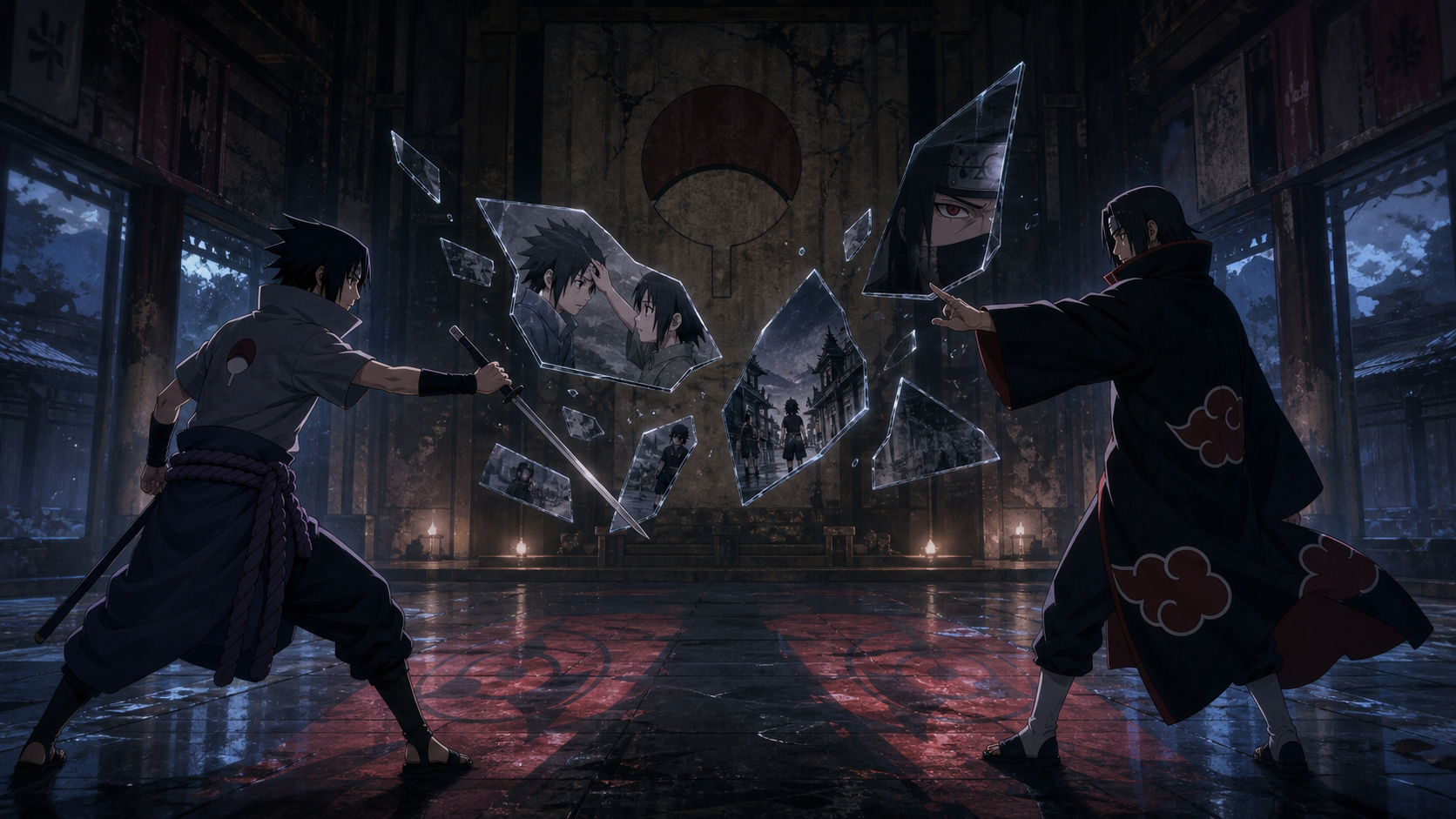
The Longest Moment
The brothers finally meet, but every strike and answer fractures into another layer of memory, illusion, and controlled truth.
What happens
Itachi waits inside the abandoned Uchiha hideout, remembering the events that led to his departure from the Leaf. Sasuke arrives, and the brothers begin the confrontation that has shaped both of their lives.
Their opening exchanges blur physical combat and genjutsu. A strike lands, a body falls, and the scene rewinds into another layer of illusion. Each brother tests whether the other can distinguish action from the image of action.
Sasuke demands answers about the massacre and the third person Itachi once implied possessed the Mangekyo Sharingan. Itachi names Madara Uchiha, expanding the family story beyond the two brothers in the room.
The duel remains an interrogation. Sasuke wants the truth badly enough to fight for it, but Itachi still controls what information enters the conversation and when.
The longest moment began years ago
The title describes more than the slow tension inside the hideout. Sasuke has been living toward this encounter since the night his family died.
Every training decision, broken bond, and alliance with Orochimaru stretched that night forward. The confrontation feels like one moment because revenge froze part of Sasuke's life around a single image of Itachi.
Itachi has also been waiting, though the episode withholds the full meaning of his preparation. His memories suggest a longer political history behind the role Sasuke understands as simple betrayal.
The brothers enter the same room carrying different timelines. Sasuke arrives at the end of a hunt. Itachi arrives inside a plan whose beginning Sasuke still cannot see.
Genjutsu makes dialogue physically unstable
The illusion battle is not separate from the conversation. It is the form their conversation takes.
Sasuke cannot trust a gesture, injury, distance, or reaction until he breaks another layer. Itachi can answer a question while changing the sensory conditions under which the answer is received.
That is an extreme version of their relationship. Sasuke knows Itachi possesses information but has no reliable way to determine whether any offered piece is complete.
The Sharingan allows both brothers to challenge visual lies, yet shared ability does not create equal knowledge. Itachi still knows which story he is constructing.
Sasuke asks the question beneath revenge
Killing Itachi has been Sasuke's declared goal, but the episode makes clear that an unexplained death would not be enough. He needs to know who helped, why Itachi spared him, and what family history made the massacre possible.
Those questions reveal that revenge contains a demand for meaning. Sasuke wants the world to become legible before he destroys the person at its center.
The problem is that Itachi remains the gatekeeper. Sasuke's determination can force a confrontation, but it cannot force a truthful answer from someone more experienced at controlling perception.
This is why the battle feels emotionally claustrophobic despite the large hall. Every route to the past runs through the brother Sasuke cannot trust.
Madara enters the room as a name
Itachi's reference to Madara adds a third Uchiha to a conflict Sasuke has understood as private. The name connects the massacre to the clan's founding history and to a model of power built through the Mangekyo Sharingan.
Sasuke receives the information without the context needed to evaluate it. Madara may be an accomplice, warning, ancestor, or story Itachi is using to guide the next emotional reaction.
That ambiguity is the point. A name can enlarge the truth while also becoming another tool of manipulation.
The audience knows Tobi is controlling the road outside, making the unseen third presence feel materially close even before Sasuke understands it.
The clan hall is not neutral ground
The Uchiha crest dominates the space, turning family identity into architecture. The brothers are surrounded by symbols of a community that cannot speak for itself.
Itachi chose this setting because history has weight here. Sasuke cannot enter without feeling the dead and the expectations attached to their name.
The emptiness also benefits whoever controls the story. There are no elders, parents, teammates, or witnesses to provide another account.
Sasuke believes he has reached the place where answers live. He has actually reached the stage Itachi prepared for delivering them.
RaeRae reaction
I appreciate that the fight begins with questions instead of immediately escalating into the largest techniques. The emotional stakes are not decoration around combat; they determine its structure.
Every illusion says the brothers cannot meet on stable ground. Sasuke attacks the person who made reality unbearable, while Itachi keeps demonstrating that reality is still his to edit.
The mention of Madara widens the mystery at exactly the moment Sasuke expects closure. Revenge promised one enemy and a final answer. The clan's history offers networks, institutions, and motives larger than one body.
“The Longest Moment” feels suspended because neither brother is simply in the present. They are fighting through childhood, massacre, clan memory, and years of preparation all at once. The first exchange does not end the wait. It reveals how much waiting is still inside it.
The duel begins as a fight over what counts as real
My bottom line is that Sasuke reaches the confrontation and still cannot secure stable ground. A blade enters a body, blood appears, and the scene collapses into another illusion. Itachi controls not only information but the conditions under which information is perceived.
Their dialogue is inseparable from genjutsu because trust has already been destroyed. Every answer arrives inside a medium designed for deception.
Sasuke needs explanation as much as revenge
If death alone were sufficient, he would not keep asking about the third Mangekyo user, the massacre, or why he survived. Revenge carries a demand that the world become legible before the central witness disappears.
Itachi exploits that need by rationing context. Sasuke can force physical proximity without forcing narrative equality.
Madara enters first as controlled information
The name expands the massacre beyond two brothers and connects it to older Uchiha power. Sasuke receives no independent source capable of confirming what role the historical figure played.
A true name can still be used manipulatively when the speaker controls timing, emphasis, and omitted context.
The hall turns dead relatives into silent authority
Clan symbols make the meeting feel historically sanctioned while every other Uchiha voice is absent. Itachi can present his account inside architecture that appears to support him without being able to testify.
Sasuke stands among evidence of belonging and has access to only the brother who destroyed it.
The Sharingan can expose an illusion without exposing an institution
Sasuke and Itachi can detect visual manipulation at a level few shinobi could match. Neither eye automatically reveals covert orders, surveillance records, clan meetings, village policy, or who benefited from keeping the massacre private.
Technical perception and historical truth require different evidence. Sasuke has trained for the first while being denied access to the second.
Itachi makes truthful fragments serve a controlled conclusion
Manipulation does not require every statement to be false. A name, an old rivalry, or a description of Mangekyo power can be accurate while omitted context guides Sasuke toward the intended emotion.
Itachi’s greatest advantage is deciding which truths arrive together and which relationships remain invisible.
Sasuke’s questions prove revenge never replaced grief
He wants to know who helped, why he lived, and what history made the massacre possible. Those are survivor questions before they are tactical questions.
The demand for explanation reveals a child still trying to understand why love, home, and safety vanished in one night.
The duel cannot provide testimony from the people who died
Itachi can describe the clan. Sasuke can remember fragments of childhood. Neither can ask their parents, elders, or ordinary Uchiha members what they knew and wanted.
Mass death concentrates narrative power in survivors, especially the survivor who controlled the killing.
Clan leadership should not stand in for every Uchiha life
A planned coup involved political actors and legitimate grievances about exclusion. Children, civilians, dissenters, and people without decision-making power were not interchangeable with leadership.
Collective punishment erases internal difference so institutions can call an entire population one threat.
The Leaf remains absent from the room it helped create
Village surveillance, Danzo’s coercion, Hiruzen’s delay, and the treatment of the Uchiha compound shaped the crisis. The brothers confront each other while state responsibility remains outside the hideout.
Calling the massacre a family tragedy protects the government from appearing as a participant.
Itachi’s sacrifice does not make his method harmless
He may have believed he was preventing war and preserving Sasuke’s life. He still killed a population, tortured his brother through repeated illusion, and constructed revenge as Sasuke’s reason to live.
A protective intention cannot grant ownership over another person’s mind or future.
Sasuke’s power was cultivated through a trauma script
He earned every hour of training, every tactical insight, and every victory that brought him to the hall. Itachi supplied the destination and repeatedly reinforced hatred as the measure of progress.
Agency and conditioning coexist. Naming manipulation should not reduce Sasuke to a puppet, and honoring agency should not erase the design around it.
The first exchanges test emotional control as much as genjutsu
Each brother watches for anger, hesitation, surprise, and certainty. A visible reaction can reveal what information landed before any physical opening appears.
Itachi’s stillness pressures Sasuke to prove that years of hatred produced someone impossible to dismiss.
Sasuke refuses to remain the frightened child in Itachi’s memory
Breaking illusion and pressing questions are ways of reclaiming authorship. He will not accept the old role of powerless witness, even when the encounter keeps trying to return him there.
That refusal is emotionally necessary regardless of whether revenge can deliver the freedom he expects.
Madara’s name introduces history as another combatant
The founder’s reputation carries clan pride, village conflict, the Eternal Mangekyo, and stories shaped by later institutions. Mentioning him puts an entire contested archive between the brothers.
Sasuke receives the name from a narrator he cannot trust and has no time to investigate independently.
Tobi makes the absent third person physically relevant
While Itachi discusses Madara, a masked man blocks Konoha outside. The audience can see that the third presence is not safely confined to ancient history.
The brothers’ private room is being protected by the organization connected to the withheld answer.
Time stretches because the present cannot contain the accumulated past
Every glance carries childhood affection, massacre imagery, years of preparation, clan politics, and an imagined ending. A few seconds of combat have to hold experiences Sasuke never processed in sequence.
The longest moment is trauma turning chronology into recurrence.
Genjutsu lets the episode stage recurrence literally
Bodies fall and return, attacks complete and become false, and certainty resets. Sasuke experiences a formal version of what memory has done since childhood: replaying the event while withholding a stable conclusion.
Breaking one layer provides control without ending the structure.
Itachi knows Sasuke’s hunger because he created it
The older brother can predict which answer will produce pursuit, anger, or another question. That knowledge came through intimacy before it became a weapon.
Family closeness makes manipulation precise. Itachi knows where love and terror occupy the same memory.
Closure cannot be served by the person controlling the archive
Sasuke may kill Itachi and still lack the political truth, other witnesses, and context required to understand what happened. Revenge can end a relationship before it ends uncertainty.
The duel may satisfy the demand for action while enlarging the demand for explanation.
Itachi’s control over the archive creates a cruel paradox. Sasuke must listen to the person least trustworthy to him because almost everyone else who could testify is dead. The massacre did not only remove family. It removed corroboration, disagreement, and the ordinary memory that could place political decisions beside intimate ones.
That concentration makes every answer dangerous. If Itachi lies, Sasuke may build another life around false information. If he tells part of the truth, omitted actors remain protected. If he offers a technically accurate history through genjutsu, the method itself reminds Sasuke that perception can be engineered.
Sasuke’s insistence on questions is therefore one of his healthiest actions in an unhealthy setting. He refuses to let the duel become simple punishment. He wants sequence, participants, motives, and the identity of the third person. Curiosity survives inside obsession.
The tragedy is that curiosity has been given almost no safe institution to approach. Konoha concealed the massacre. Itachi constructed the villain story. Orochimaru offered power in exchange for possession. Tobi waits with another account designed for his own purpose. Every available source wants something from Sasuke.
Hebi could become a different kind of archive because its members know the person he became after leaving both Konoha and Orochimaru. They cannot explain the massacre, but they can witness how each new truth changes him. Keeping them outside gives manipulation more privacy.
I understand why Sasuke wants no witnesses to grief that has been used against him since childhood. Privacy can protect dignity. It can also leave a traumatized person alone with someone skilled at controlling memory. The ethical question is not whether privacy is wrong. It is whether Sasuke had enough trustworthy options for privacy to be freely chosen.
Itachi’s apparent willingness to die does not retroactively create Sasuke’s informed consent. A person may sacrifice himself while still manipulating the survivor into performing the sacrifice. The burden of killing a loved brother will remain with Sasuke after Itachi no longer has to answer for the design.
That burden complicates every claim that Itachi did everything for him. Protection should expand a person’s future. Itachi narrowed Sasuke’s future to hatred, strength, and one encounter, then planned to remove himself at the end. Survival was preserved while self-determination was damaged.
I can recognize the impossible coercion Itachi faced from village leadership and still name what he passed downward. Danzo and the crisis reduced his choices. Itachi then reduced Sasuke’s choices, believing control could keep the child alive. Violence travels through institutions and families by presenting the next restriction as necessary protection.
Sasuke’s strength disrupts part of that plan because he is not merely the child Itachi expected. He escaped Orochimaru, assembled a team, developed his own tactical language, and arrives capable of challenging every illusion. Growth occurred inside the script and beyond it.
That is why the outcome is not predetermined even though Itachi authored the stage. Sasuke can ask questions Itachi hoped to avoid, interpret answers differently, and carry relationships the plan did not include. Agency can emerge under manipulation without proving the manipulation harmless.
The episode’s layered genjutsu captures this unstable balance. Itachi produces an image. Sasuke breaks it. The break may itself occur inside another image. Resistance is real, but certainty remains delayed. Neither total control nor total freedom describes the exchange.
Madara’s name intensifies the instability because it offers a larger history without a trustworthy map. Sasuke learns that the conflict may include an Uchiha beyond the family home, but he cannot know whether the name explains, distracts, recruits, or warns. Information expands faster than verification.
Tobi’s presence outside makes the warning physical. The hidden third actor is not an old legend sealed in a story. He is actively preventing Konoha from becoming a witness. Itachi’s account and Tobi’s obstruction work together even if their private goals differ.
Naruto’s team experiences the cost of that information monopoly without knowing it. They believe they are delayed from rescuing Sasuke from a duel. They are also delayed from observing the conversation that will reshape his understanding of the Leaf and himself.
Witnesses cannot guarantee truth, but they can preserve competing details. Kakashi might recognize a political omission. Yamato might notice a village implication. Naruto might hear the pain behind an answer. Their exclusion ensures Sasuke receives the history alone and must later decide whether anyone deserves access to it.
For me, that loneliness is the longest part of the moment. The physical duel moves quickly. Sasuke has spent years waiting for one untrustworthy person to explain why his world ended. The answer arrives inside the same relationship that made truth unsafe.
I leave this phase impressed by Sasuke’s refusal to accept appearances and furious that sources around him have turned truth into leverage. He deserves the complete political village record, the family record, and the right to judge both without genjutsu shaping the room.
The fight will test eyes, speed, chakra, and preparation. The test is whether Sasuke can survive the collapse of the story that gave those skills one purpose. Killing Itachi may complete revenge. Learning that revenge was constructed will demand a life beyond the ending.
The longest moment is therefore not waiting for the first strike. It is the suspended space between the explanation Sasuke needs and the trust required to receive it. Itachi can control the images and ration the facts. He cannot guarantee what Sasuke becomes once the brother sees how many people authored his grief.
RaeRae’s final word on the longest moment
I love that the first stage refuses a clean division between conversation and combat. Itachi weaponizes perception. Sasuke attacks while interrogating. Each broken illusion reveals another layer of unequal knowledge.
Madara’s name widens the story when Sasuke expects closure. Revenge promised one enemy. History delivers networks, institutions, and a third presence already controlling the road outside.
Sasuke earned the power that brought him here. Power cannot supply a trustworthy archive. His Sharingan can break visual lies while political omission remains intact.
The moment feels endless because the massacre never stayed in the past. It shaped every decision leading to the hall. The duel begins when the brothers meet, but Sasuke has been living inside Itachi’s opening move since childhood.
RaeRae’s call
Sasuke reaches Itachi but not stable truth. Every strike becomes another illusion, and every answer remains controlled by the brother who designed the confrontation.