
Banquet Invitation
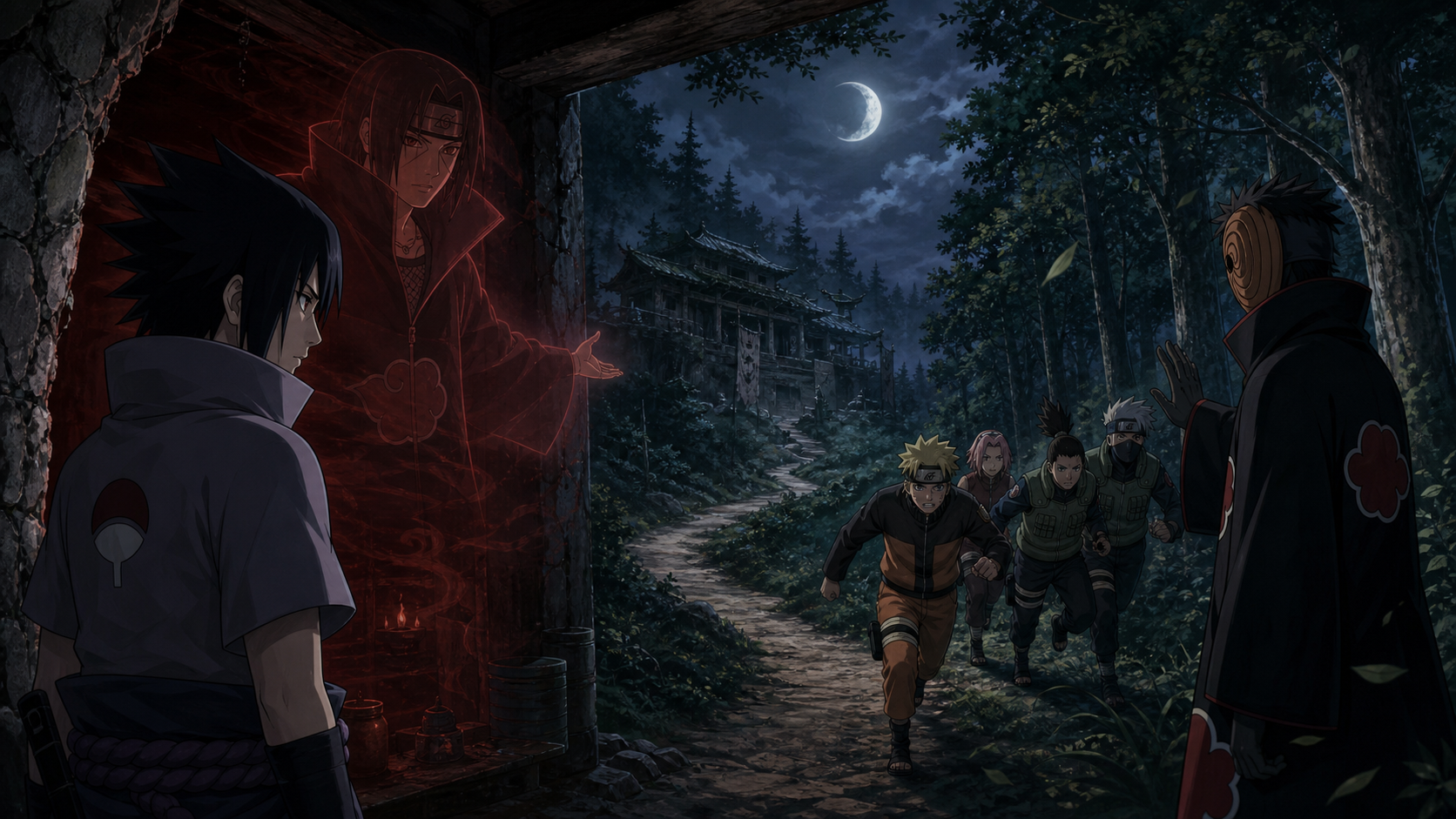
Itachi chooses the room, Tobi controls the road, and two relentless pursuits advance only on someone else’s schedule.
What happens
Sasuke follows Itachi's trail to an Akatsuki hideout and prepares to enter without Hebi. Itachi appears before him, but the encounter is a genjutsu projection rather than the confrontation Sasuke has been pursuing.
The projection directs Sasuke to the abandoned Uchiha hideout. Itachi determines the location, timing, and terms of the meeting while allowing Sasuke to believe he is moving under his own control.
Elsewhere, Konoha finally narrows Sasuke's position. Naruto and the tracking teams rush toward him, only for Tobi to appear in their path.
Tobi behaves like an irritating fool while making every attack pass through him. His comedy delays the Leaf forces and protects the private space Itachi has created for the brothers.
An invitation can still be a command
The episode calls Itachi's message an invitation, but Sasuke does not experience it as an open choice. Everything he has done since leaving the Leaf points toward accepting.
Itachi understands that compulsion. He does not need to drag Sasuke to the clan hideout. He only needs to name the place where Sasuke believes his life can finally become coherent.
That is control at its most efficient. Sasuke supplies the movement, urgency, and emotional commitment himself.
The genjutsu projection reinforces the imbalance. Even Itachi's presence can be withheld. Sasuke receives an image, a destination, and another delay from the person who has shaped years of his decisions.
Sasuke leaves Hebi outside the family story
Hebi helped Sasuke survive Deidara, evade Konoha, and reach this point. He still approaches the final meeting alone.
The choice makes tactical sense. Itachi's abilities are dangerous, and additional people could become leverage or casualties. It also reveals how Sasuke defines the conflict.
His teammates belong to the journey. The confrontation belongs to the Uchiha family, or more precisely to the version of that family history Sasuke carries.
By excluding witnesses, Sasuke protects the meaning he has assigned to revenge from interruption. Nobody can ask a question, challenge an assumption, or offer a competing reason to leave.
Tobi turns foolishness into battlefield control
Tobi's performance is frustrating by design. He jokes, waves, stumbles, and reacts as though the Leaf team is inconveniencing him rather than attacking.
Beneath the comedy, he accomplishes the objective perfectly. Konoha cannot pass, cannot land a clean hit, and cannot understand the rule governing his body quickly enough.
The mismatch between tone and effect makes him dangerous. A conventional enemy signals threat and invites focused analysis. Tobi floods the moment with irritation, encouraging attackers to repeat themselves with more force.
Every failed strike becomes time purchased for Itachi and Sasuke.
Naruto and Sasuke are close on someone else's schedule
Naruto has spent the search arc believing that enough tracking skill and persistence will create a meeting. Episode 134 reveals that distance is not the only obstacle.
Powerful people are arranging access. Karin previously scattered scent trails. Itachi now selects the site. Tobi physically controls the road.
Naruto is close to Sasuke geographically while remaining outside the structure deciding who may reach him.
This sharpens the difference between pursuit and connection. Finding a route does not guarantee that the person at the end is ready, willing, or free to meet.
The Uchiha hideout is a stage built from memory
Itachi chooses a clan site rather than neutral ground. The architecture brings ancestors, symbols, and the massacre into the room before either brother speaks.
Sasuke is being invited not only to fight Itachi but to enter a story about what the Uchiha were and why they died.
The setting gives Itachi another advantage. He knows more about the clan's institutions and secrets, while Sasuke arrives with fragments shaped by childhood trauma.
A banquet promises abundance, but this meeting offers information rationed by the person serving it.
Even the empty seats matter. The wider clan cannot answer for itself, Hebi is held outside, and Konoha is blocked on the road. The brothers will speak inside a room crowded with symbols and almost no living witnesses capable of correcting either one's account.
RaeRae reaction
I like how the episode creates tension without pretending the long-awaited battle has already begun. The important action is positional: who chooses the room, who controls the road, and who is allowed to witness.
Sasuke looks decisive, yet Itachi still writes the next instruction. Naruto looks close, yet Tobi converts an entire team into stalled traffic.
Tobi's comedy works because the audience can feel the calculation underneath it. He is not failing to take the Leaf seriously. He is choosing the emotional rhythm that makes them easiest to delay.
“Banquet Invitation” brings every character to the edge of a revelation while preserving unequal control. Sasuke accepts the invitation because revenge has made refusal unimaginable. Naruto reaches the road because love has made stopping unimaginable. Itachi and Tobi decide how far either determination is permitted to go.
Itachi can command Sasuke without issuing an order
My bottom line is that the invitation works because Itachi spent years making refusal impossible. Sasuke believes the clan hideout contains the fight, truth, and ending around which his life has been organized.
Control is most efficient when the controlled person supplies movement and urgency. Itachi names a place. Sasuke converts the name into destiny.
The genjutsu projection preserves unequal access
Sasuke reaches Itachi and still receives only an image. The older brother decides when physical presence becomes available, what information is shared, and how long anticipation continues.
Even absence becomes something Itachi can deploy. Sasuke cannot force the relationship into the present before Itachi permits it.
Hebi built the road and is excluded from the destination
Karin found routes and protected them from trackers. Suigetsu completed Sasuke’s escape from Deidara. Jugo brought strength and steadiness. Their collective labor makes the private confrontation possible.
Sasuke calls the final room a family matter, but that privacy rests on a team carrying consequences outside it.
Leaving teammates behind protects them and controls the story
Itachi could use Hebi members as leverage, and additional fighters would face mortal danger. Sasuke’s choice has a protective logic.
It also removes witnesses who might challenge an assumption, interrupt revenge, or hear information Sasuke later cannot bear alone. Protection and isolation coexist.
Tobi controls tempo by refusing the expected emotional role
He jokes while attacks pass through him, making Konoha respond with frustration instead of careful study. The fool performance is not separate from the technique. It shapes how opponents spend attention.
Every repeated strike purchases time for the brothers’ meeting while teaching Tobi more about the Leaf team.
The Leaf has tracking success without meaningful access
Naruto’s team finally reaches the correct road. Geography stops being the primary obstacle at the exact moment a more powerful gatekeeper appears.
Finding Sasuke cannot guarantee conversation when other actors determine who may enter the room and when.
The clan hideout makes architecture an argument
Uchiha symbols, empty seats, and inherited stone place the massacre inside the confrontation before either brother explains it. Itachi chooses terrain where clan history surrounds Sasuke but cannot speak for itself.
The setting looks like ancestral authority while leaving one living narrator in control of the account.
An invitation requires a meaningful ability to refuse
Sasuke can physically turn away, but Itachi built the emotional conditions that make turning away feel equivalent to abandoning his family, identity, and reason for surviving. Formal choice exists without meaningful freedom.
That distinction matters whenever power hides inside polite language. Calling a destination an invitation does not make the relationship equal.
Itachi controls the meeting long before entering the room
He selects a clan site, sends a projection, times the appearance, and relies on Tobi to delay interference. The fight begins as control over logistics and witness access before either brother exchanges a technique.
Sasuke arrives prepared for combat while Itachi has prepared the entire narrative environment.
The projection makes Sasuke prove commitment again
After years of training and pursuit, Sasuke still receives another threshold instead of the confrontation. Itachi tests whether the younger brother will follow the final instruction without demanding presence or explanation.
The answer is predictable because revenge has trained Sasuke to treat delay as another cost he must pay.
Private family business can conceal public political history
The Uchiha massacre was not only a conflict between brothers. It involved clan leadership, village surveillance, a planned coup, covert orders, and state violence. Framing the confrontation as private protects institutions from entering the room.
Sasuke believes he is resolving family trauma while lacking the political facts that explain who authorized it.
The clan hideout cannot testify for the dead
Symbols and empty seats create ancestral weight, but architecture has no voice. Itachi can point toward history while controlling every sentence about what history means.
A setting that feels authoritative may still function as scenery for one survivor’s edited account.
Hebi members deserve informed consent about the mission’s endpoint
They agreed to help Sasuke find Itachi for separate reasons. They were not necessarily told that success would mean waiting outside while he entered a likely fatal encounter alone.
Consent to a journey should be renewable when risk, purpose, or team structure changes. Loyalty does not erase the need for information.
Karin’s sensing labor becomes invisible at the threshold
She located danger, protected routes, and helped keep Konoha away. Once Sasuke reaches the clan story, that expertise is treated as support completed rather than perspective worth bringing inside.
The pattern is familiar: a woman’s labor makes access possible, then the supposedly important male conversation excludes her.
Suigetsu and Jugo also lose the right to assess the final risk
Suigetsu may accept danger casually, and Jugo may trust Sasuke deeply. Neither temperament gives Sasuke permission to decide alone what consequences the team will absorb if he dies.
When a leader vanishes into a private mission, teammates inherit uncertainty and the aftermath.
Tobi’s intangibility turns physical effort into emotional waste
Leaf attacks pass through him, producing no useful result while increasing frustration. The technique controls more than space. It controls how opponents feel about their own competence.
Frustrated fighters repeat force because repetition feels like refusing humiliation. Tobi profits from the emotional loop.
Comedy provides cover for careful observation
While acting foolish, Tobi can watch formations, timing, sensory abilities, and which Leaf ninja responds impulsively. The team treats him as an obstacle while he treats them as information.
Underestimation is not merely protection. It is access to how people behave when they believe no serious intelligence is watching.
Naruto’s urgency makes the delay especially effective
Naruto believes every minute may be the difference between reaching Sasuke and losing him to revenge. Tobi does not need to defeat him. He only needs to make urgency consume time without progress.
A blocker who cannot be struck converts determination into exhaustion.
Kakashi has reason to distrust a masked man near an Uchiha confrontation
The Sharingan, Akatsuki, spatial behavior, and deliberate obstruction create questions beyond the immediate chase. Yet the mission’s emotional urgency keeps attention centered on passing him quickly.
Tobi succeeds when the team treats understanding as a delay instead of the condition for overcoming him.
Itachi and Tobi collaborate by controlling separate forms of access
Itachi controls Sasuke’s access to truth and presence. Tobi controls Konoha’s access to the road. One manages the room; the other manages who cannot enter it.
The brothers’ supposedly private destiny depends on coordinated organizational labor.
Sasuke and Naruto both mistake relentless movement for agency
Sasuke follows because revenge makes stopping unimaginable. Naruto attacks because love makes delay unbearable. Each feels most self-directed while moving along conditions another person designed.
Determination is not freedom when the available path was narrowed in advance.
The episode delays combat to expose who authors the encounter
No large exchange is needed for power to operate. Destination, timing, misinformation, blocked roads, and excluded witnesses determine the meaning of the coming battle.
The person who chooses the stage may possess the most important advantage before anyone performs.
Sasuke’s decision to enter alone also reflects what the massacre taught him about trust. The person closest to him destroyed the family and then defined the reason. Depending on teammates may feel like giving another person access to the one confrontation that still seems capable of restoring control. Privacy becomes a defense against betrayal.
That defense has a cost. Nobody inside the room can compare Itachi’s claims with outside evidence, observe Sasuke’s condition, or interrupt if the encounter becomes something other than the duel he expected. Solitude protects the meaning from interference and protects manipulation from witnesses.
Itachi understands both effects. He can tell truths, half-truths, and provocations in a setting where the dead clan supplies atmosphere but no correction. Sasuke’s Sharingan may detect genjutsu. It cannot automatically detect political omission. Eyes built for visual deception still need reliable information about institutions.
The clan hideout intensifies that vulnerability because it feels like home without offering living safety. Symbols tell Sasuke that the conversation belongs to his bloodline. Empty seats make the brothers appear like the only remaining authorities. The village leaders and clan adults whose decisions created the crisis remain absent from examination.
Calling the encounter a banquet is bitterly accurate. Itachi controls the invitation, location, pacing, and portions of information. Sasuke arrives starving for explanation. Hunger makes rationed truth feel abundant because even fragments answer questions he has carried since childhood.
I want to preserve Sasuke’s agency without pretending the conditions are equal. He chose training, formed Hebi, defeated Orochimaru, survived Deidara, and pursued Itachi through extraordinary obstacles. Those choices are real. They occur inside a destination Itachi planted in him through trauma.
Agency is not a switch that becomes either present or absent. People make meaningful choices under pressure, limited knowledge, emotional conditioning, and unequal power. The editorial work is to name both the choice and the structure surrounding it.
Naruto faces a related problem outside. He chooses to keep pursuing Sasuke, but Tobi decides what action is physically possible. More force does not expand agency when every strike passes through the target. Understanding the rule would create more freedom than repeating determination.
The team’s frustration is useful to Tobi because urgency narrows curiosity. Naruto fears that analysis will cost the chance to reach Sasuke. In reality, unexamined attacks are the delay. Tobi does not have to stop their movement forever. He only has to make them spend the decisive minutes incorrectly.
Kakashi’s presence should create a stronger analytical counterweight, yet even he is operating under emotional history. A masked opponent with unusual spatial ability and an Uchiha-linked mission presses on memories the current team does not know. The road contains more inherited history than anyone can openly discuss.
Tobi benefits from every compartment. Naruto does not know the full Uchiha story. Sasuke does not know the village’s orders. Hebi does not know the brothers’ private plan. Konoha does not understand Tobi’s identity. Itachi controls what Sasuke receives, while Tobi protects the silence around everyone else.
That is why witness control matters as much as combat. A witness can carry a competing account, notice coercion, preserve chronology, or challenge the story told afterward. Keeping Hebi out and Konoha away ensures the confrontation produces only the evidence its surviving participants choose to share.
If Sasuke kills Itachi, he expects the act to settle memory. It may instead leave him with fewer sources and more questions. Revenge can remove the person withholding truth before the withheld structure becomes visible. The planned ending risks destroying the archive Sasuke believes he is finally opening.
Itachi may intend that outcome. He has designed himself as the villain Sasuke must defeat, perhaps believing hatred will give his brother strength and closure. Designing another person’s closure is still control, even when sacrifice or protection motivates it.
A loving intention cannot make years of psychological manipulation harmless. Itachi may believe he is preserving Sasuke’s life and the village. Sasuke carries isolation, obsession, and a false political history as the price. Protection without informed choice becomes another form of ownership.
Hebi’s excluded position offers an alternative Itachi never planned. Sasuke now has people connected to his present rather than only his clan past. They are imperfect, self-interested, and capable of choosing him after learning difficult truths. Leaving them outside preserves the old story’s monopoly.
For me, the episode’s tension comes from watching every road narrow around that monopoly. Itachi calls. Sasuke follows. Tobi blocks. Naruto strikes. The actions look decisive, but the structure belongs to the people controlling access. The real question is not who moves fastest. It is who gets to define what the meeting means after the doors close.
I enter the hideout impressed by Sasuke’s resolve and angry that resolve has been cultivated into obedience to a trauma script. He earned the strength that brought him here. He deserves an honest account of why his family died. The banquet may satisfy revenge, but truth requires witnesses, context, and the freedom to leave the table with questions.
RaeRae’s final word on the invitation
I love how positional this episode is. Itachi chooses the room. Tobi controls the road. Sasuke and Naruto supply determination while other people decide where that determination can go.
Hebi’s absence matters because the team earned this arrival. Calling the conflict private does not erase the collective labor or fear supporting it.
Tobi’s comedy is effective because irritation consumes analysis. He appears unserious while completing the serious objective perfectly.
A banquet promises abundance, but Itachi controls every serving of truth. Sasuke enters hungry for an ending. The danger is that hunger makes whatever the host provides feel like the only available meal.
RaeRae’s call
Itachi’s invitation functions like a command because revenge has made refusal unimaginable. Tobi delays every witness while Sasuke enters a room where one brother controls the evidence.