
RaeRae Reacts · One Piece Episode 42
Arlong’s Assault from the Sea
Arlong’s replaceable teeth and ocean speed become a tactical problem Luffy must solve without repeating his submersion crisis
Episode information
Japanese title: Sakuretsu! Gyojin Arlong Umi Kara no Moukougeki! (1 Jikan SP Zenpen)
English title: Exploding! Fish-Man Arlong’s Fierce Assault from the Sea!
Japanese broadcast: September 27, 2000
Saga: East Blue
Script: Michiru Shimada
Episode direction: Hidehiko Kadota
Animation direction: Masayuki Takagi
Art: Tomoko Yoshida
Luffy returns to a battlefield that changed without him
Episode 42 restores Luffy to the fight, but the return does not reset Arlong Park to the moment before he fell into the water. Zoro is badly wounded, Sanji has spent energy underwater, Usopp has completed his own battle, and Nami has openly rejected Arlong. The captain returns because everyone else kept the mission alive.
That context matters. Luffy can provide force the group urgently needs, yet his strength only becomes available after a chain of care, delay, and adaptation. The episode’s most satisfying choice is letting the final duel emerge from collective work rather than treating the crew as spectators waiting for the hero.
Arlong’s teeth make regeneration a weapon
Luffy breaks Arlong’s teeth, an attack that would permanently disable an ordinary opponent. Arlong simply grows them again. The ability turns what looks like visible progress into a temporary interruption and forces Luffy to reassess what damage actually changes the fight.
Regeneration also becomes psychological pressure. Arlong wants the repeated teeth to announce that ordinary limits do not apply to him. The practical answer is not panic or endless repetition. Luffy needs an objective that Arlong cannot instantly restore.
Breaking something is not the same as stopping the threat. The first exchange exposes a measurement problem. A dramatic impact can look successful while leaving the opponent’s capacity almost untouched. Teams need to evaluate outcomes by function: can Arlong still bite, move, command, and threaten residents?
Luffy notices the mismatch quickly, but curiosity nearly pulls him into imitation instead of strategy. The episode understands his comic instinct without pretending every experiment is useful.
Arlong turns discarded teeth into handheld blades
Once the new teeth grow, the old sets remain dangerous. Arlong grips them and attacks with weapons shaped by his own body. The move expands his reach and makes the rubble around the fight less predictable.
Anyone supporting from the perimeter should treat detached weapons as active hazards. Clearing residents back, tracking where sharp objects land, and maintaining protected routes are as important as watching the center of the duel.
Luffy tries Arlong’s teeth himself
Luffy takes the bizarre idea literally and fits a set into his own mouth. The joke comes from his willingness to test the opponent’s advantage with almost no concern for dignity. The experiment also shows a genuine learning impulse: he wants to understand what makes the bite dangerous.
The borrowed teeth do not grant the anatomy, jaw strength, or experience behind Arlong’s attack. Borrowing a tool is not the same as inheriting the system that makes the weapon effective.
Imitation can reveal limits. Luffy’s attempt is tactically weak, but the attempt gives him immediate information. He learns that the teeth alone are not the full source of Arlong’s power. The lesson should shorten the experiment rather than encourage a contest over who can bite harder.
A better adaptation uses the information to protect vulnerable areas, control distance, and redirect the opponent’s momentum. Understanding a weapon is valuable when the knowledge changes the plan.
The comedy does not erase the bite risk. The scene stays playful because Luffy treats the teeth like an absurd accessory. Arlong’s bites still carry crushing force and contamination risk. No one should interpret the gag as evidence that puncture injuries are minor.
If a bite lands, the crew needs bleeding control, cleaning, monitoring, and a real medical assessment. Continuing the duel can be necessary, but the injury should not disappear from the story’s operational memory.
Arlong believes biology establishes hierarchy
He treats replaceable teeth, underwater speed, and fish-man strength as proof of inherent superiority. The argument leaps from physical difference to political entitlement. That leap is the foundation of the system he built in Cocoyashi.
Different capacities are real; the claim that they justify domination is not. Luffy does not need to deny Arlong’s advantages. He needs to prevent those advantages from controlling other people’s lives.
The duel should not validate Arlong’s worldview. If the conflict becomes only a contest between two exceptional bodies, Arlong’s premise remains partly intact. The wider resistance offers the counterargument. Humans with different abilities survived, coordinated, protected one another, and made choices he could not fully predict.
Luffy’s role is to stop the immediate aggressor inside that collective answer. Victory belongs to the network that made resistance possible, not to a new biological ranking with Luffy at the top.
Arlong retreats to the sea for speed
When close combat stops giving him the control he expects, Arlong uses the environment designed around his strengths. The sea provides acceleration, concealment, multiple approach angles, and room to build momentum.
This is intelligent adaptation. Luffy must respect the retreat as a tactical change rather than assume that a retreat means fear or weakness.
Water remains the crew’s most important hazard
Luffy has only just survived submersion. Arlong now positions every charge near the same medium that neutralizes the captain. The risk is not merely impact. A successful hit can return Luffy to a condition where rescue becomes necessary again.
Sanji, Nojiko, and Genzo should maintain an extraction plan instead of assuming the earlier rescue solved the water problem permanently.
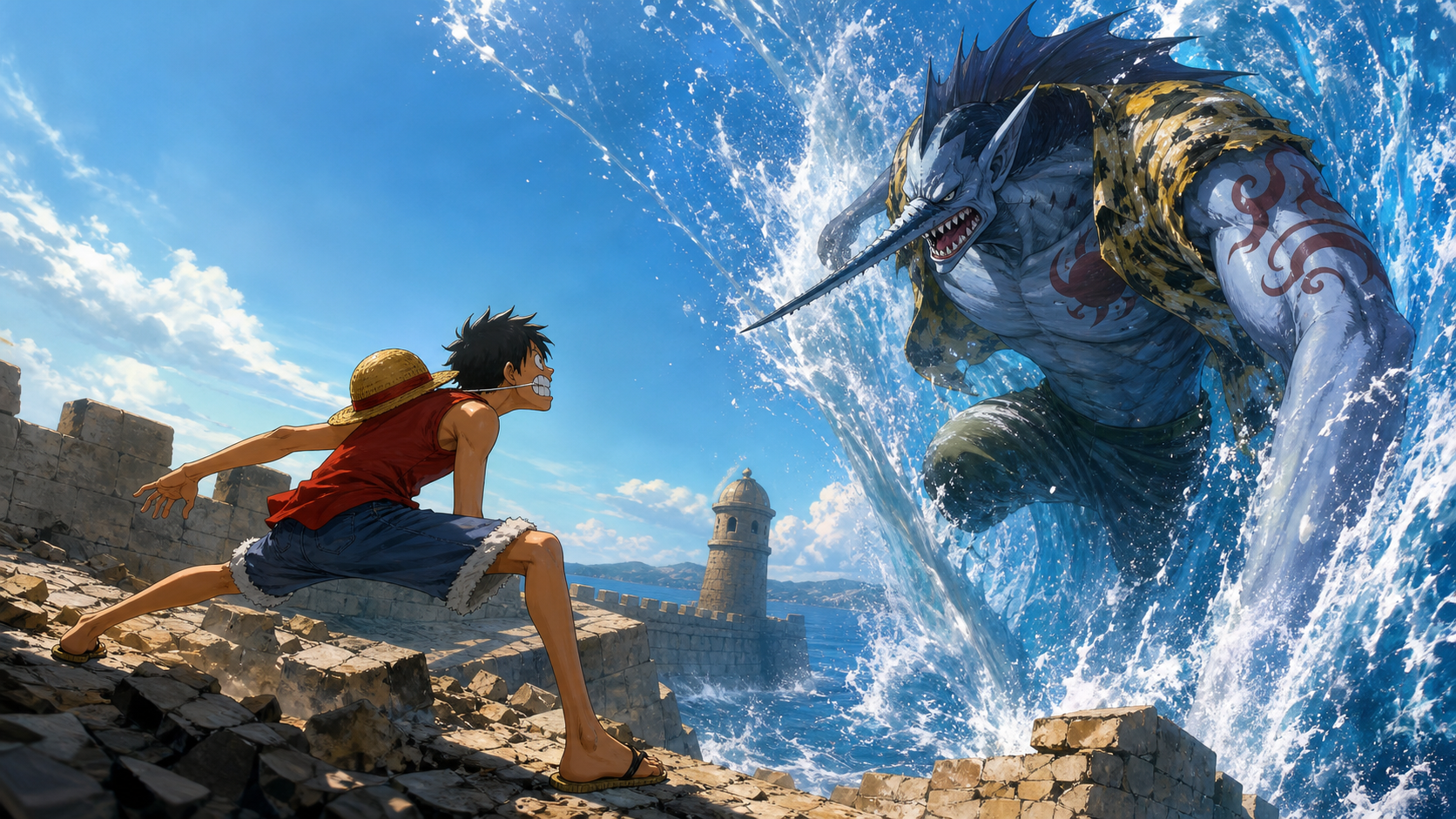
Shark On Darts converts speed into a projectile
Arlong launches himself from the sea nose-first, using his sawlike profile and acceleration as a piercing weapon. The technique makes his entire body the projectile and collapses the distinction between opponent and attack.
The straight-line force is frightening, but the line creates commitment. Once Arlong reaches full speed, changing direction becomes more difficult. That constraint may offer Luffy his best opening.
Committed attacks create predictable lanes. The crew can observe where Arlong enters the water, where spray rises, and which surfaces he uses as targets. Mapping those lanes helps Luffy move laterally instead of trying to absorb the charge.
Calling directions from a safe perimeter would convert several viewpoints into early warning. Distributed observation can compensate for one fighter’s blind angle.
The fortress becomes part of the weapon
Stone walls splinter when Arlong misses or passes through them. The destruction proves the charge’s force while also changing footing, sightlines, and structural stability. Every failed strike can still endanger people nearby.
The crew should move casualties away from load-bearing walls and avoid clustering beneath damaged masonry. A duel inside a collapsing structure is also an evacuation problem.
Luffy cannot win by standing still. Meeting the charge directly would let Arlong choose the timing, angle, and momentum. Luffy’s elasticity may absorb some impacts, but the saw nose and water hazard make passive durability a poor plan.
Mobility, misdirection, and using Arlong’s commitment against him are safer than proving who can tolerate more damage.
Full power should include restraint. The title presents Luffy as restored, yet restoration does not require reckless escalation. He can fight at full capacity while choosing when not to attack, where to stand, and what parts of the compound must remain intact.
Restraint is not softness. Restraint is control over force in service of a defined outcome.
Nami reads Arlong differently now
For years, she studied his moods to prevent retaliation and keep her plan alive. In this fight, the same knowledge can support resistance. She may recognize patterns in his anger, preferred attacks, or the way he uses the building.
The crew should invite that information without requiring Nami to direct every dangerous second. Expertise gained under coercion remains hers to share or withhold.
Knowledge should not become another burden. Nami’s familiarity with Arlong makes her valuable, but familiarity does not make her responsible for every consequence. The fighters chose to intervene, and they must own their decisions.
She can warn, advise, protect records, assist villagers, or step back. Liberation includes freedom from being the only person expected to anticipate the abuser.
Zoro needs care, not another endurance test
Arlong has already exposed the severity of Zoro’s wound. With Luffy active, there is no tactical reason to keep using Zoro as the primary barrier. His next contribution should be surviving long enough to recover.
Someone needs to control bleeding, protect the wound, check consciousness, and prevent him from interpreting continued standing as a requirement for belonging.
Sanji’s underwater effort has a cost
Sanji broke the stone and helped restore Luffy, but diving under combat conditions consumes oxygen and energy. The crew should not immediately assign him another water rescue without assessing his condition.
Backup plans matter because the person who solved the last emergency may not be ready to repeat the effort.
Usopp’s return changes the support picture
Usopp has proven he can survive fear, improvise, and finish a difficult fight. His distance skills and attention to angles could support warning, distraction, or perimeter defense without placing him directly in Arlong’s charge lane.
That role is not lesser than close combat. A precise intervention at the correct second may do more than another body near the impact zone.
Nojiko and Genzo remain essential. They know the village, the residents, and the practical consequences of Arlong’s retaliation. Their work should shift from emergency airway support toward triage, evacuation, and communication.
Local leadership prevents the pirates’ duel from eclipsing the community the battle is meant to protect.
The maps still sit inside the compound
Arlong’s destruction and Luffy’s counterattacks threaten years of Nami’s coerced cartography. Those maps are evidence of exploitation, records of skill, and potentially valuable navigation work. Their fate should not be accidental.
If access is possible, Nami should identify priorities while another person documents or moves the maps. If entry is not safe, human life comes first, but the loss should be named rather than treated as meaningless debris.
Evidence extends beyond the maps. Ledgers, tribute records, Marine contacts, weapons, and witness accounts could establish the structure of Arlong’s control. Nezumi’s corruption makes preservation especially important.
Stopping Arlong is urgent; proving what happened will shape what comes after. Accountability needs more than the memory of a victorious fight.
Arlong’s repeated attacks expose his priorities. He spends extraordinary force trying to reassert dominance over Luffy. Every charge narrows his attention and may leave residents, records, or escape routes less guarded.
The crew can use that fixation to accomplish parallel objectives. Winning does not require everyone to stare at the duel.
The special-length broadcast changes the rhythm. This episode formed the first half of a one-hour special in its original Japanese broadcast. The pacing therefore builds sustained pressure rather than resolving every beat within a usual endpoint.
That context helps explain why the duel expands through repeated experiments and environmental shifts. The episode is constructing momentum for a larger confrontation, not merely delaying an answer.
Michiru Shimada keeps the battle character-driven. Shimada’s script uses teeth, imitation, and tactical escalation to reveal how each fighter thinks. Arlong weaponizes anatomy as ideology. Luffy responds with curiosity, humor, and refusal to accept the hierarchy attached to Arlong’s claims.
The exchange stays specific to these characters even while the scale of destruction grows.
Hidehiko Kadota emphasizes approach and impact. Kadota’s direction gives the sea enough visual space to become an active threat. Arlong disappears into the water, acceleration builds offscreen, and spray announces the attack before the body returns.
The staging lets anticipation carry as much tension as collision. Viewers learn to scan the water with Luffy.
Masayuki Takagi makes speed readable. The animation direction separates Arlong’s explosive lines from Luffy’s elastic reactions. Their powers do not blur into generic motion. One body commits like a spear while the other survives through flexibility and timing.
Clear silhouettes are especially important when water, rubble, and rapid cuts crowd the frame.
Tomoko Yoshida preserves spatial logic. The art grounds the fantasy in a fortress with identifiable walls, water access, and changing damage. Viewers can understand why the sea favors Arlong and why each broken surface alters the next exchange.
That continuity keeps the environment from becoming decorative scenery.
RaeRae’s real-time reaction
Luffy putting Arlong’s teeth in his own mouth is exactly the kind of terrible experiment only he would try during a lethal fight. I laughed, then immediately wanted someone to remind him that learning does not require sampling every hazard personally.
Arlong bursting out of the water lands because Episode 41 made drowning feel real. The sea is no longer pretty background. The water is the route the opponent uses to attack Luffy’s most dangerous limit.
The moment that changes the fight
Arlong’s Shark On Darts attack reveals both his greatest environmental advantage and a new constraint. He can generate devastating speed, but the technique commits him to a path.
Luffy now has something more useful than a broken tooth: a repeatable pattern. If he reads the lane instead of chasing the spectacle, Arlong’s force can become exploitable.
What the crew should communicate. Call the water entry point, expected line, damaged walls, and any civilians near the projected impact. Keep instructions short enough to be heard over the surf and collapsing stone.
Confirm who owns extraction if Luffy enters the water again. Confirm who is caring for Zoro, who is watching Sanji, and who is moving villagers. An emergency plan fails when everyone assumes someone else accepted the role.
What Luffy should change next. Stop testing the teeth and focus on the movement system behind them. Hold stable ground away from the edge, evade across the charge rather than backward toward water, and let Arlong spend momentum against empty space or durable structure.
Use elasticity to redirect only when the angle is understood. A poorly timed grab could pull Luffy into the sea or bring the saw nose closer to residents.
What victory must protect. The immediate goal is ending Arlong’s capacity to command violence. The larger goal includes keeping villagers alive, preserving Nami’s choices, securing evidence, recovering resources where possible, and preventing corrupt officials from rewriting the outcome.
A spectacular finishing blow cannot substitute for those results. The attack should serve them.
Bottom line
Episode 42 turns Arlong’s body and the surrounding sea into one integrated weapon. Replaceable teeth frustrate simple damage, handheld jaws extend his reach, and Shark On Darts converts the water into a launch system. Luffy’s curiosity gives the fight personality, but the useful discovery is the committed line behind Arlong’s speed.
RaeRae rating: 9.4/10. The duel gets bigger without losing the rescue work that made the return possible. Luffy is back at full power because a whole network protected him, and his next responsibility is using that power without recreating the crisis they just survived.