
RaeRae Reacts · One Piece Episode 41
Nami’s Resolve and the Straw Hat
Nami’s rejection of Arlong joins the coordinated rescue that frees Luffy and turns entrusted care into shared action
Episode information
Japanese title: Luffy Zenkai! Nami no Ketsui to Mugiwara Boushi
English title: Luffy at Full Power! Nami’s Resolve and the Straw Hat
Japanese broadcast: September 13, 2000
Saga: East Blue
Script: Michiru Shimada
Episode direction: Munehisa Sakai
Animation direction: Eisaku Inoue
Art: Kunihiro Chida
Nami returns to Arlong Park as a decision maker
Episode 41 brings Nami back into the battle space after her private plan and savings have been destroyed. Arlong tells her to return to his side as though eight years of coerced labor remain a role he can reactivate.
Her presence is not passive witness. She must decide what relationship, risk, and future she will claim.
Arlong frames captivity as a choice
He presents return as one available option beside continued resistance. The language ignores the tribute, threats, murder, fraud, and collusion that shaped every earlier decision.
A coerced system often calls compliance voluntary once the immediate weapon is not visible in the sentence.
Nami rejects the false choice
She refuses to resume the officer role and commits to fighting with the village through the end. The decision is not simply switching allegiance from Arlong to Luffy.
She chooses a collective future in which her community and crew share risk she had been forced to carry alone.
Trust is being rebuilt through evidence
Luffy listened when Nami asked for help. Usopp understood her staged rescue. Zoro recognized care beneath performance. Sanji joined an emergency he did not cause. Genzo and Nojiko kept Luffy breathing.
Trust becomes credible because people act, adapt, and remain when the first plan fails.
Nami includes villagers’ lives in her decision. She does not treat resistance as a private duel over personal betrayal. Arlong’s system has governed households, money, movement, and fear across Cocoyashi.
The mission must therefore protect the community, not only settle Nami’s account with one pirate.
Collective risk requires community consent. Nami can speak for her own choice and from deep knowledge of the village. Individual residents still have different capacities, injuries, dependents, and tolerance for danger.
No one should be required to enter combat to prove support for liberation.
The straw hat remains with Nami
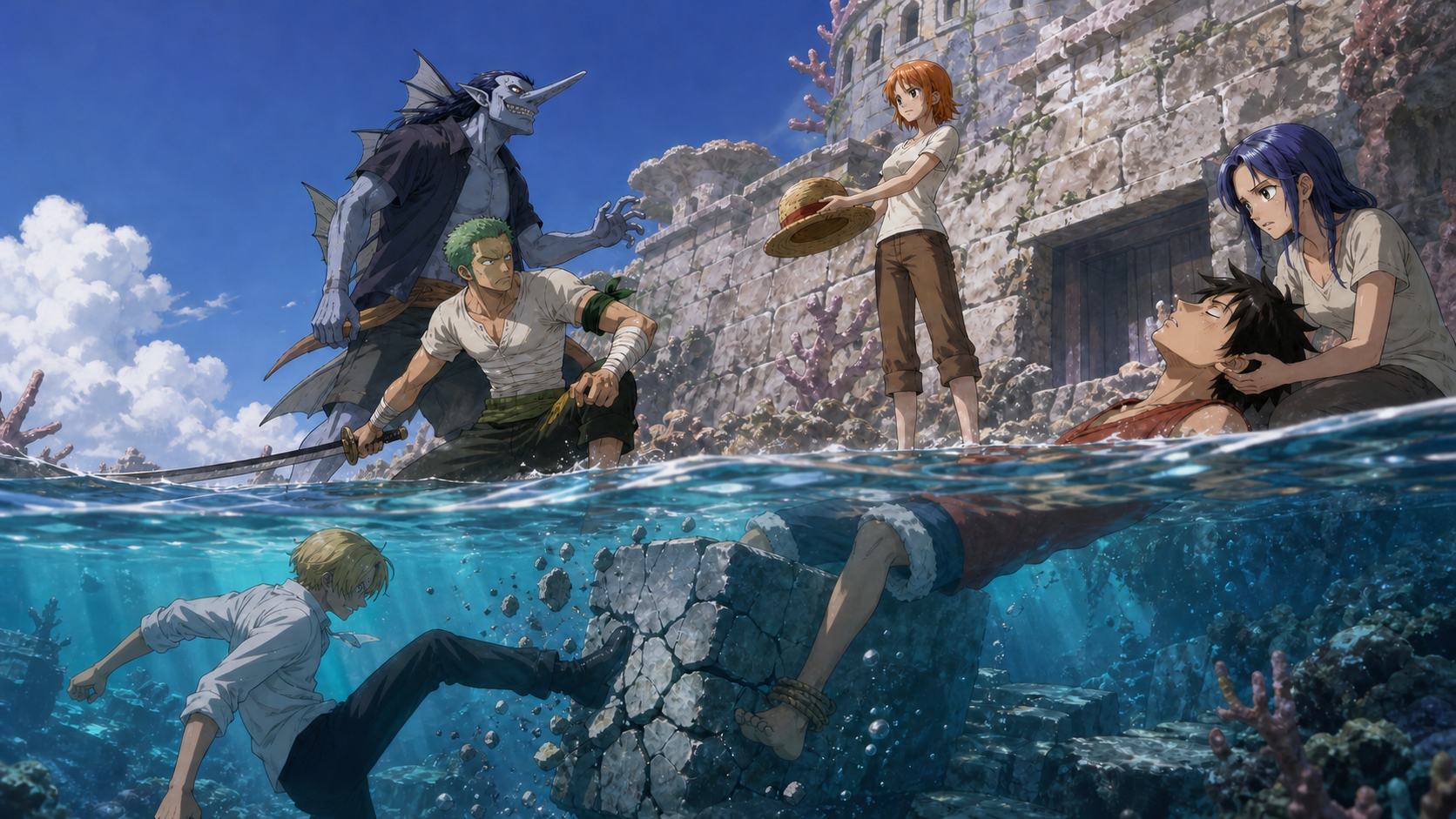
Luffy entrusted his hat to her before the march on Arlong Park. She holds an object tied to his identity and promise while he remains physically unavailable.
The hat is not a trophy that transfers ownership of Nami’s struggle to him. The gesture is care placed temporarily in her custody.
Custody is different from possession. Nami protects the hat because Luffy values the object and because the gesture represented his answer to her request. She is responsible for the hat without being defined by the object.
Healthy trust can place something precious in another person’s hands without using that gift to demand obedience.
The hat carries continuity while Luffy is submerged. His body is trapped, but the promise to help remains visible above water. Nami can see that the crew’s action does not depend entirely on hearing the captain speak every second.
Symbols are useful when they connect people to shared commitments rather than replace practical work.
Luffy begins breathing again
Genzo and Nojiko’s airway strategy works long enough for signs of life to return. The moment validates stabilization as active rescue.
Revival does not mean full recovery. Exposure, exhaustion, and the stone remain serious concerns.
The rescue chain has multiple authors
Nojiko and Genzo adapt the airway, Sanji returns to the water, others protect the perimeter, and Luffy’s own physiology makes the method possible.
Calling the outcome only Luffy’s resilience would erase coordinated care.
Zoro delays Arlong
With the captain not yet free, Zoro places himself between Arlong and the rescue. His task is not necessarily to win the central fight.
Buying time is a complete tactical contribution when another process will change the battlefield.
Arlong tears away the bandages
The action exposes the severity of Zoro’s Mihawk injury to people who may not have understood what he was carrying. The wound becomes tactical information for the opponent.
Concealed vulnerability can protect morale temporarily while preventing teammates from planning around real limits.
Zoro’s endurance shocks Arlong. Standing with that injury demonstrates extraordinary commitment. The sight also shows how close the crew came to depending on a person whose body could fail without warning.
Awe should lead to medical urgency, not a new expectation that Zoro always override injury.
Delay needs an exit condition. Zoro should know what signal means Luffy is free and when he can disengage. Otherwise “buy time” can become fighting until collapse with no connection to the rescue timeline.
Communication turns endurance into strategy.
Sanji returns underwater with a precise objective
After defeating Kuroobi on land, he dives to break the stone rather than seeking another opponent. The shift shows mission awareness.
His role is defined by what the team needs, not by maintaining the identity of combat victor.
A kick succeeds where hammers failed
Sanji can use angle, body alignment, and concentrated force differently from unanchored rescuers. The success does not make Genzo and Nojiko’s attempt foolish.
Their failure identified the need, and their airway support created the time for Sanji to arrive.
Different tools solve different parts of the problem. Hammers were suited to stone but poorly supported underwater. Luffy’s neck addressed breathing but not entrapment. Sanji’s kick breaks the block but does not provide medical monitoring.
The rescue succeeds because partial methods are sequenced rather than judged against one imaginary complete solution.
The stone finally releases Luffy
Freedom from the block restores movement and removes the environmental trap Arlong exploited. Release does not erase fatigue or guarantee immediate combat readiness.
Extraction should be followed by assessment, even when urgency pressures the captain to rise.
Luffy returns to his normal form. His stretched neck and weakened state resolve as he regains control. The visual return signals that the crew’s rescue has restored agency.
Recovery is a process, not merely appearance. A familiar silhouette can hide lingering effects.
Nami’s trust becomes reciprocal
She trusted Luffy enough to ask for help and protect the hat. The crew trusted her through apparent betrayal and now relies on her knowledge of Arlong and the village.
Reciprocity means no one relationship is reduced to rescuer and rescued forever.
Luffy can fight because others governed the emergency
The captain’s return is made possible by people who made decisions without him. Distributed leadership preserved the mission.
A strong captain should value that autonomy rather than interpret independent action as a challenge to authority.
The rescue network also shows why emergency roles cannot depend on status alone. Genzo and Nojiko maintain breathing, Sanji changes the underwater obstacle, Zoro buys time, Nami interprets the political stakes, and the remaining crew members protect the broader battlefield. No single contribution replaces another. A post-crisis review should name every role, identify where communication failed, and preserve the methods that worked. Recognition matters because future teams repeat what leadership notices, funds, and teaches.
The next attack should not repeat the first. Luffy knows Arlong observes constraints and uses water strategically. Charging without a recovery plan could recreate the crisis.
Full power should include learning from the error, not only restored physical force.
Arlong still controls the structure. Officers may be falling, but the compound contains maps, records, weapons, and evidence of Nami’s coerced labor. Destroying the compound indiscriminately could erase proof and property she values.
Force should distinguish the leader’s capacity from the resources residents need recovered.
Nami’s maps require specific protection. Her childhood dream has been converted into compelled production. The crew should locate originals and copies before battle damage spreads.
Nami must decide what to preserve, reclaim, share, or destroy. Liberation includes authorship and information governance.
The village needs security during the final clash. Arlong may target residents or infrastructure when control weakens. Noncombatants need protected locations, communication, and evacuation routes.
Victory at the fortress should not be purchased through preventable retaliation elsewhere.
Nezumi remains outside the immediate duel. The corrupt Marine link means Arlong’s defeat will not automatically end every threat or restore the seized treasure. Evidence and witnesses must survive.
The crew and village should plan for accountability beyond the compound.
Production links the hat to rescue work. Kunihiro Chida’s art direction keeps Nami and the hat above the waterline while Sanji, stone, and Luffy occupy the submerged field. Symbol and labor appear together.
Munehisa Sakai’s direction moves from Nami’s decision to Luffy’s breathing and freedom, while Eisaku Inoue’s animation direction makes Zoro’s delay and Sanji’s kick parts of one timed chain.
RaeRae’s real-time reaction
Nami holding the hat while telling Arlong no works because she is not borrowing Luffy’s identity. She is holding proof that someone trusted her before demanding every explanation.
Sanji breaking the stone is satisfying, but Genzo and Nojiko are why he has time to complete the rescue. The episode remembers that keeping someone alive is not a lesser contribution.
The moment that lands
Luffy opens his eyes while Nami keeps the hat safe. Their trust exists across distance, water, and incomplete information.
The scene turns the hat into a temporary promise of return rather than a claim over her future.
What should happen before Luffy reengages. Confirm that he is breathing independently, alert, coordinated, and capable of standing without immediate collapse. Report the submersion timeline and rescue interventions.
Tell him the status of Zoro, Sanji, Usopp, Nami, Nojiko, Genzo, officers, and villagers. Returning without situational awareness would waste the work that preserved mission continuity.
Agree on water safeguards and an extraction route. Someone should retain rescue readiness if Arlong tries the same environmental tactic again.
Clarify the objective: stop Arlong, protect residents, recover Nami’s work and community resources, preserve evidence, and avoid treating destruction as the only measure of victory.
What Nami’s decision changes. The crew no longer needs to guess whether intervention contradicts her plan. She has rejected return and chosen shared resistance.
That decision does not grant unlimited authority over the village or her future. The decision creates permission for specific help inside a collective objective.
After the battle, she may feel relief, grief, anger, exhaustion, or uncertainty rather than immediate happiness. Support should remain available without prescribing the emotional result of liberation.
Resolve does not cancel the cost of the decision. Nami’s refusal is decisive, but the episode does not need to pretend that saying no makes the danger disappear. Arlong still has physical power, control of the compound, and years of experience punishing resistance. Her choice matters precisely because she understands those conditions and acts without a guarantee that the crew will win.
That distinction protects the scene from becoming a simple lesson about confidence. Nami was never trapped because she lacked determination. She was trapped because Arlong built a violent system around the people she loved and repeatedly demonstrated that he would use them as leverage. The answer is not asking her to become braver in isolation. The answer is dismantling the conditions that made individual bravery insufficient.
The crew answers coercion with coordinated capacity. Each contribution removes one limit Arlong expected to control. Nojiko and Genzo prevent drowning from ending the fight. Sanji removes the stone. Zoro occupies Arlong’s attention. Nami rejects the officer role that gave the arrangement a false appearance of consent. Luffy’s return becomes the final result of that coordination, not a miracle detached from everyone else’s labor.
This is why the sequence works as more than a countdown to the captain’s next attack. The crew is learning how to function as a system. They can preserve a goal while changing roles, respond to information they did not have at the start, and recognize that rescue, delay, care, and combat all belong to the same mission.
The hat needs a return ritual, not a ownership story. When Luffy is ready, Nami can return the hat directly. The gesture should affirm that she protected something precious while he and the crew protected the possibility of her choosing freely.
Neither person owes lifelong obedience because of the exchange. Trust is renewed through future conduct, not frozen into debt.
Bottom line
Episode 41 joins Nami’s decision above water to the rescue chain below the surface. She rejects Arlong’s false offer, protects Luffy’s hat, and trusts a network in which Zoro delays, Sanji breaks the stone, and local caregivers keep the captain breathing.
RaeRae rating: 9.7/10. Luffy’s return belongs to everyone who revised the plan when strength alone failed. Nami’s resolve matters because shared action now expands her own future choices instead of replacing one controller with another. The whole village can choose again.