
Twilight
Karin turns tracking evidence into a diversion while Sasuke leaves his team behind for the final road to Itachi.
What happens
Sasuke recovers enough to resume the route toward Itachi. Hebi shelters briefly at an inn, but Karin detects the approaching Leaf search teams before they can close in.
The group leaves quickly. Sasuke's priority is no longer gathering information with everyone beside him; it is reaching the confrontation he has organized his life around. Karin proposes a diversion that will keep Konoha occupied while he moves ahead.
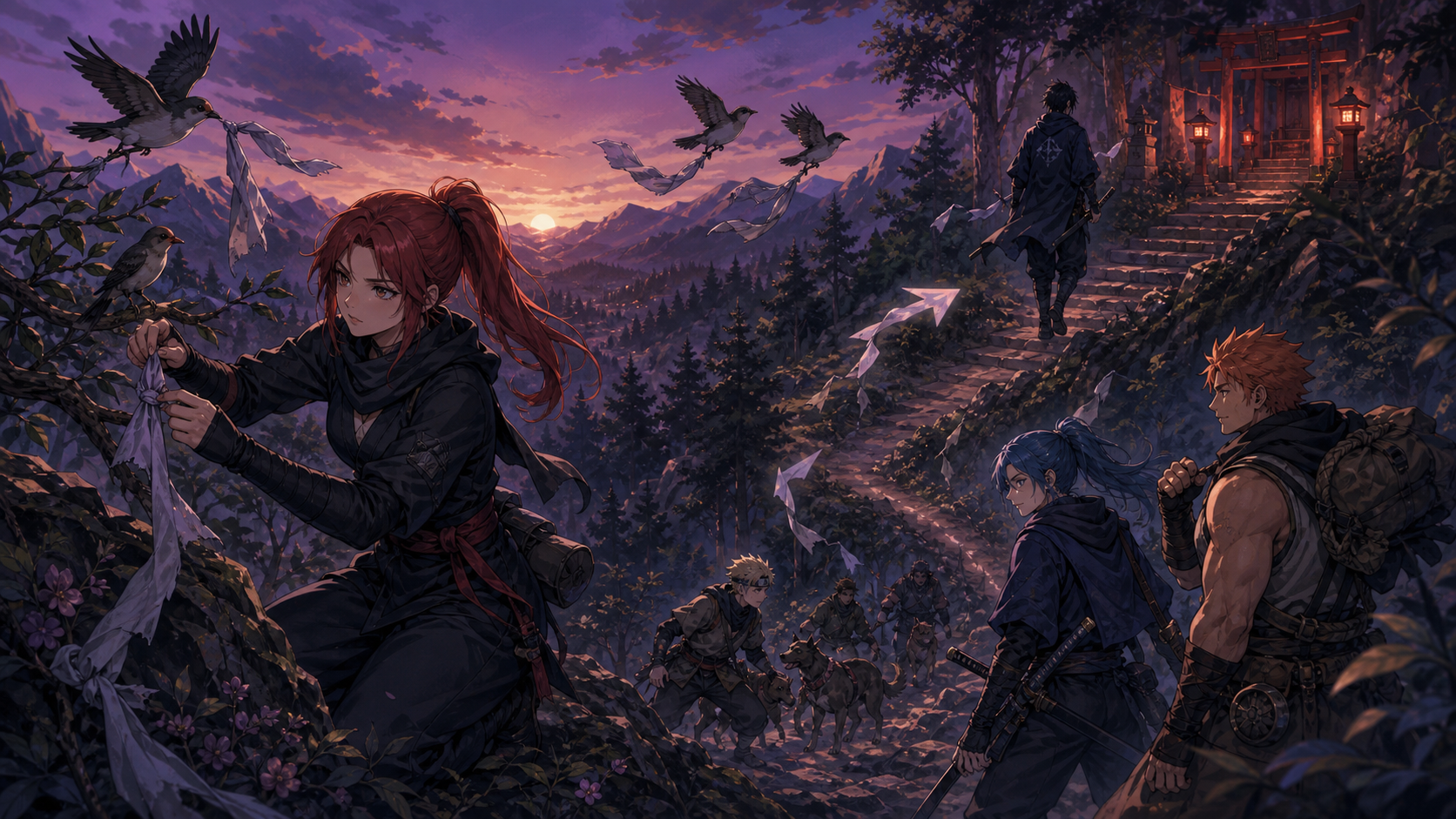
She distributes pieces of Sasuke's clothing along multiple routes, using birds and separate trails to scatter his scent. Kiba and the ninja hounds receive too many plausible directions, forcing the Leaf teams to divide attention and lose time.
Sasuke continues alone toward Itachi. Suigetsu, Karin, and Jugo support that separation even though it temporarily dissolves the team structure that saved him after Deidara's explosion.
Karin designs the battlefield without fighting
Karin's plan is one of the clearest demonstrations of her value to Hebi. She understands sensory information from both sides: how Konoha trackers will read scent and how a deliberately contaminated trail can turn their strength into delay.
The trick is simple because it uses the search team's confidence against them. A tracker expects scent to answer where someone went. Karin changes the question by creating several true traces attached to false movement.
That is intelligence work, not a romantic gesture dressed as one. She assesses the pursuers, finds the resource available, and changes the search environment before contact occurs.
I wish the story consistently treated her with the respect this competence deserves. Karin can be funny and emotionally attached to Sasuke without those traits erasing her tactical intelligence.
A team built to let one person leave
Hebi was assembled to help Sasuke reach Itachi, so the group's success ultimately creates its own separation. Suigetsu, Karin, and Jugo perform their roles well enough that Sasuke can walk the last stretch alone.
There is something sad about that design. They rescued him from the crater, but the rescue does not make him more willing to share the burden. It restores his ability to continue carrying it by himself.
Sasuke's solitude is partly strategic. Itachi is his history, and additional fighters could complicate the confrontation. It is also emotional control. If nobody stands beside him, nobody can interrupt the meaning he has assigned to the encounter.
The others accept the plan for different reasons. Karin wants to protect his goal, Jugo chose him as a stabilizing presence, and Suigetsu has his own ambitions tied to the journey. Their consent is real, but the balance remains centered on Sasuke.
Naruto follows a manufactured ghost
Konoha has better numbers, experienced trackers, and a clear mission. Karin still stalls them because the hunt depends on reading evidence Sasuke's side can manipulate.
For Naruto, the false trails repeat an emotional pattern. Sasuke seems close, then becomes several possibilities at once. Every route offers hope, and choosing one means accepting that the others may be lost time.
Naruto's determination is genuine, but determination does not automatically produce understanding. He is chasing the friend he remembers while Sasuke is arranging the world so that nobody can interfere with the person he has decided to become.
The decoys make that conflict physical. Naruto is not only behind Sasuke in distance. He is following a version of Sasuke deliberately left for him to find.
Twilight is a threshold
The title fits the episode's position between major confrontations. Deidara's blast is behind them. The battle with Itachi is ahead. Daylight fades while every character chooses a direction.
Twilight also matches the uncertainty around allegiance and identity. Hebi looks like a team but exists to enable an individual mission. Konoha calls its pursuit a rescue while the person being rescued actively avoids it. Sasuke seeks truth through a confrontation built on years of incomplete information.
Nothing is fully dark yet, but clarity is disappearing. The routes through the forest multiply as the emotional path narrows.
This quieter episode earns its place by showing that strategy between battles matters. A strip of cloth and a bird can shape the next encounter as much as a spectacular jutsu.
RaeRae reaction
I enjoy seeing Karin solve a problem that brute strength would make worse. Fighting Konoha would expose Hebi, drain resources, and delay Sasuke. Her diversion buys time without creating a battlefield full of casualties.
The plan also reveals a boundary in Sasuke's leadership. He trusts his teammates to protect the mission, but not to accompany him into its emotional center. Their loyalty gives him the privacy to keep avoiding vulnerability.
Naruto's side remains sympathetic because they are trying to prevent a tragedy, yet the episode does not pretend their numbers guarantee access. Tracking someone who does not want to be found is an argument conducted through traces.
“Twilight” lowers the volume after Deidara and lets anticipation do the work. By the end, Sasuke is moving toward Itachi alone, the Leaf teams are following manufactured ghosts, and the last light feels like a warning.
Karin turns evidence into misdirection
My bottom line is that Episode 126 gives Karin one of the smartest quiet victories in the pursuit. Konoha’s trackers are good at reading scent, so she does not try to erase Sasuke completely. She gives them too much accurate evidence attached to false movement.
Each strip of clothing genuinely carries his scent. The lie exists in the relationship between trace and destination. Karin understands that information can be true at the smallest level and still build a false conclusion.
The diversion respects Kiba by planning around his skill
A weak story would make Kiba suddenly unable to follow a trail. Karin’s plan works because she assumes he and the hounds will detect every piece correctly. Their competence becomes the mechanism of delay.
That is what good tactical writing does. One character does not become foolish so another can look clever. Two real abilities meet, and the person who shapes the conditions gains time.
Scent becomes a contested language
Kiba reads scent as a record of movement. Karin uses scent as something that can be copied, transported, and arranged. Both understand the same medium from opposite sides of the chase.
The forest is therefore not neutral terrain. Branches, birds, wind, fabric, and distance become parts of an argument about where Sasuke is. Nobody needs a giant jutsu for the environment to become strategic.
Karin’s intelligence should not be swallowed by romance
She cares about Sasuke and wants his attention. She is also a sensor with operational judgment, experience managing a hideout, and the nerve to design a response while Konoha closes in. Those facts belong together.
Reducing her plan to devotion would repeat the very problem the series creates around women near Sasuke. Feeling does not cancel expertise. Here feeling helps Karin recognize urgency, and expertise turns urgency into action.
Hebi saves Sasuke so he can leave them again
The group recovered him from Deidara’s crater through coordinated work. Once he can move, the mission returns to its original hierarchy. Their job is to secure his path toward a confrontation he intends to face alone.
There is sadness in that structure. Loyalty restores Sasuke’s independence, but he interprets independence as separation rather than a chance to share the burden differently.
Sasuke treats solitude as control
Itachi belongs to the most private and manipulated part of his history. Bringing teammates into the room might add variables he cannot predict. Going alone lets Sasuke preserve the meaning he assigned to revenge.
Solitude feels like agency after Orochimaru tried to own his body. It can also keep Itachi’s framework intact. Nobody beside Sasuke can question an assumption or witness what the brothers tell each other.
The team consents to a mission without owning its purpose
Suigetsu wants swords and opportunity. Karin wants proximity and recognition. Jugo wants connection to Kimimaro and help managing his transformations. They support the Itachi search, but revenge is not equally theirs.
A functioning team needs room for those separate motives. Sasuke’s leadership remains stable only while everyone believes the road still leaves space for a personal destination.
Jugo and Suigetsu accept separation for different reasons
Jugo trusts Sasuke as an anchor and may read the solo confrontation as something deeply necessary. Suigetsu is more willing to let another person take an unreasonable risk if it keeps his own route open.
Neither response proves indifference. Their temperaments shape how concern appears. A team does not need matching emotional performances to contain real attachment.
Naruto follows the version Sasuke left behind
The decoy trails are physical pieces of Sasuke detached from his living choices. Naruto and the trackers receive scent without intention, evidence without access. That is painfully close to Naruto’s larger pursuit.
He keeps chasing the teammate he remembers while the present Sasuke deliberately constructs distance. Memory is true. It is not the whole person moving through the forest now.
More trackers create more possibilities, not certainty
Konoha can divide teams across several routes, but every split costs concentration and time. Karin makes their numerical advantage expensive by multiplying plausible answers.
Resources do not remove uncertainty. They change how much uncertainty an organization can investigate at once. A small team can still win minutes by forcing a large one to verify everything.
The pursuit raises a consent problem Naruto has not solved
Naruto refuses to abandon Sasuke, and that loyalty is one of his best qualities. Sasuke is also actively avoiding contact. Care has to hold both truths without pretending persistence automatically becomes permission.
Naruto needs a plan for the conversation after arrival. Bringing Sasuke home cannot mean restoring village ownership while leaving the reasons for departure unnamed.
Konoha calls the mission rescue from inside its own story
The searchers know Orochimaru exploited Sasuke and Akatsuki threatens him. Their concern is justified. They do not know everything the village concealed around the Uchiha massacre.
That missing knowledge shapes the moral frame. An institution can sincerely believe it is rescuing somebody while refusing to examine why its version of home feels unsafe.
Twilight makes certainty visually disappear
The episode lives between Deidara’s explosive daylight and the darkness surrounding Itachi. Routes become harder to read as the sky changes. The visual threshold matches a story where every category is unstable.
Hebi is a team and a temporary arrangement. Konoha is caring and controlling. Sasuke is exercising agency inside a plan another person built. Twilight lets contradictory shapes remain visible at once.
Birds become unwilling participants in shinobi conflict
Karin uses moving animals to distribute scent beyond a simple branch trail. The maneuver is elegant, but it also reminds us how ninja strategy recruits the ordinary world. Creatures become carriers without understanding the pursuit.
The choice is far less violent than direct combat, yet it belongs to the same habit of treating surrounding life as available material. Strategy always has a footprint.
A strip of cloth can matter more than another explosion
Episode 124 changed a landscape. Episode 126 changes decisions with small pieces of fabric. The contrast is useful. Power is not measured only by damage.
Karin buys the resource Sasuke needs most: uncontested time. A nonlethal diversion can shape the future more effectively than defeating another searcher.
Sasuke’s privacy protects him and isolates him
Facing Itachi alone prevents teammates from being used as leverage and keeps the confrontation focused. It also ensures Sasuke has no witness outside the Uchiha story.
Privacy can be necessary without being harmless. The question is whether Sasuke chose solitude freely or learned to need it because every powerful adult made vulnerability dangerous.
The episode is a hinge, not empty travel
Quiet transition episodes are sometimes treated as disposable because nobody completes a giant attack. Here movement, separation, and misinformation determine who will reach the next conflict and in what condition.
The story earns anticipation by showing the work that produces it. Itachi does not simply appear in front of Sasuke. Several people create the space where that meeting can happen.
Karin’s plan also exposes how much tracking depends on an assumption of honest residue. Scent is usually left accidentally by a moving body. The searcher trusts that relationship because people cannot easily separate themselves from every trace. Karin does not erase the evidence. She edits its context. That is what makes the diversion feel less like magic and more like counterintelligence.
The birds add motion to the lie. A strip tied to a branch might create one false stopping point. A strip carried through the air creates a trail that continues changing after Hebi leaves. Karin recruits time itself, allowing the decoys to produce new locations while Sasuke gains distance on the real route.
I want the episode to give her full credit without turning competence into another reason she exists for Sasuke. Karin designed the solution. She should own that achievement as a shinobi, not merely as proof that she will do anything for a man. Devotion may motivate the choice, but knowledge makes it work.
There is a parallel between Karin distributing Sasuke’s scent and Itachi distributing pieces of truth. Both create several plausible routes around the same person. A seeker can follow accurate fragments and still arrive at a conclusion somebody else prepared. Sasuke recognizes manipulation on a battlefield more easily than he recognizes the story shaping his revenge.
Naruto has the same vulnerability from another direction. Every trace of Sasuke confirms the bond remains worth pursuing. He rarely asks whether the meaning he gives the trace matches Sasuke’s present intention. Hope can become its own interpretive filter, selecting the evidence that keeps a promise alive.
This does not mean Naruto should stop caring. It means caring has to grow beyond recovery as a physical operation. If he finds Sasuke, he must be ready to listen to anger that cannot be defeated, fix a village failure he did not personally create, and accept that friendship does not grant command over another person’s future.
Sasuke faces a related test with Hebi. He offered each member freedom from a place where someone else controlled them. Then he organized that freedom around his destination. The team agreed, but agreement made under incomplete information needs room to be renewed. They deserve to know when the mission changes from search to likely death.
I keep thinking about the inn as a brief image of an ordinary life the group cannot inhabit. They rest under a roof, notice pursuit, and leave before safety becomes real. Hebi can resemble travelers for a moment, but every relationship remains tied to motion. Nobody knows what the team will be after Itachi.
That missing future is part of the twilight. Sasuke has a precise answer for the next destination and almost none for the morning after revenge. Karin, Suigetsu, and Jugo have attached personal hopes to a leader whose plan ends at a confrontation. A mission without an aftermath can consume people who assumed there would be another road.
Konoha’s teams have an institutional future waiting for them. They can return, report, receive another assignment, and remain part of a village structure. That stability gives their pursuit resources Hebi lacks. It also makes them less likely to question the village’s claim over Sasuke. Institutions make their own continuation feel natural.
The decoy operation briefly reverses that advantage. A small group understands its pursuers well enough to make bureaucracy expensive. Each Leaf team must verify a trail, communicate findings, and redirect. Karin cannot defeat Konoha’s network, but she can make the network spend time obeying its own standards.
That restraint deserves praise. Hebi could ambush trackers or leave traps designed to wound them. Karin chooses misdirection. The plan protects Sasuke without requiring bodies. In a story where power often proves itself through damage, buying time without bloodshed is a meaningful tactical success.
The episode leaves me with one sharp contradiction. Sasuke depends on a team while designing the most important part of his mission as proof that he needs nobody. Karin’s diversion, Suigetsu’s adaptability, and Jugo’s steadiness create the solitude he interprets as self-sufficiency. Independence is being produced collectively.
That does not make his choice fraudulent. It makes the debt visible. Sasuke can face Itachi alone only because three people protect the route behind him. If the confrontation is truly about reclaiming agency, then recognizing their agency should be part of what comes next.
Twilight holds that recognition just outside the frame. Hebi watches Sasuke go. Konoha chases the traces Karin arranged. Nobody stops long enough to ask what the team has become. The sky darkens, movement continues, and relationships do their most important work without receiving a name. That silence will matter after the trail reaches its destination.
RaeRae’s final word on twilight
I love that Karin wins this round by understanding the trackers rather than overpowering them. She respects Kiba’s nose enough to build several true scents and lets Konoha’s own verification process create the delay.
I am less comfortable with how quickly Sasuke returns to solitude after Hebi saved him. His teammates prove they can act without him, combine skills, and carry real concern. He takes that loyalty as support for another private risk.
Naruto is following pieces of a person who does not want the meeting yet. His love matters, but love needs an answer for consent, truth, and the village failures waiting behind the word home.
Twilight is the correct title because clarity is fading while everybody insists on a direction. Karin scatters evidence. Konoha scatters teams. Sasuke narrows his world to one brother. The last light does not stop the pursuit. It reveals how much each person is willing to leave unseen.
RaeRae’s call
Karin defeats superior tracking with too much truthful scent, proving intelligence can redirect a battlefield without violence. Sasuke uses the time to leave the team that just saved him.