
RaeRae Reacts · One Piece Episode 38
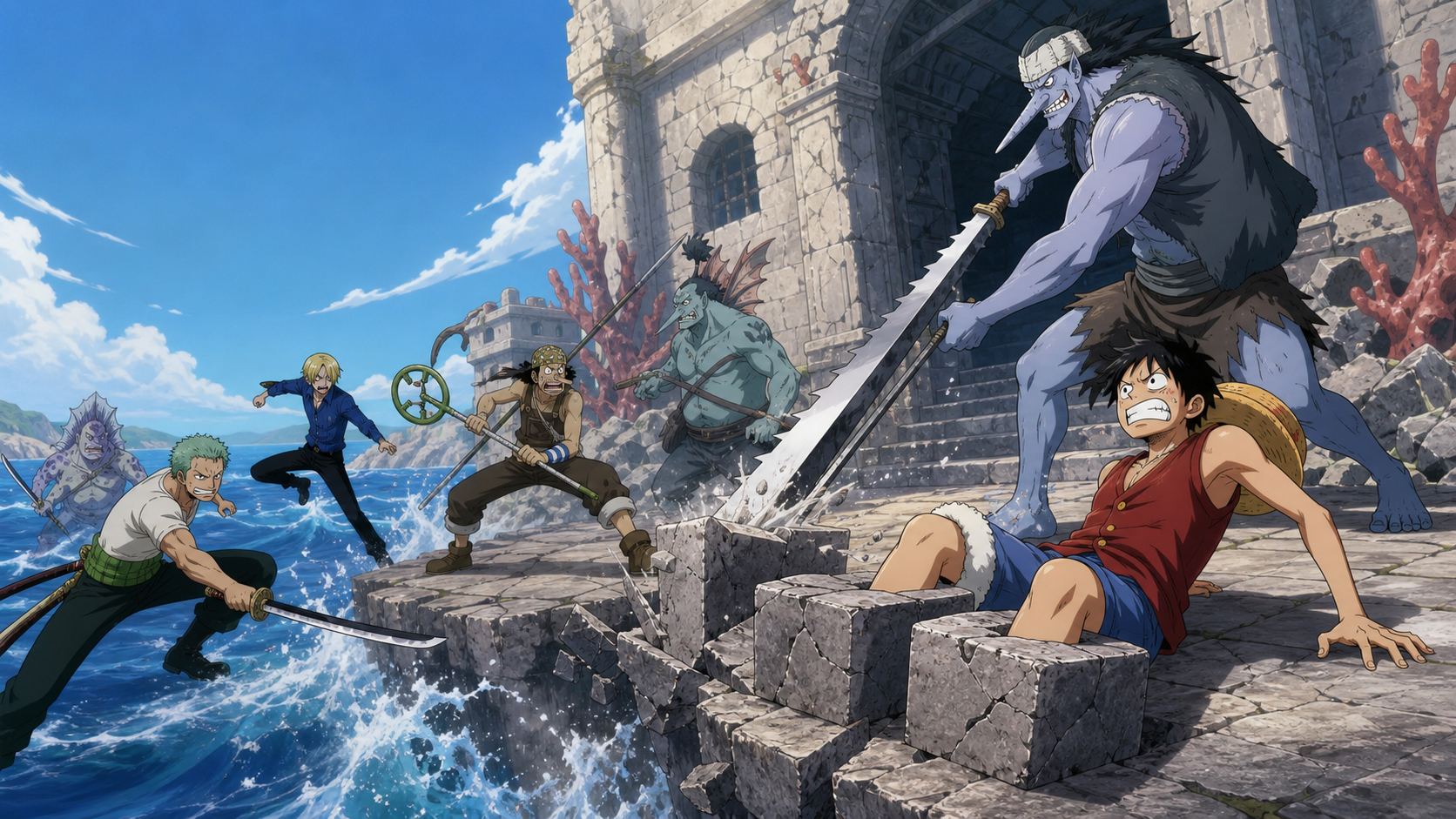
Fish-Men vs. the Straw Hat Crew
The Arlong Park battle turns Luffy’s improvised windmill attack into a tactical rescue crisis for the whole crew
Episode information
Japanese title: Luffy Daipinchi! Gyojin VS Luffy Kaizokudan
English title: Luffy in Big Trouble! Fish-Men vs. the Luffy Pirates
Japanese broadcast: August 23, 2000
Saga: East Blue
Script: Michiru Shimada
Episode direction: Yuji Endo
Animation direction: Yuji Hakamada
Art: Yoshida
The official episode archive displays only the surname “Yoshida” for the art credit. This page preserves that label rather than supplying an unverified given name.
Luffy enters Arlong Park with one clear answer
Episode 38 begins after Nami’s plan has been exposed as fraud and her request for help becomes possible. Luffy reaches the compound and strikes Arlong immediately.
The punch answers years of coercion with visible refusal, but the strike is only the opening of a battle whose success depends on more than anger.
The first strike breaks the performance of inevitability
Arlong’s power has relied on residents believing resistance cannot touch him. One hit does not dismantle the organization, yet the hit makes physical vulnerability public.
Symbols of invincibility matter in terror systems. Breaking one can change what witnesses believe is possible.
Sanji, Usopp, and Zoro enter behind him
The crew’s arrival turns Luffy’s action from an isolated challenge into coordinated presence. Each member brings a distinct skill and unresolved physical condition.
Standing together is meaningful only if roles, rescue capacity, and priorities become more organized than the charge itself.
Nami’s request defines the mission
The crew is not invading because the Straw Hats want territory, treasure, or public reputation. They act after Nami’s eight-year bargain is deliberately destroyed and she can no longer protect the village alone.
That origin should govern the use of force: protect people, end coercion, recover what was taken, and preserve Nami’s agency.
The request also establishes a boundary around victory. Removing Arlong while ignoring injured residents, stolen records, Nami’s maps, or corrupt Marine involvement would leave essential parts of the coercive system untouched. The crew needs to distinguish defeating officers from repairing conditions. Combat can create an opening, but residents must retain authority over reconstruction, testimony, property, and the future use of Arlong Park. Nami’s plea authorizes help; the plea does not transfer ownership of the village’s future.
Arlong Park is both fortress and administrative center
The compound contains fighters, water access, records, maps, resources, and the architecture of occupation. Damage may weaken the crew and destroy evidence or property residents need.
Victory should target oppressive capacity rather than treating total destruction as automatically liberating.
The fish-man officers divide the crew
Arlong’s commanders present different movement, strength, and environmental advantages. The Straw Hats cannot solve every matchup through Luffy.
This is the first major test of a crew in which specialists must operate independently while the captain faces the central threat.
Zoro enters while seriously injured
His Mihawk wound has not disappeared because the story moved to another island. Combat risks reopening damage and reducing his ability to assist later.
Determination should not conceal condition from teammates. A plan built around false assumptions about capacity can make everyone less safe.
Sanji becomes rescue and combat infrastructure. His mobility and awareness may be needed against an officer, around water, and for an endangered captain. The cook role does not limit him to the galley, but neither should fighting erase his responsibility for food and recovery after battle.
Multiple roles require priority decisions rather than heroic overextension.
Usopp must hold ground without copying the others. His strengths lie in distance, improvisation, observation, and performance. Arlong Park pressures him to prove courage through direct confrontation.
The crew benefits more when he uses his actual expertise than when he imitates a swordsman or kick fighter.
Hatchan calls Momoo into the fight
The sea cow is summoned as organizational equipment, revealing how Arlong’s crew uses a living creature for intimidation and force.
Momoo’s earlier hunger and fear remain relevant. Participation under conditioning or command does not make the animal morally identical to the people directing the attack.
Luffy grabs Momoo
He takes control of the creature and prepares a spinning windmill attack. The improvisation transforms an enemy resource into force against the surrounding formation.
The move is inventive and treats Momoo’s body as a weapon without consent. Tactical effectiveness does not erase that ethical cost.
The windmill scatters the formation
Luffy anchors his feet in stone and spins Momoo through the fighters. The attack disrupts numbers and creates space quickly.
Improvisation can overcome a structured defense when the opponent has not planned for an absurd use of the environment.
Anchoring solves one problem and creates another
Fixing his feet prevents Luffy from being pulled off balance during the spin. Once the attack ends, the stone holds him in place.
A solution optimized for one movement can become a hazard when the situation changes. Exit design should be part of setup.
Luffy fails to test disengagement. He commits before confirming how quickly he can free himself. Confidence in the attack substitutes for a recovery plan.
Leaders often receive praise for decisive action while teammates absorb the consequences of omitted exit conditions.
Arlong recognizes the constraint immediately. Rather than contesting Luffy’s strength directly, he cuts away the stone around the trapped feet. He treats the captain’s improvisation as an environmental vulnerability.
Good adversaries attack dependencies, not only bodies. Luffy’s inability to move becomes more important than the power of his punch.
The sea changes the threat category
As a Devil Fruit user, Luffy loses strength in water and cannot simply stretch free. Throwing the stone into the sea converts immobilization into a lethal rescue emergency.
The crew must shift from offensive matchups to preserving the captain before time runs out.
The captain becomes the person who needs saving
Luffy initiated the assault and carries enormous combat power. Neither fact makes him self-sufficient.
A healthy crew must be able to reverse support direction without shame. Leadership includes accepting rescue after one’s own mistake.
Rescue labor is not secondary to the duel. Someone must locate Luffy, enter or work around water, move stone, protect rescuers, and maintain breathing. These tasks may decide the battle more than the most visible strike.
Stories often center offense while lifesaving coordination happens at the edge. Episode 38 makes that edge the central danger.
Arlong exploits species-specific advantage. Fish-men can operate in water with capacities the human crew does not share. Using the sea against a Devil Fruit user combines environmental knowledge with biological advantage.
The difference should be analyzed tactically without treating species as moral destiny. Arlong’s choice is political and personal, not inevitable biology.
The crew needs a water-rescue protocol. They have known since the Alvida encounter that Luffy cannot swim. Repeated reliance on improvised rescue is an avoidable systems failure.
Lines, flotation, assigned swimmers, signals, and rules about anchoring near water should exist before the next emergency.
Rescuers should not become additional victims. Entering water during combat exposes anyone without protection. One person should secure the line, another monitor threats, and another manage the trapped stone or airway.
Uncoordinated courage can turn one drowning risk into several.
Nami’s navigation expertise belongs in the response
She understands currents, depth, shoreline, and vessel movement. Even during emotional crisis, her knowledge may guide rescue more effectively than raw strength.
Asking for help should not reduce her to a passive person being saved. She remains a specialist and decision maker.
Local residents know the water and structure. Cocoyashi’s people may know pool connections, tides, submerged foundations, and access points around Arlong Park. Their knowledge could shorten rescue time.
Intervention should make room for local capability rather than treating villagers only as spectators.
The tactical error does not invalidate the mission. Luffy’s trapped feet are a serious mistake. The goal of ending Arlong’s control remains necessary.
Teams need a culture where errors can be named during justified action. Otherwise moral certainty becomes an excuse to ignore operational failure.
Rescue authority should be explicit before the captain disappears. Once Luffy goes underwater, shouted ideas can compete while time contracts. The crew needs a person empowered to coordinate the rescue, reassign fighters, and stop actions that endanger the airway or destabilize the stone further.
That authority should be functional and temporary rather than a contest over who outranks whom. Nami may have the best environmental judgment, Sanji the most useful mobility, Zoro cutting capacity, and local residents knowledge of submerged structure. Coordination should connect expertise rather than reward the loudest voice.
A status cadence would help: location confirmed, airway reached, stone stabilized, extraction route clear, medical handoff ready. Simple updates prevent distant teammates from acting on obsolete assumptions.
Afterward, Luffy should participate in reviewing the mistake without treating criticism as disloyalty. A captain who wants people to trust his judgment must also make criticism safe enough to improve that judgment.
Arlong’s response reveals adaptive intelligence. He does not rely solely on strength or ideology. He observes, identifies the trapped anchor, and uses the sea with speed.
Underestimating him as merely arrogant would repeat the kind of shallow assessment that sank the Marine fleet.
Momentum now belongs to the officers. With Luffy underwater, Zoro injured, and the crew divided, Arlong’s side can isolate matchups and delay rescue. The initial symbolic victory has become a coordination crisis.
Maintaining situational awareness matters more than preserving the emotional feeling of a strong entrance.
Nami sees help become vulnerable. She finally allowed the crew into a burden she carried alone, and the captain is immediately endangered. That could reinforce her fear that involving others only creates more people to lose.
Successful rescue must show that shared risk can be managed collectively rather than returning responsibility to her.
The village should not be asked to watch helplessly. Residents can support evacuation, medical preparation, communications, and protection of records and homes. Not everyone should enter combat.
Participation should be voluntary and matched to capacity, not demanded as proof that the community deserves liberation.
Production makes the reversal spatially clear. The official archive credits the art only as “Yoshida,” and this page preserves that incomplete label. The episode’s art places stone, water, fortress edges, and separated fighters so the hazard can be read as a systems problem.
Yuji Endo’s direction lets the windmill feel triumphant before the fixed feet become obvious, while Yuji Hakamada’s animation direction turns the cut stone and fall toward water into a rapid shift from comedy to emergency.
RaeRae’s real-time reaction
Luffy putting his feet into stone without a plan to get them out is exactly the kind of idea that works brilliantly for ten seconds and then becomes everyone’s problem. Arlong sees the flaw immediately.
I love the crew’s entrance, but the rescue is the real test. Nami asked for help, and help has to mean more than one dramatic punch followed by another person managing the consequences.
The moment that lands
Arlong cuts the trapped stone free and sends Luffy toward the sea. The movement turns Luffy’s own anchor against him.
The reversal is a precise lesson in why improvisation needs recovery planning, especially when the leader has a known environmental vulnerability.
What the crew should do next. Assign rescue leadership immediately. Identify who can enter water safely, who can move or break stone without harming Luffy, who maintains the airway, and who holds back opponents.
Communicate the captain’s status across every matchup so fighters know whether to delay, disengage, or protect a rescue route. Silence will cause each person to optimize a private battle.
Use local knowledge about depth, currents, and structure. Nami and residents can guide placement even if others supply physical force.
Prepare medical response for water inhalation, impact, and delayed symptoms. Returning to combat should not occur automatically once Luffy is conscious.
Release Momoo from the immediate battle if possible. The creature should not remain a weapon passed between groups.
Document what happened afterward. The crew needs a standing rule that any improvised anchor, restraint, or high-risk maneuver includes a disengagement check and named backup.
Leadership should distribute mission continuity. The fight cannot become meaningless whenever Luffy is incapacitated. Crew members need shared understanding of objectives: protect Nami and residents, stop Arlong’s violence, preserve evidence, and avoid unnecessary destruction.
That shared purpose lets them continue making decisions without guessing what the captain would want in every second.
Shared purpose also prevents rescue from becoming a choice between saving Luffy and honoring Nami’s request. Both belong to the same mission when roles are distributed.
Bottom line
Episode 38 delivers the catharsis of Luffy striking Arlong and then refuses to let conviction substitute for planning. The windmill attack disrupts the enemy, but trapped feet give Arlong a simple route to the captain’s greatest vulnerability.
RaeRae rating: 9.2/10. The crew’s real strength will be measured by how the Straw Hats rescue Luffy, continue Nami’s mission, and adapt without hiding the mistake. Shared purpose must survive even when the person who declared the mission is underwater.