
Art
Deidara makes annihilation his final argument, and Sasuke survives by seeing both the technique and its human cost.
What happens
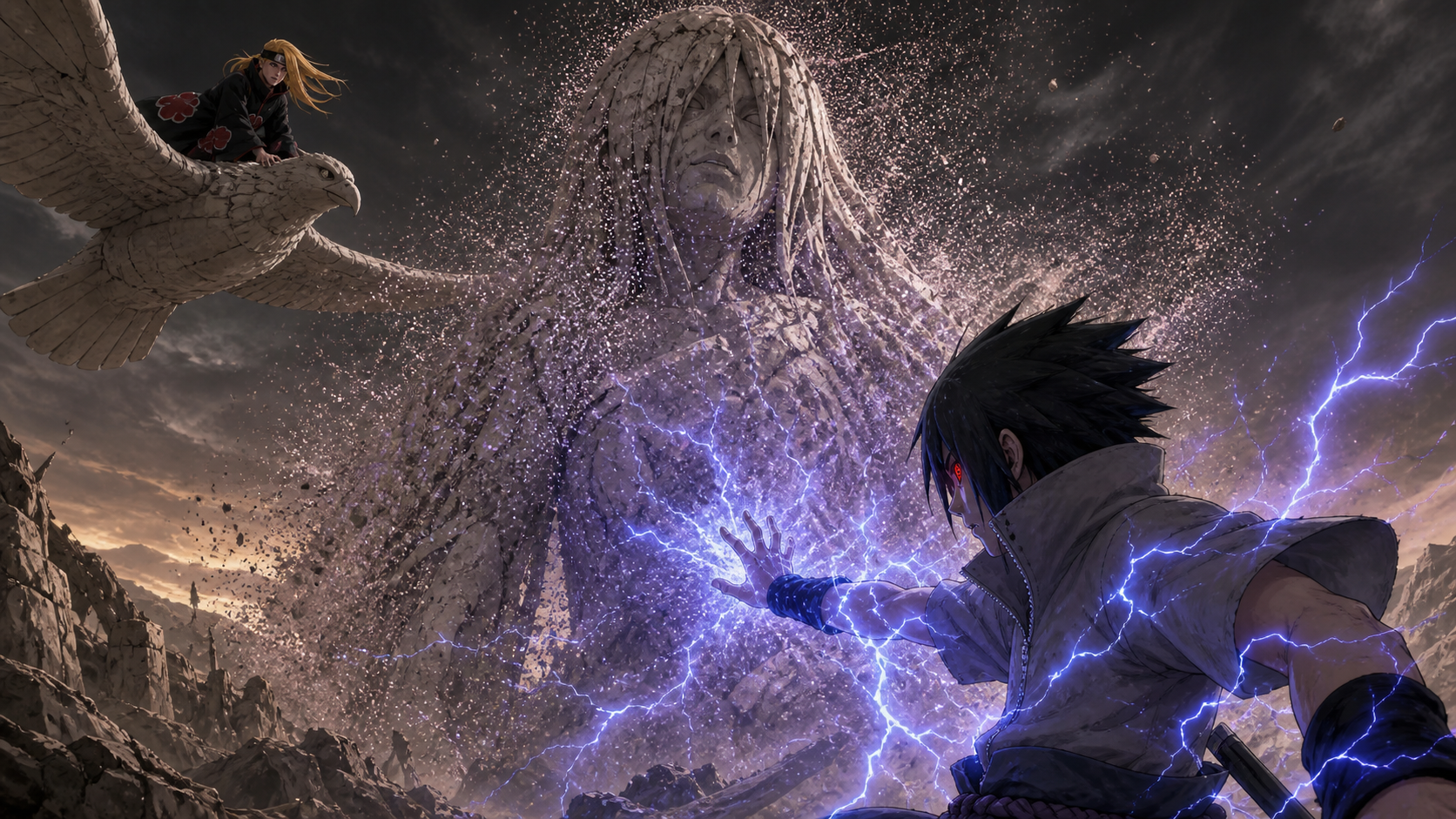
Deidara escalates from aerial bombardment to C4 Karura, a gigantic clay figure that releases microscopic explosives into the air. The attack is designed to enter living bodies and destroy them from within, making ordinary dodging almost meaningless.
Sasuke appears to be caught. Deidara celebrates because the Sharingan user finally seems unable to analyze his way out of the spectacle. Then Sasuke reveals that he used genjutsu, detected the bombs through the Sharingan, and neutralized them with lightning release.
The explanation completes the tactical pattern established in the previous episode. Deidara's clay is earth-natured. Lightning disrupts it. Sasuke has been testing that relationship while also manipulating what Deidara believes he sees.
Deidara's remaining choices shrink with his chakra and composure. Unable to accept another defeat associated with the Uchiha eyes, he turns his own body into a final explosive work. Sasuke summons Manda to escape the blast, forcing the giant snake to absorb the damage.
Art that demands surrender
Deidara's idea of art depends on the audience submitting to a moment. The explosion must overwhelm thought, erase distance, and leave no room for interpretation beyond awe.
Sasuke refuses that surrender. He looks at C4 and asks what it is made of, how it enters a body, what element governs it, and what false information might make its creator lower his guard. Analysis is almost an insult to Deidara because it converts transcendence into mechanics.
That conflict explains why victory alone is no longer enough for Deidara. He needs Sasuke's face to register wonder. When the Sharingan instead sees more clearly than everyone else, Deidara experiences perception itself as domination.
I understand the emotional wound even while rejecting what he does with it. Being dismissed can make recognition feel like survival. Deidara has built an entire lethal philosophy around never feeling small again.
Sasuke solves the impossible attack
C4 is frightening because it removes the visible object from the threat. The air itself becomes dangerous. Sasuke's eyes let him perceive the cloud of microscopic chakra, but perception only matters because he connects it to evidence gathered earlier.
He knows lightning disabled the clay mines. He knows Deidara is watching for the Sharingan to fail. He knows genjutsu can feed that expectation. Each insight is useful alone; together they become an escape route.
The episode rewards attention without pretending the solution is free. Sasuke spends chakra, takes risks, and depends on abilities with real limits. His composure is not proof that the situation is easy. It is the method he uses to survive situations that should kill him.
This is one of his defining combat traits. Naruto often changes a battle by connecting emotionally or inventing something chaotic. Sasuke narrows a battle until only the decisive relationship remains.
Manda pays the cost
Sasuke's escape from Deidara's final explosion is clever and brutal. He summons Manda, controls him with genjutsu, shelters inside him, and uses reverse summoning to leave the blast zone.
Manda is dangerous and hardly innocent, but that does not make him disposable. Sasuke converts another living being into armor without consent. The maneuver keeps him alive while revealing how far his instrumental thinking has progressed.
This matters because tactical brilliance can hide ethical collapse. The story invites admiration for the timing and scale of the summoning, then leaves the cost in the wreckage. Sasuke's goal has become so absolute that almost any other life can be entered into the equation.
Suigetsu helps complete the reverse-summoning route, showing that Hebi is already more than four people traveling beside each other. Their skills create a survival network even when trust remains uneven.
Deidara chooses the final frame
Deidara's last act is not an accident or a loss of control. He turns himself into the medium and tries to make death the artwork no one can look past.
There is tragedy in the consistency. He would rather disappear in an unquestionable spectacle than remain alive after another Uchiha refuses to admire him. His philosophy promises freedom, but his choices are controlled by Itachi's old victory until the final second.
Tobi appears to be caught in the detonation too, adding uncertainty to a scene already built around false perceptions. The masked partner has spent the battle looking like comic support, yet this story has trained us to distrust the obvious reading of his limits.
RaeRae reaction
This conclusion works because the spectacle never replaces the strategy. The giant clay figure and massive final blast are memorable, but the real satisfaction comes from tracing Sasuke's reasoning backward.
I also cannot celebrate the win without sitting with Manda's treatment. Sasuke survives because he is intelligent, prepared, and willing to make someone else carry the consequence. That combination is exactly why he is compelling and alarming in this era.
Deidara dies trying to control how he will be seen. Sasuke survives because he controls what Deidara sees. The symmetry is sharp, cruel, and perfectly suited to a battle called “Art.”
The episode closes one Akatsuki story while tightening the road to Itachi. Sasuke has defeated a powerful obstacle, but every solution shows how much of himself he is spending to reach his brother.
C4 turns breath into a battlefield
My bottom line is that Deidara’s most frightening work is not the largest visible explosion. C4 removes the comfort of seeing danger arrive. Microscopic clay enters the body through ordinary breathing, converting the environment and the victim’s own biology into parts of the weapon.
That design exposes how far his need for recognition has moved from art as communication. The audience does not get to interpret or walk away. The work enters them, destroys them, and leaves Deidara as the only person able to describe what happened.
Karura combines tenderness of form with total violence
The colossal figure carries a name and shape associated with Deidara himself. It looks almost serene before releasing a cloud meant to erase living bodies from within. Careful construction and intimate self-image become delivery systems for annihilation.
That contradiction matters. Beauty does not clean the violence, and violence does not prove the craft was empty. Deidara’s skill is real. The horror is what he demands the skill accomplish.
Sasuke survives because Episode 123 taught him how to ask
The counter is earned across two episodes. Sasuke tested lightning against clay, watched detonation patterns, learned Deidara’s need to see the Sharingan fail, and kept conclusions private. C4 looks impossible until those smaller observations become one answer.
I appreciate a fight that remembers its own evidence. The solution does not appear because the hero suddenly wants survival more. It appears because he did disciplined work while the opponent mistook silence for helplessness.
Seeing microscopic chakra is only the first step
The Sharingan lets Sasuke recognize that the air contains chakra particles. Perception alone cannot neutralize them. He has to understand their elemental nature, infer how they activate, and send lightning through his own body before detonation.
That sequence keeps the eye from becoming a magic answer key. Bloodline ability supplies information. Training and judgment turn information into survival.
Genjutsu gives Deidara the ending he expects
Sasuke knows Deidara wants proof that an Uchiha finally failed to see. He feeds that desire with an illusion. The false victory works because it agrees with the story Deidara is desperate to believe.
Genjutsu here is psychological before it is visual. Sasuke does not invent a random image. He identifies the conclusion his opponent will accept without checking. Deidara’s grievance becomes an opening.
Deidara prepared his eye and ignored his need
He trained an eye to resist Sharingan genjutsu after losing to Itachi. That preparation is serious and technically impressive. It still does not address the emotional reason another Uchiha can pull him into escalation.
Resistance to a technique is not freedom from the person who inspired the training. Deidara strengthened the eye while preserving Itachi’s authority over his sense of worth.
The final explosion tries to end interpretation
When ordinary victory becomes impossible, Deidara makes his body the last piece. The blast is supposed to be too large, too final, and too costly for anybody to analyze afterward. Death becomes a way to seize the last word.
That is not artistic freedom. It is surrender to the demand that every encounter produce validation. Deidara would rather remove himself from the world than live beside an audience that reached a different judgment.
Sasuke’s escape is brilliant and morally ugly
Summoning Manda, using genjutsu, sheltering inside the snake, and relying on reverse summoning requires astonishing speed and coordination. It also requires turning a living creature into armor without consent.
Both statements belong in the review. Tactical admiration should not erase the body that absorbs the blast. Calling Manda cruel does not grant Sasuke ownership of his life.
Manda’s death reveals Sasuke’s instrumental logic
Sasuke has spent years being treated as a vessel by Orochimaru. In the moment of crisis, he survives by making another being into a vessel for damage. The parallel should make us uncomfortable.
Trauma can explain why control feels safer than negotiation. It cannot transform coercion into consent. Sasuke escaped possession and is still capable of reproducing its logic when his goal feels absolute.
Suigetsu makes the escape a team achievement
The reverse-summoning route depends on Suigetsu recognizing what happened and acting through the contract. Sasuke’s calculation matters, but he does not return through solitary genius. Hebi’s network completes the maneuver.
This is why leadership ethics matter. Sasuke uses team capability while keeping emotional ownership of the mission. People who make survival possible deserve information and a voice in the risks being taken.
Tobi’s apparent death is another staged perception
The blast encourages viewers to count Tobi among the casualties. His foolish persona and position near Deidara make that conclusion easy. Yet this fight has repeatedly warned us that visible outcomes can be constructed for an observer.
Tobi benefits when enemies and allies underestimate what he can survive. Deidara dies seeking control over one final image while his masked partner continues controlling the image of himself.
Akatsuki loses a member but not the system that used him
Deidara brought rare craft, mobility, capture power, and intelligence to the organization. Akatsuki gave his grievance missions where destruction could be praised as productivity. The partnership fed the worst part of his philosophy.
His death will be recorded as operational loss, not an institutional reckoning. Violent systems replace workers more easily than they question the appetite that consumed them.
Sasuke wins and moves closer to the trap he wants
Removing Deidara clears another obstacle between Sasuke and Itachi. The victory confirms his skill and deepens his confidence. It also shows how much life he will spend to reach the confrontation.
Progress toward revenge is not automatically progress toward freedom. Itachi still determines the destination, the emotional terms, and much of the information Sasuke carries into it.
Art cannot demand one approved response
Deidara’s fear is recognizable. Artists want work to land, and dismissal can feel personal. The moment an artist requires awe and punishes interpretation, the relationship stops being communication.
Sasuke’s analysis does not destroy the existence of craft. It creates a response Deidara cannot control. An audience is not disrespectful because it remains conscious.
The episode makes intelligence visible
Sasuke’s reasoning appears through timing, false images, lightning moving across the body, and earlier experiments gaining new meaning. We see thought without pausing the fight for a lecture after every step.
That visual grammar gives the audience fair access to the solution. Surprise and coherence arrive together. We can be shocked by the escape and still trace why it worked.
Deidara and Sasuke both confuse endurance with purpose
Deidara survives missions so his next work can force recognition. Sasuke survives battles so he can reach Itachi. Each man has extraordinary discipline attached to a destination that cannot build a life afterward.
The difference in their wounds remains important. Sasuke is responding to massacre and manipulation. Deidara is responding to humiliation. Obsession can create a structural resemblance without making their pain equivalent.
C4 also changes the ethics of defense because nobody else on the battlefield can see what Sasuke sees. A microscopic weapon does not announce a safe perimeter. If civilians, animals, or Hebi members had entered the cloud, they might have inhaled death before understanding that an attack happened. Deidara calls the technique art while making informed response impossible for almost every member of the audience.
That is more than collateral risk. It is a method built around the victim’s ignorance. The clay crosses the body’s boundary without permission, waits inside, and destroys from within. Deidara’s obsession with being seen produces a weapon whose most lethal component cannot be seen. The contradiction feels like the honest endpoint of his philosophy: he wants recognition for himself while denying other people enough knowledge to choose their relationship to the work.
Sasuke’s self-electrocution is a sharp answer because survival requires trusting his analysis completely. If the elemental theory is wrong, lightning adds injury without stopping the bombs. If his timing is wrong, detonation begins first. Calm here is not a mood pasted over invulnerability. It is the ability to commit the body to a conclusion after gathering enough evidence.
I still question what that discipline is serving. Sasuke can tolerate frightening pain when pain keeps the route to Itachi open. He rarely asks whether the route deserves everything it consumes. Revenge gives him a clean hierarchy: survival matters because the confrontation matters, and other costs are measured underneath it. The clarity makes decisions fast. It also makes moral objections easy to classify as interference.
Manda’s rage before death restores some of the consent the escape tries to hide. He understands that Sasuke summoned and controlled him as a shield. The accusation matters because it refuses the language of clever sacrifice. Manda did not volunteer. He was selected by someone with enough ocular power to remove his ability to refuse.
I am not sentimental about Manda’s history. He demanded human sacrifices and threatened summoners. Ethics do not become meaningful only when the victim is kind. If cruelty makes a life available for coercive use, every violent character can justify the next abuse by pointing backward. Sasuke’s action may be understandable under seconds of mortal danger. Understandable is not identical to clean.
Suigetsu’s role after the blast also reveals how teams absorb consequences created by leaders. He has to recognize the summoning plan and complete the return while Sasuke is depleted. Karin and Jugo are left to interpret an explosion large enough to suggest their leader died. Sasuke’s secrecy protects tactics from enemies, but it makes allies carry uncertainty without preparation.
Deidara leaves no room for grief inside his own final act. By making death the masterpiece, he asks survivors to remember the spectacle before the person. That framing can tempt viewers too. The blast is visually unforgettable. The quieter tragedy is a young man whose creativity became so dependent on defeating somebody else’s gaze that continued life felt like artistic failure.
I do not believe Itachi caused Deidara’s choices, but his victory became the event Deidara refused to metabolize. Instead of letting humiliation become information, Deidara made it an enemy. He trained, escalated, joined violence to craft, and finally destroyed himself trying to reverse a judgment that existed mostly inside him. Sasuke happens to carry the eyes that reopen it.
The episode therefore closes with two forms of survival. Tobi survives by concealing what he is. Sasuke survives by exposing what C4 is. One depends on other people misreading the body. The other depends on reading a hidden threat correctly. Both men leave Deidara believing he understood more than he did.
What stays with me is not the scale of the crater. It is the chain of people turned into materials. Deidara makes his body into a bomb. He makes microscopic clay enter other bodies. Sasuke makes Manda’s body into shelter. Akatsuki made Deidara’s art into organizational labor. Obsession keeps converting lives into tools, then calling the result necessity, victory, or art.
That is why my reaction remains split. I can cheer the intelligence of Sasuke’s counter and still refuse the hero shot. I can recognize Deidara’s craft and still reject his demand that destruction settle every argument. The episode is strongest when it lets those truths remain beside each other. Art can be astonishing and ethically bankrupt. Survival can be deserved and achieved through an abused life. An explosion can close a battle without resolving the wound that created it. Sasuke moves toward Itachi with another victory, but the road behind him includes Manda’s body, and that cost belongs in the story.
RaeRae’s final word on art
I love the tactical payoff and refuse to let the cleverness make Manda invisible. Sasuke reads C4, weaponizes Deidara’s expectation, neutralizes microscopic clay with lightning, and assembles an escape in seconds. Then another living being dies carrying the blast.
Deidara’s final work is enormous because no smaller answer can repair the old humiliation. He trained against genjutsu but never questioned why Itachi remained the judge inside his head. Sasuke barely has to speak for that wound to take over.
The title asks us to consider what art means when the maker demands surrender. Deidara has craft, imagination, conviction, and style. He also removes consent from the audience and calls destruction the only valid conclusion.
Sasuke survives by continuing to interpret. That is the satisfying part. The frightening part is what he is willing to use as material for survival. One artist dies inside his final work. One tactician walks away after making somebody else’s body carry the cost.
RaeRae’s call
Sasuke defeats C4 by seeing method where Deidara demands awe. The escape proves his brilliance, but Manda’s death keeps that brilliance from becoming a clean victory.