
Kakashi Chronicles: Part 2
Obito chooses Rin, Kakashi chooses his teammates, and the Sharingan becomes a permanent record of what the war took.
What happens
Rock shinobi kidnap Rin, and Kakashi orders the team to continue the bridge mission. Obito refuses. He chooses to rescue their teammate even if the decision violates command and risks the strategic objective.
Kakashi initially follows the mission, then turns back. Obito's argument and the memory of Sakumo finally break through the rigid rule system Kakashi built after his father's disgrace. He arrives in time to save Obito from an enemy attack but loses his left eye in the process.
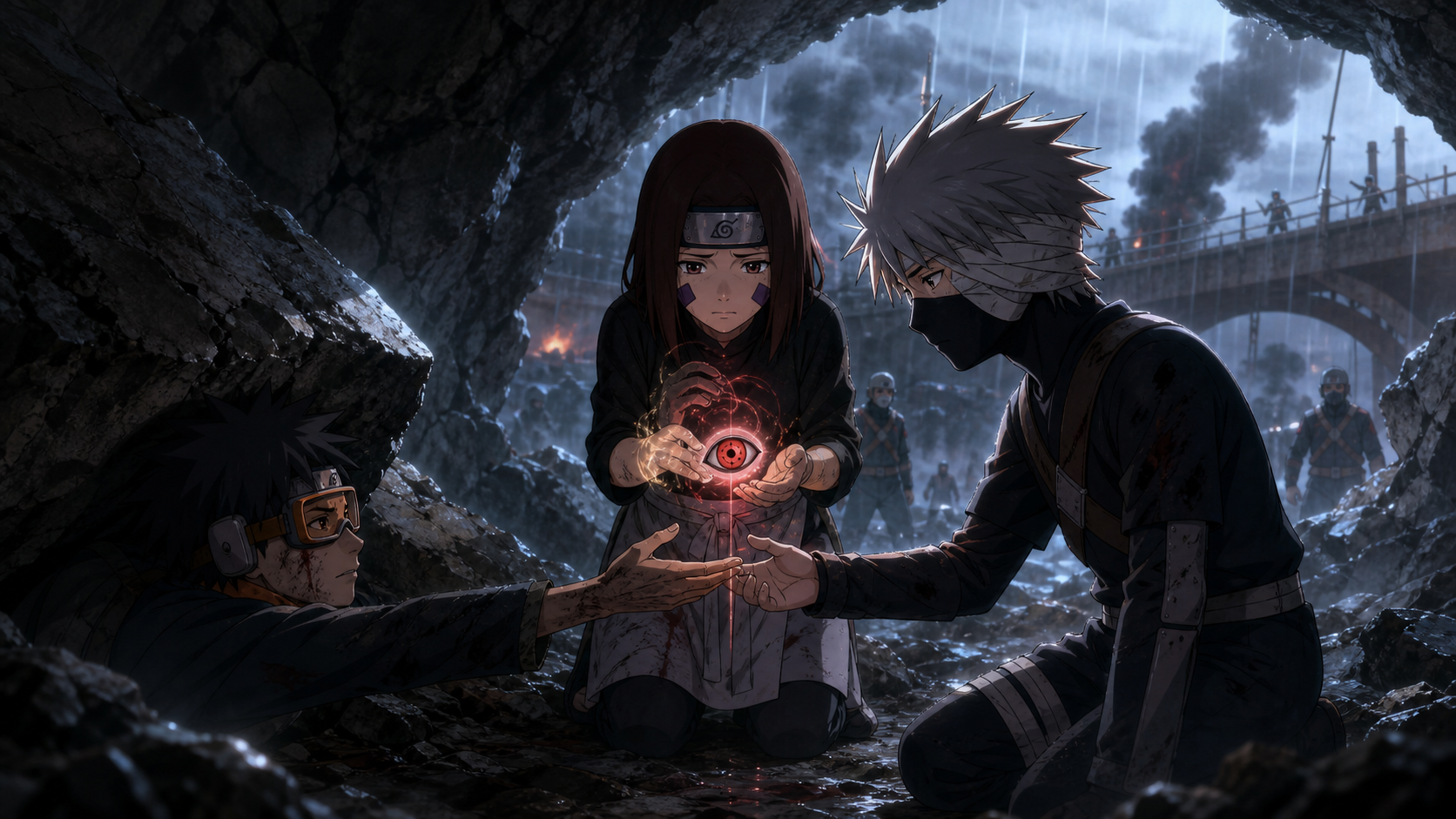
Together they rescue Rin. Obito awakens the Sharingan under pressure, and the three children briefly fight as the team they might have become. The victory does not last. The cave collapses, crushing half of Obito's body beneath a boulder.
Unable to escape, Obito gives Kakashi the Sharingan from his uninjured eye as a late promotion gift. Rin performs the transplant on the battlefield. Kakashi leaves the cave carrying his teammate's eye, words, and an obligation that will shape the rest of his life.
Obito disobeys correctly
The bridge matters. Destroying it can weaken the enemy's supply line and save lives elsewhere. The episode never removes that strategic reality.
Obito still refuses to treat Rin as an acceptable cost. His decision rejects the idea that a teammate becomes expendable once the mission report can justify it.
That does not make every impulsive rescue wise. Obito is detected and nearly killed. The moral force lies in the priority, not flawless execution. He understands that a system willing to abandon Rin will eventually abandon everyone.
Kakashi's turn is equally important because he knowingly risks the institutional judgment that destroyed Sakumo. Returning for Rin means accepting that his father may have been right and the village may have been wrong.
The eye is a gift and a burden
Obito gives Kakashi the Sharingan because he never brought a promotion gift and because he wants part of himself to continue with his teammate. The gesture is intimate, practical, and devastating.
Rin's role cannot be reduced to the person who performs the transplant. She has just survived kidnapping and genjutsu, yet immediately uses medical skill under collapsing battlefield conditions. The famous eye exists in Kakashi's face because Rin makes the transfer possible.
The Sharingan then becomes evidence of a bond Kakashi once resisted. Every time he uses it, he carries Obito's perspective literally. The teammate who challenged his rules becomes part of how he sees.
That inheritance is not simple empowerment. Kakashi lacks Uchiha physiology, so the eye consumes enormous chakra. The gift expands his ability while continually taxing his body. Memory has a physical cost.
Children should not have to make this beautiful
The scene is moving, but the war created every condition around it. Children are trapped under rock because adults sent them to sabotage supply infrastructure. A girl performs battlefield transplant surgery because no adult medic is present. A newly promoted boy accepts his friend's eye because evacuation is impossible.
Their courage deserves respect. The institution should not receive credit for producing it.
Naruto often turns child-soldier endurance into heroic legend. Kakashi Chronicles is strongest when the beauty of the bond makes the surrounding system look worse, not better.
Minato eventually arrives and helps complete the mission, but even the fastest shinobi cannot undo the time his students spent alone. Adult competence enters after the children have paid the permanent price.
RaeRae's reaction
This episode is foundational for a reason. Adult Kakashi's entire philosophy comes from the moment he finally chose a teammate and still lost one.
Obito's famous rule about people who abandon comrades can sound like uncomplicated inspiration when quoted later. Here it is a child's argument against military logic, delivered while another child is being held by enemy soldiers.
Kakashi losing his eye after turning back makes the choice costly without proving it wrong. The story refuses the cheap version where moral action guarantees safety. Doing the right thing can still hurt, and that does not make abandonment correct.
Rin breaks my heart. She stabilizes both boys emotionally, survives capture, and performs impossible medicine while the cave is coming down. History remembers Kakashi's Sharingan and Obito's gift, but her hands complete the inheritance.
Obito's final calm also hurts because he believes the sacrifice gives his life meaning. A child should not need death to become worthy of recognition. He was already valuable when he was late, loud, scared, and trying.
Kakashi walks away with a transformed philosophy and no healthy way to process the loss. He will visit memorial stones, repeat Obito's words, and train future children differently. That is meaningful. It is also what survival looks like when grief becomes a job description.
The Kannabi Bridge mission succeeds, but I refuse to call the outcome clean. The supply route falls. Rin returns. Kakashi becomes a legend. Obito is buried under the battlefield. Those facts belong in the same accounting.
Part 2 closes the origin of the Copy Ninja by showing that his most famous power was never a trophy. It was a teammate's last act, a medic's battlefield labor, and a permanent reminder that the mission is not worth more than the people asked to complete it.
Kakashi changes the decision and still cannot control the cost
My bottom line is that Episode 120 refuses the comforting idea that choosing teammates guarantees a happy rescue. Kakashi turns back for Rin, accepts the moral truth Obito argued, and loses an eye. Obito saves him and becomes trapped. The right choice remains right even when the battlefield punishes everybody.
That distinction is essential. If loss proved the rescue was wrong, the shinobi system could use every casualty to justify abandonment. Moral action does not control rock, enemy technique, timing, or war. Kakashi can choose what he values without choosing the outcome.
Obito’s disobedience exposes a gap in the command structure
He refuses Kakashi’s order because the plan offers no meaningful process for rescuing a captured teammate. A mature military system would define when intelligence, medical necessity, or risk to personnel justifies reassessment. These children receive an objective and are left to improvise the ethics.
Obito’s execution is dangerous, but the absence of a contingency belongs to the adults who designed the mission. Calling him reckless cannot substitute for asking why a child must invent rescue policy under attack.
Kakashi turns back toward Rin and toward Sakumo
Choosing rescue forces him to reconsider the lesson built from his father’s disgrace. Sakumo may not have been the shameful failure Konoha described. The village may have judged compassion because the failed objective was easier to count than the lives saved.
Kakashi cannot resolve years of grief during one run through enemy territory. His action begins the revision before his language catches up. He follows Obito because the alternative interpretation of his father has become possible.
Losing the eye makes the new philosophy physical
Kakashi is injured while protecting Obito. The scar will remain after the mission and after the war. His body records the cost of turning toward a teammate rather than leaving the decision inside memory.
The injury should not become punishment for compassion. The enemy attack caused the wound. Kakashi’s choice placed him in danger, but every military route carried danger. Blaming care would repeat the institution’s treatment of Sakumo.
Rin survives capture before the story asks her to become a surgeon
She has endured enemy custody, fear, and genjutsu. Once freed, Rin immediately returns to medical responsibility because her teammates are injured and no adult healer is present. The episode gives almost no recovery time between victimization and labor.
Her competence saves Kakashi and completes Obito’s gift. That achievement deserves attention alongside the boys’ emotional decisions. The famous Sharingan transplant exists because a child medic performs delicate surgery inside a collapsing cave.
The transplant needs sterile conditions the battlefield cannot provide
Rin has limited light, tools, time, medication, and control over debris. Kakashi is injured. Obito is crushed and fading. The situation is the opposite of safe surgical practice. Her success is extraordinary, and the need for that success indicts the mission.
A village should not rely on children producing miracles under impossible conditions. Heroic medicine can save one life while hiding the logistical failure that left the medic alone.
Obito’s gift is consent under extreme circumstances
He identifies what he wants done with his eye and asks Rin to perform the transfer. The choice gives him agency in a moment when the boulder has removed nearly every option. Respecting that agency matters.
The pressure remains enormous. He believes death is near, wants a promotion gift for Kakashi, and seeks meaning in a life he considers disappointing. The gift can be valid and emotionally shaped by conditions no child should face.
The Sharingan does not become Kakashi’s by simple possession
Obito gives the eye, Rin transfers it, and Kakashi carries it. The ability remains connected to Uchiha physiology, Obito’s history, and a promise between teammates. Kakashi’s later fame can make the eye look like personal equipment detached from origin.
Remembering the chain does not diminish his skill. He adapts to a permanent chakra cost and develops techniques around a body not born for the Sharingan. Mastery becomes part of stewardship.
The chakra burden keeps memory active in daily life
Kakashi cannot deactivate the eye like an Uchiha, so the gift consumes energy continuously unless covered. The forehead protector becomes practical management and a visible sign that inherited power has limits.
Every use therefore asks his body to pay for memory. The Sharingan expands what he can see while reducing stamina. Obito’s perspective becomes a strength that never feels weightless.
Children should not need sacrifice to feel recognized
Obito speaks with calm because the gift lets him believe he finally accomplished something worthy. That belief is heartbreaking. His value existed before the cave: in his loyalty, humor, care for elders, frustration, mistakes, and determination.
War teaches children that a dramatic death can settle insecurity more efficiently than ordinary belonging. The emotional beauty of his gift should make that teaching look cruel.
The cave turns structural failure into personal legend
The story will remember Obito’s sacrifice, Kakashi’s eye, and Rin’s surgery. The mission planners, staffing shortage, separation from Minato, and use of children can fade behind the legend. Individual heroism becomes easier to celebrate than institutional accountability.
A complete account keeps both levels visible. The children made brave choices. Adults and villages created the conditions requiring those choices.
Minato’s speed cannot repair arriving after the permanent loss
He is one of the fastest shinobi alive, yet battlefield demands pull him away when his students need adult command. Returning later may help complete the objective and save survivors. Speed does not reverse the time the children spent alone.
The irony matters because military systems can render even extraordinary individual ability insufficient. Minato’s care is real. The structure distributed him across too many crises.
Kannabi Bridge falls while the team remains broken
Destroying the bridge achieves the strategic goal and may change the war. The success does not restore Obito or Kakashi’s eye. A mission report can mark completion while the surviving children begin carrying permanent injuries and grief.
Both truths belong in the accounting. Strategy has consequences beyond the team, and the team paid a cost the strategy cannot repay.
Adult Kakashi turns Obito’s words into a teaching standard
Years later, he will test students on teamwork, refuse to pass groups that abandon one another, and quote the principle born here. The philosophy improves how he leads Team 7. That legacy gives Obito’s choice real reach.
The influence does not make the original loss necessary. People can create meaning from harm without declaring the harm a gift. Kakashi’s better teaching is what he builds afterward.
The memorial stone holds names the village cannot reduce to results
Kakashi’s later visits show that the dead remain present outside official reports. A stone records names while his habits record relationships. Lateness becomes connected to time spent speaking with people who cannot answer.
The behavior frustrates students who lack context, much as young Kakashi judged Obito’s lateness. The reversal carries grief, affection, and a quiet refusal to let schedules erase the dead.
Rin’s role must remain visible inside Kakashi’s legend
The Copy Ninja story often becomes Obito gave the eye and Kakashi mastered it. Rin performed the transplant, treated the injury, and made the inheritance physically possible. Her labor cannot become a connecting verb between two male arcs.
She also carried her own trauma from capture. Recognizing her work should lead to questions about who treated her afterward, who checked the genjutsu effects, and whether anybody gave the medic permission to stop caring for everyone else.
Obito’s body remains under the rock, but the episode knows less than viewers later learn
At this point, Kakashi and Rin reasonably believe their teammate will die in the collapse. The reaction should remain grounded in their knowledge. Later revelations do not make the original grief false.
The emotional truth comes from what the children saw, chose, and carried away. Survival elsewhere cannot retroactively give them information or remove the years shaped by presumed death.
RaeRae’s final word on the battlefield life
I love the gift, and I hate the conditions that made the gift necessary. Obito finds a way to give Kakashi sight after Kakashi loses an eye protecting him. Rin turns that decision into surgery while stone falls around three children. The bond is beautiful. The war is obscene.
Kakashi made the right choice and still lost somebody. That fact matters because morality is not a bargain with the universe. Returning for Rin did not guarantee safety. The injury and collapse do not prove the mission should have mattered more.
Rin deserves to remain centered. She survived capture, maintained enough control to treat Kakashi, and performed the operation that created one of the series’ most famous abilities. Her hands belong in every telling of the Sharingan gift.
The bridge falls and the report can call the mission successful. I am keeping another account. One child loses an eye. One child believes death finally made him worthy. One child performs surgery after captivity. Adult Kakashi will spend decades making sure future students hear the lesson the institution learned too late: people are not acceptable mission costs.
The rescue also depends on information gathered under fear
Obito and Kakashi need to locate Rin, understand enemy numbers, identify the genjutsu, and choose an approach without adult reconnaissance. Every decision happens while emotion pushes them toward speed. The episode shows courage, but preparation remains thin because the original mission never planned for capture.
A better structure would include signals, rally points, extraction routes, and authority to request support. Children should not have to invent those procedures after a teammate disappears.
Rin’s captivity should remain part of her medical needs
Physical rescue does not end what happened in enemy custody. She may have been threatened, restrained, questioned, and placed under genjutsu. Rin then suppresses those reactions because Kakashi and Obito need immediate treatment. The medic becomes the last person allowed to be a patient.
After evacuation, another healer should assess her body and chakra while a trusted adult explains what happens next. Asking Rin to report intelligence before care would repeat the same habit of valuing function first.
Obito’s awakening comes through fear for another person
The Sharingan emerges during a crisis involving Rin and Kakashi, connecting power to attachment rather than solitary ambition. That emotional trigger fits the Uchiha history while exposing how often the shinobi world makes trauma the route to development.
The awakening helps save lives. The institution should not interpret success as evidence that war is a valid training method. A child gaining power under terror remains a child under terror.
Kakashi receives the eye before he can consent calmly to the burden
He is injured, grieving, and facing collapse. Obito is dying beside him. The gift is clear, but Kakashi cannot evaluate long-term chakra cost, medical complications, or what carrying the eye will mean. Emergency consent is enough for survival, not enough to answer every future question.
Later care should include monitoring, adaptation, and permission to decide how the eye is used. Obito’s wish matters without becoming a command that controls Kakashi forever.
The boulder makes time the cruelest opponent
Strength, medicine, and teamwork all exist, yet the cave leaves almost no time. Obito’s choices become compressed because rescue appears impossible. The pressure creates the heartbreaking clarity of the gift while removing alternatives children should have had.
Minato arriving earlier might have changed everything. The thought cannot become blame placed entirely on him. War distributed one adult across too many fronts and called the arrangement necessary.
The legacy should include a promise to change procedure
Remembering Obito through sayings and memorial visits matters. The village should also examine why a new jonin led peers without adult backup, why capture contingencies were weak, and why medical evacuation depended on a child inside a cave.
Private grief cannot be the only archive. Institutional memory should change future mission staffing, rescue authority, and protection for young shinobi. Otherwise the village honors sacrifice while preserving the conditions that demand another one.
The lesson reaches forward
Adult Kakashi will teach teamwork because Obito’s choice saved Rin and changed him. That teaching matters, but the village should not leave the lesson inside one survivor. Every academy, commander, and future mission plan should recognize that protecting comrades requires authority, preparation, and adults to make rescue possible before children face collapse.
RaeRae’s call
Kakashi chooses his teammates and the battlefield still takes Obito. The loss does not make rescue wrong. The loss proves right action needs support, planning, and adults present before children pay the cost.