
Kakashi Chronicles: Part 1
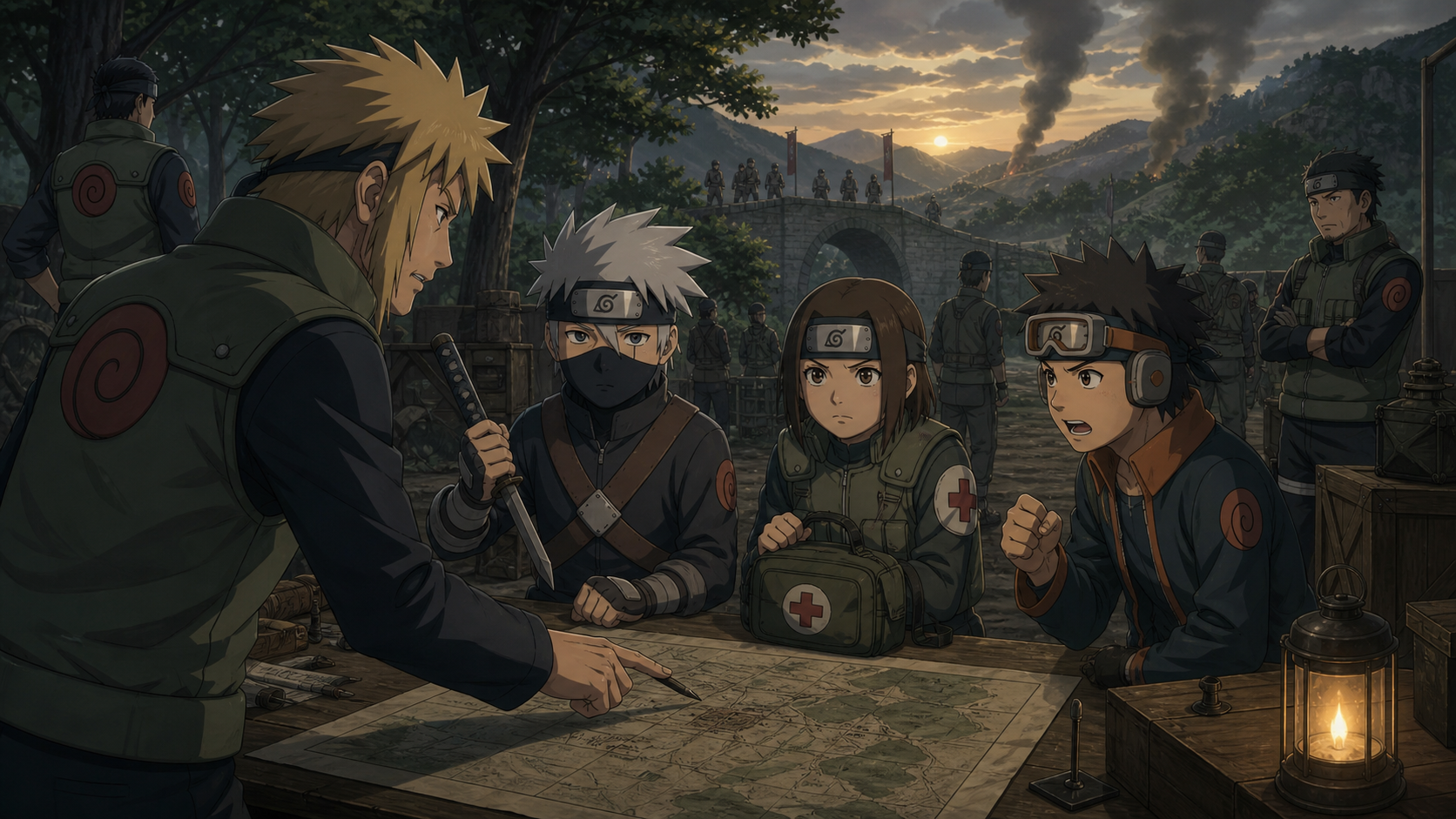
The Third Shinobi War promotes Kakashi before he has finished grieving and sends three children toward Kannabi Bridge.
What happens
More than a decade before the main story, the Third Shinobi War turns borders, supply routes, and children into military resources. Minato Namikaze assigns young Kakashi Hatake, Obito Uchiha, and Rin Nohara a mission to destroy Kannabi Bridge and cut the enemy's supply line.
Kakashi has just become a jonin and receives command responsibility while still a child. He prioritizes the mission, procedure, and chain of command. Obito arrives late, argues openly, and believes teammates matter more than rules. Rin serves as the medical center between two boys who interpret duty through different wounds.
Their conflict is not simple discipline versus irresponsibility. Kakashi watched his father Sakumo be destroyed by the village for abandoning a mission to save comrades. He learned that rules provide protection from the shame that killed his parent. Obito sees the opposite danger: a system that can call a person honorable while leaving teammates behind.
Minato separates from the group to handle another battlefield, leaving Kakashi to lead. Enemy Rock shinobi attack, and the mission's abstract language becomes immediate. These children have to make adult decisions with lethal consequences because the village calls promotion readiness.
A jonin is still a child
Kakashi's promotion is presented as achievement, but the war context makes it disturbing. Rank gives him authority without giving him emotional adulthood. He receives a blade, a mission, and responsibility for two peers while still processing his father's death.
The village treats competence as evidence that more burden is appropriate. Kakashi is talented, so adults keep placing him closer to violence. His precision hides how little space he has been given to grieve or question the institution that judged Sakumo.
Calling him commander does not change his age. It only makes the consequences of childhood coping strategies operational for an entire team.
Sakumo's death lives inside every rule
Kakashi's insistence on the mission sounds cold until we recognize its source. Sakumo saved comrades rather than complete an assignment and became a public disgrace. Even the people he rescued condemned him. He died by suicide after the village made survival feel dishonorable.
Young Kakashi responds by becoming impossible to accuse. He follows procedure, values outcomes the institution can measure, and refuses the kind of exception that destroyed his father.
That response is understandable and dangerous. Trauma can produce perfect institutional behavior when a child learns that disobedience risks social annihilation. The village benefits from Kakashi's rigidity without repairing the wound that created it.
Obito's challenge therefore reaches deeper than an argument about punctuality. He asks Kakashi to risk becoming like the father Konoha taught him to reject.
Obito sees the person before the report
Obito is messy, emotional, and frequently late. He also understands something the shinobi system keeps trying to suppress: a mission does not become meaningful if completing it requires treating teammates as replaceable.
His position is not free of risk. Charging toward every endangered person without strategy can create more casualties. The strength of his argument comes from refusing the opposite extreme, where procedure becomes permission to abandon people.
Rin recognizes value in both teammates. She respects Kakashi's skill and sees Obito's care. Her presence holds the conflict together, but the war gives the girl medic another unfair assignment: manage two boys' emotions while keeping their bodies alive.
Minato's command problem
Minato is supportive, capable, and far more humane than many officers. He still participates in a system deploying children. His confidence in Kakashi may be sincere, but sincerity does not remove the structural problem.
The mission needs Kannabi Bridge destroyed. Enemy pressure requires Minato elsewhere. Those military facts explain why the team separates; they do not make the children less vulnerable.
This is one of Naruto's recurring truths. Good adults can care about children while continuing institutions that endanger them. Personal kindness matters, but it cannot substitute for accountability.
RaeRae's reaction
Kakashi Chronicles hurts because we already know the adult these choices produce. Every rule adult Kakashi later bends for Team 7 was paid for here.
Young Kakashi is frustrating, but I cannot call him heartless. He built an armor from the only lesson Konoha made publicly available: his father saved people, lost honor, and died. Of course the child clings to mission law.
Obito's argument lands because he names the moral failure underneath professional language. A shinobi who abandons the mission may be called trash, but somebody who abandons comrades is worse. The line becomes famous because it attacks the institution's ranking of values.
I also refuse to let the promotion ceremony distract from the obvious. Kakashi is a child receiving command of other children during a continental war. The village can call him a jonin; his nervous system does not magically become adult.
Rin's medical role deserves attention. She carries supplies, reads injuries, de-escalates conflict, and remains the person both boys orient around. The team depends on her labor before the story gives her equal narrative space.
Minato's warmth makes the system more believable, not less culpable. Harmful institutions rarely consist only of cruel adults. They also contain decent people making impossible assignments feel manageable.
Part 1 sets the trap with painful clarity. The bridge matters. The war is real. Kakashi's rules have evidence behind them. Obito's loyalty has moral force. Rin will become the point where those principles collide.
The episode does not need nostalgia. These children are not having an origin adventure. They are standing at a field table while adults move armies behind them, and the future is already charging interest on every decision.
The episode begins with achievement and makes the achievement terrifying
My bottom line is that Kakashi’s promotion should never be read as proof the system treated him well. A child demonstrates extraordinary skill, and the village responds by increasing command responsibility during a continental war. The rank recognizes ability while normalizing a burden no child should carry.
Kakashi receives authority over teammates near his own age, responsibility for a strategic bridge, and consequences that can affect entire battle lines. Adults call the promotion readiness because military need has narrowed their definition of childhood.
Sakumo’s death became an institutional lesson taught through shame
Kakashi did not invent his obsession with rules. He watched Konoha condemn his father for saving comrades instead of completing a mission. The criticism came from the village and from people Sakumo rescued. Public shame entered the family home and ended in suicide.
A child observing that collapse learns a brutal equation: compassion creates disgrace, while procedure creates safety. Kakashi follows orders because rules promise protection from becoming the next person everybody agrees to abandon.
The village benefits from the trauma it never repaired
Konoha receives a precise, disciplined, highly productive young shinobi. His behavior looks admirable in reports. The institution does not have to confront why the child fears mistakes, rejects exceptions, and treats emotional need as danger. Unhealed grief becomes military efficiency.
That pattern appears across the series. Villages praise resilience after creating the conditions that require it. Kakashi’s competence is real. The system’s use of that competence remains exploitative.
Obito’s lateness and care come from the same attention
He stops for people, notices need, and values relationships more than schedules. Those habits make him unreliable by military standards and morally alert in situations where procedure forgets the person. The story should not pretend every late arrival is noble, but punctuality cannot measure the whole character.
Obito’s challenge to Kakashi carries weight because he practices the priority he argues for. He may lack strategy and discipline, yet he refuses to treat another person’s danger as somebody else’s problem.
The famous trash line works because both sides contain risk
Abandoning a mission can expose villages, civilians, and other teams. Abandoning comrades can destroy the people performing that mission and teach every survivor that loyalty ends when rescue becomes inconvenient. Obito’s declaration is not a complete policy. The line is a moral boundary against one extreme.
Kakashi needs strategy around that boundary. Rescue attempts require information, timing, and attention to wider consequences. The lesson becomes mature when care and judgment work together rather than when one slogan replaces another.
Rin carries the emotional and medical center without equal authority
She treats injuries, monitors the team, softens conflict, and gives both boys a person whose safety matters. That labor keeps the unit functional. The boys debate leadership while Rin performs the relationship work that allows them to keep traveling together.
Her medical role also creates a contradiction. She is responsible for preserving life while participating in a mission designed around lethal force and destruction of supply lines. The war expects a girl to heal bodies inside a system producing injuries faster than she can treat them.
Rin should be more than the point where two boys disagree
The story often frames her through Obito’s affection and Kakashi’s responsibility. She has her own training, fear, judgment, and understanding of the war. A stronger reading asks what she thinks about the bridge, promotion, separation from Minato, and the likelihood that one teammate’s argument will put her between them.
Her kidnapping in the next movement carries more weight when she exists as a professional and person before becoming the rescue question.
Minato’s kindness does not solve the command failure
He listens, offers guidance, and treats the team with warmth. He still accepts a structure that places Kakashi in command and then separates from the children during a high-risk operation. Enemy pressure may leave no easy alternative, but necessity does not make the arrangement harmless.
Good adults inside harmful institutions often reduce immediate pain while helping the institution continue. Minato’s care matters. His participation also matters.
The bridge objective turns infrastructure into a battlefield
Kannabi Bridge carries supplies, movement, and communication. Destroying it can change the war without defeating every enemy soldier. The assignment teaches young viewers that logistics determine conflict as much as spectacular techniques.
The strategic value also means civilians, laborers, roads, and nearby communities may absorb consequences. A bridge is not an abstract target. Somebody built it, uses it, and depends on the routes connected to it.
Cutting supplies creates effects beyond the enemy army
Food, medicine, equipment, and reinforcements travel through supply lines. Disruption can shorten fighting or weaken opponents. The same disruption may leave wounded people untreated and civilians without essentials. Military success often arrives through suffering outside the frame.
Kakashi receives responsibility for that calculation before reaching adulthood. The mission report will measure whether the bridge falls. The report may never record every body affected downstream.
Promotion cannot substitute for mentorship during the mission
A new commander needs supervision, feedback, and a clear process for decisions outside the plan. Minato gives Kakashi authority and then must leave for another front. The separation removes the adult most capable of helping him balance mission and team.
Kakashi falls back on rules because rules remain when mentorship leaves. That response is predictable. The system treats predictability as professionalism while creating the conditions for rigidity.
Obito understands abandonment before he understands command
He sees the emotional truth that teammates cannot become expendable. He has less experience deciding how to rescue without multiplying casualties. His growth requires keeping the moral clarity while learning tactics that protect more people.
The tragedy is that war gives him almost no time. Children are expected to transform conviction into mature command during the same emergency that tests them.
Kakashi’s mask of control is already visible
Young Kakashi speaks through procedure, rank, and measurable duty because those categories feel safer than grief. He can correct lateness and assign formation without discussing his father. Control keeps the conversation away from the wound.
Adult Kakashi will use humor, lateness, and apparent ease as another mask. Episode 119 shows the earlier armor before experience changes its style.
The mission places friendship and command in direct conflict
Kakashi leads people who are also peers. Obito can challenge him as a teammate while rank requires obedience. Rin cares about both and depends on command clarity during combat. The arrangement makes every personal disagreement operational.
Adult officers usually have training and distance to manage that conflict. These children carry shared insecurity into lethal decisions and receive consequences larger than their emotional tools.
The Third Shinobi War is not atmospheric backstory
War explains the rank, shortage of adults, strategic bridge, enemy patrols, and pressure to treat children as replaceable capacity. The smoky horizon and moving troops are not decoration around a character origin. The institution of war creates the origin.
Kakashi, Obito, and Rin will carry the results into later generations. Naruto inherits teachings shaped by decisions adults made before he was born.
Knowing adult Kakashi changes every small choice
Viewers recognize his future loyalty to teammates, habitual lateness, use of the Sharingan, and attachment to the memorial stone. Episode 119 places those traits before their causes finish happening. The knowledge creates dread rather than nostalgia.
Every time young Kakashi chooses the mission, we understand why adult Kakashi will later refuse that choice. Growth arrives through loss the child should never have needed.
RaeRae’s final word on the battlefield boys
I refuse to celebrate the jonin promotion without naming what follows. Kakashi is brilliant. He is also a grieving child handed command of two other children during war. Talent made the village comfortable increasing the burden.
Sakumo’s death sits inside every rule Kakashi repeats. Konoha taught him that saving comrades could destroy a family’s honor and a father’s life. Of course he reaches for procedure. The institution created the rigidity and then rewarded the result.
Obito’s famous line lands because he sees the person the report may erase. His answer still needs strategy, but the moral center is correct. A completed mission cannot become the excuse for deciding a teammate was disposable.
Rin deserves more than standing between their philosophies. She heals, observes, keeps the team together, and enters the next crisis with her own fear and skill. Part 1 builds a collision everybody remembers. The painful truth is that adults placed three children on the track and called the assignment an opportunity.
The team needs rules for changing the plan
Kakashi receives an objective and formation, but war rarely follows the briefing. A good command structure needs conditions for retreat, rescue, and reassessment. Without those conditions, the young leader may interpret every change as failure or insubordination.
Minato should tell the team what information justifies abandoning the bridge temporarily and how long they can delay before the strategic cost becomes unacceptable. Clear contingencies would give Kakashi permission to use judgment without feeling that compassion repeats Sakumo’s disgrace.
Sakumo’s comrades also reveal a culture of displaced blame
The people he saved reportedly condemned him after the failed mission. Their reaction shows how institutions can make survivors carry shame for the person who protected them. Blaming Sakumo may have helped them restore standing or avoid confronting a system that placed everyone inside an impossible choice.
Kakashi learned from the public result, not the private complexity. Nobody gave the child a full account of fear, politics, or gratitude that may have existed underneath condemnation. He inherited the harshest lesson because that lesson was loudest.
Rin’s medical kit carries another supply-line story
The bridge mission targets enemy logistics while Rin depends on her own village’s medicine, bandages, food, and tools. Supply lines sound abstract until one medic reaches for an item that may not be replaceable. Destroying infrastructure affects the care available on both sides.
Her role could help the team understand that strategy and bodies remain connected. Every delay, detour, and wound changes what she can preserve with limited materials.
Enemy shinobi are also working inside the war’s demands
The Rock fighters pose lethal danger and make choices for which they remain responsible. They are also soldiers protecting a supply route their command considers essential. The episode does not need to excuse their violence to recognize that another village sent people into the same machinery.
This perspective keeps the conflict from becoming good children against faceless obstacles. The bridge matters because organized communities on both sides depend on what crosses it.
Kakashi’s new blade represents authority and expectation
A weapon given for promotion celebrates skill, but the gift also tells him what the village expects the skill to do. The blade is practical equipment, public recognition, and an invitation to perform adulthood before he has reached it.
Kakashi accepts the symbol because achievement remains one of the few stable forms of approval available. The episode should let pride coexist with the cost instead of treating either feeling as false.
Obito’s challenge gives Kakashi a choice the village never revisited
Konoha concluded that Sakumo was wrong and allowed that verdict to harden into family trauma. Obito reopens the question by valuing comrades above rules. The argument gives Kakashi an alternative interpretation of his father, even before he can accept it.
That is why Obito’s words survive into adult Kakashi’s teaching. The line does not merely win an argument. The line returns moral dignity to the parent he was trained to reject.
The episode needs silence around the father, not a neat explanation
Young Kakashi may not be able to discuss suicide, shame, and love in clear language. Rigidity, irritation, and repeated rules can carry what he cannot say. The writing is strongest when viewers recognize the wound without making the child deliver an adult diagnosis.
Obito does not need full knowledge to interrupt the pattern. Sometimes another person’s stubborn moral instinct reaches a truth before anybody can explain the history.
War made the children useful before anyone made enough room for them to remain children.
RaeRae’s call
Kakashi’s promotion recognizes talent while weaponizing grief. Obito’s challenge matters because mission discipline cannot become permission to abandon the people carrying the mission.