
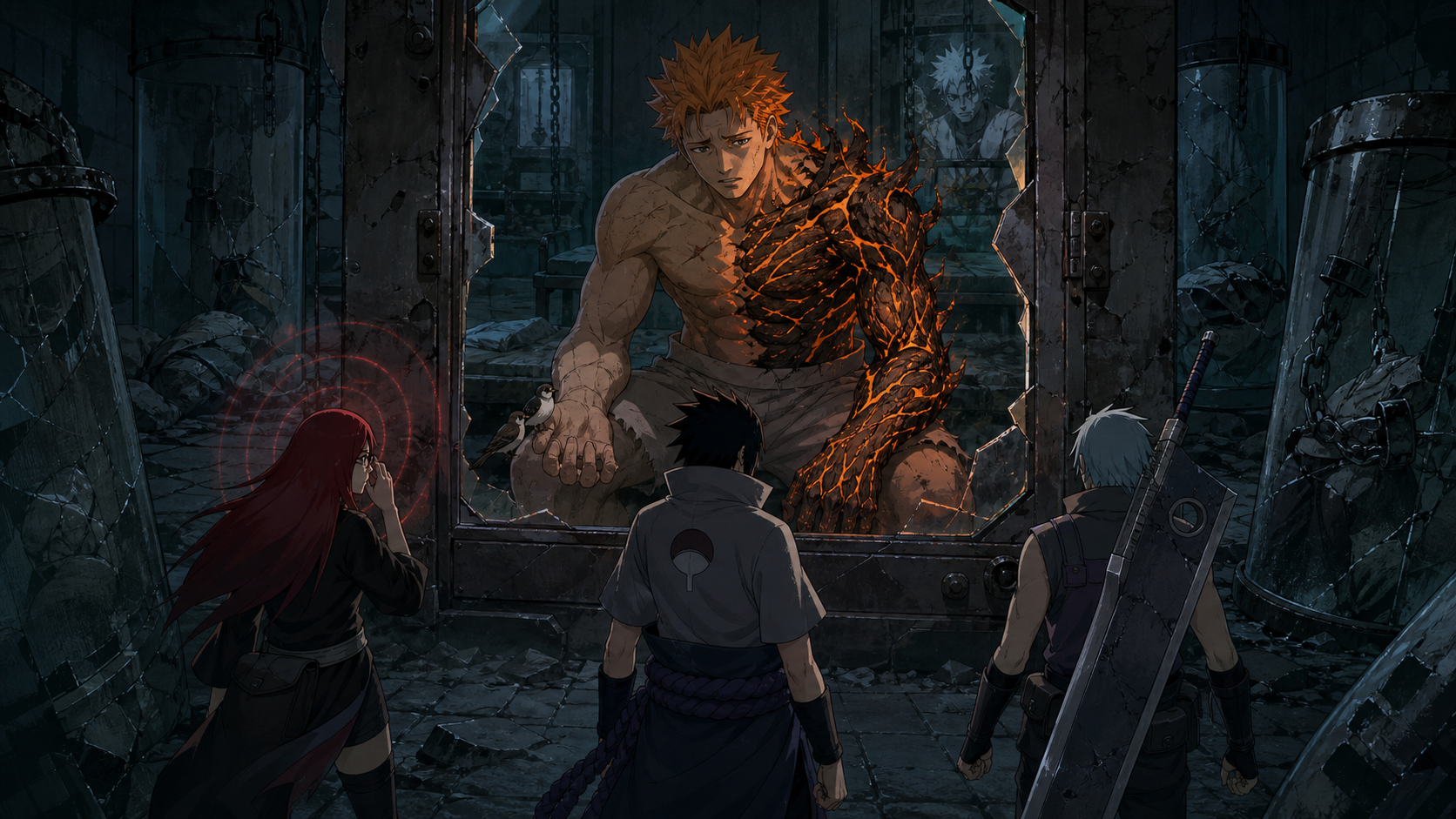
Jugo of the Northern Hideout
The final recruit is not simply violent. Jugo is the frightened human source Orochimaru mined to manufacture the curse mark.
What happens
Sasuke, Suigetsu, and Karin head to Orochimaru's northern hideout for the final recruit. Karin explains that the facility was used for horrific human experiments and that Jugo is central to the curse-mark program.
Jugo carries a natural enzyme that absorbs natural energy and triggers involuntary transformations. Orochimaru studied that condition, isolated the mechanism, and built his cursed seals from it. The power other shinobi received as a forbidden upgrade began as one man's body and a condition he could not safely control.
Jugo's transformation brings homicidal impulses he fears. He entered confinement because he wanted to stop hurting people, not because he enjoyed being a monster. The northern hideout turned that self-protective choice into access for experimentation.
Sasuke needs Jugo's strength, but recruitment requires more than opening a door. Jugo's connection to Kimimaro matters. Kimimaro once calmed him and gave him a reason to trust another person. Sasuke now arrives carrying the complicated legacy of the man Kimimaro died serving.
The curse mark began with a person
The curse mark has followed the story since the Chunin Exams as Orochimaru's branded shortcut to power. Episode 117 forces us to look behind the technique. Its source is not a neutral laboratory discovery. It is Jugo's biology.
Orochimaru takes an involuntary condition and turns it into a product he can implant into other bodies. The recipients experience pain, altered judgment, and dependence, while he gains a way to select, control, and test potential vessels.
Jugo receives no meaningful benefit from becoming the foundation of that program. His inability to regulate natural-energy absorption leaves him frightened of himself. Orochimaru gains a scalable weapon from the exact trait that makes Jugo vulnerable.
That is the hideout's real horror. The restraints and tanks are visible, but the deeper theft is conceptual: a person's medical crisis becomes somebody else's intellectual property.
Violence is not his whole identity
Jugo's homicidal episodes are dangerous. The people around him have every reason to protect themselves. Yet danger does not make cruelty the only honest response.
He seeks isolation because he understands the risk. That choice shows responsibility and fear, not evil. Small animals approach him when he is calm, revealing a gentleness the transformations do not erase.
The curse-state violence is part of his condition, but the story should not confuse symptoms with character. Jugo's character appears in how desperately he tries to prevent those symptoms from deciding other people's fate.
Kimimaro understood that distinction. He could stop Jugo without treating him as disposable. Their friendship gave Jugo a human relationship strong enough to interrupt the cycle of fear and attack.
The northern hideout has no moral authority
Calling the facility a prison suggests containment served public safety. Karin's explanation makes clear that experimentation was the real purpose. Orochimaru gathered dangerous or unusual people where no outside institution would inspect what happened to them.
Jugo's voluntary wish for confinement therefore does not authorize every procedure performed inside it. Consent to protection is not consent to extraction, cloning, cursed-seal development, or permanent captivity.
Sasuke's team enters after Orochimaru's fall, but the damage remains active. Subjects are still trapped, transformations continue, and the institutional chain of command has collapsed. Removing the director does not automatically free the people his system organized.
RaeRae's reaction
Jugo is one of the clearest examples of Naruto separating a dangerous condition from a person's moral worth. His transformations can kill people. He also hates that fact enough to lock himself away. Both truths belong in the same sentence.
Orochimaru saw that fear and found a research opportunity. Of course he did. He took the enzyme behind Jugo's loss of control, converted it into cursed seals, and distributed a distorted version to subjects who could advance his experiments.
The revelation makes Sasuke's curse mark even uglier. What looked like Orochimaru granting power was always a chain connecting one exploited body to another. Jugo's biology became the raw material; Sasuke's ambition became the delivery route.
Karin deserves credit for explaining the facility plainly. She worked inside Orochimaru's network, but she does not romanticize the northern hideout. Naming the experiments as horrific is a small act of honesty the organization never offered its subjects.
Suigetsu's confidence also meets a useful limit. A giant blade does not solve a transformation driven by absorbed natural energy and unstable impulse. This recruitment requires knowledge and connection, not merely force.
Kimimaro's memory gives the episode its emotional center. He was loyal to Orochimaru in a way I find tragic, but his care for Jugo was real. The organization exploited both young men while their friendship helped one of them survive it.
Sasuke arrives as somebody Kimimaro died to protect indirectly, which makes the recruitment ethically messy. He can use that connection to reach Jugo, but he should not pretend to inherit Kimimaro's trust automatically.
Jugo of the Northern Hideout asks whether Sasuke's new team can offer something different from Orochimaru's facilities. Freedom, defined roles, and shared goals are a start. The real test is whether Jugo remains a person when his power becomes useful and frightening at the same time.
Jugo sought containment before Orochimaru turned containment into access
My bottom line is that Jugo’s decision to isolate himself shows more responsibility than the adults who experimented on him. He knows the transformations can hurt people and wants distance during periods when control fails. Orochimaru sees the same fear and recognizes a body available for study.
Consent to a locked room for public safety does not become consent to procedures, samples, replication, or indefinite captivity. Jugo asked for help managing danger. The northern hideout converted that request into ownership of his condition.
The natural-energy enzyme is not a product Orochimaru invented
The curse mark carries Orochimaru’s branding, yet the underlying biological capacity belongs to Jugo. He absorbs natural energy automatically and transforms because his body cannot regulate the intake. Orochimaru studied the mechanism, modified the effect, and distributed cursed seals as tools of control.
Calling the technique his creation erases the person whose medical crisis supplied the foundation. Research can involve genuine discovery while remaining exploitative. Intelligence does not grant ownership of another person’s biology.
Jugo’s condition needs treatment, not a morality label
The homicidal impulses create real risk, and people nearby deserve protection. The transformations still do not reveal his ordinary moral character. Jugo fears causing harm, seeks isolation, forms gentle bonds with animals, and responds to people capable of calming him. Those choices belong to him more than the involuntary state does.
The distinction matters because the shinobi world often treats dangerous bodies as dangerous people. A humane plan manages symptoms, creates warning systems, and preserves dignity. A punitive plan waits for loss of control and then uses the violence as proof that confinement was always deserved.
The animals recognize the person the laboratory ignores
Small birds approaching Jugo provide more than a cute contrast. Animals respond to his calm state without the institutional story that labels him a source or monster. Their presence gives him a relationship where usefulness and fear are not the first terms.
That image should not be romanticized into proof that nature magically cures him. The transformations remain dangerous. The birds show that gentleness exists alongside the condition and that Jugo can participate in connection when the environment does not constantly trigger defense.
Kimimaro provided regulation through trust
Kimimaro could interrupt Jugo’s violent state because Jugo trusted him. Voice, presence, memory, and repeated safety became tools of regulation. The bond did not remove the enzyme or guarantee control, but the relationship gave Jugo a route back to himself.
That care existed inside Orochimaru’s abusive network, which makes the history complicated. Kimimaro loved the man exploiting them and still protected Jugo in a way the institution did not. Real affection can grow inside a harmful system without making the system responsible for the love.
Sasuke cannot simply inherit Kimimaro’s place
Jugo may recognize Sasuke as the person Kimimaro died helping, but association is not replacement. Kimimaro earned trust through time and specific acts. Sasuke can use the connection to open conversation, not to demand automatic loyalty.
If he tells Jugo that joining would honor Kimimaro, the argument risks turning grief into leverage. A fair offer explains the mission, danger, support available during transformations, and Jugo’s right to refuse.
The northern hideout’s label of prison hides a research facility
A legitimate secure medical setting would separate treatment from experimentation, review procedures, document consent, and plan for the least restrictive safe environment. Orochimaru’s hideout answers to none of those standards. Isolation protects secrecy more effectively than it protects patients or the public.
Karin naming the experiments as horrific matters because she worked inside the network. Her knowledge can identify rooms, records, surviving subjects, and procedures that need to stop. Honesty should lead to action rather than serving as background exposition.
The cursed seals connect many victims through one stolen mechanism
Sasuke, the Sound Four, Anko, and other recipients experienced different versions of a technique derived from Jugo. Each person carried pain, altered chakra, and a relationship to Orochimaru’s control. The marks appeared individual, yet the system connected them to one exploited source.
That network complicates responsibility. Jugo did not choose what Orochimaru built from his body. Recipients who harmed others remain responsible for choices made under varying degrees of coercion and altered judgment. The creator bears responsibility for designing the chain.
Sasuke carries evidence of the theft on his own body
The curse mark gave him power and helped bring him to the hideout. Meeting Jugo reveals that the gift was never only between Sasuke and Orochimaru. Another person’s condition sat beneath the technique from the beginning.
Sasuke should recognize that debt without treating Jugo as the owner of his choices. Jugo did not mark him, and Sasuke did not request Jugo’s biology. Both young men were placed inside Orochimaru’s design for different reasons.
Suigetsu’s confidence cannot solve involuntary transformation
A giant sword and liquefying body make Suigetsu dangerous in direct combat. Jugo’s power changes unpredictably with natural-energy absorption and violent impulse. Fighting harder may escalate the exact state they need to calm.
Suigetsu needs information, distance, agreed signals, and a way to restrain without humiliating or killing. The encounter tests whether Hebi can respond to danger with something beyond domination.
Karin’s sensory ability can help identify the transition early
She may detect chakra changes before Jugo’s body fully transforms. That warning could allow space, grounding, or voluntary restraint before somebody gets hurt. Early recognition offers more dignity than waiting until violence justifies overwhelming force.
The team should agree that detection does not give Karin unilateral authority over Jugo. She can report what she senses while he explains warning signs from inside his own body. Both forms of knowledge matter.
Jugo needs a crisis plan before joining a traveling team
The group should know triggers, early symptoms, helpful voices, safe distances, restraint methods, and when retreat becomes necessary. Jugo should participate in every part of that plan while calm. Decisions made with him are more reliable than rules imposed during a transformation.
Travel adds natural energy, unfamiliar terrain, civilians, and enemies who may deliberately provoke him. Sasuke wants strength for the Itachi mission, but strength without preparation can endanger the exact teammates he recruited.
A locked door can feel safer after freedom becomes uncertain
Jugo may resist leaving because confinement reduced the chance of killing somebody. Outsiders can interpret that choice as irrational attachment to prison. The fear is practical. Freedom without support may feel like being handed responsibility for every possible victim.
Recruitment should include an alternative to roaming unprotected. If Jugo says no, he still deserves safer care, supplies, and protection from renewed experimentation. Joining Hebi cannot become the price of opening the cell.
The team is collecting people Orochimaru defined by function
Suigetsu was experimental material and a swordsman. Karin was a surveillance system and sensor. Jugo was a biological source and weapon. Sasuke recruits each person for the same useful ability, which creates an uncomfortable resemblance to Orochimaru’s method.
The difference must appear in relationships: consent, separate goals, clear terms, the ability to leave, and care when an ability becomes inconvenient. Good intentions alone cannot separate Hebi from the laboratory.
Kimimaro’s devotion remains a warning for the new group
Kimimaro found purpose in serving Orochimaru and died completing a mission for him. His loyalty gave Jugo comfort while consuming his own life. Sasuke may admire the strength and use the connection, but he should not build another team where devotion means self-erasure.
Jugo deserves to remember his friend without being asked to repeat the sacrifice. Honoring Kimimaro can mean protecting the person he cared for rather than dying for the master who exploited both of them.
RaeRae’s final word on Jugo
I refuse the easy monster reading. Jugo is dangerous during involuntary transformations, and people need protection. He is also the person most frightened by that danger. Locking himself away was an attempt to prevent harm, not proof that he wanted captivity.
Orochimaru saw a medical crisis and imagined a product. The curse marks spread Jugo’s stolen mechanism across other bodies while leaving the source trapped without meaningful treatment. That is not innovation worth admiring without an indictment attached.
Kimimaro’s care mattered because he saw the person before the symptom. Sasuke cannot inherit that trust with one name. He has to offer honest terms, prepare for episodes, respect refusal, and keep Jugo human when the power becomes useful.
Hebi’s final recruit becomes the clearest test of the team’s ethics. If Sasuke only wants a weapon strong enough to reach Itachi, the cell door changes location. If Jugo can choose, plan, rest, fail safely, and remain valued outside transformation, freedom begins to mean something.
The northern hideout needs an emergency closure plan
Orochimaru’s defeat leaves laboratories without clear authority, and dangerous experiments do not become safe because the director vanished. Karin knows which rooms contain unstable subjects, medicines, records, restraints, and environmental hazards. Sasuke’s group should not open one cell and abandon the rest to hunger, panic, or whoever arrives next.
A responsible exit would release people who can travel safely, secure those in crisis, mark areas, and send information toward healers or investigators. Sasuke may reject Konoha, but he can still prevent the facility from continuing through neglect.
Jugo’s warning signs belong in his own words
Karin can observe chakra changes and Kimimaro once recognized behavior before transformation. Jugo remains the primary expert on what the transition feels like. He may notice heat, pressure, sound, intrusive thoughts, agitation, or changes in how natural energy enters his body. The team needs his description rather than building a plan entirely around outside observation.
Writing those signs down can help when memory becomes difficult during an episode. A shared plan should identify actions he finds grounding and restraints he considers tolerable. Preparation gives him agency before control begins slipping.
Restraint can protect without becoming punishment
Jugo may request physical containment because he fears killing somebody. The method still matters. Restraints should prevent immediate harm, allow breathing and circulation, avoid known triggers, and end when the dangerous state passes. Nobody should use isolation to discipline him for symptoms.
The group also needs an observer who can distinguish transformation from deliberate aggression. Anger, disagreement, or refusal must not become excuses to lock him away. Safety plans fail when authority uses them to silence inconvenience.
Natural energy connects Jugo to a larger system he does not understand
His body absorbs environmental power automatically, long before the story explains senjutsu. That link suggests the condition is not random evil inside him. The problem lies in uncontrolled intake and transformation. Knowledge from people experienced with natural energy could eventually offer safer regulation.
Orochimaru chose extraction because extraction served cursed-seal research. A healer or teacher might ask how to reduce exposure, recognize saturation, and build controlled release. The same phenomenon can support care when the goal changes.
Sasuke needs Jugo’s strength and should admit that plainly
Using Kimimaro’s memory to hide the practical reason for recruitment would be manipulative. Sasuke expects dangerous opposition while pursuing Itachi and wants a fighter capable of extraordinary power. Jugo deserves the direct version of the request.
Honesty lets him evaluate the risk. He may join because Kimimaro valued Sasuke, because travel offers purpose, because the hideout is unsafe, or because structured teammates could help manage transformation. Several reasons can coexist without turning one into destiny.
The team should not make Karin responsible for controlling Jugo alone
Her sensory ability may provide early warning, but permanent monitoring would reproduce the southern hideout’s dependence on her attention. Suigetsu and Sasuke need assigned roles too. One can create distance or physical interruption while the other uses voice, chakra control, or planned restraint.
Shared responsibility protects both members. Jugo does not become Karin’s private burden, and Karin does not become the alarm expected to prevent every possible failure. A team earns the word team by distributing care along with combat.
Jugo’s gentleness should survive outside the cell
The birds show what he is like when fear and transformation are not controlling the moment. Hebi should leave room for that person through quiet travel, contact with animals, practical tasks, and relationships not organized around crisis. A life cannot consist only of managing the next dangerous episode.
Purpose also needs to extend beyond serving Sasuke. Jugo may want to understand his condition, honor Kimimaro, protect teammates, or explore a world the hideout kept away. Those goals make freedom durable because they belong to him.
RaeRae’s call
Jugo asked for safety from a condition he feared. Orochimaru turned that request into access to his body. Hebi must offer support without making team membership the price of release.