
Zabuza’s Blade
Sasuke frees Suigetsu, but liberation is not automatic loyalty, and the first negotiation leads back to a grave Team 7 never forgot.
What happens
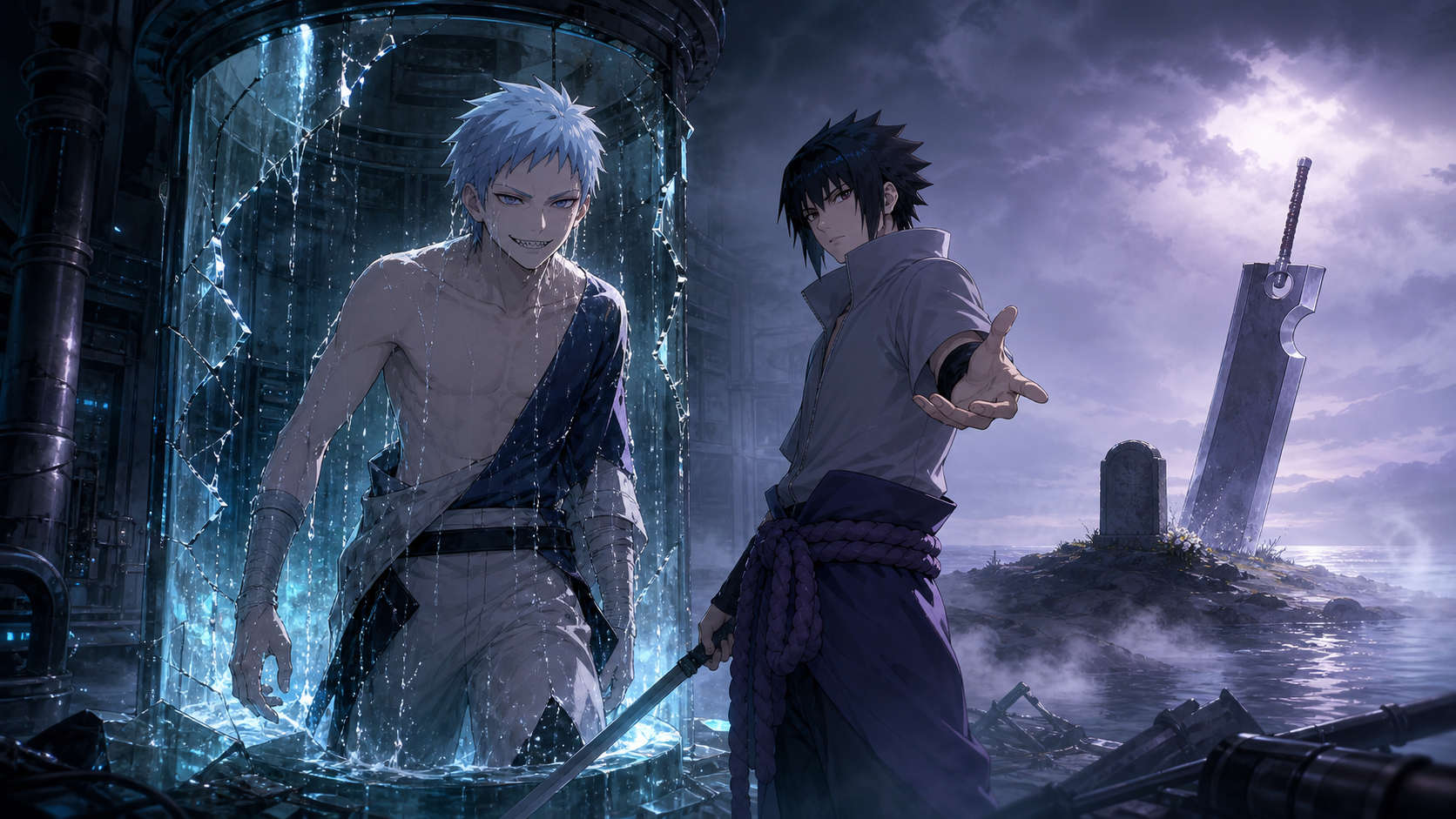
After defeating and suppressing Orochimaru, Sasuke begins assembling the team he needs to reach Itachi. His first recruit is Suigetsu Hozuki, a young swordsman Orochimaru kept suspended inside a water tank as an experimental subject.
Sasuke breaks the tank and offers freedom with conditions. He wants Suigetsu to join his mission. Suigetsu does not accept immediately, and that hesitation establishes the relationship correctly: liberation does not create automatic loyalty.
Suigetsu has his own objective. He wants the massive blade once carried by Zabuza Momochi, the Executioner's Blade left at Zabuza's grave in the Land of Waves. Sasuke agrees to help retrieve it, making the recruitment a negotiation between two people whose ambitions temporarily align.
Their journey reconnects Shippuden to one of the original series' defining missions. Zabuza and Haku's deaths taught Naruto and Team 7 that shinobi called tools still love, grieve, and choose. Suigetsu approaches the grave through a different inheritance: the weapon, reputation, and unfinished dream of the Seven Ninja Swordsmen of the Mist.
Freedom does not mean debt
Sasuke freeing Suigetsu could have been staged as instant heroism. The episode wisely lets Suigetsu remain suspicious. Orochimaru imprisoned and studied him, so another powerful stranger opening the tank and presenting a mission deserves scrutiny.
Sasuke is not offering a charitable rescue. He needs a capable water-style fighter and swordsman. The act improves Suigetsu's life, but it also serves Sasuke's revenge plan. Both facts can be true.
Suigetsu protects his agency by bargaining. He identifies what he wants before joining: access to Zabuza's blade and movement toward his own larger ambition. That prevents the new team from becoming a copy of Orochimaru's hierarchy, at least for now.
The blade carries more than steel
The Executioner's Blade is physically absurd and historically heavy. It belonged to one of the Seven Ninja Swordsmen, then became inseparable from Zabuza's image as the Demon of the Hidden Mist.
For the audience, the sword also carries the bridge mission. We remember Zabuza pretending not to care about Haku, then breaking when Naruto forced him to face the lie. We remember Kakashi standing at the grave after a mission that changed how Team 7 understood the profession.
Suigetsu wants the weapon as part of his dream to gather the legendary blades and rebuild the Seven Swordsmen. That ambition risks reducing Zabuza back into a symbol of power after his final moments exposed the human being beneath the title.
The episode does not require Suigetsu to share Team 7's grief. He never experienced the bridge. Still, viewers cannot see the blade as neutral loot. Its silhouette carries a dead man's choices.
Sasuke starts building Hebi
Sasuke's recruitment method reveals how he differs from Orochimaru. He selects people for specific abilities, but he does not pretend they exist without personal goals. He expects cooperation around a defined target rather than worship.
That is healthier than possession, but it is not friendship yet. Sasuke's central objective remains killing Itachi. Suigetsu's freedom matters to him partly because a free and motivated ally is useful.
The team will function only if those separate ambitions remain compatible. Suigetsu wants swords. Sasuke wants access, information, and combat support. Neither promises emotional allegiance.
That arrangement suits Sasuke because intimacy feels dangerous. Team 7 loved him enough to challenge his revenge, while hired allies can be given tasks and boundaries. He is building a team designed to avoid the kind of bond he left behind.
RaeRae's reaction
Suigetsu's introduction is fun because he refuses to behave like a grateful rescue project. He comes out of a laboratory tank, assesses Sasuke, and immediately asks what the deal costs. Good. He has already spent enough time being treated as material.
Sasuke also benefits from having somebody who talks back without carrying Team 7's emotional history. Suigetsu can question him without begging him to return to Konoha. Their friction feels practical and sharp.
The trip to Zabuza's grave hits differently after all this time. That sword was once the most terrifying object in Naruto's world. Now Sasuke can approach it as equipment for a recruit, which shows how far the power scale has moved without making the original arc smaller.
I do not love the idea of a grave becoming an armory, but the discomfort belongs in the story. Shinobi villages constantly turn dead fighters into techniques, legends, bloodlines, and weapons for the next generation. Suigetsu is participating in the same inheritance economy.
The important difference is that the blade is tied to his own chosen ambition. Orochimaru collected people and tools to extend himself. Suigetsu wants the swords because they connect to the identity he is building, not because somebody assigned him the role.
Sasuke's offer remains transactional, yet it gives Suigetsu room to refuse. That modest boundary is meaningful after the hideout's captivity. Freedom is not proven by an unlocked door alone; it is proven when saying no remains possible.
Zabuza's Blade opens a new team-building sequence without pretending Sasuke suddenly became warm. He has removed Orochimaru, identified his target, and started recruiting specialists. The hawk is no longer trapped in the serpent's den. Now we get to see what kind of formation he creates when every member arrives with teeth and a separate plan.
Opening the tank does not erase the captivity
My bottom line is that Suigetsu’s introduction works because he does not confuse release with rescue. Sasuke breaks the tank, but the months or years inside do not disappear with the water. Suigetsu wakes into a hideout controlled by another powerful person who immediately wants something from him. Suspicion is the healthy response.
He needs food, clothing, physical assessment, information about the outside world, and time to understand what Orochimaru did. The episode moves quickly toward recruitment because the plot has a destination, yet the body coming out of that tank has endured confinement and experimentation. Freedom should include recovery, not only motion.
Sasuke offers terms because he understands forced ownership
After defeating Orochimaru’s possession ritual, Sasuke knows exactly what happens when a powerful person treats help as a deed to another body. He does not ask Suigetsu for worship or claim that opening the tank creates permanent debt. He names a mission and allows negotiation.
That boundary marks genuine difference from Orochimaru, but the standard remains low. Sasuke still approaches Suigetsu because his abilities are useful. The relationship becomes ethical only if refusal stays possible after the first agreement and if each member can leave without punishment.
Suigetsu bargains before gratitude can become a cage
He identifies the Executioner’s Blade as his condition. The demand is not a random detour. The sword connects to his ambition, his village’s history, and the identity he wants after being reduced to an experimental subject. Bargaining tells Sasuke that the new ally arrives with a future of his own.
That choice also protects Suigetsu from the emotional script of rescue. He does not need to perform gratitude, admiration, or instant loyalty. He can recognize that Sasuke improved his circumstances while asking what the arrangement provides in return.
The Land of Waves remembers a different Zabuza
For Sasuke and the audience, the blade cannot be separated from the bridge mission. Zabuza was the first enemy who forced Team 7 to see how the shinobi system turned people into tools. Haku’s death and Naruto’s confrontation cracked the demon title open and revealed grief beneath performance.
Suigetsu approaches through legend rather than memory. He sees a famous weapon and a place in the Seven Ninja Swordsmen’s inheritance. Neither perspective is false. The tension comes from a sword carrying public reputation, personal grief, village history, and practical combat value at once.
A grave is not a free equipment locker
I understand why Suigetsu wants the blade, but taking a weapon from a grave raises questions the episode moves past quickly. Who buried Zabuza? Who decided the sword belonged there? Does the nearby community consider the grave protected? Does Kirigakure claim the weapon as village property? Legendary equipment accumulates owners who do not agree.
The shinobi world treats dead fighters as sources of techniques, bodies, bloodlines, intelligence, and symbols. Suigetsu’s plan fits that culture. The familiarity should not make the extraction neutral. Respect for Zabuza does not require leaving the blade forever, but somebody should acknowledge the person before claiming the steel.
The Executioner’s Blade carries the labor of maintenance
A sword that large requires strength, balance, transport, repair, and constant practice. Suigetsu’s unusual body helps him wield the weapon, yet desire alone will not make mastery immediate. He wants the symbol and accepts the physical job attached to the symbol.
The blade’s reputation can also attract enemies. Carrying such a recognizable object announces his identity and location. A legendary weapon grants power while narrowing anonymity. Suigetsu chooses both consequences when he lifts it.
Sasuke returns to a place tied to Team 7 without returning to them
The Land of Waves holds early memories of Kakashi, Naruto, Sakura, and shared danger. Sasuke once risked himself for Naruto before he had language for that attachment. Passing through the region now should carry emotional pressure even if he refuses to discuss it.
His silence does not prove the memories vanished. Avoidance can be evidence of importance. Sasuke is building a replacement team designed around function and controlled terms while walking near a grave connected to the first team that became personal.
Hebi begins as a contract among dangerous strangers
Sasuke needs specialists who can help locate and confront Itachi. Suigetsu offers combat skill, unusual physiology, knowledge of Orochimaru’s network, and ambition strong enough to keep him moving. The relationship starts with aligned goals rather than affection.
Contracts can be healthier than false intimacy because the terms are visible. They can also become exploitative when one person controls information, resources, and exit. Sasuke must decide whether Hebi members are partners whose goals matter or tools whose independence lasts only until it complicates revenge.
Suigetsu’s humor protects distance
His sharp comments and refusal to act impressed keep Sasuke from controlling the emotional tone. Humor lets Suigetsu question authority without turning every disagreement into a formal confrontation. After captivity, that ability to annoy the person holding power can be a small test of safety.
Sasuke tolerating the pushback matters. Orochimaru surrounded himself with people expected to obey or perform usefulness. A team where somebody can make a joke at the leader’s expense has at least one sign that hierarchy remains negotiable.
Water is both Suigetsu’s strength and a reminder of confinement
His body can liquefy, reform, and interact with water in ways that make him difficult to restrain. Orochimaru still kept him inside a tank. The same element associated with his power became the medium of captivity. Freedom may therefore carry a physical memory every time his body changes.
The episode does not need to turn that history into a speech. Small behaviors can show the effect: checking exits, resisting closed rooms, demanding access to water on his own terms, or reacting sharply when somebody discusses his body as an ability.
The Seven Swordsmen dream is also a political inheritance
Suigetsu wants more than one famous weapon. Rebuilding or surpassing the Seven Ninja Swordsmen connects him to Kirigakure’s violent history, military prestige, and mythology. The dream can restore identity after experimentation, but the organization he admires was never only a collection of cool blades.
Zabuza participated in the Bloody Mist’s culture and attempted a coup. Kisame carried another sword into the Akatsuki. The title holds ambition, brutality, exile, and village politics. Suigetsu will have to decide which parts of that inheritance he wants to continue.
Zabuza’s final choice complicates the weapon’s legend
He died after admitting, through action and grief, that Haku was more than a tool. The blade belonged to the demon persona, but the grave marks the person who broke that performance at the end. Suigetsu cannot know the bridge mission the way Team 7 does, yet viewers bring that knowledge to every shot of the sword.
The weapon therefore carries a warning for Hebi. A team assembled for function may still create bonds. Pretending those bonds are irrelevant does not prevent them from shaping decisions. Zabuza learned that truth too late.
Sasuke’s freedom remains organized around one target
He escaped Orochimaru and immediately begins building the route to Itachi. Movement looks like independence, but revenge still dictates the schedule, recruits, and destination. Sasuke has removed one owner while keeping a single purpose in control of nearly every choice.
That distinction does not diminish his victory. It clarifies the next danger. Freedom requires more than replacing an external master with an internal command that cannot be questioned.
The recruitment needs an honest exit condition
Suigetsu should know when his obligation ends. Is he joining until they locate Itachi, until the fight concludes, or until Sasuke helps collect more blades? Ambiguous terms benefit the person setting the mission. Clear terms protect both members when priorities separate.
The same clarity should apply to risk. Sasuke knows Itachi and the Akatsuki are deadly. Suigetsu deserves enough information to decide whether the blade is worth the danger. Consent requires knowledge of the assignment, not merely freedom to say yes.
RaeRae’s final word on Zabuza’s blade
I like Suigetsu immediately because he refuses the grateful-prisoner performance. Sasuke opened the tank. Good. Suigetsu still gets to ask what comes next, demand something for himself, and decide whether this new powerful stranger is another owner wearing a calmer face.
The blade makes the episode richer because Naruto fans cannot see neutral metal. I see Haku, the bridge, Naruto screaming at Zabuza, Kakashi beside the grave, and the first time Team 7 learned that the word tool was a lie people used to survive grief.
Suigetsu sees another story: Kirigakure, legendary swordsmen, a weapon worthy of his body, and a dream interrupted by Orochimaru’s tank. He does not need to inherit Team 7’s feelings. The page needs enough memory to let both histories stand beside the grave.
Hebi begins with a useful boundary. Sasuke wants help. Suigetsu wants the blade. They negotiate. The next test is whether Sasuke still respects separate goals when a teammate’s choice interferes with Itachi. Freedom is proven each time no remains possible, not once when glass breaks.
Retrieving the blade should include the people living nearby
The Land of Waves is not an empty memorial map waiting for Sasuke and Suigetsu. People rebuilt after Gato’s violence, completed the bridge, and continued living around the site where Zabuza and Haku died. Arriving with shinobi power to remove a famous weapon could frighten residents who remember what that blade once meant.
A respectful visit would ask who maintains the grave and whether the community has customs around the site. Suigetsu may still take the sword, but acknowledging local memory prevents the episode from treating civilians as scenery around ninja inheritance.
Sasuke’s presence changes the meaning of the return
Naruto would approach the grave through grief and gratitude. Kakashi might remember responsibility for both enemies and students. Sakura could recall how unprepared Team 7 was. Sasuke returns after leaving all three, carrying Orochimaru’s power and recruiting a new team. The location quietly measures the distance he traveled.
He does not need to narrate every memory. A pause, glance, or refusal to answer Suigetsu could show that the bridge mission remains inside him. Emotional restraint is believable. Emotional absence would flatten one of the experiences that shaped his early understanding of sacrifice.
Suigetsu needs information about how Zabuza died
If he wants to inherit the blade, he should know more than the swordsman’s reputation. Zabuza died attacking Gato after admitting Haku mattered to him. The final act was not a legendary duel for status. The act was grief, rage, and a late rejection of the tool language he had used.
That story could complicate Suigetsu’s dream in a useful way. Rebuilding the Seven Swordsmen cannot mean collecting silhouettes while ignoring what each owner learned, destroyed, or regretted.
The blade tests whether possession can become stewardship
Suigetsu can carry the sword as property, trophy, inheritance, or responsibility. A trophy exists to enlarge the owner. Stewardship recognizes history, maintenance, and the possibility that the object should outlast the current wielder. The episode does not need a formal oath, but his treatment of the grave and blade can show which relationship he chooses.
He should repair damage, learn technique, understand previous users, and avoid claiming Zabuza’s reputation without earning his own. Carrying a famous weapon creates duties along with spectacle.
Sasuke should not use freedom as a recruitment shortcut
Opening the tank gives Suigetsu an immediate reason to cooperate, but Sasuke needs to separate emergency help from team membership. The first safe destination should not depend on joining Hebi. Food, clothing, and release from the hideout should not become benefits withdrawn if Suigetsu says no.
The negotiation feels fairer because Suigetsu has leverage and voices a demand. Future recruits may have fewer options. Sasuke’s ethics will be measured by how he treats the person who cannot bargain as aggressively.
The episode’s humor should not hide the trauma
Suigetsu’s attitude keeps the story lively after Orochimaru’s grotesque defeat. The jokes and irritation belong to his voice. Humor can coexist with captivity rather than proving captivity caused no harm. People often use sharpness to reclaim control of a room.
The writing should let him be funny without making every concern a gag. He can tease Sasuke, complain about the journey, and still take closed spaces, bodily control, or experimentation seriously when those subjects return.
Zabuza’s blade carries history Suigetsu cannot see yet.
RaeRae’s call
Sasuke opens the tank, but Suigetsu protects his own freedom by bargaining before gratitude becomes obedience. Hebi will be different from Orochimaru only if that right to refuse survives pressure.