
A Place to Return to
The battle ends in injury and uncertainty, but Yukimaru may finally receive a future that does not depend on controlling the Three-Tails.
What happens
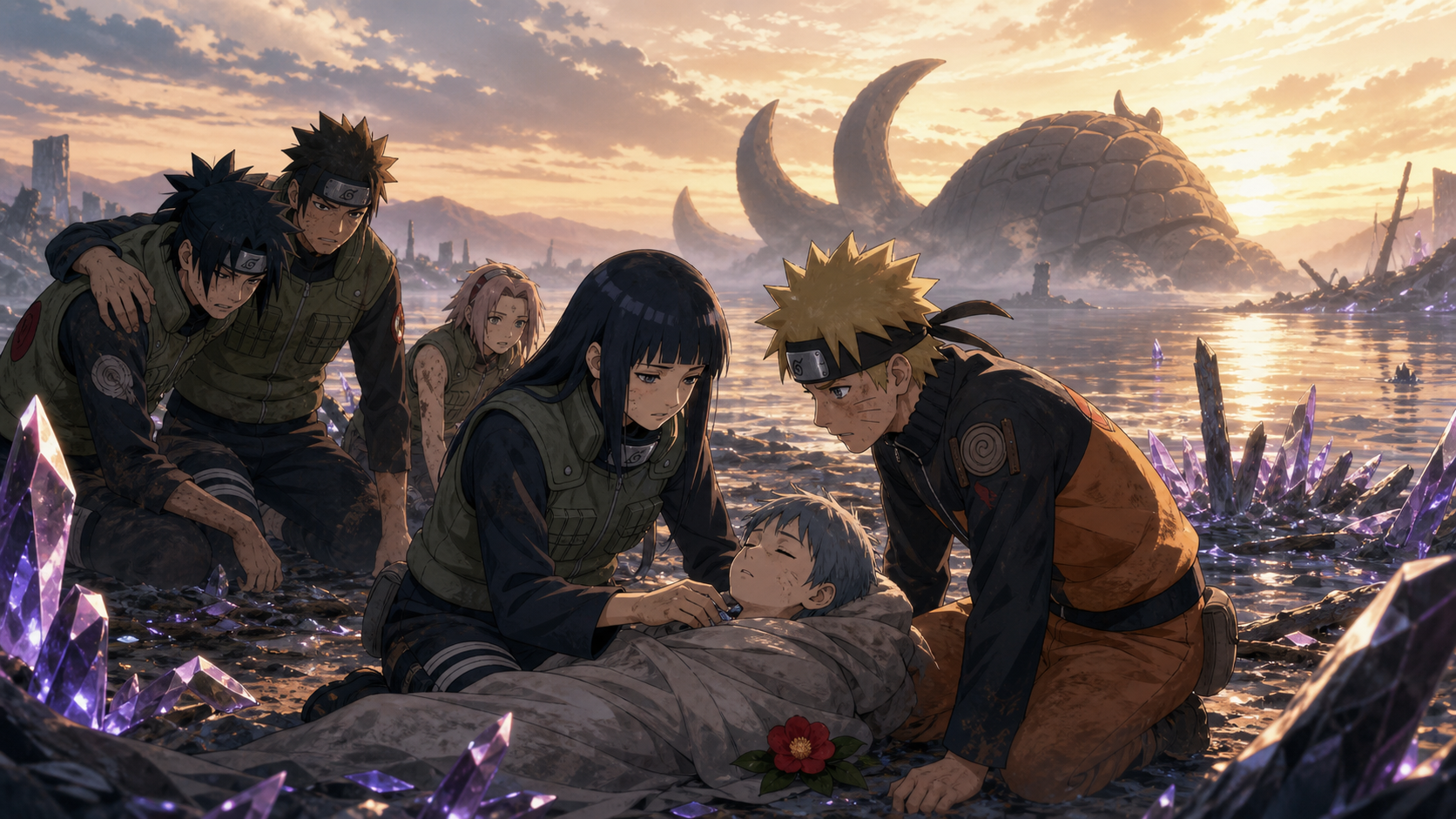
The Leaf shinobi pull back from the ruined lake and begin treating the damage. Nobody walks away clean. The sealing team is exhausted, fighters carry serious injuries, and Yukimaru lies unconscious after Kabuto forced his power far beyond anything his body could safely sustain.
Shizune's examination delivers the clearest sign that Orochimaru's plan has ended: Yukimaru can no longer control the Three-Tails. Kabuto treated that ability as the child's only value, but losing it may be the first real protection Yukimaru has received. The organization no longer has the same reason to hunt him, and the beast can retreat beyond another attempt at human ownership.
Naruto struggles with uncertainty around Guren. Her crystal remains scattered across the battlefield, and the damage suggests she may have died protecting Yukimaru. The boy's red camellia carries the memory of their promise even before he wakes.
The mission ends without the Leaf sealing the Three-Tails. On paper, that looks like failure. In human terms, the team prevents Kabuto from sacrificing Yukimaru, survives an impossible containment attempt, and leaves the beast outside Orochimaru's control. Those outcomes matter more than a clean mission report.
Yukimaru is not a failed weapon
The line about Yukimaru losing control of the Three-Tails could sound tragic if the episode accepted Kabuto's values. It does not. His body has spent the arc screaming that this power was never a sustainable assignment. Collapse is not proof that he lacked discipline. It is proof that adults kept demanding something destructive.
Shizune approaches him as a patient rather than an asset. That difference changes the entire meaning of the examination. She wants to know what his body needs, not whether the experiment can resume. Medical knowledge becomes care instead of extraction.
I wish the shinobi world made that distinction more often. Children in Naruto constantly receive praise for surviving burdens they should never have carried. Yukimaru does not need a stronger technique or another motivational speech. He needs sleep, treatment, honest information, and adults who will not invoice him for their kindness.
The mission failed correctly
The Four-Corner Sealing Barrier does not capture the Three-Tails, and the creature escapes into deep water. That outcome frustrates the village objective, but forcing another round after the team is injured would repeat Kabuto's logic. A responsible commander has to recognize when completing the assignment would consume the people performing it.
Retreat is not cowardice here. It is the point at which the Leaf stops treating effort as infinitely renewable. Shizune, Sakura, Hinata, Ino, Kakashi, Yamato, Naruto, and the tracking teams all contributed. Their work kept Orochimaru from gaining the beast even though it did not produce a neat victory pose.
The Three-Tails also deserves to leave. Every faction entered the lake assuming the creature could become somebody's resource. Its retreat refuses that ownership. The beast is dangerous, but danger does not automatically grant a village moral title to its body.
A place to return to
The title completes Yukimaru's repeated belief that home is wherever someone thinks of you. Guren complicated that promise because she began as one of the adults manipulating him. Her affection became genuine, but genuine feeling did not erase the harm or guarantee survival.
What matters is that she eventually chose the child over Orochimaru's approval. The red camellia and remaining crystal fragments preserve that choice when certainty disappears. Yukimaru can remember Guren as someone who finally protected him without pretending she had always done so.
The episode leaves enough quiet hope to resist a cruel ending. A place to return to does not have to be a building or official village status. It can begin with proof that another person chose your life when using you would have been easier.
Naruto understands this instinctively. Iruka's recognition gave him a first emotional home before Konoha earned the right to celebrate him. That history is why Naruto refuses to let Yukimaru's future be measured by whether his unusual power comes back.
RaeRae's reaction
I appreciate an arc finale willing to admit that survival can be the victory. The Leaf does not seal the Three-Tails, Naruto does not deliver a perfect defeat to Kabuto, and Guren's fate is not wrapped in a cheerful bow. Everybody is too hurt for that kind of lie.
Shizune's medical assessment is the emotional hinge for me. Kabuto would hear that Yukimaru cannot control the beast and call the subject useless. Shizune hears it and continues treating a child. Same knowledge, completely different ethics.
The exhaustion on the shore also validates the sealing team. They held a technique against tailed-beast chakra while enemy shinobi attacked their formation. Their retreat does not make their effort pointless. It proves the mission finally acknowledged their bodies had limits.
Naruto's concern for Guren feels earned even after opposing her. He can condemn what she did and recognize the choice she made at the end. Accountability does not require flattening a person into the worst order they obeyed.
Yukimaru's future remains uncertain, but uncertainty is better than the certainty Orochimaru offered. Under Kabuto, the boy had a defined purpose and no safe life. Now he has no assigned function, which gives him the first chance to discover an identity beyond the Three-Tails.
The arc ran longer than it needed to, and several battles repeated the same strategic pressure. Still, the conclusion lands because it refuses to make possession of the beast the only score that counts. Orochimaru loses access. Yukimaru survives. Guren breaks obedience. The Leaf learns to withdraw.
A Place to Return to closes on a truth Naruto has carried since childhood: belonging that depends on usefulness is not belonging. Yukimaru deserves people who remember him when he cannot summon anything, control anything, or repay anyone. The moment his power disappears is the moment that promise can finally become honest.
The ending refuses to call a child useless
My bottom line is that Episode 112 finds its moral center when Yukimaru loses the ability everybody wanted. Orochimaru’s operation valued him because his chakra could influence Isobu. Kabuto kept pushing his body because usefulness mattered more than survival. Once Shizune confirms the connection is gone, the story has to decide whether the child still matters. Her treatment answers correctly before anybody delivers a speech.
Loss of power can feel frightening to Yukimaru. The ability tied him to Guren, made adults pay attention, and gave him a defined role even while that role hurt him. Freedom therefore may arrive with grief, confusion, and fear of abandonment. The adults cannot celebrate the medical result over his head. They need to explain what changed and prove care will continue.
Shizune restores the meaning of medical authority
Kabuto used expertise to calculate how much suffering Yukimaru might survive. Shizune uses expertise to stop demands, assess damage, and protect recovery. The contrast matters because both characters understand anatomy, chakra, drugs, and risk. Knowledge does not carry an automatic ethic. The person applying that knowledge chooses whether a patient remains a person.
Her examination should include more than the question of Isobu. Yukimaru needs monitoring for poisoning, chakra exhaustion, dehydration, neurological injury, memory gaps, and delayed reactions. The team should preserve samples and record symptoms. Medical care also requires privacy. He should not wake surrounded by commanders waiting to ask when his power might return.
Recovery needs a plan longer than one quiet morning
Sleeping after the battle is necessary, but rest cannot solve everything Kabuto did. Yukimaru may experience pain, nightmares, distrust, confusion about Guren, and fear that protection will disappear now that his ability has faded. A responsible plan includes follow-up care, stable shelter, familiar people, and honest answers delivered at a pace he can manage.
The team also needs to guard against a new form of extraction. Intelligence officers may want hideout locations, descriptions of experiments, and details about Orochimaru. Those questions can wait until Shizune says he is medically ready and Yukimaru agrees. Safety cannot become payment for testimony.
The mission report should name what actually succeeded
A narrow report might say the Leaf failed to seal the Three-Tails. That sentence would erase the lives saved and the enemy objective denied. Kabuto did not recover Yukimaru. Orochimaru did not gain Isobu. The sealing team survived. Naruto and Guren escaped the creature. A child left the battlefield with less exploitable power and more possible choices.
Those results belong in the official record because institutions learn from what they count. If only captured assets define success, the next commander will repeat the same dangerous push. A report that values withdrawal, medical limits, and prevention of enemy control can change later decisions.
Retreat protects the exhausted people who held the line
Shizune, Sakura, Hinata, and Ino spent sustained chakra on a technique facing a tailed beast. Kakashi, Yamato, Naruto, Kiba, Akamaru, and the others fought across two fronts. The team has injuries, depleted reserves, and limited information. Continuing would not prove courage. Continuing would gamble lives for an objective already slipping away.
A commander earns trust by ending a mission before total collapse. Shinobi culture praises endurance so loudly that retreat can look shameful even when retreat is the professional choice. Episode 112 lets survival outrank pride. The exhausted people on the shore are evidence that the limit arrived.
Isobu’s escape is not a loose end that needs punishment
The Three-Tails remains dangerous and may threaten people later. The creature also endured pursuit, sealing, forced contact through Yukimaru, and attacks from several directions. Retreating into deep water is a reasonable response to a battlefield humans created around the beast. The Leaf does not earn ownership because its containment method was more organized than Orochimaru’s.
Future contact should begin with observation, evacuation planning, and attempts to understand Isobu’s movements. Another immediate capture operation would repeat the assumption that danger grants possession. The arc becomes more meaningful when the beast’s freedom counts alongside human survival.
Guren’s uncertain fate should not become a shortcut around accountability
Crystal fragments and silence make Naruto fear she died. Sacrifice can feel like a clean ending because a dead person never has to answer hard questions. Guren’s story deserves more. If she survived, she needs to face Yukimaru, tell the truth, provide information about the experiments, and accept whatever relationship he chooses after learning everything.
If the others believe she died, they should still preserve an accurate account. Yukimaru deserves to know both the harm she caused and the protection she chose. Turning her into a flawless martyr would be another lie built for emotional convenience.
Yukimaru should hear about Guren from people who witnessed her choice
When he wakes, adults may want to soften the news or avoid discussing uncertainty. That silence leaves him alone with imagination. Naruto can say that Guren protected the sealing team, fought against Kabuto’s objective, and remained connected to the rescue until the lake collapsed. He should separate what he saw from what he hopes.
Honest uncertainty allows grief without closing possibility. Saying she is definitely dead would exceed the evidence. Saying she will certainly return would offer comfort that may later become betrayal. Yukimaru has already lived inside too many stories designed to manage his behavior.
Home cannot depend on one person carrying every emotional need
Yukimaru’s idea of home centers on Guren because she became his strongest bond. That attachment is real, but no child should have only one possible place to return to. Naruto, Shizune, Sakura, and the others can help create a wider network of safe relationships without asking him to replace Guren.
A network protects him from future exploitation. If one adult leaves, becomes ill, makes a mistake, or loses trust, Yukimaru still has people to call. Home can include a caregiver, medical team, friends, education, routine, and a voice in daily decisions. Belonging becomes safer when nobody controls the entire doorway.
Naruto needs to resist making his own story the answer
Naruto found belonging through Iruka, Team 7, and a long fight for recognition inside Konoha. He may naturally believe Yukimaru needs a similar village connection. The comparison can offer hope, but Yukimaru has different wounds and may not want a shinobi identity at all. Help should not arrive with a required character arc.
Naruto can share experience when invited, listen when the details diverge, and defend Yukimaru’s right to choose a quieter future. The most generous version of empathy does not demand imitation.
The camellia now represents a question rather than an answer
Earlier, the red camellia marked Guren’s promise and gave Yukimaru a direction. At the end, the flower carries memory without certainty. Guren may be alive. Their relationship may continue. The truth about his mother may break trust. The symbol no longer guarantees a safe destination.
That change makes the flower stronger. A meaningful object does not have to solve grief. The camellia can remind Yukimaru that Guren chose him at a decisive moment while leaving him free to judge the whole relationship later.
The arc needed fewer repeated battles and more aftermath
I will say the blunt part: the Three-Tails arc repeats sealing pressure, rescues, barriers, mist, and recapture attempts longer than necessary. Several episodes circle the same tactical problem while the character material waits. The ending works because the emotional questions were always better than another exchange of techniques.
I wanted more time with the medical and social aftermath. What drugs remain in Yukimaru’s body? Who explains Guren’s history? Where does he sleep next week? How does the Leaf record a failed sealing operation that still prevented Orochimaru from winning? Those questions would give the conclusion more weight than another extended attack.
Failure should change the next Leaf operation
The barrier required four specialists to remain exposed and consumed enormous chakra. The mission lacked a strong evacuation plan for the sealing team and depended on controlling variables nobody understood. A useful debrief should examine those structural problems rather than blaming individual stamina.
The village also needs rules for missions involving exploited children. Medical authority, consent, custody, questioning, and protection from enemy recapture should be planned before combat. Yukimaru cannot become a one-time lesson everyone praises and nobody applies.
RaeRae’s final word on the place to return to
I like that Yukimaru’s power disappears before the story decides whether he deserves a future. Kabuto would call him useless. Shizune calls him a patient by the way she works. That difference is the whole arc in one quiet medical scene.
The Leaf failed to capture Isobu, and I am comfortable calling that the correct failure. The team was injured, the barrier was breaking, and another push could have killed the specialists and the child. Orochimaru still lost access. The beast escaped ownership. Survival is not a consolation prize when possession was the wrong scoreboard.
Guren’s choice matters, but I do not want crystal fragments to turn her into a saint. Yukimaru deserves the whole truth if she returns. He may love her, forgive her slowly, remain angry, or decide that home needs distance. His answer should not exist to reward her redemption.
A place to return to begins when care survives the loss of usefulness. Yukimaru cannot summon or control the Three-Tails anymore. Good. Let him wake and discover that food, medicine, safety, explanation, and affection remain available anyway. That is the promise every adult should have made before anybody asked what his chakra could do.
The quiet shore still contains decisions
The battle may be over, but the next hour determines whether the survivors are truly safe. Weapons need to be collected, missing people counted, injuries triaged, and Kabuto’s possible return considered. Someone must watch the water without provoking Isobu. Someone must remain beside Yukimaru when he wakes. Quiet does not mean the crisis has organized itself.
Kakashi should assign those tasks before exhaustion scatters attention. The strongest shinobi may need treatment first. The least injured person may become the temporary coordinator. A good aftermath scene respects fatigue by showing people simplify the plan rather than suddenly recovering because the music softened.
Yukimaru needs ordinary choices as soon as he can make them
Large decisions about Guren, Konoha, and his future can wait. Small choices should return immediately: water or broth, light or shade, company or privacy, which blanket, who sits nearby, and when questions stop. Kabuto controlled his body through a sequence of imposed decisions. Recovery can begin through a sequence of respected ones.
The Leaf should not keep the loss of power secret
Somebody may think Yukimaru needs protection from the news that his connection to Isobu has faded. Hiding the result would repeat the same paternalism that let other adults manage him. Shizune can explain what she knows, state what remains uncertain, and make clear that his treatment does not depend on the ability returning.
He may grieve. The power caused pain, but the connection also shaped identity and linked him to Guren. Relief and loss can arrive together. Nobody needs to correct his feelings into the emotion adults prefer.
The arc closes best when usefulness leaves before belonging
Yukimaru spent the story hearing that home exists where somebody thinks of him. The finale tests that belief after the strategic reason to keep him disappears. If people remain, feed him, treat him, answer him, and help search for Guren, belonging becomes evidence rather than poetry.
That is the ending I want carried into the Naruto story. Power should never be the admission price for care. The child who cannot summon the Three-Tails is the same child who deserved protection before the first experiment began.
RaeRae’s call
The mission succeeds where the official objective fails. Yukimaru survives, Orochimaru loses access, Isobu escapes capture, and the Leaf finally stops before effort becomes another excuse to spend people.