
Guidepost of the Camellia
Naruto and Guren are missing inside the Three-Tails, so the rescue depends on a frightened child whom every adult has already asked to carry too much.
The child they used becomes the only person who can guide them
My bottom line is simple: Episode 108 works because rescue finally requires the adults to listen to Yukimaru instead of measuring what they can extract from him. Naruto and Guren have vanished inside Isobu. Kakashi cannot track them by sight, Kiba cannot follow an ordinary trail, and brute force could hurt the people they want to save. Yukimaru senses where Guren is, but that knowledge comes from the same bond Orochimaru and Kabuto abused. The Leaf team has to accept his help without repeating the abuse under a kinder banner.
That distinction gives the episode more weight than a standard search sequence. Yukimaru is not a magical compass that conveniently points toward the next fight. He is exhausted, grieving, frightened, and desperate to find the woman who became his home. Every useful signal costs him something. Kakashi therefore has two jobs at once: trust the information and protect the person providing it. A rescue that leaves Yukimaru collapsed on the shore would repeat the logic that created the emergency.
The red camellia carries a memory nobody else can read
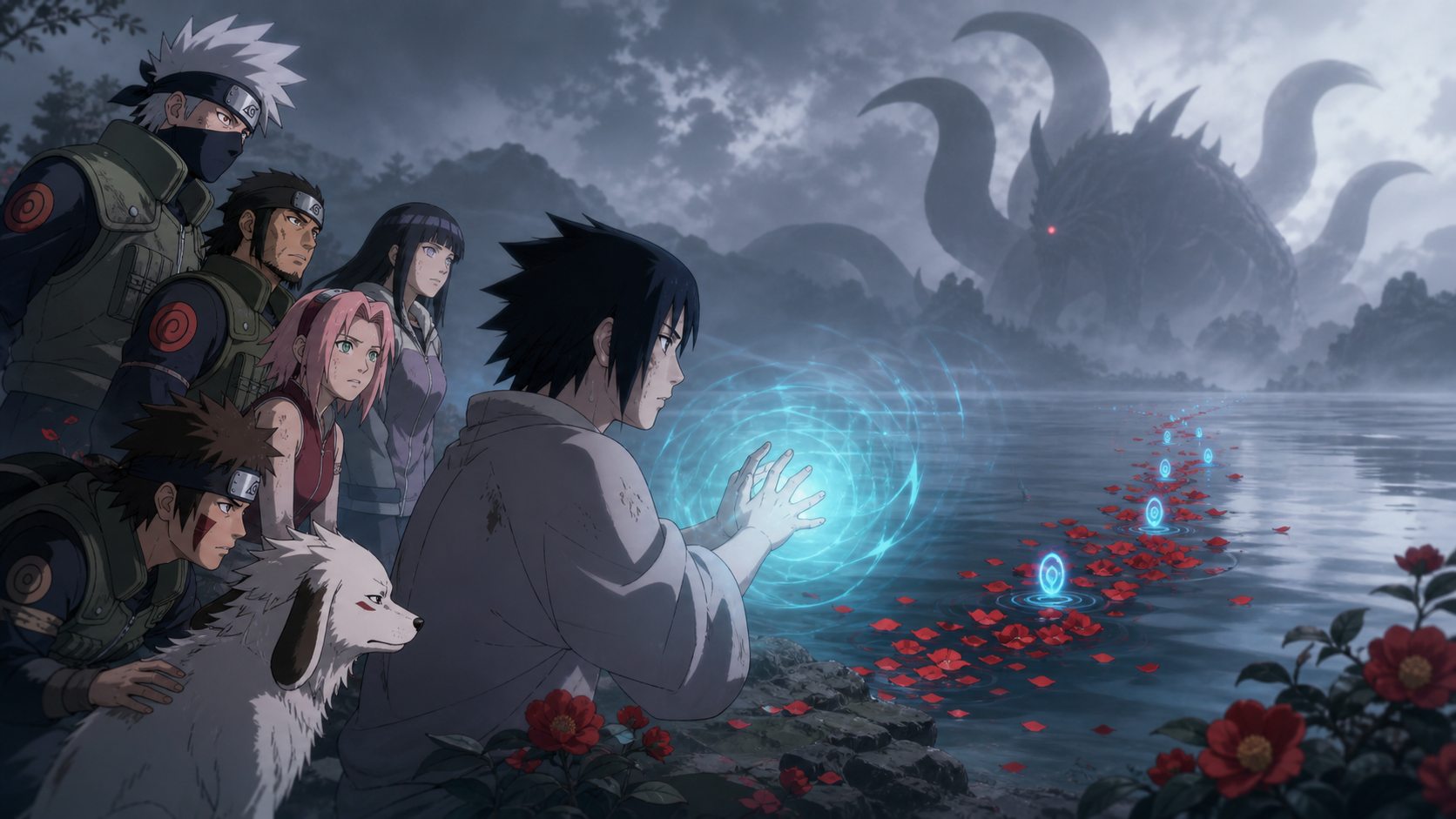
The camellia is a beautiful guide because the flower belongs to Yukimaru and Guren before the Leaf shinobi ever see the petals. Guren gave him the crystal camellia as a promise of connection. His mother remains tied to the same image. Kabuto tried to turn those attachments into controls, yet Yukimaru uses the flower to choose a direction for himself. The symbol stops being evidence of his vulnerability and becomes a language he controls.
Red petals against dark water also make the episode’s emotional logic visible. The Three-Tails is enormous, ancient, and capable of swallowing people whole. The guide is fragile enough to scatter with wind or current. Size does not decide which force matters. The petals help because the team pays attention. That point fits Naruto better than another spectacular attack would. People survive because somebody notices a small sign and treats the person behind that sign as credible.
Kakashi chooses disciplined trust, not blind faith
Kakashi does not receive a clean map, coordinates, or proof that every impression is accurate. He receives a child’s description of a connection nobody else can feel. Following Yukimaru still makes tactical sense because the team has no better lead, but necessity does not excuse carelessness. Kakashi must compare the boy’s reactions with Hinata’s vision, Kiba and Akamaru’s senses, Yamato’s control of the terrain, and Sakura’s medical judgment. Teamwork turns one uncertain signal into a responsible route.
I like Kakashi most when his intelligence looks practical. He does not need a speech about trusting children. He needs to ask clear questions, watch Yukimaru’s condition, and decide how far the group can move without losing its way back. Leadership here is not certainty. Leadership is knowing which person has the relevant knowledge and building enough support around that person for the whole group to act safely.
Sakura has to protect the guide from the rescue mission
Sakura’s role matters because Yukimaru’s body has already been treated like equipment. Kabuto drugged him, forced chakra from him, and measured success by Isobu’s response. The Leaf cannot call its goal protective while using the same physical limits. Sakura should monitor his breathing, pulse, awareness, pain, and ability to continue. If the connection weakens because he needs rest, the group needs to rest rather than demanding one more attempt.
Medical authority also gives Sakura a responsibility to say no when urgency starts making bad arguments. Naruto is missing. Guren may be injured. Everybody wants speed. Those facts can pressure a healer as easily as they pressure a patient. Sakura has to keep Yukimaru from believing that love requires self-destruction. Helping Guren should remain his choice, and that choice still deserves boundaries.
Hinata can confirm danger without replacing Yukimaru
Hinata’s Byakugan provides a second layer of observation, but the episode should not use her eyes to make Yukimaru unnecessary. She can watch chakra movement, identify shifts near the water, and warn the team about threats. She cannot feel his personal bond with Guren. Their abilities answer different questions. Yukimaru offers direction. Hinata helps the group judge what surrounds that direction.
This division respects both characters. Hinata does not become a convenient scanner who solves every problem through range, and Yukimaru does not carry the entire mission alone. The strongest formation lets specialized knowledge overlap without pretending every skill is interchangeable. That principle sounds obvious until a story starts treating one gifted child as the answer to every obstacle.
Kiba and Akamaru need something physical to track
Kiba’s frustration makes sense because water, mist, chakra disruption, and the scale of Isobu complicate scent. A tracker who cannot use his normal method should not pretend confidence. He can look for disturbed shoreline, broken vegetation, changes in animal behavior, unfamiliar chemical smells, or traces left by the team before Naruto disappeared. Those clues will not locate someone inside a tailed beast, but they can protect the rescuers from walking into another ambush.
Akamaru also gives the group an early warning system that does not depend on a human explanation. Fear, poison, hostile chakra, and hidden movement may register in his behavior before anybody names the cause. Kakashi needs to read that behavior as evidence instead of pushing forward because the camellia points in one direction. A guidepost shows a destination. The route still has hazards.
Yamato must build stability without pretending to control Isobu
Yamato can create platforms, barriers, and anchors that keep the group from being scattered. His Wood Style is useful because the lake offers almost no reliable ground. The technique cannot become an excuse to dominate the Three-Tails. Isobu is not an empty landscape. Every structure placed near the beast may feel like restraint or attack, especially after the sealing attempt.
A careful Yamato would test the smallest construction first and watch the response. He can mark the return route, give Sakura a stable place to treat Yukimaru, and keep the team together. The objective is access, not ownership. Orochimaru’s people keep confusing contact with control. The Leaf team needs to prove the difference through method, not slogans.
Inside Isobu, Naruto and Guren need their own guideposts
The outside team follows camellia petals, while Naruto and Guren face an interior where ordinary direction may fail. Columns repeat, surfaces shift, and every path belongs to a living creature. They need markers that survive movement without causing harm. Guren’s crystals may offer visible reference points. Naruto can test whether chakra carries toward the surface. Neither method should be trusted until the pair checks whether Isobu reacts.
Their first agreement matters more than any clever technique. They need a shared rule for turning back, a signal for danger, and a promise not to disappear around a corner without warning. Episode 107 forced them to take each other’s hands. Episode 108 should turn that desperate contact into an actual working partnership. Trust becomes real through repeated small choices.
Guren owes Naruto facts about Kabuto’s experiment
Privacy inside Isobu gives Guren a chance to tell Naruto what happened to Yukimaru. She knows about the medication, the forced activation, the manipulation of his memories, and Orochimaru’s intended use for the Three-Tails. Naruto does not need every detail before they move, but the medical and tactical facts could save Yukimaru. Silence would protect Kabuto, not the child.
Confession does not have to become instant forgiveness. Naruto can accept useful information while remaining angry about the harm. Guren can choose honesty without demanding that he comfort her. Accountability begins when truth serves the injured person instead of the person seeking relief from guilt. Yukimaru deserves adults who stop making his pain about their emotional needs.
The episode cannot treat Guren’s love as automatic absolution
Guren cares about Yukimaru. Her choices during the crisis prove that care has become stronger than her loyalty to Orochimaru. Love still does not erase the killing, coercion, deception, or years spent serving a system that treated human beings as material. The story becomes stronger when change carries consequences. Guren can protect Yukimaru now and face his eventual judgment later.
Naruto understands the desire to be seen as more than a person’s worst moment, but he should not promise an easy future. Konoha may hold Guren accountable. Yukimaru may love her and remain furious. Safety may require distance, medical care, and testimony. Redemption has substance when the person changing accepts those costs instead of using one heroic act as a receipt for innocence.
Yukimaru’s idea of home needs room to grow
Yukimaru has attached home to Guren because she offered protection and attention after adults repeatedly abandoned or exploited him. The attachment is understandable. The danger appears when every adult assumes the child must choose one permanent caretaker immediately. He needs safety, medical recovery, honest information about his mother, and time to decide what relationship with Guren feels possible after the truth.
A home can include more than one trustworthy person. Naruto’s promise matters. Sakura’s care matters. Kakashi’s restraint matters. Guren’s willingness to return matters. None of those relationships should become another claim of ownership. The healthiest ending would give Yukimaru a network strong enough that losing one person never leaves him available for the next Kabuto.
Isobu remains a victim of the same operation
The rescuers are understandably focused on Naruto and Guren, but Isobu has also been pursued, restrained, provoked, and treated as a weapon waiting for an owner. The beast’s violence does not erase that context. Swallowing the pair may be defense, panic, or an involuntary response to the battle. The Leaf team should avoid adding another attack until they understand what Isobu is doing.
This perspective changes the rescue plan. Success means recovering the trapped people without injuring the creature or restarting the sealing operation. Yukimaru’s connection should not become a leash. The team can use communication, distance, and observation before force. A tailed beast deserves more than being classified as scenery around the human emergency.
Kabuto will exploit every delay he helped create
Kabuto understands that frightened people make shortcuts. He can offer false certainty, claim Yukimaru needs another drug, or suggest that only Orochimaru’s method can control Isobu. The rescue team needs to expect that manipulation. Protecting the boy includes controlling access to him and documenting what has already been administered.
Guren’s absence also creates an opening for Kabuto to rewrite her intentions. He can tell Yukimaru that she abandoned him, died because of the Leaf, or never cared. Honest updates matter even when the news is incomplete. The team should say what they know, what they are testing, and what remains uncertain. Silence gives the manipulator room to supply a story.
The camellia route should remain fragile
The petals would lose meaning if they became an indestructible glowing road. Wind, current, and chakra should scatter some markers. The team then has to combine memory, observation, and trust. Fragility creates participation. Everybody must watch the route instead of following a special effect that cannot fail.
The same principle applies emotionally. Yukimaru’s connection to Guren is strong, but pain, exhaustion, fear, or Isobu’s movement may interrupt the signal. A broken connection does not prove betrayal. Kakashi needs to prepare the group for uncertainty before the first interruption happens. Otherwise panic will turn a temporary loss of direction into a bad decision.
RaeRae’s reaction
I love that Episode 108 makes listening the useful skill. The loudest people cannot punch their way to Naruto. The most experienced shinobi cannot pretend they already know the route. A child who has spent the arc being handled, drugged, and spoken over finally says where the people he loves are, and the adults have to believe him without taking his body as payment.
The camellia image lands because the story earned the flower. The petals carry his mother, Guren’s promise, his grief, and his choice to help. That history keeps the visual from becoming random pretty symbolism. Yukimaru takes an object connected to manipulation and turns the memory toward rescue.
Kakashi’s best move is restraint. Follow the signal, surround Yukimaru with protection, and keep checking every assumption. Sakura guards his health. Hinata watches chakra. Kiba and Akamaru monitor physical danger. Yamato creates stable ground. Nobody needs to steal the boy’s role to prove usefulness.
I also need the episode to remember that Guren and Naruto are not standing still inside Isobu. Their survival depends on cooperation that has no witness. Guren cannot perform goodness for Yukimaru from inside the beast. She has to tell the truth and make choices Naruto can verify. That private accountability matters.
The rescue becomes meaningful only if everybody comes out with more freedom than before. Naruto and Guren need a safe exit. Isobu needs the sealing attack to end. Yukimaru needs medical care and the right to choose his relationships. The Leaf needs to protect him without claiming him. One route can serve all four outcomes if the adults refuse the shortcut Kabuto expects them to take.
Guidepost of the Camellia turns a delicate flower into a test of leadership. Kakashi can follow the petals while still questioning the route. Yukimaru can guide the team without surrendering control of his body. Guren can become worth returning to by telling the truth and accepting consequences. That is how a sign becomes enough.
A guide needs a return plan, not only a destination
A rescue party can follow correct signs and become trapped if nobody records back. Kakashi should assign one person to track distance, changes in current, landmarks, and where the camellia signal weakens. Yamato’s platforms can double as numbered markers. Kiba can note scent changes near each point. Hinata can remember chakra patterns that distinguish one stretch of water from another. Records matter if Yukimaru loses consciousness or Isobu moves before they reach Naruto.
The return plan also needs a medical threshold. Sakura should decide what symptoms require withdrawal and explain that boundary to Yukimaru before continuing. He may protest because Guren remains missing. The adults must accept his anger without bargaining away his health. A child does not become capable of informed choice merely because the emergency makes his power useful.
The team should ask Yukimaru what the signal feels like
Directions such as left, deeper, or closer may not describe his connection accurately. Yukimaru may experience warmth, pressure, sound, memory, pain, or emotional pull. Kakashi needs to ask for the sensation in his words before translating the answer into a route. Otherwise the team may build precision an assumption Yukimaru never made.
They should also record which changes happen when Guren moves and which happen when Isobu moves. One signal may belong to the person while another belongs to the creature around her. Separating those sensations could prevent the rescue party from following the beast’s motion instead of the trapped pair.
Communication inside and outside may need different signals
Naruto can create shadow clones, but sending clones through unknown tissue may trigger a defensive reaction. Guren can form crystals, but sharp structures may cause injury. The pair should begin with the smallest signal: a controlled chakra pulse, a dull vibration, or a repeated pattern against a stable surface. The outside team needs to distinguish that pattern from Isobu’s movement.
Yukimaru may recognize Guren’s chakra before anybody else does. That possibility gives him useful confirmation without asking for another overwhelming command attempt. Hinata can watch for the pulse simultaneously, turning one personal perception into shared evidence.
Finding Naruto cannot become permission to restart the battle
The moment the Leaf confirms his location, somebody may argue for a strike to create an exit. That choice needs evidence about Isobu’s anatomy, Naruto’s distance from the impact, and how the beast responds to pain. A dramatic opening is worthless if the collapse behind it buries the people inside.
The team should first test communication and voluntary release. Yukimaru’s bond may help calm Isobu, but nobody should force him to command the beast. Naruto may also be able to communicate through his experience as a jinchuriki. Rescue should give the trapped pair a path, not turn them into collateral damage during a victory pose.
Guren’s camellia promise must become a practical promise
A crystal flower is meaningful, yet Yukimaru needs commitments that survive after the lake. Guren must promise truthful answers, medical care, freedom from Orochimaru, and respect for his decisions. She cannot guarantee that they will never separate. She can guarantee that she will not hand him back to the people who drugged him.
Naruto can help by refusing to negotiate Yukimaru’s future while the boy is absent. The adults may discuss immediate safety, but permanent custody belongs in a conversation that includes him. Home stops being a poetic word when the person living there has a voice.
The episode’s quiet suspense comes from whether adults will repeat themselves
The lake already contains enough physical danger. The sharper tension comes from watching people face the same temptation that drove the villains: use Yukimaru now because his ability can solve the problem. The Leaf team does not need evil intentions to cause similar harm. Fear, urgency, and affection can produce coercion when nobody protects the boundary.
Episode 108 earns its flower motif when the rescuers handle something fragile without crushing it. Yukimaru’s guidance, his trust, Guren’s chance to change, and Isobu’s temporary calm all require care. Kakashi’s team proves its difference through each restrained choice. The petals point toward Naruto, but the method shows whether everybody deserves to arrive.
RaeRae’s call
Follow Yukimaru, protect Yukimaru, and stop treating those actions as opposites. His connection gives the team a direction. His humanity determines how they are allowed to use that knowledge.