
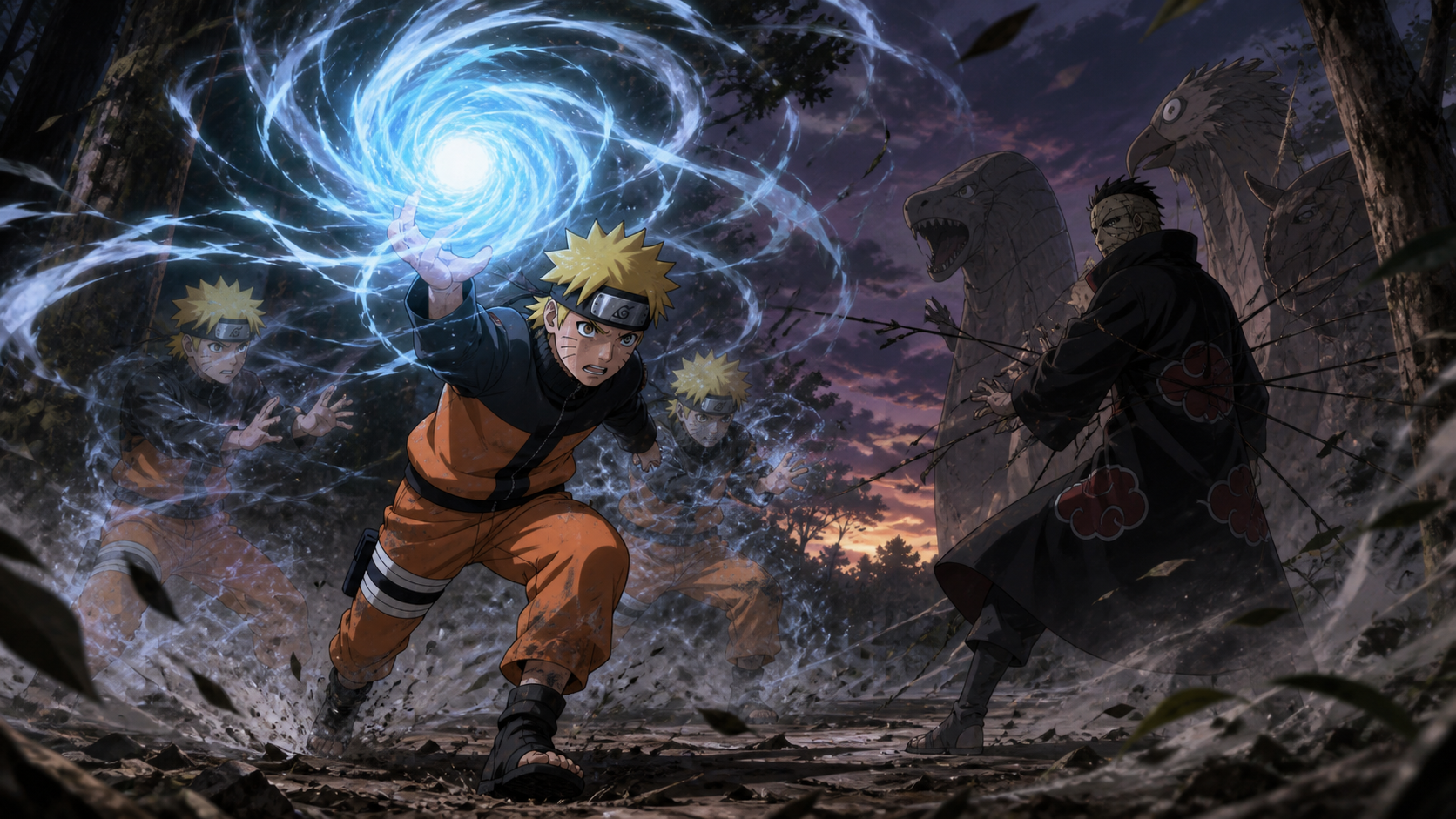
Wind Style: Rasen Shuriken!
Naruto brings a historic wind-style breakthrough into live combat, where Kakuzu exposes the difference between forming overwhelming power and landing it.
A finished technique can still fail its first real test
Naruto enters the battlefield carrying something Kakashi, Yamato, Ino, and Choji immediately recognize as extraordinary. The Wind Style: Rasen Shuriken compresses nature transformation and shape transformation into a form even the Fourth Hokage could not complete.
That achievement matters, but Episode 88 refuses to confuse technical completion with reliable execution. Training proved Naruto could create the jutsu. Kakuzu forces him to discover whether he can deliver it against an intelligent enemy who moves, reads danger, and fights back.
The first attempt dissipates before contact. The failure does not erase the breakthrough; it reveals the distance between possessing power and knowing how to use it.
Kakuzu recognizes danger before anyone explains it
Kakuzu has survived long enough to distrust unfamiliar chakra. He does not need a lecture about the new technique to understand that the spinning wind mass can threaten his remaining hearts.
His caution gives the jutsu credibility. This is not a crowd waiting politely for Naruto's entrance to become heroic. Kakuzu watches the formation, measures the attack path, and reacts to the instability he can see.
The veteran's fear and discipline coexist. He knows the technique is dangerous, but he also sees that its user has not yet made danger inevitable.
The visible strain changes the meaning of spectacle
Rasen Shuriken looks spectacular: shrieking wind, dense light, and a shape that appears too sharp to hold. The scene could have treated scale as proof of superiority.
Instead, every visual flourish also communicates instability. The sound is abrasive. The chakra strains against its boundary. Naruto's body carries the cost of maintaining something whose internal motion is more violent than an ordinary Rasengan.
The beauty of the technique is inseparable from the warning built into it.
Shadow clones remain Naruto's real tactical language
The new jutsu exists because Naruto used clones to divide an impossible learning process. On the battlefield, those clones are still more than extra hands. They let him test spacing, create misleading targets, and distribute attention.
Kakuzu can read one charge. Multiple Narutos force him to decide which body holds the real threat and when that threat has finished forming.
The episode reminds us that Naruto's defining skill is not raw chakra alone. He learns by turning multiplication into collaboration with himself.
Failure becomes information instead of humiliation
Naruto's first release falls apart before it reaches Kakuzu. Earlier versions of him might have experienced that moment as public shame, especially with teammates and a rival-level enemy watching.
Here, he absorbs the result. The range was wrong. The formation time exposed him. The technique demanded a delivery method his first approach did not supply.
He does not pretend the attempt succeeded, and he does not abandon the jutsu. He converts the failure into the next plan.
Kakashi gives Naruto room to own the risk
Kakashi understands both the scale of Naruto's progress and the danger of improvising with unfinished control. His concern is visible, yet he does not immediately seize the fight back from his student.
That restraint is a form of teaching. Naruto must learn judgment in conditions no training field can reproduce, but he also needs teammates ready to intervene if the cost becomes unacceptable.
Kakashi's role shifts from instructor who supplies an answer to witness who evaluates whether Naruto can construct one.
Ino and Choji see growth beside grief
Team Asuma has just endured a battle defined by their teacher's absence. Naruto's arrival introduces a different continuity between generations: Kakashi and Yamato have helped a student push beyond inherited technique.
Ino and Choji's amazement is not empty audience reaction. They are seeing another classmate carry the consequences of recent failure into disciplined training.
The battlefield holds grief and growth at the same time. Neither cancels the other.
Wind nature makes Naruto's usual approach more dangerous
Naruto normally closes distance and commits his body to a Rasengan. Adding wind nature magnifies the attack's cutting force without removing that close-range habit.
The mismatch is crucial. He has created a technique whose destructive radius exceeds the safe assumptions of the move it evolved from.
Before it can become dependable, Naruto must understand not only how to strike Kakuzu, but how to avoid becoming another target inside his own chakra.
Confidence is tested by the second attempt
The episode ends before the new jutsu earns a clean victory. That boundary preserves the importance of adaptation. Naruto has announced that he can finish the fight in one strike, then watched the first strike disappear.
Trying again is not valuable merely because persistence sounds heroic. It matters because he changes the arrangement around the attempt.
Real confidence is not insisting the failure did not happen. It is returning with a better reading of why it happened.
RaeRae's reaction
I love that Episode 88 lets the Rasen Shuriken be astonishing and unreliable at once. Naruto has genuinely accomplished something historic, but history does not make Kakuzu stand still or make a volatile technique safe.
The failed first charge keeps the scene honest. A training breakthrough is evidence of capacity, not a guarantee under pressure.
What makes Naruto impressive here is not the size of the chakra effect. It is the speed with which disappointment becomes usable information.
The new jutsu reveals the next lesson
Episode 88 gives Naruto the power he wanted and immediately exposes the judgment he still needs. Kakuzu's experience, the technique's instability, and the danger to Naruto's own body all resist an easy debut.
The Rasen Shuriken is therefore both culmination and beginning. It completes the wind-training problem while opening questions about range, delivery, recovery, and cost.
Naruto has learned how to create the impossible shape. His next task is learning how to make contact without letting that shape control him.
Official episode reference: Naruto Official episode guide
Licensed episode route: Crunchyroll licensed episode page
Naruto enters after listening to a battlefield he did not build
Kakashi and Team Ten have already removed hearts, identified elemental masks, spent chakra, and survived combinations designed to erase escape routes. Naruto’s arrival matters because he joins that accumulated work.
He cannot treat the scene as a fresh duel staged for his technique. Backup begins with accepting the intelligence and exhaustion already present.
The Rasen Shuriken is historic because it combines two impossible demands
The Rasengan already requires extreme shape transformation. Adding Wind Style asks Naruto to control nature transformation inside that rotating density without letting the structure collapse.
Kakashi explains that even the Fourth Hokage could not complete this evolution. The achievement therefore belongs to Naruto’s unusual chakra, clone learning method, persistence, and willingness to approach the problem differently from his father.
Surpassing a predecessor should not become pressure to repeat his sacrifice
Completing what Minato could not is emotionally powerful, but Naruto’s worth does not depend on proving himself through bodily damage. A technique can mark growth and still require limits.
Kakashi’s pride must coexist with responsibility. The student who reaches beyond a teacher’s expectation deserves protection from the idea that historic power excuses every consequence.
Kakuzu reads the jutsu through survival experience
He sees concentrated wind chakra, hears its violent pitch, and recognizes that the attack threatens more than an ordinary Rasengan. Decades of combat tell him not to test unfamiliar force through arrogance.
His caution makes him a useful first opponent. Naruto cannot rely on surprise alone because Kakuzu treats warning signs as information and actively searches for the unstable point.
The first failure proves formation is part of technique
Naruto can create the Rasen Shuriken, but the charge exposes a short-range delivery problem. Kakuzu has time to move before contact, and the wind structure dissipates.
A jutsu is not complete in combat merely because its chakra form exists. Range, timing, approach, teammate positions, and recovery are part of the usable design.
Naruto’s disappointment stays brief because the battlefield cannot comfort him
There is no training pause in which Kakashi can discuss the attempt for an hour. Kakuzu remains dangerous, allies are exhausted, and another attack can begin immediately.
Naruto has to acknowledge failure without turning it into identity. The technique failed to connect. That does not mean he is a failure or that repeating the same approach will become courage.
Shadow clones let Naruto redesign delivery in real time
Clones can present several approach lines, hide which body carries the true attack, and force Kakuzu to divide attention among threats that share one strategist.
This is Naruto’s native tactical language. He does not need to imitate Shikamaru’s forest preparation. He builds uncertainty through bodies, timing, and the willingness to learn from every destroyed copy.
A clone is not disposable simply because memory returns
The technique encourages Naruto to spend copies as feints, but each collapse sends experience and strain back to the original. Multiplication compresses learning while concentrating aftermath.
Kakashi and Yamato should account for cumulative exhaustion. What looks like several bodies sharing a burden eventually becomes one body receiving all of it.
Kakashi’s trust includes readiness to stop the attempt
Allowing Naruto another chance is not passive faith. Kakashi watches control, field position, and physical condition. He has to intervene if persistence becomes self-harm or threatens teammates.
A teacher can believe a student is capable while still recognizing that capability does not erase present limits.
Yamato’s presence remains essential after training ends
He helped contain the Nine-Tails and sustain the accelerated method. On the battlefield, his Wood Style can reshape terrain, protect allies, and create routes Naruto’s short-range strike needs.
The story should not reduce him to transportation for the new hero moment. Naruto’s achievement rests on support that continues during delivery.
Ino and Choji are witnesses with tactical knowledge, not an audience
They know which hearts Kakuzu has lost, how the masks combine, and where his threads can reach. Naruto needs their information before selecting the central body as his target.
Astonishment at the Rasen Shuriken does not suspend their roles. They remain the people most capable of warning when Kakuzu’s system changes around the charge.
Kakuzu’s remaining hearts define what one strike must accomplish
The attack’s microscopic wind blades can damage a chakra network far beyond the visible impact. That destructive scale may defeat several reserves if it reaches the correct body.
But “one strike” is only meaningful if the team knows which hearts are present and prevents external masks from escaping the blast. Power needs an inventory.
The shriek of the jutsu is an alarm as much as a signature
The sound announces unstable wind compressed beyond ordinary control. It terrifies the enemy and warns allies that the attack’s radius may not respect the familiar boundary of a Rasengan.
Spectacle becomes useful when it communicates danger. Everyone nearby should move according to a rehearsed signal rather than waiting to admire the light.
Close-range delivery places Naruto inside his own weapon
The Rasen Shuriken is named like something thrown, yet Naruto still carries it by hand. That contradiction exposes the unfinished stage of the technique.
If the wind blades attack chakra pathways at the cellular level, proximity may punish the arm and network sustaining the strike. A successful hit can still be an unacceptable method.
Tsunade will need medical evidence before approving repeated use
Battlefield victory cannot settle whether the jutsu is safe. Naruto needs examination, comparison of tissue and chakra damage, and clear restrictions based on what medics find.
A village that celebrates new military power without studying its effect on a young user repeats the extraction logic it condemns in Akatsuki.
The episode keeps Asuma’s arc present through collective timing
Naruto trained under a deadline because Team Ten was already moving. His arrival is one part of the village’s response to the men who killed Asuma.
The new jutsu does not replace Shikamaru’s trap or Kakashi’s work. It becomes available because several people held the operation together long enough for reinforcement to reach them.
Kakuzu and Naruto embody opposite uses of accumulated power
Kakuzu collects hearts from murdered people and stores their affinities as property. Naruto creates clones of himself, gathers their experience, and returns with power meant to protect friends.
Both systems multiply capacity, but one depends on extraction while the other depends on shared identity and chosen support. The moral difference lives inside the mechanism.
A second attempt deserves confidence only if something changes
Naruto does not earn another charge through stubbornness alone. He must alter timing, deception, or approach based on Kakuzu’s successful evasion.
Persistence without revision is repetition. The episode makes growth visible when Naruto treats failure as data and rebuilds the next attempt around what the enemy revealed.
RaeRae’s full take
The Rasen Shuriken sounds like the air itself wants everybody to back up, and I need the adults to listen. Yes, Naruto completed something Minato could not. No, that does not mean his arm is now acceptable collateral.
Kakuzu refusing to stand there for the hero entrance makes the scene better. He sees danger, sees instability, and makes Naruto prove he can deliver more than a beautiful threat.
The first collapse is not embarrassment. It is the battlefield handing Naruto a receipt: too visible, too close, too slow to connect against a veteran. The second attempt has to answer that receipt.
Team Ten and Kakashi built the opening with grief, planning, and exhausted bodies. Naruto’s power matters most when it respects that work and gets everybody home.
The team should define the Rasen Shuriken clearance zone aloud
No ally should guess how far the wind damage reaches. Naruto, Kakashi, and Yamato need a clear signal before formation, commitment, and impact.
Ino can relay the warning while Choji and Kakashi create distance. A technique this destructive becomes safer when communication is treated as one of its required hand signs.
Kakuzu’s threads can exploit the moment Naruto commits both hands
Forming and carrying the jutsu restricts Naruto’s defensive options. Extending tendrils may bind him, redirect the strike, or bring an ally into the attack path.
Clones should protect the carrier rather than only disguise him. The formation needs an answer for contact made before Naruto reaches the target.
Yamato can shape a corridor instead of merely watching
Wood Style barriers can limit Kakuzu’s lateral movement and give Naruto a clearer approach. Terrain control reduces the number of directions the veteran must evaluate.
That support does not diminish Naruto’s achievement. It converts an unstable close-range weapon into part of a team operation.
Kakashi must tell Naruto which hearts remain
The target is not simply Kakuzu’s visible body. Naruto needs to know whether masks remain external and which reserve absorbed earlier damage.
A precise briefing prevents the new jutsu from landing beautifully on the wrong component while another heart escapes through the threads.
The first miss protects the story from effortless inheritance
Naruto has Minato’s technique, enormous chakra, and exceptional clone training, but none of those gifts provides automatic mastery. He still has to solve a problem his own body and battlefield create.
Inheritance gives him a starting language. Experience writes the usable version.
The second attempt should preserve a path for aborting safely
If Kakuzu changes position or an ally enters range, Naruto needs somewhere to release or disperse the chakra without forcing a bad hit.
Commitment is not courage when new information makes the attack unsafe. Control includes the ability to stop.
Victory cannot make the injury invisible
If the Rasen Shuriken lands, medics still need to examine Naruto’s arm and chakra network. Adrenaline may hide damage until after celebration begins.
The village should record the consequence alongside the success. Future use must be based on the whole result, not only what happened to Kakuzu.
Episode 88 makes Naruto’s breakthrough more meaningful by refusing to let applause finish the lesson. He has accomplished what brilliant predecessors could not, and Kakuzu still moves. The technique can exist in his hands while remaining incomplete as a battlefield answer. That distinction is not humiliation. It is the beginning of mastery. Naruto’s best response is the one he has practiced through every clone: gather evidence, accept the failed attempt, change the arrangement, and try again with more information. The difference now is that real people occupy the failure radius. Kakashi, Yamato, Ino, Choji, and the surviving parts of Kakuzu all turn experimentation into responsibility. I want the second attempt to belong to the formation. Let clones divide Kakuzu’s attention. Let Yamato shape movement. Let Team Ten share the heart count and protect the approach. Let Kakashi decide when the opening is real. Naruto can still carry the final strike without pretending he created the entire opportunity. The shrieking chakra is a warning to the user as much as the enemy. Close-range delivery means Naruto stands inside the edge he invented. If victory damages his chakra network, Tsunade has to name that cost plainly and refuse to let military usefulness outrank his future. Surpassing Minato should mean solving what Minato left unfinished, including the safety problem. Power becomes inheritance when the next person improves its relationship to life. The first Rasen Shuriken teaches Naruto that creation, delivery, recovery, and restraint are one technique. Kakuzu only exposes the missing parts faster than training could. The jutsu deserves wonder, but Naruto deserves a body capable of carrying wonder into more than one desperate battle for friends who need him alive tomorrow and through many shared years afterward.
RaeRae checkpoint: Naruto completed an impossible chakra shape. Kakuzu immediately asks the harder question: can he land it against someone who refuses to cooperate, without making his own body pay the victory bill?
Receipts and official routes
- Licensed title and official account of Naruto unveiling the Wind Style Rasen Shuriken before Kakuzu exposes the first attempt’s instability: Naruto Official Site episode guide.
- Licensed episode title, number, and watch route: Crunchyroll.