
Target: Locked On
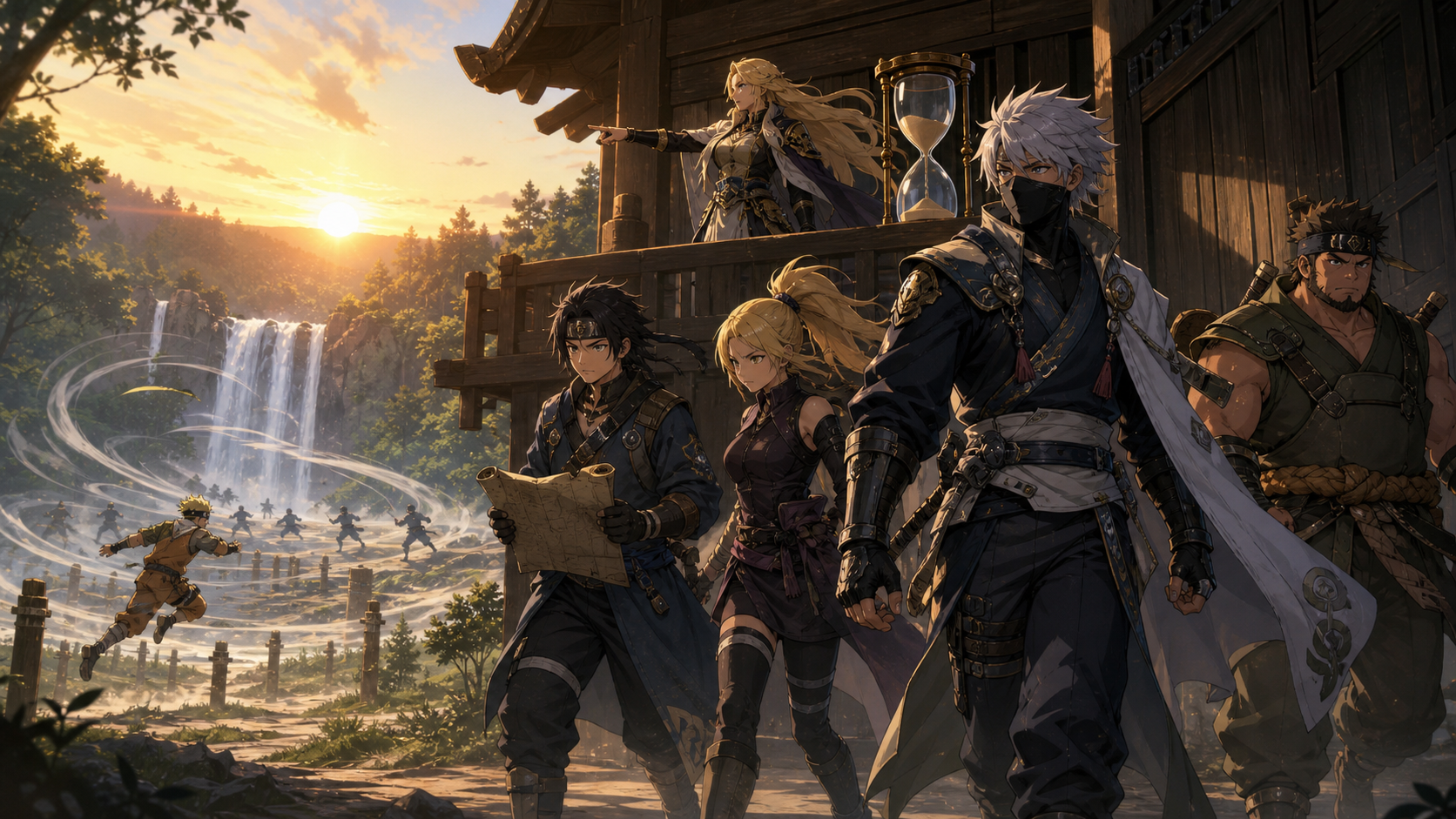
Kakashi reinforces Team Ten’s pursuit while Naruto receives twenty-four hours to turn an unfinished technique into backup his friends can trust.
Team Ten chooses a target after choosing to move
Episode 83 begins after grief has stopped being purely inward. Shikamaru, Ino, and Choji are ready to pursue Hidan and Kakuzu, but readiness cannot mean walking into the same conditions with the same information.
Their target is emotionally obvious. The mission still needs structure, authorization, and a leader capable of helping them survive contact.
Resolve becomes useful only when it can operate as a team.
Kakashi joins without trying to replace Asuma
Kakashi brings elite experience, analytical discipline, and knowledge of Akatsuki-level combat. He does not step into the formation as a substitute father or pretend Team Ten's history can be reassigned.
His role is to help Asuma's students act on what they learned while covering dangers they cannot yet manage alone.
Support respects grief when it strengthens continuity instead of claiming ownership of it.
Shikamaru turns mourning into a bounded plan
Anger could send the team toward a direct rematch. Shikamaru instead develops an operation shaped by Hidan's ritual rules and Kakuzu's partnership.
The target is locked because he has narrowed uncertainty: separate the opponents, deny Hidan access to blood and his circle, and prevent Kakuzu from restoring the advantage.
Planning does not cool Shikamaru's grief. It gives that grief a disciplined direction.
Ino and Choji are participants, not pieces
Shikamaru may design the strategy, but Team Ten's formation depends on each member choosing the mission. Ino's sensory awareness and mind techniques create information and control. Choji's physical power changes the space opponents can occupy.
Their loyalty to Asuma is shared, not delegated to the strategist.
The plan works because three different strengths agree on one purpose.
Tsunade has to authorize people who are personally involved
Sending Team Ten after Asuma's killers carries obvious risk. Emotion can sharpen attention, but it can also distort retreat conditions and acceptable losses.
Tsunade must judge whether their preparation is operationally sound rather than merely understandable. Kakashi's presence provides oversight without denying the team's agency.
Leadership sometimes means allowing wounded people to act after ensuring they are not acting alone.
Naruto receives a separate version of the same deadline
Tsunade identifies Team Seven as the ideal backup, but Naruto's new technique remains unfinished. He has twenty-four hours to turn experimental progress into something usable.
The order connects his training directly to the field. Every clone attempt now belongs to people already moving toward danger.
Naruto is not being asked for abstract improvement. He is being asked to become reliable on someone else's timetable.
A deadline exposes what training has actually produced
Unlimited practice can hide the difference between refinement and avoidance. Twenty-four hours forces Naruto and his instructors to identify which problems are essential and which improvements can wait.
The technique does not need to feel perfect. It must be controlled enough to help without adding a second crisis.
Urgency makes safety harder, which is why Kakashi and Yamato's earlier emphasis on fundamentals matters now.
Two teams prepare along different paths
Kakashi and Team Ten leave through the village gate while Naruto returns to the waterfall and his clones. One group converts intelligence into pursuit. The other converts repeated failure into a potential answer.
Neither path is secondary. The first team needs to hold the battle together long enough for backup to matter; the second must arrive with something worth bringing.
Coordination begins before the teams share a battlefield.
Targeting an enemy also defines what must be protected
Hidan and Kakuzu are the visible objective, but Asuma's lesson about the king remains beneath the mission. Team Ten is not only moving toward revenge.
They are preventing the pair from repeating the Fire Temple and Asuma's death against another family, squad, or village.
The target supplies direction. Protection supplies meaning.
RaeRae's reaction
I like that the episode does not treat grief as instant permission for a reckless revenge mission. Team Ten has to present a plan, accept Kakashi's support, and work within a larger backup strategy.
Kakashi is exactly the right addition because he understands loss without making himself the center of theirs. Meanwhile, Naruto's twenty-four-hour deadline ties his training to friends who may soon need the result.
Both threads turn private determination into responsibility to other people.
Locked on means the plan can finally move
Episode 83 rebuilds momentum without pretending Team Ten is healed. Shikamaru, Ino, and Choji carry Asuma's absence into a formation reinforced by Kakashi's experience.
Naruto races a separate clock, knowing Team Seven may become the backup that changes the fight.
The target is identified, the roles are assigned, and the village has replaced helpless reaction with coordinated intent. What remains is whether preparation can survive contact with Akatsuki again.
Official episode reference: Naruto Official episode guide
Licensed episode route: Crunchyroll licensed episode page
Team Ten arrives at the gate with a plan and without permission
Shikamaru, Ino, and Choji are prepared to leave before Tsunade approves the pursuit. Their urgency is understandable. Hidan and Kakuzu remain active, and waiting feels like allowing Asuma’s killers to move beyond reach.
But readiness built inside grief can still miss danger. Tsunade’s refusal to send a three-person team is not an insult to their resolve. It is recognition that Asuma’s formation lost the experienced jonin who once absorbed uncertainty for them.
Tsunade does not owe revenge an exception to mission standards
The Hokage must protect the team from an impulse the village could easily romanticize. A noble story about students avenging their teacher will not matter if all three die because command ignored its own requirements.
Authorization should depend on intelligence, roles, reinforcement, and an exit plan. Emotion explains why the mission matters to them. It cannot be the only evidence that the mission is ready.
Kakashi joins by making the team operational, not by taking it over
His arrival fills the missing fourth position and satisfies Tsunade’s condition, but the emotional center remains with Team Ten. Kakashi does not rewrite Shikamaru’s plan or behave as if his rank erases their firsthand knowledge.
He brings Lightning Style, Sharingan analysis, field experience, and the ability to confront Kakuzu directly. The addition expands what the team can survive while preserving who understands Hidan best.
Kakashi knows what it means to enter another team’s grief
He has lived with names carved into stone, a teammate’s eye, and years shaped by people who did not return. That history could make him project his own loss onto Team Ten. Instead, it gives him patience.
He can recognize revenge without dismissing it, and danger without pretending caution means cowardice. His support works because he does not require their grief to look like his before treating it seriously.
Shikamaru’s plan starts with separation
Hidan and Kakuzu cover each other’s weaknesses. Hidan can take catastrophic damage because Kakuzu restores him. Kakuzu benefits when Hidan’s ritual consumes every opponent’s attention.
Separating them changes the fight from one interlocking system into two bounded problems. It is not automatically safe, but it prevents support from moving freely between enemies and lets each Leaf subgroup use the intelligence it actually possesses.
Hidan must be denied blood before he is denied life
The team does not know how to kill him. It does know how his ritual begins. Avoiding cuts, controlling discarded blood, and keeping him away from prepared ground are immediate priorities.
This reframes defense. A shallow wound is not minor, and a powerful strike is not necessarily progress. Everyone needs the same rule before contact so one person’s instinct does not endanger the whole formation.
Kakuzu requires a separate reserve of attention
The previous battle revealed almost nothing about his full abilities. Treating him as Hidan’s support would repeat the error of focusing on the loudest threat.
Kakashi should lead that assessment while Ino monitors positions and Choji controls space. Shikamaru’s plan needs enough flexibility to absorb new information without collapsing when Kakuzu stops observing and begins attacking.
Ino is an intelligence node, not an accessory to Shikamaru
Her sensory attention, communication, and knowledge of both teammates help the formation maintain a shared picture. Against opponents whose abilities depend on hidden conditions, that picture is survival.
She can also recognize when Shikamaru’s grief is driving a decision he presents as pure logic. Team trust includes permission to challenge the strategist before the plan becomes irreversible.
Choji changes the terrain Hidan wants to control
Expansion techniques can force movement, block routes, and separate bodies from ritual space. Choji’s strength is not only damage. It is geometry.
That makes him essential against an enemy whose power depends on standing in a marked circle. If Choji can control where Hidan lands, Shikamaru can turn knowledge of the rule into repeatable pressure.
Naruto’s deadline is tied to people already walking toward danger
Tsunade wants Team Seven available as reinforcement, but the new jutsu remains unfinished. Naruto receives twenty-four hours because the field will not pause until his training feels complete.
The deadline gives every clone attempt a face. This is not about impressing Kakashi or surpassing Sasuke in the abstract. Shikamaru, Ino, and Choji may need the technique before the next sunrise.
A rushed jutsu can become another threat to the rescue
Naruto’s Wind Style work has extraordinary power and incomplete control. Bringing it to a crowded battlefield without a delivery plan could harm allies or exhaust him before the decisive opening.
Reliability matters more than spectacle. Yamato and Kakashi have to help him identify what minimum control makes the technique usable, and what limitations the team must understand before he arrives.
Shadow clones compress experience but not judgment
The training method gives Naruto more attempts than the clock should allow. It does not automatically teach him when to stop, where to aim, or how to read a condition-based enemy.
Accumulated practice becomes useful only when Naruto integrates it into one body capable of choosing. Thousands of repetitions cannot substitute for the decision that protects teammates standing near the target.
Yamato carries the hidden cost of Naruto’s acceleration
He suppresses the Nine-Tails, maintains the training environment, and watches for failure that could spill beyond the exercise. Naruto’s progress depends on labor the story should not treat as invisible.
A twenty-four-hour deadline affects instructors too. Yamato needs rest, clear limits, and authority to stop the process if urgency turns dangerous. Support is not infinite because the hero wants to improve quickly.
Two clocks are running toward the same battlefield
Team Ten and Kakashi pursue moving targets. Naruto races technique development. Neither group controls when contact will happen.
The tension comes from coordination across distance. The pursuit team must survive without assuming backup will arrive. The training team must prepare without assuming one new attack can repair every tactical problem already in motion.
The target in the title is also emotional focus
Hidan and Kakuzu give grief a direction, which can feel like relief after helpless mourning. A named enemy is easier to face than absence.
Shikamaru’s responsibility is to keep the target specific. Stop their abilities. Prevent further killings. Return the team. If rage expands the objective into suffering for its own sake, Hidan will still be defining the terms.
Asuma’s lesson about the king should determine retreat conditions
Protecting the next generation includes Ino, Choji, and Shikamaru themselves. They do not honor the king by treating their own lives as disposable currency for revenge.
The plan needs a point at which surviving becomes the mission. Asuma died protecting them. A strategy that assumes they should follow him misunderstands the inheritance.
Konoha’s best answer is coordinated knowledge
Shikamaru brings the ritual counter. Kakashi brings elite combat analysis. Ino brings awareness. Choji brings spatial control. Naruto may bring a new Wind Style weapon. Tsunade coordinates the risk.
No single person replaces Asuma. The village answers his loss by allowing several people to carry different parts of the protection he once provided.
RaeRae’s full take
I understand why Team Ten is standing at that gate ready to go with or without permission. Grief hates paperwork. But Tsunade is right to refuse a beautiful tragedy where three children follow their teacher because nobody insisted on a fourth teammate.
Kakashi joins in exactly the way I need him to. He offers skill and experience without acting like Asuma’s place is available. That empty position belongs to the team’s history. The mission position needs an adult who can help them come home.
Naruto’s deadline only matters because the people ahead of him are real. A giant new jutsu is not backup unless he can control it around friends. Power has to arrive with judgment.
The target is locked. Now every choice has to prove that Team Ten is pursuing protection, not offering itself to grief in matching uniforms.
The pursuit needs communication rules before the first ambush
Hidan’s ritual punishes confusion. If one teammate is cut, everyone must know immediately. If a circle appears, its location and boundary must be called out. If Kakuzu separates from Hidan, the team must track both without losing the shared picture.
Ino can help coordinate, but communication cannot depend on one person remaining untouched. Simple verbal signals and fallback roles make the plan resilient when the enemy disrupts the preferred formation.
Kakashi should challenge the plan before trusting it
Respecting Shikamaru does not mean approving every assumption. Kakashi can ask what happens if separation fails, if Hidan already has blood, if Kakuzu pursues the wrong subgroup, or if Naruto’s backup never arrives.
Those questions are not doubt in Shikamaru’s ability. They are how experienced teammates strengthen a strategy before enemies test it with consequences.
Ino and Choji deserve explicit authority to call retreat
Shikamaru’s emotional investment may make him the last person willing to abandon a failing pursuit. Kakashi’s attention may be occupied by Kakuzu. The remaining teammates need permission to identify when the objective has become impossible.
A retreat signal only works if everyone agrees beforehand that using it is not betrayal. Survival preserves the chance to revise. Martyrdom ends every future plan.
Naruto’s new technique needs a delivery system, not only a finished shape
The Wind Style change is unstable, close-range, and potentially dangerous to the user. Creating it is only one part of battlefield usefulness. Naruto must approach, maintain control, strike the intended target, and leave teammates outside the damage.
Clone feints and Yamato’s restraint may help in training, but actual opponents move with intent. Backup should arrive knowing which opening Team Ten can create and which signal means the field is clear.
The twenty-four-hour order risks making exhaustion look heroic
Naruto’s clone method compresses experience while his original body absorbs fatigue and memory. A deadline encourages him to treat collapse as evidence of commitment.
That is dangerous before a mission. The instructors should protect sleep, hydration, chakra reserves, and judgment. A completed jutsu carried by someone too depleted to aim it is not reinforcement.
Team Ten’s grief creates insight as well as bias
They remember Hidan’s movements with painful clarity because every detail is connected to Asuma. That closeness may reveal habits another team would miss. It may also make them interpret every action through the need for revenge.
Kakashi’s outside perspective can test the difference. The best plan uses their firsthand knowledge without pretending trauma automatically makes every conclusion accurate.
Tsunade’s authorization should include what happens after success
If Hidan and Kakuzu are defeated, Team Ten will not instantly feel restored. The mission may intensify grief once the target no longer gives their days a direction.
Medical checks, decompression, and continued support belong in planning now. Konoha should prepare for the people who return, not only the enemies it hopes will not.
The village gate marks a choice to remain connected
Team Ten could have slipped away alone, treating grief as a private debt. Kakashi’s arrival and Tsunade’s approval bring their response back inside community responsibility.
That does not make the mission emotionally neutral. It means the village shares the risk, provides backup, and refuses to let Asuma’s students disappear into a story of solitary vengeance.
Episode 83 works because nobody is allowed to mistake determination for preparation. Team Ten wants Hidan and Kakuzu with every raw part of grief, but Tsunade still asks whether the mission can bring them home. Kakashi’s arrival answers more than a staffing rule. He brings another mind, another body capable of meeting Akatsuki force, and the humility to enter a formation whose missing teacher cannot be replaced. Shikamaru remains the architect because he owns the clearest intelligence about Hidan. Ino and Choji remain partners because the plan depends on their choices, not their obedience. Naruto’s deadline extends that same ethic. His new technique cannot merely look finished beside the waterfall. It has to reach a battlefield crowded with friends and function as support rather than spectacle. The target is locked, but the title should not narrow our attention to the enemies alone. Konoha is also locking onto the people it intends to protect: Team Ten, Naruto, future victims, and the village children Asuma called the king. A responsible pursuit carries all those lives inside its success conditions. Defeating Hidan matters. Separating Kakuzu matters. Preserving information matters. Returning together matters. If grief writes only the first objective, Asuma’s students may win the fight and lose the future he asked them to guard. Kakashi and Tsunade are there to keep that future inside the plan. Adults around them must defend the standard when bravery starts sounding too much like surrender to death.
RaeRae checkpoint: Tsunade does not disrespect Team Ten by stopping three grieving students at the gate. She respects Asuma enough to insist that his children receive support before they walk back toward his killers.
Receipts and official routes
- Licensed title and official account of Kakashi joining Team Ten while Naruto receives a twenty-four-hour training deadline: Naruto Official Site episode guide.
- Licensed episode title, number, and watch route: Crunchyroll.