
Last Words
Asuma cannot undo Hidan’s damage, but he can spend his remaining breath making sure each member of Team Ten knows exactly how he sees them.
The battle narrows to the time Asuma has left
Episode 80 begins after strategy has done everything it could. Shikamaru broke Hidan's ritual condition, Asuma struck back, and the team created a path away from immediate destruction.
None of that can reverse the damage already delivered through the body link. The battle's central question is no longer how to defeat Akatsuki. It is what Asuma can still give his students before time closes.
Victory and loss occupy the same clearing.
Reinforcements create safety without creating rescue
Additional Leaf shinobi can pressure Hidan and Kakuzu, protect the wounded, and prevent the remaining team from being overwhelmed. Their arrival matters.
It does not grant control over an injury that has already become mortal. The distinction is painful because the village finally has more strength in the right place, yet strength cannot solve the specific problem before them.
Sometimes help arrives in time to save the survivors, not everyone.
Asuma returns to the role that defined him
His final moments are not organized around proving toughness or cursing the enemy. Asuma looks toward Shikamaru, Ino, and Choji as their teacher.
That choice restores the relationship Hidan's ritual tried to reduce to a wounded body. Asuma remains someone who can interpret, encourage, and entrust responsibility even when he cannot stand.
The enemy shaped the injury. Asuma shapes the meaning of his remaining time.
Shikamaru receives more than tactical praise
Asuma has always recognized the mind behind Shikamaru's laziness and complaints. His last words acknowledge not only intelligence but the responsibility that intelligence will carry.
Shikamaru can see patterns other people miss, but leadership will require him to act while knowing exactly how much can go wrong.
Asuma's faith becomes both comfort and an assignment that cannot be returned.
Ino is asked to trust her own care
Ino's strength includes sensitivity to people, emotional perception, and the ability to hold a team together when personalities pull apart.
Those traits are sometimes treated as secondary beside combat power. Asuma's recognition refuses that hierarchy.
Care is operational strength because teams do not survive grief, fear, and failure through technique alone.
Choji is seen beyond the doubt he carries
Choji's gentleness and loyalty have always existed beside insecurity. Asuma speaks to the person capable of courage rather than the version Choji fears others see.
The message matters because grief can harden kindness into shame or anger. Asuma does not ask Choji to become colder.
He asks him to believe that compassion and strength have never been opposites.
Team Ten becomes an inheritance
A team is usually defined by shared missions and a living leader. In this clearing, Team Ten changes form.
Asuma can no longer direct the next assignment, settle their arguments, or stand between his students and every consequence. His lessons have to function without his presence.
The formation survives by becoming something each student carries into future choices.
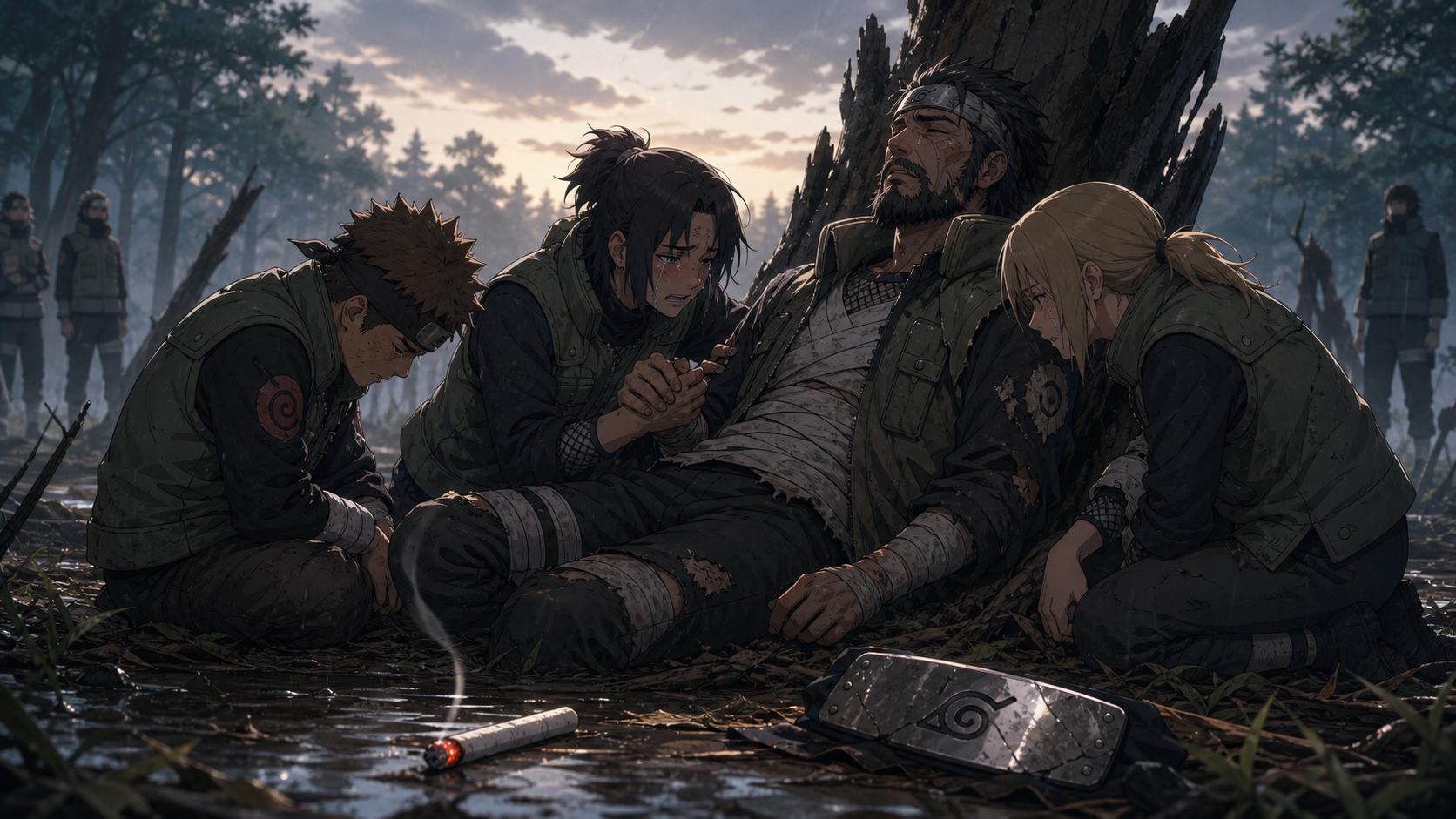
The fading cigarette makes absence visible
Asuma's cigarette has often accompanied conversation, strategy, and quiet moments between missions. Its ember going dark creates a small, ordinary image for an irreversible event.
That restraint is more powerful than turning death into spectacle. The world does not explode when a life ends. A familiar habit simply stops continuing.
The silence afterward gives grief somewhere to enter.
Hidan and Kakuzu leave consequences they do not understand
To Akatsuki, the encounter belongs to objectives, rituals, bodies, and tactical withdrawal. They do not remain to witness what Asuma means to the people around him.
That ignorance does not lessen their responsibility. It reveals the moral emptiness of treating lives as interchangeable resources.
The bonds they dismiss will become the structure of the response that follows them.
RaeRae's reaction
This episode hurts because Asuma spends his final strength making sure each student is seen clearly. He does not give them one generic speech about being strong. He speaks to Shikamaru, Ino, and Choji as different people with different gifts and fears.
The extinguishing cigarette is devastating precisely because it is quiet. After techniques built from immortality and ritual, the episode returns death to one simple absence.
Team Ten is still together, but every future formation will show who is missing.
Last words become the first responsibility of what comes next
Episode 80 does not offer Asuma a miraculous escape from Hidan's damage. It gives him agency over his final conversation.
He leaves Shikamaru with trust, Ino with recognition, and Choji with permission to believe in his own strength. Those words cannot replace their teacher, but they can keep grief from becoming directionless.
Asuma's voice ends in the clearing. The responsibility carried by it has only begun.
Official episode reference: Naruto Official episode guide
Licensed episode route: Crunchyroll licensed episode page
Asuma wins back the right to define his final scene
Hidan tried to turn Asuma’s death into a ritual performed for someone else’s god. Once the link is broken and the Akatsuki pair withdraws, Asuma uses the remaining time for something Hidan cannot claim. He speaks to his students.
The shift is not a miracle. His injuries remain fatal. It is agency inside loss, the ability to decide that his last breath will name love, responsibility, and the people he helped raise rather than the man who wounded him.
Reinforcements arrive at the cruel edge of being in time
Aoba, Raidō, and the others change the balance enough to push Hidan and Kakuzu away. They prevent more deaths. They create space around Team Ten. They do everything reinforcements are supposed to do except reverse what has already happened.
That difference is the episode’s first wound. Help can arrive in time for the team and too late for the teacher. The village’s response matters even when it cannot produce the outcome everyone wanted.
Asuma speaks to Ino as a shinobi whose care is power
Ino is often asked to prove herself in comparison with louder fighters or through appearance. Asuma does not reduce her to either. He understands that her attentiveness to people helps hold the team together.
His words ask her to look after Choji and Shikamaru, but that responsibility should not mean becoming their unpaid emotional caretaker. It recognizes a strength they all need while also asking the boys to value the person supplying it.
Ino deserves to grieve without immediately becoming everyone’s support
The expectation attached to her can be loving and unfair at once. She has just watched her teacher die. Her instinct may be to steady the others, yet she also needs room to break, rage, and be cared for.
A mature Team Ten will honor Asuma by making support reciprocal. Ino’s compassion is not an infinite village resource. It is a gift her teammates should protect while they learn how to carry her too.
Choji hears the truth Asuma spent years proving
Asuma tells Choji that kindness is not a flaw he must outgrow. That matters because shinobi culture often treats hesitation to hurt people as weakness. Choji’s gentleness has always been part of why he fights so fiercely when friends are threatened.
The message does not flatter him with empty praise. It asks him to trust the strength already present in the boy who shares food, notices loneliness, and refuses to abandon Shikamaru when other children do.
Choji’s body is not the measure of his worth
Asuma’s affection refuses every joke and insult that trained Choji to expect ridicule. He sees appetite, softness, loyalty, and power without treating one as evidence against another.
That recognition matters after death because grief repeats old insecurities in the voice of the person missing. Choji will need to remember the teacher who looked directly at him and did not ask him to become smaller before calling him strong.
Shikamaru receives the heaviest trust because he can understand its cost
Asuma identifies Shikamaru as someone capable of becoming Hokage material, not necessarily because he wants the office, but because he can see the board and care about the people on it.
The compliment is also an assignment. Intelligence cannot remain a private talent used to avoid inconvenience. Shikamaru’s decisions will shape who comes home, and Asuma believes he can bear that responsibility without losing the humanity that makes the choices matter.
The king finally stops being an abstract shogi question
Asuma once asked Shikamaru who the king is. The answer points toward the children who will inherit the village, the lives every generation is supposed to protect rather than spend casually.
That idea lands differently beside Asuma’s death and Kurenai’s pregnancy. He is not describing patriotism as a monument or title. He is describing obligation to people who cannot yet defend the future being built around them.
Kurenai is present even before the news reaches her
Asuma’s thoughts carry the life beyond Team Ten that the battlefield is about to shatter. Kurenai does not need to stand in the clearing for the audience to feel the conversation he will never have with her.
The coming child makes the language of inheritance painfully literal. Asuma leaves students who know his lessons and a family that will know him partly through what others remember. The village becomes responsible for telling the truth about both his warmth and his failures.
The cigarette turns a repeated habit into a final punctuation mark
Asuma’s smoking has never been a grand symbol every time it appears. That ordinariness is why the ember going out hurts. A background detail suddenly carries the knowledge that it will not restart in his hand.
The image refuses melodramatic noise. Fire narrows, smoke thins, and the people beside him understand before anyone can make the moment less final. Absence enters through an object that used to mean he was nearby.
Shikamaru’s face cannot solve this problem
The series has trained us to watch him think. His narrowed eyes usually mean a pattern is becoming visible. Here, intelligence cannot produce a move that returns Asuma to the board.
That helplessness is essential. A character should not be protected from grief by the same gift that makes him exceptional. Shikamaru has to meet a loss that cannot be outplanned, then decide later what kind of strategist survives it.
Team Ten’s formation now contains a permanent empty space
They remain Ino, Shikamaru, and Choji. Their childhood bonds remain. Yet every future mission will reveal the missing adult who once watched their blind sides, broke up arguments, and decided when they were ready.
The team does not honor Asuma by pretending the shape is unchanged. It honors him by naming the absence and learning how to distribute responsibilities he used to carry.
Hidan and Kakuzu escape without understanding what they created
They see a completed objective, an enemy casualty, and a practical withdrawal. They do not see the networks of loyalty that will follow them. They mistake grief for damage that remains at the scene.
That blindness will matter. Asuma’s students now possess tactical knowledge of Hidan’s ritual and personal reason to pursue him. The Akatsuki pair leaves behind a response taking shape inside the people they dismissed.
Revenge will be tempting because grief wants a task
Hunting Hidan offers Shikamaru somewhere to put anger that otherwise has no boundary. A plan can feel easier than sitting with the fact that Asuma is gone.
But revenge becomes another trap if it repeats Asuma’s exposure and risks the surviving team without support. The lesson of this battle is coordination. Any answer worthy of Asuma must protect Ino and Choji rather than spend them to quiet one person’s pain.
The episode allows each student a different grief
Choji’s grief is open and immediate. Ino reaches toward the people around her even as she cries. Shikamaru appears contained until containment becomes impossible elsewhere. None is more loyal because of how visible the pain becomes.
That distinction gives Team Ten emotional specificity. They are not three copies delivering the same reaction shot. They are young people whose histories with Asuma determine how loss moves through them.
Asuma does not demand that they become him
His last words recognize their separate gifts. He does not ask Shikamaru to smoke, Choji to harden, or Ino to lead in his exact style. The inheritance is permission to become fuller versions of themselves.
Good teaching survives through adaptation, not imitation. Team Ten will carry Asuma most honestly when his confidence helps them trust their own methods instead of turning his habits into sacred rules.
The village must support the people behind the heroic story
Calling Asuma a fallen hero cannot substitute for caring for Kurenai, the child, and Team Ten. Memorial language is easy. Daily support after everyone else returns to routine is the real measure of communal loyalty.
The king is protected through meals, training, medical care, patient listening, and adults willing to stay when grief becomes inconvenient. The Will of Fire means little if it only appears in speeches beside graves.
Last words matter, but ordinary words built the relationship
Asuma’s final message lands because it confirms years of smaller exchanges. Games with Shikamaru, meals with Choji, trust in Ino, and steady presence made the speech believable before he began.
No perfect sentence could create that bond in one scene. His last words gather the ordinary evidence his students already carry. The episode is not saying people must die eloquently. It is showing how a life of attention gives simple recognition enormous weight.
RaeRae’s full take
This one does not need to shout. Asuma looks at three children who are trying to be shinobi and makes sure they know he saw the people underneath the uniforms. That is the part that ruins me.
Ino should not have to become everybody’s strength before she gets to feel her own loss. Choji should never again believe cruelty tells the truth about his body. Shikamaru has to understand that being the smartest person in the clearing will not keep every person alive.
The cigarette going out is merciless because it is so small. After an immortal man, a curse, and enough violence to split bodies apart, death arrives as an ember that simply does not come back.
Asuma’s voice ends, but he has placed a different sentence inside each student. Their next lives will answer him. That is not closure. It is love becoming responsibility while none of them are ready.
Asuma leaves them permission to remember joy
The battlefield will dominate Team Ten’s immediate memory, but it should not be allowed to swallow every version of their teacher. Asuma was also restaurant bills, shogi boards, teasing, patience, and the adult who kept showing up.
Grief often makes the final scene feel like the truest scene. It is not. The violence explains how Asuma died, not the whole of how he lived. His students will need ordinary memories because ordinary memories return him to human scale.
Shikamaru will have to learn that carrying the team does not mean carrying grief alone
Asuma’s trust could easily become another excuse for Shikamaru to hide his pain while organizing everyone else. Leadership is not emotional disappearance. A strategist who never admits he is wounded eventually makes decisions from wounds nobody is allowed to name.
Ino and Choji are not pieces he must protect without speaking to them. They are his oldest friends. The strongest response will let all three share information, anger, fear, and the responsibility of deciding what comes next.
The funeral will not be the end of the village’s obligation
Ceremony can gather people and mark public loss, but Team Ten will meet Asuma’s absence repeatedly after the crowd leaves. The next training session, empty chair, unfinished shogi game, and mission briefing will each create another first.
Konoha should understand recovery as continued accompaniment. Assigning a new leader or approving a revenge mission cannot replace adults checking whether three young shinobi are sleeping, eating, and making choices that belong to them rather than their shock.
Hidan’s ritual failed to decide what Asuma passed forward
The curse controlled injury, but it never controlled inheritance. Hidan could link bodies and imitate pain. He could not enter the history between Asuma and his students or choose which words would remain after him.
That limit is the episode’s quiet refusal. Violence can end a life and still fail to own its meaning. Team Ten carries knowledge Hidan cannot touch because it was built long before the circle reached the ground.
The final silence is not empty
When Asuma stops speaking, the episode leaves room for every unfinished response. His students cannot fit gratitude, fear, apology, and love into the seconds available. Their silence contains all of it.
There is no perfect goodbye here, only a teacher doing what he can and children hearing more than they are ready to understand. The words will change as they grow. That continuing interpretation is part of how Asuma remains with them without the story pretending he is still alive.
Episode 80 understands that final words do not close grief. They give grief names to protect. Ino carries care without losing herself. Choji carries kindness without apologizing for it. Shikamaru carries intelligence toward responsibility, but not toward isolation. Asuma gives each student a direction, then trusts them to walk together. The cigarette fades because his life has ended. The team remains because his attention taught three children how to see one another, even when pain makes looking difficult in the silent battlefield clearing.
RaeRae checkpoint: Asuma cannot give Team Ten a future without grief. He gives them something harder and more useful: proof that he saw who each of them already was, and trusted who they could become.
Receipts and official routes
- Licensed title and official account of Asuma’s final words to Shikamaru, Ino, and Choji after reinforcements reach the battlefield: Naruto Official Site episode guide.
- Licensed episode title, number, and watch route: Crunchyroll.