
The Old Monk’s Prayer
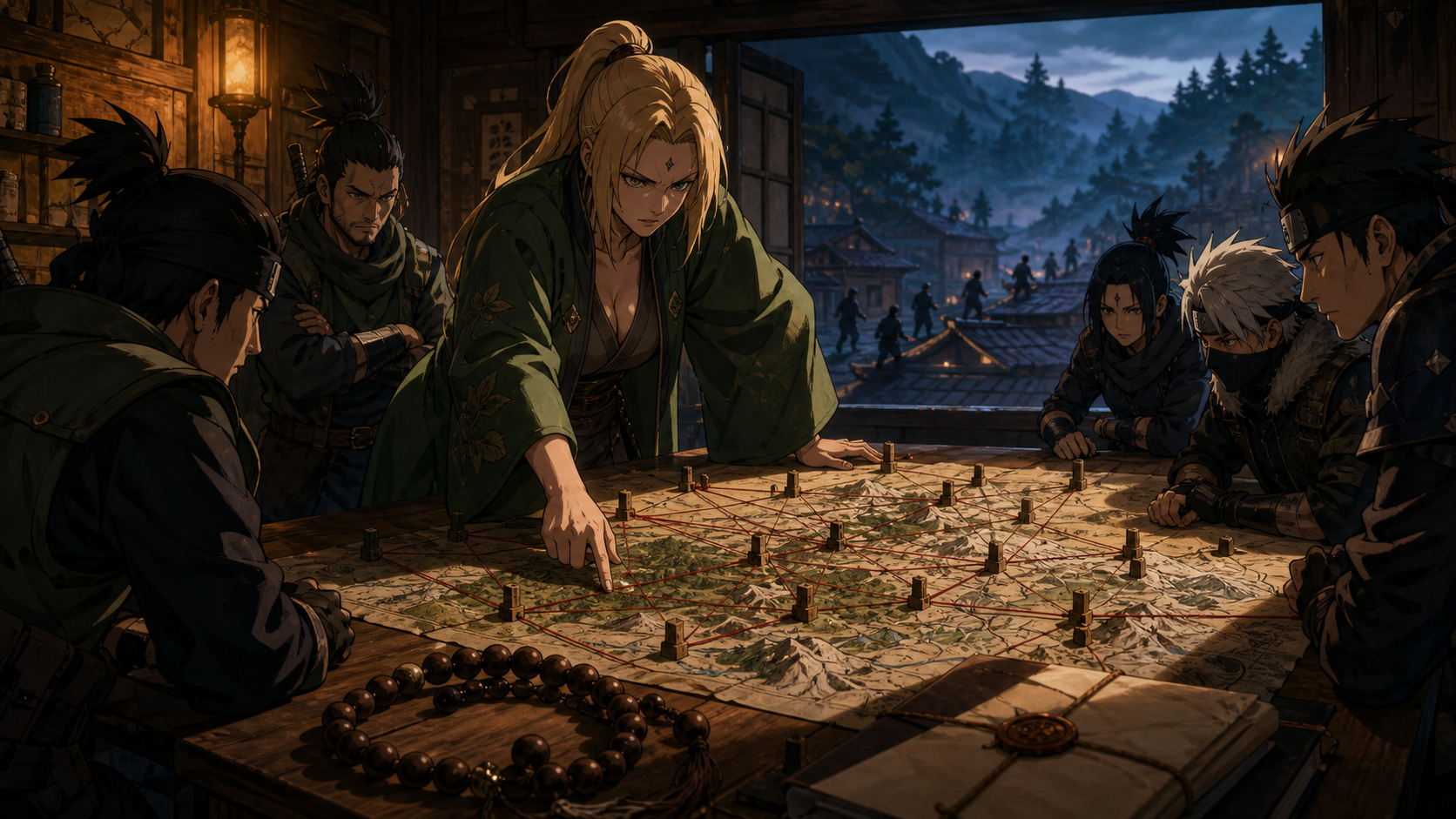
Tsunade fills the Land of Fire with search teams, but an enemy built around secrets keeps slipping through the village’s most careful net.
Konoha answers catastrophe with a net
Episode 75 begins from the uncomfortable truth delivered by the Fire Temple survivor: Akatsuki has already struck inside the Land of Fire. Tsunade responds by organizing a search so dense that the official description compares it to a net an ant could not escape.
That scale communicates how seriously the village takes the threat. Konoha is not sending one celebrated squad toward a convenient clue. It is attempting to control roads, borders, forests, and likely routes at once.
A perfect plan can still meet an enemy who refuses its logic
The search net reflects disciplined institutional thinking. Divide the terrain, assign teams, watch exits, and force the targets into a narrowing space.
Hidan and Kakuzu frustrate that logic because they do not move like ordinary fugitives. Their endurance, experience, and confidence let them treat pursuit as an inconvenience rather than a trap.
The failure is not proof that Konoha planned carelessly. It is evidence that the village has not yet understood the full problem.
Tsunade's frustration comes from responsibility
Tsunade has received proof of mass death and must prevent the next attack without reliable knowledge of the enemy's abilities or destination. Every hour without contact creates more possible targets.
Her anger is therefore not impatience for its own sake. Leadership makes uncertainty personal because she will be accountable for whatever slips through the gaps.
A commander can deploy more people, but cannot order information to appear.
The old monk's prayer survives as an obligation
The title shifts attention away from Akatsuki's spectacle and toward the spiritual community left behind. A prayer does not reverse the Fire Temple's destruction, but it preserves meaning where the attackers see only bodies and rewards.
The surviving monk carried more than a report to Konoha. He carried the final request of people whose lives now demand recognition and action.
The search becomes a promise that their deaths will not be treated as distant background damage.
Asuma reads the mission through Chiriku
For Asuma, the Fire Temple is connected to a former comrade from the Twelve Guardian Ninja. That bond changes the emotional temperature of the hunt.
He cannot reduce the temple to a mark on Tsunade's map because he knows someone inside it as a person. Memory adds urgency, but it can also make restraint harder.
The coming confrontation will test whether grief sharpens Asuma's judgment or pulls him toward the enemy's chosen rhythm.
Shikamaru belongs in a hunt defined by missing information
Akatsuki's escape creates a strategic puzzle before it creates a battle. Searchers need to infer routes, motives, and habits from incomplete evidence.
Shikamaru's value is not limited to inventing clever techniques after a fight begins. He notices structures in what others treat as chaos.
Against opponents who survive by violating expectations, that ability to revise an assumption may matter more than the size of the original net.
Hidan and Kakuzu exploit different kinds of confidence
Hidan behaves as if death cannot discipline him. Kakuzu behaves as if experience and calculation have already priced every risk.
Together they create an opponent who is difficult to intimidate, hurry, or predict. Konoha's overwhelming manpower does not automatically create psychological pressure because the pair does not believe the search can truly punish them.
Before the Leaf can capture them, it must discover what each man thinks is impossible.
Naruto's training remains part of the same response
Naruto is not assigned to every search squad, but his work continues under the same approaching danger. Combining wind nature and shape transformation is an investment in a confrontation Konoha cannot yet locate.
That makes the training feel less like a private milestone and more like village preparation. Kakashi and Yamato are helping produce an answer before anyone knows exactly where it will be needed.
Readiness develops beside operations, not after uncertainty politely ends.
More shinobi do not erase the need for better knowledge
The episode draws an important distinction between coverage and understanding. Konoha can fill the region with capable teams and still fail if every team is searching according to the wrong model.
Numbers close physical gaps. Intelligence closes conceptual ones.
Tsunade's frustration marks the moment when the village must stop assuming that tighter coverage alone will solve an enemy built around secrets.
RaeRae's reaction
I like that this episode lets a competent plan fail without pretending competence was meaningless. Tsunade's net is the responsible response to a confirmed attack, and the squads are doing real work. Hidan and Kakuzu escaping tells us something specific about Akatsuki rather than making Konoha look foolish.
The prayer in the title keeps the mission attached to people instead of turning it into a tactical exercise. Someone asked for help, a temple is gone, and Asuma cannot separate those facts from Chiriku.
That emotional weight makes the empty spaces on the search map feel dangerous.
A net is only the first draft of an answer
Episode 75 shows Konoha mobilizing at full institutional strength and discovering that effort does not guarantee contact. The Akatsuki pair remains outside the village's assumptions, leaving Tsunade with a wide operation and too little certainty.
The old monk's prayer gives the search its moral center. The next step must give it sharper intelligence.
Konoha has filled the map. Now it has to learn how Hidan and Kakuzu move through it.
Official episode reference: Naruto Official episode guide
Licensed episode route: Crunchyroll licensed episode page
Asuma’s squad finds the absence that changes the investigation
At the ruined Fire Temple, destruction is everywhere, but Chiriku’s body is missing. That absence is more useful than another footprint because it suggests the attackers took something deliberately rather than simply leaving after the massacre.
Asuma connects the missing body to Chiriku’s bounty. The search changes from sweeping terrain to predicting a transaction. Hidan and Kakuzu may ignore ordinary escape logic, but Kakuzu’s interest in money creates a route Konoha can follow.
The bounty station turns death into logistics
A black-market exchange does not merely reward violence after it happens. It creates destinations, schedules, intermediaries, and records. Kakuzu’s greed gives the team a chance because profit requires infrastructure.
Konoha should study that infrastructure without pretending only Akatsuki uses it. Who lists bounties? Who verifies bodies? Which officials tolerate the stations? A system that prices shinobi operates through many hands. Catching one collector will not dismantle the market that makes corpses portable currency.
Chiriku deserves to remain a person inside the clue
Calling his body evidence is operationally necessary and emotionally dangerous. Asuma knew him as a fellow Guardian Shinobi, a monk, and a man who continued living after their unit fractured. Kakuzu sees the bounty value. Konoha must not let pursuit copy that reduction.
Recovering Chiriku matters even if it costs time. His community deserves burial and certainty. The body is not disposable once it has pointed toward the enemy.
The old monk’s prayer gives the hunt a moral boundary
A prayer can ask for justice, safety, remembrance, or peace. It does not need to become authorization for revenge. The title keeps the mission attached to people whose spiritual life Hidan treats with particular contempt.
Asuma can carry that prayer by protecting the living and returning the dead, not by chasing anger until his team enters a trap. Honor should widen responsibility. If it narrows attention to one satisfying kill, grief has taken command.
Tsunade’s net failed because it searched movement without motive
Twenty squads covered enormous ground, yet Hidan and Kakuzu slipped through because the original model assumed fugitives would prioritize distance and concealment. Kakuzu may instead prioritize a nearby exchange where Chiriku’s bounty can be collected.
The correction is not to deploy forty squads blindly. It is to combine coverage with behavioral intelligence. Understanding what an opponent values can shrink a map faster than adding more bodies to it.
A competent plan should be designed to learn when it fails
Tsunade’s first operation does not capture the pair, but it produces sightings, cleared areas, timing, and evidence about routes they did not choose. That information can refine the next search if teams report consistently.
Failure becomes waste only when leaders hide it or repeat the same assumptions. A strong command system asks what the enemy taught them by escaping and changes accordingly.
Shikamaru’s reasoning turns grief into a testable lead
The missing body and bounty hypothesis create a prediction: the attackers will approach a collection point. The team can identify nearby exchanges, travel times, and routes instead of roaming toward anger.
This is where Shikamaru’s intelligence matters before any dramatic trap. He helps translate emotional urgency into a proposition that can be checked. If the evidence changes, the plan should change with it.
The exchange-point approach needs patience
A squad rushing directly into a bounty station may warn the target, endanger intermediaries, and destroy information about the larger network. Surveillance, perimeter control, and identification matter before confrontation.
Asuma’s personal stake makes patience harder. His team should agree on signals, fallback positions, and who can order withdrawal. Procedure protects people when emotion makes improvisation feel righteous.
Hidan and Kakuzu are dangerous because their partnership divides appetites
Kakuzu follows money and task completion. Hidan follows ritual and the opportunity to kill. One can pull the other toward a location the search model did not expect, while their irritation hides functional cooperation.
Konoha must profile them separately and together. A tactic that provokes Hidan may leave Kakuzu calculating. A financial lure that attracts Kakuzu may not control Hidan’s behavior. Treating the pair as one personality invites surprise.
Reports of immortality need disciplined belief
Survivor accounts may describe injuries that should have killed Hidan. Teams should neither dismiss the claim nor leap to a supernatural conclusion without observation. They need contingencies for an opponent who continues after lethal damage.
Distance, restraint, dismemberment prevention, and ritual interruption become rational precautions. Expertise means adjusting when reality violates expectation, not defending the expectation while teammates die.
Naruto’s training offers a parallel lesson about failed models
If a clone attempts the same wind transformation repeatedly and gets the same result, more effort is not enough. Naruto needs to identify which assumption about shape, force, or concentration is wrong.
Tsunade’s search and Naruto’s training both improve through feedback. Scale accelerates discovery only when someone examines what the failures say. Otherwise, hundreds of clones and twenty squads merely repeat one mistake faster.
Kakashi’s ramen gesture recognizes labor without making exhaustion noble
Taking Naruto to eat after punishing training can be care, humor, and a necessary reset. It should not become a cute reward system for running his body empty every day.
Food, sleep, and recovery are part of technique development. Kakashi needs Naruto able to interpret accumulated clone experience, not merely proud that he stayed upright longer than anyone expected.
Sakura’s concern belongs in the training record
She sees a method beyond ordinary human practice. Medical observation can identify danger that Naruto’s excitement and Kakashi’s deadline obscure. Her concern should influence rest, monitoring, and decisions about whether the next stage begins.
Support is not standing nearby while the hero overworks. It is having enough authority to interrupt when the process threatens the person it is supposed to strengthen.
Tsunade must coordinate pursuit without turning the Land of Fire into a checkpoint
A massive search can frighten civilians, disrupt trade, and encourage local officials to detain anyone unfamiliar. Those harms may produce resentment and bad intelligence while Akatsuki continues moving.
Squads need clear identification, respectful questioning, and narrow reasons for searches. Security becomes self-defeating when the response teaches ordinary people to fear the protectors more than the cloaks they seek.
The monks’ spiritual community needs practical aid
Prayer and memorials matter, but survivors also need shelter, transport, records, food, and help notifying families. Konoha should allocate resources alongside pursuit teams rather than assuming vengeance is the only service the dead require.
Recovery work proves the temple mattered before it became a battlefield. It keeps Hidan and Kakuzu from owning the final meaning of the place.
Finding the exchange is not the same as understanding the network
Even if Asuma’s team intercepts Kakuzu, other bounty stations may remain active and other hunters may use them. Evidence should identify brokers, communication methods, payment routes, and officials providing cover.
The wider system belongs outside one squad’s immediate fight, but somebody must preserve the lead. Tactical urgency should not erase strategic opportunity.
The prayer should guide what victory looks like
A successful outcome protects the squad, prevents another attack, recovers Chiriku, preserves evidence, and supports survivors. Killing an Akatsuki member may be necessary, but it is not the only measure.
Defining victory broadly keeps grief from shrinking into a body count. The Fire Temple lost people, history, and safety. Justice should answer more than one of those losses.
The bounty hypothesis needs confirmation before it becomes certainty
Chiriku’s missing body strongly suggests Kakuzu intends to collect the reward, but a smart team keeps alternate explanations alive. Akatsuki might want information, a technique, leverage, or a lure. Treating the first good theory as proven can make an exchange point into a prepared ambush.
Asuma’s squad should verify known bounties, travel time, station activity, and reports of similar transactions. A hypothesis becomes useful when it generates checks. It becomes dangerous when emotional urgency turns it into a fact nobody is allowed to question.
Exchange-station workers may know more than they can safely say
People operating around the bounty market face violent clients and may fear retaliation more than Konoha’s authority. Demanding instant cooperation could close the only information channel the team has.
Investigators need discreet questions, protection options, and a way for informants to report later. The goal is not to excuse participation in corpse trading. It is to understand that fear shapes testimony. Kakuzu’s network survives partly because speaking carries a price.
Choji and Ino should not be treated as Shikamaru’s supporting equipment
Shikamaru may identify the route, but the team’s survival depends on complementary judgment. Ino brings sensory and communication possibilities. Choji brings force, protection, and attention to the people around him. Asuma brings experience and command.
A plan becomes stronger when each member understands the goal and can revise their part. If everyone merely waits for Shikamaru’s instructions, one disruption can freeze the squad. Intelligence should distribute agency, not concentrate it.
The team needs a protocol for an enemy who may not stay dead
Temple evidence and survivor testimony may suggest Hidan endured impossible harm. The squad should plan for restraint, separation, observation, and immediate communication rather than assuming one lethal strike ends the encounter.
They also need to protect blood and avoid ritual conditions they do not understand. Unknown abilities punish casual contact. Caution is not cowardice when the enemy’s rules remain hidden.
Asuma can honor Chiriku without promising vengeance
A promise to kill may feel emotionally honest and tactically reckless. A better promise is specific: recover him, protect the team, stop the attackers, preserve evidence, and bring the truth back to the temple.
Those duties leave room for force without making force the only proof of love. Chiriku’s life contained more than the circumstances of his death. Honor should remember the man, not only punish the people who ended him.
Tsunade’s operation needs an exit from escalation
If every failed sweep produces more squads and broader searches, the village will exhaust itself and burden civilians without necessarily learning. Leadership should define when to narrow, regroup, or change methods.
The missing body provides exactly that kind of pivot. Move from blanket coverage toward likely financial routes while keeping enough patrols to protect communities. Adaptation is not admitting the first response was foolish. It is proving the response can think.
The prayer also asks the hunters to remember restraint after they find the men responsible. Hidan will provoke disgust, and Kakuzu will treat Chiriku’s body like proof that everything has a price. The squad must refuse both invitations. They can fight decisively without letting ritual cruelty or profit define their own behavior. Secure the area, protect witnesses, recover the body, and report what remains uncertain. Those steps may feel ordinary beside an Akatsuki battle, but they separate justice from retaliation. The old monk’s request survives when people keep the mission connected to the community that suffered. If the team returns with two dead enemies and no Chiriku, no evidence, and more injured civilians, revenge may be satisfied while responsibility fails. The prayer deserves a better answer than that.
RaeRae’s full take
The missing body is the smartest clue in the episode. Konoha covered the map and found nothing because it was tracking escape. Kakuzu is tracking profit.
Chiriku cannot become a bag of bounty money just because the clue works. Recover him, name him, and remember why Asuma cares.
I respect Tsunade’s twenty-squad net. Competent plans can fail. The question is whether leadership learns or simply deploys more people into the same assumption.
Shikamaru’s value begins before a shadow touches anybody. He turns absence, motive, and geography into a lead the team can test.
Asuma needs his squad precisely because grief makes solitary certainty dangerous. Let them challenge him if the hunt becomes personal enough to choose the route.
The old monk’s prayer should produce protection, recovery, and truth. If it becomes permission for reckless revenge, Hidan has already pulled Konoha into his ritual.
RaeRae checkpoint: Kakuzu took Chiriku because a hidden market gave the body a price. Konoha’s answer must recover the person, follow the money, and refuse to let grief turn one more team into inventory.
Receipts and official routes
- Japanese title, Konoha’s search cordon, Asuma’s team finding Chiriku missing, the bounty hypothesis, and the decision to check nearby exchange points: Naruto Official Site episode guide.
- Licensed title, episode number, Akatsuki evading the Leaf net, and watch route: Crunchyroll.