
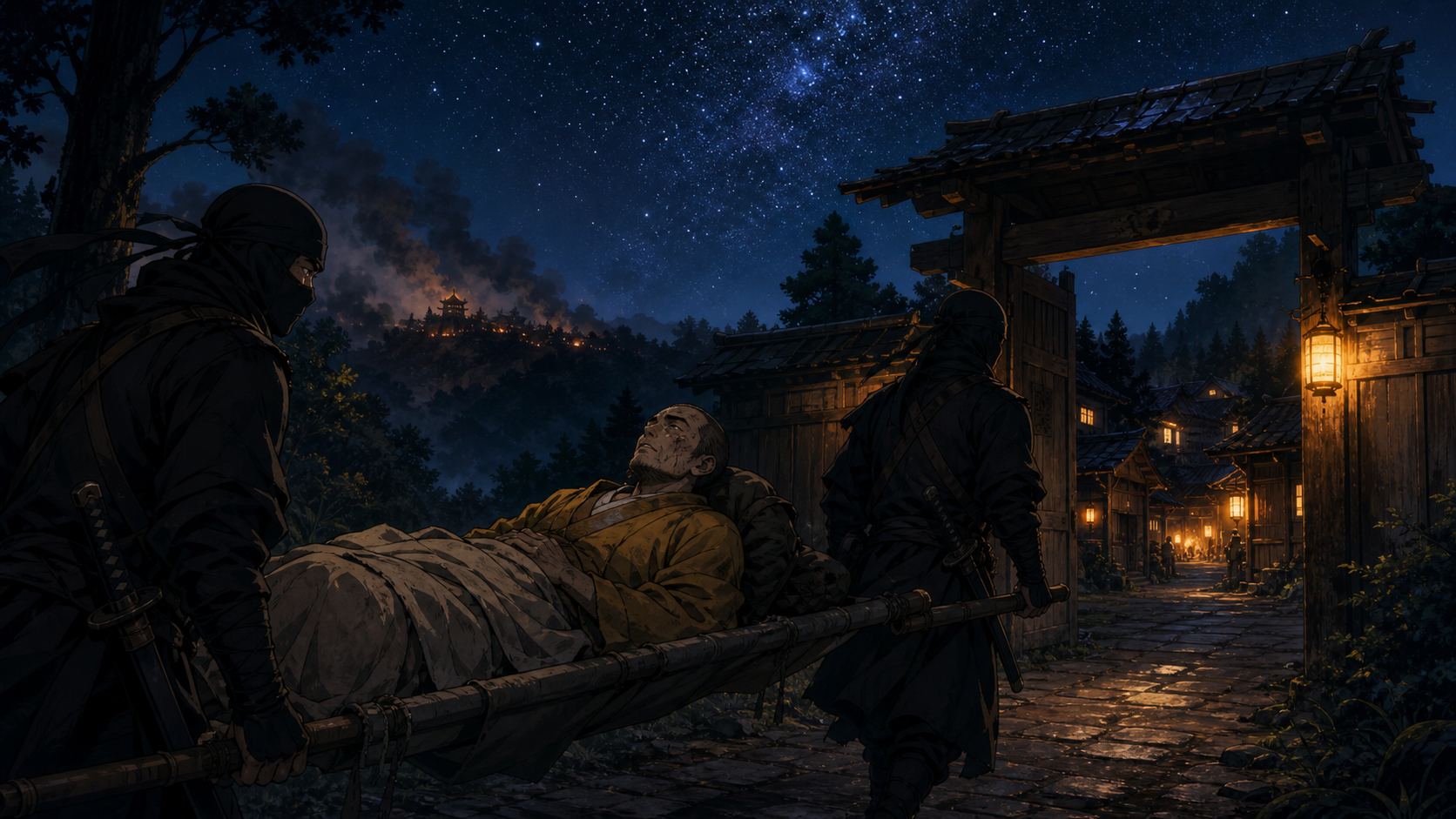
Under the Starry Sky
A lone survivor carries the Fire Temple’s destruction into Konoha while Naruto trains against a deadline he cannot yet see.
One survivor turns distant violence into Konoha's problem
Episode 74 opens with the cost of the Fire Temple attack arriving at the Hidden Leaf in human form. A surviving monk is carried into the village after escaping destruction that most of Konoha has not yet seen.
His condition collapses the distance between an attack elsewhere in the Land of Fire and a threat approaching Naruto's home. The village cannot dismiss the report as rumor because the witness carries the evidence on his body.
The Fire Temple's destruction changes the scale
The temple was not an undefended roadside stop. Its monks included trained fighters, and its history connects religious authority, political service, and the Land of Fire's military past.
Destroying it demonstrates that Hidan and Kakuzu will attack a recognized institution directly. Their advance is neither reconnaissance nor a minor criminal raid. Akatsuki announces capability through devastation, even if the attackers have no interest in speeches.
Warning and grief travel beneath the same stars
The title sounds peaceful until the episode places suffering beneath it. The night sky remains beautiful and indifferent while the injured monk is carried toward help.
That contrast gives the journey weight. Disaster does not change the stars or make the wider world acknowledge what was lost. Someone must survive the distance and speak for the people who cannot.
Intelligence begins with listening to the wounded
Konoha's first responsibility is medical, but treatment and intelligence gathering cannot remain separate for long. The survivor knows where the attackers came from, what they did, and how quickly they may move.
A rushed interrogation could deepen his trauma. Waiting too long could cost another target its warning. The village has to balance compassion with urgency, a quieter form of shinobi judgment that is no less consequential than combat.
Hidan and Kakuzu make violence feel procedural
The pair is frightening because destruction requires no emotional escalation from them. Hidan turns killing into ritual, while Kakuzu treats bodies, objectives, and money with cold practicality.
Their partnership makes cruelty routine. One supplies ecstatic devotion; the other disciplined calculation. The Fire Temple is not an exception that exhausted them. It is one completed task on a route that continues.
Asuma cannot hear this as neutral history
The temple's connection to Chiriku and the Twelve Guardian Ninja gives the attack a personal edge for Asuma. Old service, former comrades, and political wounds return through present danger.
That history does not make him less professional. It makes the cost legible before the rest of the village understands it. A destroyed institution contains individual lives, promises, and unfinished relationships.
Naruto trains while the deadline moves closer
Naruto remains focused on combining wind-nature and shape transformation. His work consumes every available thought, but the audience knows the time surrounding it is shrinking.
Every failed attempt occurs while enemies move through the Land of Fire. Naruto does not need to know the exact deadline for the deadline to be real.
Preparation depends on a community
Kakashi supplies analysis, Yamato containment, medics receive the survivor, and intelligence must turn testimony into action. Naruto's technique is only one part of Konoha's response.
The village survives through overlapping competence. No spectacular jutsu can replace communication, triage, planning, or people willing to carry an injured stranger home. That collective work gives Naruto's future power somewhere responsible to belong.
The episode refuses a clean transition
The Guardian Shinobi conflict has ended, but Konoha receives no long recovery. Damage is still being repaired when a new report arrives from beyond the walls.
Peace here is not an empty calendar. It is labor performed between emergencies without knowing how much time remains. Akatsuki exposes how quickly yesterday's aftermath becomes tomorrow's battlefield.
RaeRae's reaction
I love the restraint in making a survivor's arrival the central alarm. A giant attack on the village would be louder, but this is more unsettling because danger reaches Konoha first as testimony.
The starry setting makes the journey lonely, and the ruined temple turns one injured person into the bearer of a community's loss. Meanwhile, Naruto trains without realizing how urgently Konoha may need what he is building. That gap between knowledge and danger supplies the pressure.
A warning matters only if people act
Episode 74 moves Akatsuki from an approaching possibility to a confirmed local threat. The survivor cannot provide safety; he can only provide a chance to respond.
Konoha must convert grief into intelligence and intelligence into movement. Asuma's history makes the news personal, while Naruto's unfinished technique represents power that may be tested before it feels ready. Under the starry sky, the village receives both a survivor and a countdown.
Official episode reference: Naruto Official episode guide
Licensed episode route: Crunchyroll licensed episode page
The survivor carries a report nobody should make him earn the right to give
Reaching Konoha after the Fire Temple massacre already required endurance. The monk should not have to perform composure before adults believe him. Medical stabilization comes first, followed by questions paced around what he can safely recall.
Urgency does not require cruelty. A skilled debrief can gather direction, numbers, abilities, and timing without demanding a complete emotional account in one sitting. The village needs his information, but his body is not another resource to extract because Akatsuki created a deadline.
Tsunade’s twenty new squads turn testimony into movement
The official episode guide gives the key response: Tsunade dispatches twenty newly organized teams to hunt Akatsuki within the Land of Fire. That decision acknowledges the scale. One famous squad cannot search roads, temples, exchange points, and border routes simultaneously.
Quantity alone is not a plan. The teams need shared descriptions, reporting intervals, medical support, capture priorities, and rules for engaging opponents whose abilities remain uncertain. Coordination prevents twenty squads from becoming twenty isolated chances to repeat the temple’s disaster.
The Fire Temple’s destruction requires more than revenge
Anger can mobilize Konoha quickly, especially for shinobi who knew Chiriku. It can also narrow the objective to killing Hidan and Kakuzu. The larger response should preserve evidence, recover bodies, support survivors, secure the temple grounds, and identify how the attackers found and approached it.
Justice includes stopping the pair. It also includes caring for the community they damaged and learning enough to protect the next target. Revenge makes the enemy the center. Recovery keeps the harmed people there.
Asuma’s team enters a mission carrying personal history
Chiriku’s connection to the Twelve Guardian Ninja means the report will not land as ordinary intelligence for Asuma. He has just survived Kazuma’s return and confronted what happened among those former comrades. Now Akatsuki has attacked another person from that history.
Command should acknowledge that personal stake rather than pretending professionals become emotionless on assignment. Asuma can still lead, but the team needs permission to challenge reckless pursuit and enough information to recognize when grief is choosing the route.
Shikamaru’s judgment matters before the clever trap
His intelligence is often celebrated once a complicated strategy appears. The earlier skill is knowing what problem the team is actually solving. Are they tracking? Protecting a route? Gathering proof? Capturing an attacker? Preventing another strike?
A clear objective lets Shikamaru allocate limited people and avoid being baited by Hidan’s provocation. Genius is not merely inventing an answer under fire. It is refusing the wrong question before the fight begins.
Naruto’s waterfall training is extraordinary and visibly costly
The official guide notes that Sakura sees a gap no ordinary training can close. Hundreds of shadow clones let Naruto compress experience at a scale other shinobi cannot reproduce. That advantage makes his growth look almost alien from outside.
Sakura’s concern should not become envy or a judgment about her own worth. Different bodies, disciplines, and roles develop through different methods. Naruto’s training also carries costs unique to him. Comparison becomes useful only when it helps teammates plan together, not rank whose effort is real.
Sakura recognizes that support cannot mean matching every feat
She may not cut a waterfall through clone accumulation, but she can observe physical changes, notice dangerous fatigue, and provide medical judgment the training team needs. Her contribution is not lesser because it does not mirror Naruto’s technique.
Teams become fragile when every member believes value requires identical growth. Sakura’s path through medicine and precise chakra control offers a different expertise. The approaching enemy will demand those differences, not four copies of the same fighter.
The training field needs news without becoming a panic chamber
Naruto should learn that Akatsuki has attacked within the country, but timing and delivery matter. Dropping every horrifying detail during dangerous chakra work could increase risk. Hiding the attack until he finishes would remove his right to understand the deadline shaping decisions around him.
Kakashi and Yamato can pause the session, explain what is known, and decide together whether continuing remains safe. Information belongs inside the safety protocol, not outside it.
Twenty squads create twenty opportunities for misinformation
Hidan and Kakuzu may split, change direction, leave false witnesses, or exploit bounty networks. Reports will arrive unevenly. Tsunade needs a central process that distinguishes confirmed sightings from assumptions without punishing people for uncertainty.
Teams should state source, time, location, and confidence. A confident rumor can redirect half the search while the enemy walks elsewhere. Precision in reporting is another form of combat discipline.
Bounty stations may reveal where Kakuzu will go next
Kakuzu’s interest in money gives Konoha a behavioral lead. Tracking underground exchanges, known brokers, and valuable targets could narrow routes that raw geography leaves enormous.
That intelligence must be handled carefully. Informants may be criminals without being disposable, and a village cannot build reliable cooperation through threats alone. Kakuzu treats people as prices. Konoha should not copy that logic while trying to catch him.
Hidan’s ritual makes normal assumptions about injury unreliable
Reports from the temple may describe behavior that sounds impossible: apparent fatal damage followed by continued movement, ritual preparation, and harm transferred through an unknown link. Teams must believe the witness enough to adjust.
Assuming exaggeration because the ability violates expectation would be deadly. The correct response is cautious testing, distance, and observation. Shinobi survive unfamiliar jutsu by treating contradictions as data rather than insults to their expertise.
The stars make the episode’s scale brutally clear
Everyone operates under the same sky, but knowledge remains uneven. Naruto trains without seeing the temple. Tsunade receives a report after the destruction. Search teams move while Hidan and Kakuzu choose their next step. Yugito’s fate unfolds beyond Konoha’s view.
The shared sky does not create shared awareness. People have to carry information across the distance. The survivor’s journey becomes the human bridge between separate scenes.
A lone survivor should not become the entire memory of the temple
He may feel pressure to represent every person killed, explain every choice, and preserve a community while grieving it. Konoha can relieve that burden by gathering records, contacting families, and treating the temple as more than the site of an Akatsuki clue.
Memorial work matters alongside pursuit. Names, teachings, and daily life should survive, not only the account of how everyone died. Otherwise, Hidan and Kakuzu define the institution through its destruction.
The search squads need civilian protection rules
Moving through the Land of Fire means entering villages, roads, shrines, and markets where frightened people may have seen the attackers. Shinobi should request information without turning every resident into a suspect.
They also need a plan for evacuation if Akatsuki appears. Chasing the enemy through a populated area can convert a search into another massacre. Tactical success includes where a fight is allowed to happen.
Naruto’s progress cannot be measured only by whether the new jutsu finishes in time
He is learning wind control, disciplined repetition, and how to work inside supervision after the Sora crisis. Even if Akatsuki arrives before the final technique is ready, those gains remain real.
Teachers should prepare alternatives rather than making one unfinished jutsu the only acceptable answer. Naruto has clones, Rasengan, teamwork, and growing control. A deadline should shape planning, not erase every tool that already works.
The episode turns mourning into a test of institutions
Konoha can respond with coordinated protection, honest intelligence, survivor care, and measured pursuit. Or it can chase revenge, hide uncertainty, and demand impossible readiness from Naruto. Both responses may look decisive from the outside.
The difference appears in who carries the cost. Responsible institutions spread work and protect vulnerable people. Performative ones concentrate sacrifice in the grieving, the young, and the unusually powerful.
The survivor needs an advocate inside the command process
Once his testimony becomes operational intelligence, squads and leaders may discuss it repeatedly while he remains in a hospital bed. Someone should represent his medical limits, privacy, and right to know how the information is being used.
That advocate can prevent repeated questioning, correct exaggerations, and make sure investigators return with answers when they promise them. Trauma deepens when institutions take a person’s story, distribute it, and disappear. Respect includes closing the loop.
The twenty squads should share one map and many judgments
Central coordination can combine sightings and prevent duplicated searches, but field teams need authority to adapt when roads, civilians, or unfamiliar abilities change the situation. One rigid order from Konoha cannot anticipate every village and trail.
The balance is shared purpose with local judgment. Report quickly, preserve evidence, protect people, and do not chase beyond support simply because the enemy appears. Hidan and Kakuzu benefit if pride separates one squad from the network behind it.
Asuma’s team should discuss Chiriku before meeting the enemy
Silence would not make the personal connection vanish. Shikamaru, Ino, and Choji need enough context to understand why their leader may react strongly and why the Fire Temple matters beyond the mission briefing.
Asuma does not have to turn the road into therapy. One honest conversation can establish a safeguard: if grief narrows his judgment, the team is allowed to say so. Trust includes permission to interrupt a leader before emotion becomes an order.
Sakura’s observation should change the training plan
Recognizing that ordinary practice cannot match Naruto’s method is not the end of her role. She can help define recovery intervals, watch coordination after clone dispersal, and identify when cumulative strain changes movement or speech.
Medical expertise belongs at the design stage, not only after collapse. If a training method is unprecedented, health monitoring should be equally inventive. Naruto’s determination is data about motivation, not proof that his body has no limit.
The temple’s dead should not become motivation props for Naruto
Naruto may eventually learn what happened and feel pressure to finish the new technique for them. That emotion can be real without becoming the official training strategy. The monks did not die to improve his focus.
Teachers should reject language that turns their deaths into fuel. Honor them by stopping the killers, supporting survivors, and building better warnings. Grief deserves action without being converted into a teenager’s productivity demand.
The episode’s calm makes room for responsibility, not sentimentality
The stars, quiet roads, and training pauses give characters space to decide what happens after news arrives. Noise could hide those choices inside adrenaline. Calm exposes whether leaders listen carefully, whether teams prepare honestly, and whether people remember the community behind the report.
The threat remains urgent. The response becomes stronger because it is deliberate. Panic is loud, but coordination travels farther.
There is one more duty hidden in the survivor’s arrival: Konoha must tell the temple what happens next. Search teams may leave quickly, but somebody should remain responsible for communication with surviving clergy, families, and local officials. They deserve updates that distinguish confirmed facts from rumor, plus a clear path for requesting protection or recovering property. Otherwise the village takes the warning and abandons the people who supplied it. The same standard applies when squads enter other communities. Ask what residents need, explain what danger is known, and avoid treating homes as convenient terrain. Akatsuki’s movement crosses jurisdictions, but that does not erase local dignity. A coordinated national response should make people safer, not merely make shinobi faster. Under the starry sky, the survivor has already done the part nobody should have asked of him: escaping a massacre and carrying the truth. Konoha’s part begins when it receives both the message and the person, then refuses to value one more than the other with care, clarity, and speed.
RaeRae’s full take
The survivor arriving under a beautiful sky is the image that stays with me. The world did not darken politely when his community was destroyed. He had to carry the news through it.
Tsunade sending twenty squads is the right scale, but those squads need more than orders to find two cloaks. They need shared intelligence and rules that keep grief from choosing every fight.
Asuma’s connection to Chiriku matters. Professional does not mean untouched. His team should know when the mission becomes personal enough to distort judgment.
Sakura watching Naruto’s impossible training is not proof she is falling behind. Teams need different expertise, and Naruto needs someone able to see the physical cost he will ignore.
Hidan and Kakuzu destroyed a community. Do not let the story reduce that community to a warning delivered to the main cast.
The stars are quiet because the universe is not going to organize the response. People have to listen, move, protect, and remember before Akatsuki chooses the next place.
RaeRae checkpoint: One survivor brought Konoha a chance, not a guarantee. The village honors the Fire Temple by protecting him, remembering everyone else, and turning accurate grief into coordinated action.
Receipts and official routes
- Japanese title, the Fire Temple survivor’s report, Tsunade dispatching twenty squads, Naruto’s waterfall training, and Sakura recognizing its extraordinary scale: Naruto Official Site episode guide.
- Licensed title, episode number, the survivor reaching Konoha, and watch route: Crunchyroll.