
Despair
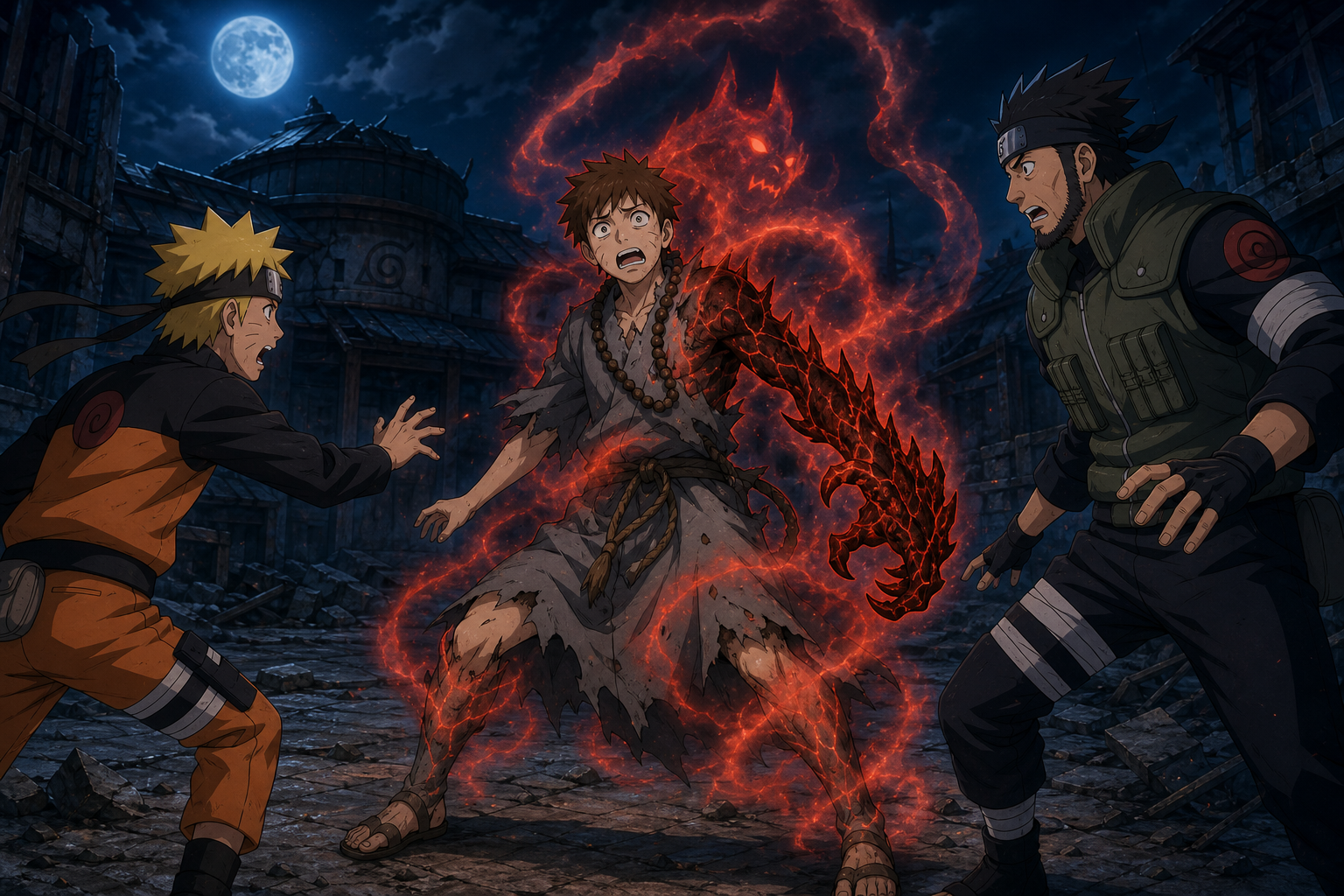
Naruto and Asuma reach Sora after promised power has become a transformation that frightens the person trapped inside it.
Naruto and Asuma arrive after Sora has begun to change
Episode 69 brings Naruto and Asuma to Sora, but physical contact does not immediately restore him. Ominous chakra has already wrapped around his body and begun forcing a transformation.
The timing creates the episode's despair. They reached the person they were trying to save, yet arrival is not the same as rescue.
Furido's manipulation has moved from ideas and isolation into a process Sora cannot simply argue himself out of.
Sora looks terrified, not triumphant
The transformation would be easier to read if Sora welcomed it as proof of power. Instead, his fear shows the gap between what Furido promised and what is happening.
He was told that his chakra was a blessing and a rightful inheritance. The changing body reveals how little control that story actually gave him.
Power that erases the person's ability to choose is not recognition. It is another form of possession.
Despair comes from seeing no clean choice
Sora has reasons to distrust Konoha. Asuma withheld the truth about Kazuma. Village authorities discussed Sora as a danger. Furido exploited those failures and then revealed a plan for mass murder.
Now Sora cannot return to innocence by choosing one side. Every available relationship contains injury, compromise, or danger.
The episode's emotional weight comes from that trap. A good choice can still leave grief unresolved.
Naruto recognizes the chakra before he understands its origin
The ominous energy around Sora echoes something Naruto knows intimately. He understands the terror of power surging beyond conscious control and the fear on other people's faces when they see it.
That recognition gives Naruto an emotional route toward Sora, but it does not make their conditions identical. Naruto must resist turning his experience into a complete explanation.
Empathy is most useful when it creates patience rather than certainty.
Asuma faces the consequence of delayed truth
Asuma is not responsible for Furido's jutsu, but he cannot avoid the role secrecy played in Sora's vulnerability. By the time Asuma admitted killing Kazuma, Furido had already prepared the meaning Sora would attach to that fact.
The transformation makes the cost visible. Silence intended to avoid pain gave manipulation more room.
Asuma's responsibility now is not to defend his earlier judgment. It is to protect Sora while telling the truth without conditions.
The chakra turns Sora's body into contested ground
Furido has treated Sora as heir, weapon, and proof of Kazuma's cause. Konoha's fearful leaders treated him as a security problem. Both perspectives risk ignoring the person whose body carries the danger.
The transformation makes that struggle literal. Sora's arm and silhouette change under a power other people want to define.
Saving him requires returning agency, not merely transferring control from one authority to another.
Naruto reaches instead of striking first
Naruto's instinct is to keep Sora inside the circle of people worth saving, even when the chakra makes approaching him dangerous.
That does not mean allowing uncontrolled violence. It means the objective remains Sora's survival rather than the fastest removal of a threat.
Naruto offers what he once needed from others: someone able to see the danger clearly without deciding the person inside it has disappeared.
Furido designed the transformation to isolate Sora further
An uncontrollable outburst can make every frightened reaction look like confirmation that Furido was right about Konoha. If shinobi respond only with weapons, Sora may believe the village never intended to help him.
The trap therefore operates emotionally and tactically. The more dangerous Sora becomes, the harder it is for defenders to demonstrate care without risking lives.
Furido benefits whether the transformation destroys Konoha or convinces Sora that return is impossible.
The village crisis leaves little room for patient rescue
Limelight is forming, revived guardians are attacking, civilians remain trapped, and every capable shinobi has competing obligations. Naruto and Asuma cannot pause the wider battle while Sora recovers.
That pressure makes compassion harder but more necessary. Urgency encourages people to reduce complex problems to immediate targets.
The episode asks whether Konoha can protect many lives without sacrificing the one frightened boy at the center of the weapon.
RaeRae's reaction
Sora's face is what makes this episode work for me. He does not look empowered. He looks like the promise of specialness has turned into a nightmare he cannot stop.
Naruto reaching him matters because Naruto knows how quickly adults can stop seeing a child once dangerous chakra appears. He cannot solve Sora by claiming they are the same, but he can refuse to let fear make the decision alone.
Asuma also has to sit with the fact that honesty arrived too late. Protecting Sora now means accepting that consequence instead of asking for immediate forgiveness.
Despair is not the end while another person keeps reaching
Episode 69 places Sora at the point where every story about his life appears to have failed. His father is dead, his mentor concealed the truth, Furido used him, and his own body is becoming dangerous to everyone nearby.
Naruto and Asuma cannot erase those facts. Their presence can still change what the facts demand next.
Despair says there is no choice left. Reaching Sora is the insistence that a choice remains, even if it is painful, incomplete, and made one breath before the transformation takes everything.
Official episode reference: Naruto Official episode guide
Licensed episode route: Crunchyroll licensed episode page
The Nine-Tails chakra was placed inside Sora, not awakened by destiny
The ugliest revelation is that Sora’s condition was manufactured. Chakra left over from the Nine-Tails attack could not be sealed completely into Naruto, and some of it was gathered and implanted into Sora. Furido then built a story of inheritance around an injury somebody deliberately created.
That distinction destroys every romantic claim about Sora finally becoming his true self. The transformation is not fate recognizing him. It is an experiment reaching the stage its controller wanted. His terror is the correct response to learning that adults turned his body into storage and called the result potential.
Furido weaponizes the difference between being special and being valued
Sora spent years treated as strange, dangerous, and difficult. Furido answered that loneliness by praising his unusual chakra. The praise felt like recognition because nobody else had given Sora a truthful explanation. Yet Furido valued the power precisely where Sora needed someone to value the person.
That switch is grooming with shinobi vocabulary. Make a wounded child feel chosen, isolate him from relationships that might challenge the story, then reveal that being chosen means surrendering control. Furido did not cure Sora’s rejection. He found the shape of it and built a handle.
Despair becomes a self-fulfilling weapon
The official episode account makes the emotional mechanism plain: after repeated betrayal, Sora yields to a desperate destructive impulse. Furido has arranged those betrayals so that collapse appears to prove his claims. If Sora attacks Konoha, frightened villagers will see a monster. Their fear will then seem to confirm that the village never accepted him.
This is why rescue cannot focus only on suppressing chakra. Naruto and Asuma have to interrupt the interpretation Furido attached to it. Sora needs evidence that losing control does not erase every relationship or make return impossible.
Naruto knows the shame that follows an outburst
Naruto’s experience with the Nine-Tails includes more than physical danger. It includes waking after rage, seeing injuries, and fearing what other people now believe about him. He knows how quickly one uncontrolled moment can become somebody’s permanent definition of a jinchuriki.
That knowledge makes his presence essential after the immediate fight too. Sora may survive and still expect disgust, punishment, or abandonment. Naruto can name the difference between responsibility and identity: harm must be addressed, but a person is not reducible to the worst thing dangerous chakra did through his body.
Shared chakra does not make Naruto and Sora interchangeable
The story draws an obvious parallel, but good empathy requires limits. Naruto was sealed as a newborn to contain Kurama during an emergency. Sora received residual chakra through a separate deliberate act and grew up with different relationships, information, and training. Their fear can rhyme without their histories becoming identical.
Naruto helps most when he says, in effect, “I recognize this terror,” rather than “I know everything you feel.” The first creates company. The second risks replacing Sora’s voice with Naruto’s autobiography.
Asuma owes Sora an apology without a defense attached
Asuma may have withheld Kazuma’s history because he feared what the truth would do. The feared outcome arrived anyway, strengthened by someone else controlling the disclosure. Intent does not cancel consequence.
An honest apology should name the choice and its cost: I knew, I waited, and that silence left you alone with a man who used the truth against you. It should not immediately ask Sora to understand why. Explanation can come later. First, Asuma must prove that truth is no longer a reward offered only when Sora behaves correctly.
Protecting Sora and protecting Konoha are one objective
Furido wants defenders to see a choice between saving the village and saving the boy. If they kill or discard Sora, he proves that institutions protect themselves by sacrificing inconvenient children. If they ignore the danger, civilians die. The answer requires refusing both simplifications.
Contain the chakra, move civilians, use proportionate force, keep talking, and coordinate medical support. Rescue is not passive. It is the disciplined work of reducing harm without accepting Furido’s definition of who must be removed.
People should speak to Sora, not about him
Too many adults have discussed Sora as a security question while he stood outside the decision. During the transformation, tactical communication is necessary, but it should not erase direct address. Use his name. Tell him what is happening. Explain what defenders are about to do before restraint becomes unavoidable.
Those choices may seem small beside the chakra cloak. They are how people return agency in fragments. Furido made Sora an object inside a plan. Every moment that recognizes his understanding pushes against that reduction.
Furido’s betrayal does not make every earlier kindness fake
Manipulators often provide real attention because real attention works. Sora may remember moments when Furido listened, answered questions, or made him feel less alone. Learning the larger plan does not erase the emotional effect of those moments, and demanding that Sora instantly call all of them false will only increase his confusion.
The better truth is harder: care-shaped behavior can coexist with exploitation. What decides the relationship is whether Sora’s choices mattered when they diverged from Furido’s goal. They did not. That is the evidence Sora can use without pretending he never felt understood.
Konoha has to earn the right to be an alternative
Stopping Furido will not automatically make the village trustworthy. Leaders allowed secrecy, stigma, and factional games to surround a child carrying dangerous chakra. If Konoha wants Sora to return, it must offer more than shelter under surveillance.
He needs honest records, medical care, a voice in decisions, adults accountable for what they hid, and relationships not conditioned on obedience. Belonging is not the absence of expulsion. It is the presence of dignity and meaningful choice.
Despair narrows time until destruction feels like the only action left
Sora’s world has collapsed into immediate sensation: pain, chakra, fear, and the belief that everyone lied. Long explanations cannot compete easily with that state. Naruto should offer one reachable next step rather than a complete philosophy of forgiveness.
Look at me. Breathe. Move away from Furido. Let us hold the chakra back together. Tiny choices widen time. Once Sora can imagine surviving the next minute, the future stops belonging entirely to the person who designed his collapse.
The people nearby must manage their fear honestly
Seeing Nine-Tails chakra will trigger memories of Konoha’s destruction. Adults may feel terror before they can reason through Sora’s circumstances. Pretending that fear does not exist will make it leak into commands, body language, and unnecessary force.
Professional restraint means recognizing the reaction and refusing to let it decide policy. Assign roles, keep civilians moving, and let shinobi with relevant experience approach. Courage is not the absence of fear around Sora. It is the refusal to turn fear into a verdict about him.
Sora will need a recovery plan that survives public memory
Even if the transformation ends without mass casualties, rumors will travel faster than any official explanation. Some residents will remember only the chakra cloak. Sora cannot be expected to repair that reputation alone.
Konoha should tell the truth about Furido’s operation without exposing every private detail of Sora’s trauma. Leaders must reject collective blame, protect him from retaliation, and make clear that he was exploited. Silence would allow frightened speculation to become another prison.
Asuma and Naruto offer different pieces of the rescue
Naruto brings lived recognition and stubborn presence. Asuma brings the missing history, adult responsibility, and a direct connection to Kazuma. Neither can substitute for the other. Naruto cannot confess what Asuma withheld, and Asuma cannot claim Naruto’s experience inside dangerous chakra.
The strongest rescue lets both contributions remain distinct. Sora needs someone who understands the bodily terror and someone willing to answer for the political and family history that surrounded it.
Despair is interrupted when choice becomes visible again
The episode does not need Sora to feel hopeful immediately. Hope is too large and cheerful a demand for this moment. He needs proof that Furido has not eliminated every possible action.
A hand that remains extended, a truthful sentence, a barrier used to protect rather than punish, or one civilian moved out of danger can become evidence. Despair says all paths end the same way. Rescue begins by making one different ending concrete.
The sealing history creates responsibilities beyond Furido
Someone collected residual Nine-Tails chakra, someone performed the implantation, and other adults either knew or failed to ask what had been done to Sora. Furido is the immediate abuser, but a complete investigation cannot stop with the easiest villain. Konoha and the Fire Temple need records, testimony, and safeguards against another child becoming a secret vessel.
Accountability should follow decisions, not affiliations. If an official helped, rank cannot protect that person. If records were hidden, the concealment must be named. If adults suspected danger but treated Sora only as a problem, they owe him more than private regret. The truth belongs in the recovery plan because secrecy was part of the weapon.
Sora deserves informed care after emergency containment
Sora needs medical information in language he can understand. What chakra remains? What can trigger it? Which treatments carry risks? Who controls access to his body during care? He should not wake from forced transformation and discover that another council made every decision while he was unconscious.
Emergency treatment may require speed, but continuing care requires consent and explanation. Naruto can support him without becoming his only lifeline. One friendship should not carry the work of doctors, mentors, investigators, and village leaders.
Building a wider circle protects both boys from a familiar mistake: expecting traumatized children to rescue each other while adults congratulate their bond. Despair thrives when responsibility disappears into admiration for one heroic kid. The adults need to show up too.
Grief for Kazuma is not a loyalty contract
Sora must be allowed to grieve Kazuma without inheriting his politics. A child can love a dead parent, reject what that parent did, and remain uncertain about stories told by former enemies. Nobody should demand that he prove recovery by condemning Kazuma on schedule.
Grief is not allegiance. Memory is not a contract. Giving Sora that freedom may be the first time an adult relationship with his father’s legacy does not ask him to become evidence for someone else.
Recovery also needs a plan for anger. Sora may direct it at Furido, Asuma, the village, himself, or anyone who witnessed the transformation. Adults should not treat that anger as proof the chakra still owns him. They should help him separate feeling from action, offer ways to speak and train, and remain present when the grateful moment passes. Trauma does not become tidy because the battle ended. Some days Sora may want answers; other days he may want distance from everyone. Respecting that rhythm is part of returning control. The victory is not a quiet child. It is a living person able to choose what healing looks like.
RaeRae’s full take
Sora did not awaken into his destiny. Somebody put stolen disaster inside a child, waited for loneliness to do half the work, then called the explosion power. I need the story to keep that moral line bright.
His frightened face matters more than the chakra effects. He understands before everyone else that the thing Furido praised was never under his control.
Naruto is the person I want reaching for him because Naruto knows the stare people give a dangerous body. He also has to respect that Sora’s history is not a duplicate of his own.
Asuma cannot apologize his way out of the battle, but he owes the apology anyway. He waited to tell the truth, and Furido filled that silence with poison.
Konoha must protect civilians and Sora at the same time. Any solution that treats one as disposable is Furido’s logic wearing a different forehead protector.
Despair does not vanish because Naruto shouts loudly enough. It weakens when Sora sees one choice that still belongs to him. Keep reaching until he can make it.
RaeRae checkpoint: Sora’s chakra is dangerous. Sora is not disposable. Holding both truths at once is the entire moral test, and anybody offering only one has missed the child inside the crisis.
Receipts and official routes
- Japanese title, Sora’s implanted Nine-Tails chakra, his transformation, and the despair driving his destructive impulse: Naruto Official Site episode guide.
- Licensed title, episode number, synopsis, and watch route: Crunchyroll.