
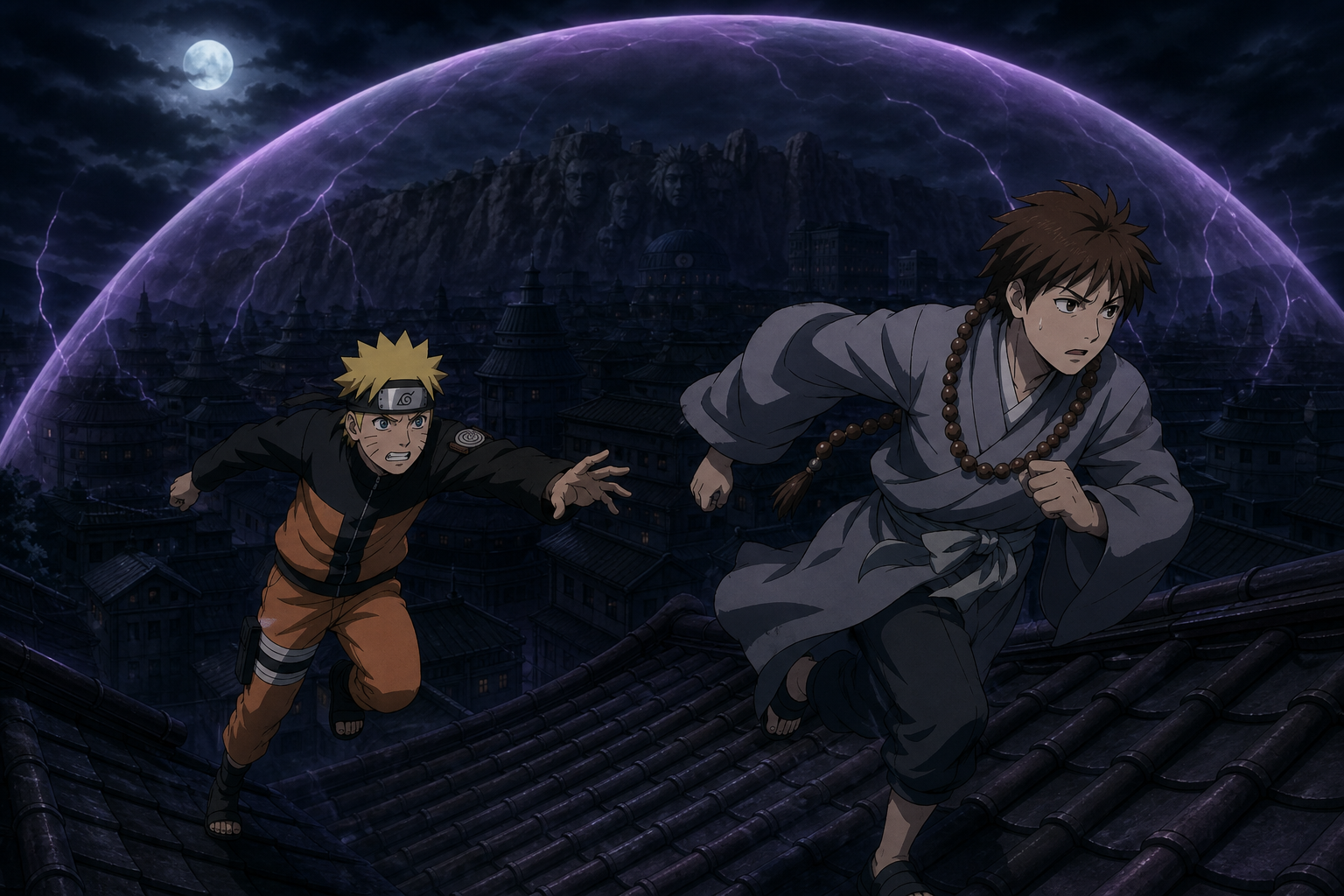
Lockdown of Darkness
Furido turns a total blackout and sealed barrier into a weapon against a village already divided by distrust.
The blackout converts private distrust into public danger
Episode 65 begins when the argument around Sora is no longer contained inside one room. A massive power outage drops the Hidden Leaf into darkness, and Furido uses the confusion to begin his assault.
The timing is deliberate. Konoha has just exposed fractures between Tsunade, Danzo, Asuma, and Sora. Darkness removes the village's shared visibility at the exact moment its leaders need coordinated trust.
Furido does not create every weakness. He attacks when existing weaknesses are hardest to manage.
A barrier makes Konoha's protection feel like captivity
Furido's men raise a barrier around the village, trapping everyone inside. The Hidden Leaf's walls usually represent safety. Now the same boundary becomes a sealed perimeter controlled by the enemy.
That reversal gives the title its pressure. Lockdown is not protection when the people inside cannot choose the terms or reach help beyond it.
For Sora, the image echoes his emotional fear that Konoha only wants to contain him. The enemy turns that fear into architecture.
Furido controls the first interpretation of the crisis
The attackers know why the power failed, where the barrier stands, and what they intend to do next. The village sees only symptoms.
That information gap allows Furido to move while shinobi are still identifying the problem. It also lets him present the assault to Sora as a consequence of Konoha's corruption rather than an operation designed around manipulation.
Whoever explains chaos first can often decide whom frightened people blame.
Naruto pursues Sora without treating him as the enemy
Naruto follows Sora because he understands that Furido is trying to isolate him. The pursuit is urgent, but its purpose is connection rather than punishment.
That distinction matters after Naruto took an attack meant for Sora. His actions show a consistent position: Sora can be dangerous, angry, and wrong without becoming disposable.
Naruto is trying to reach the person inside the crisis before Furido turns every rescue attempt into evidence of control.
Sora is running with someone else's story in his head
Sora now knows Asuma killed his father, but he understands that fact through Furido's framing. He has been told that Kazuma represented a rightful vision and that Konoha stole both his father and his destiny.
The story gives grief a target. It also relieves Sora from the harder work of holding several truths at once: Asuma cared for him, Asuma killed Kazuma, Konoha feared his power, and Furido benefits from his rage.
Fleeing keeps those contradictions from being examined.
Darkness tests command at village scale
Tsunade must respond without reliable power, outside assistance, or a complete picture of the attackers. Every unit needs instructions, but centralized command is harder when communication systems fail.
This is where preparation becomes political. A village cannot depend entirely on one leader seeing everything. Shinobi need shared priorities that survive temporary isolation: protect civilians, report barrier points, preserve medical access, and avoid chasing decoys.
Legitimate authority proves itself by enabling responsible action beyond the leader's immediate reach.
Danzo's secrecy has made cooperation more expensive
Danzo may possess intelligence useful to the crisis, but his concealed operations make every contribution harder to trust. Information cannot be evaluated quickly when its source has already withheld relevant facts.
The episode exposes the operational cost of governing through compartments. Secrecy can protect a mission in the short term, yet accumulated secrecy slows collective action when a threat reaches everyone.
Konoha is paying interest on decisions its institutions never examined together.
The barrier separates survival from escape
Once the village is sealed, escape is no longer a simple answer. Civilians and shinobi must survive inside the enemy's chosen field while specialized teams search for the barrier's logic.
That changes every fight. Pursuing one attacker too far can abandon a district. Destroying the wrong structure can endanger people sheltering without power.
The defenders have to think beyond winning individual encounters. Their objective is restoring a functioning village.
The visual darkness amplifies uncertain allegiance
In daylight, uniforms, landmarks, and movement help shinobi identify allies. A blackout makes silhouettes ambiguous and familiar streets unreliable.
The setting externalizes the story's central problem. Tsunade cannot immediately distinguish loyal secrecy from disloyal conspiracy. Sora cannot distinguish flawed care from deliberate imprisonment. Naruto cannot know whether reaching Sora will be enough.
The village has lost light after its relationships already lost clarity.
RaeRae's reaction
The barrier is such an effective escalation because it turns Konoha's confidence inside out. The village is not invaded through an open gate. It is made helpless within its own perimeter.
I also keep thinking about Naruto chasing Sora across that darkness. Naruto cannot offer a perfect explanation for every adult failure, but he can keep choosing not to abandon him. That consistency matters more than another speech right now.
Furido offers Sora certainty. Naruto offers presence. The second is less dramatic, but it is the only one that leaves Sora free to think.
Restoring light will not automatically restore trust
Episode 65 traps Konoha physically while exposing how divided it already was. Breaking the barrier and restoring power are necessary, measurable goals. They will not undo what Sora heard or resolve the conflict between public leadership and hidden authority.
The defenders must therefore fight on two levels. They need to reopen the village, and they need to prevent Furido from owning the meaning of the crisis.
Darkness gives the enemy cover. Distrust gives him direction. Konoha can survive only by addressing both.
Official episode reference: Naruto Official episode guide
Licensed episode route: Crunchyroll licensed episode page
The outage attacks coordination before it attacks bodies
Lights disappear, familiar streets become uncertain, and ordinary communication slows. Furido gains time because every defender must first determine whether the failure is local, accidental, or part of a larger assault.
The blackout therefore functions as command disruption. It forces Konoha to spend attention identifying the crisis while attackers already understand it.
Information becomes the first battlefield.
The barrier converts the village perimeter into enemy property
Konoha’s boundary usually distinguishes protected interior from dangerous exterior. Furido seals that same line and decides who may cross. Safety architecture becomes captivity without changing shape.
The reversal is politically sharp. A wall is not protective because leaders call it protection. Its meaning depends on who controls it, whom it serves, and whether people inside retain agency.
The enemy turns home into a contained target.
Civilians need visible instructions more than heroic secrecy
Most residents cannot identify barrier seals or enemy techniques. They need clear shelter routes, medical points, fire precautions, and signals that distinguish Leaf orders from manipulation.
Withholding everything to prevent panic can create worse panic when people invent explanations in darkness.
Public trust grows when leaders share what residents need to act safely without exposing operational details.
Distributed command becomes necessary when central visibility fails
Tsunade cannot direct every street personally. Unit leaders need standing priorities that survive broken power and communication: protect civilians, maintain medical access, report barrier nodes, and avoid unverified pursuit.
Decentralization does not weaken legitimate authority when everyone works from shared principles.
It proves leadership prepared people to act responsibly beyond direct supervision.
Danzo’s compartments make useful information harder to trust quickly
He may know enemy movements, hidden operatives, or vulnerabilities. Because he concealed networks from Tsunade, every claim now requires extra verification at the worst possible moment.
Secrecy did not eliminate risk. It moved risk into the emergency response.
Konoha pays operational interest on political decisions it refused to examine earlier.
Naruto follows Sora to preserve contact, not to collect a fugitive
The purpose matters. If Naruto treats Sora as a target to capture, he confirms Furido’s claim that the village sees only dangerous chakra. If he ignores the risk, he abandons everyone Sora might harm.
Naruto tries to hold both truths: Sora is in danger and can create danger.
Care becomes responsible when protection includes the person and the people around him.
Sora’s flight gives Furido privacy inside a public attack
The blackout draws defenders outward while emotional isolation pulls Sora away from anyone who could challenge Furido’s story. Physical chaos creates a private recruitment space.
That structure reveals the assault’s personal objective. Village damage is not separate from manipulation; it supplies cover for it.
Furido controls attention at scale so he can control one young person more closely.
Certainty feels like light when every trusted relationship has become complicated
Sora knows Asuma killed his father, but the reasons remain painful and contested. Konoha feared his power while also protecting him. Naruto defended him but cannot answer every question.
Furido offers a clean story with one villain and one destiny. Simplicity feels relieving in darkness.
Relief should not be confused with truth, especially when the storyteller benefits from the conclusion.
The defenders must treat every obvious attacker as a possible diversion
Furido has already used coffins, routes, and barriers to direct pursuit. A visible enemy inside Konoha may exist to pull skilled shinobi away from civilians, medical facilities, or a barrier node.
Teams should ask what each encounter causes elsewhere before committing every resource.
Winning the offered fight can still lose the operation the enemy concealed.
Medical systems become strategic infrastructure during blackout
Hospitals need power, routes, supplies, and protection. Sakura and other medical ninja cannot be treated merely as combat support when widespread darkness increases accidents alongside deliberate attacks.
Restoring medical access may save more lives than chasing one intruder.
A village survives through systems, not only elite duels.
The darkness makes mistaken identity part of the enemy’s weapon
Silhouettes, sounds, and hurried movement become ambiguous. Defenders can injure allies or civilians if fear replaces verification. Attackers may exploit uniforms, false calls, or familiar routes.
Teams need challenges, signals, and controlled zones.
Discipline protects people from the panic the blackout was designed to produce.
Naruto’s consistency gives Sora evidence Furido cannot explain away easily
Naruto welcomed him, trained beside him, protected him, and now follows without declaring him disposable. Those actions do not erase institutional failures. They complicate Furido’s claim that every Leaf bond is false.
Consistency matters because manipulation depends on isolating each event.
A pattern of care can survive one argument better than a perfect speech.
Naruto must still respect that presence is not permission
Following Sora may be necessary during immediate danger. Naruto should explain why when he can and avoid treating emotional closeness as a right to control every movement.
Protection without transparency can resemble surveillance.
The relationship remains trustworthy only if emergency limits are temporary, reviewable, and connected to actual risk.
Breaking the barrier requires understanding the system, not attacking its surface
A large seal may have anchors, maintainers, linked points, or consequences if disrupted incorrectly. Brute force against the visible wall could waste chakra or injure people nearby.
Specialists need to map its structure while defenders buy time.
Precision at village scale follows the same lesson Naruto learned from a leaf.
The title joins physical confinement with emotional narrowing
Konoha is locked inside a barrier. Sora is locked inside a revenge story. Both enclosures restrict alternatives while presenting themselves as inevitable.
Breaking either requires identifying who constructed the boundary and what keeps it active.
Freedom begins when the imposed structure stops looking like the natural shape of reality.
Restoring electricity cannot be mistaken for ending the crisis
Light may return while barrier damage, injuries, misinformation, and distrust remain. A technical repair can make the village look normal before relationships or systems recover.
Leaders need a public account, medical follow-up, security review, and honest examination of how Furido reached Sora.
Recovery includes what the emergency exposed.
Barrier teams need protection while they solve the problem everyone can see
Specialists examining seals become obvious targets because their work threatens the entire lockdown. Combat squads should defend them without crowding the nodes or damaging evidence.
This division of labor matters. The shinobi holding off attackers may look more heroic, but the people reading the barrier can restore movement for the whole village.
Victory depends on protecting expertise long enough for it to work.
The village should assume the blackout has more than one purpose
Darkness can conceal attackers, disrupt command, create civilian panic, interrupt medical care, and draw defenders toward visible incidents. Furido gains more if Konoha assumes only one objective.
Leaders need parallel checks rather than one massive response chasing the loudest threat. Power systems, archives, gates, hospitals, and communication points all require attention.
A layered attack deserves a layered defense.
Sora’s route through the village can reveal whether he is choosing or being guided
Naruto should notice whether Sora moves toward familiar places, follows signals, avoids certain districts, or appears to know a path Furido prepared. Those details can distinguish panicked flight from coordinated extraction.
Observation is not an excuse to stop reaching him. It makes the approach safer and more honest.
Understanding the route may expose the person controlling the destination.
Naruto needs support instead of another solo rescue assignment
His emotional connection to Sora makes him valuable and vulnerable. Furido can predict that Naruto will keep chasing after others hesitate. Sending backup protects both boys and preserves an outside view of manipulation Naruto may miss.
Support does not mean replacing Naruto as the person who speaks. It means nobody asks one teenager to carry a village crisis and another teenager’s grief alone.
Shared responsibility is what Team Kakashi should mean under pressure.
Sakura can protect civilians and still remain connected to Naruto’s pursuit
Medical duty may keep her away from the rooftops, but information should travel both ways. Reports about Sora’s condition can help her prepare treatment, while observations from injured civilians can reveal enemy movement.
The episode should not frame care work as absence from the real battle. Keeping people alive is central to restoring the village.
Her expertise turns scattered injuries into evidence about how the assault operates.
False signals become more dangerous when everyone wants reassurance
A familiar voice, flare, or order may promise that a district is safe. In darkness, frightened people are likely to follow relief before verifying its source.
Konoha needs authentication practices simple enough to use during chaos. Shinobi should repeat orders, confirm chains of command, and challenge changes that redirect civilians unexpectedly.
Trust becomes resilient when it includes methods for checking trust.
The barrier is also a message about Furido’s view of power
He does not persuade the village or confront its leadership openly. He removes choice, isolates the population, and creates conditions where his preferred story can dominate.
That method matches his treatment of Sora. Furido narrows available paths until obedience looks like the only meaningful action.
The physical lockdown reveals the politics inside his promised liberation.
After the crisis, Konoha must account for people who were harmed indirectly
Not every injury will come from an assassin. Darkness can cause falls, interrupted treatment, fires, separated families, and panic. Those consequences belong to the attack even if they happen far from a fight.
Recovery records should include them. Otherwise the village will measure success by defeated enemies while residents carry uncounted damage.
Public safety becomes credible when ordinary losses matter alongside shinobi victories.
Emergency restrictions need an ending condition
A sealed village may require checkpoints, movement limits, and rapid orders. Those measures should be tied to specific risks and removed when those risks pass. Otherwise an enemy lockdown can quietly become an excuse for permanent internal control.
Tsunade should require records of who authorized restrictions, whom they affected, and when they were reviewed.
Safety loses legitimacy when temporary power has no visible path back to ordinary accountability.
Sora needs a route back that does not begin with surrendering every feeling
Naruto may reach him before the barrier falls. The invitation should not demand that Sora forgive Asuma, trust Konoha completely, or deny his anger. It should ask for one immediate choice that protects lives and preserves time for truth.
Returning can mean pausing Furido’s plan, accepting medical help, or sharing what he knows. Small choices restore agency better than an all-or-nothing loyalty test.
A safe path back leaves room for unresolved grief after the emergency ends.
Konoha also needs to tell residents what happened after power returns. Silence may protect embarrassed leaders, but it leaves rumors to explain the barrier, the missing light, and the violence. A clear public account should name confirmed facts, acknowledge uncertainty, identify support, and promise review. People who endured the lockdown deserve more than an order to resume normal life without questions or answers from those responsible for protecting them afterward.
RaeRae’s full take
I love the cruelty of using Konoha’s own perimeter as a cage. The wall did not suddenly become evil. Control changed hands, and every promise attached to that boundary flipped with it.
The blackout also proves why Danzo’s secrecy is not free. Maybe he has useful intelligence. Nobody can evaluate it quickly because he trained leadership to expect hidden agendas.
Naruto chasing Sora matters because he refuses the easiest category. Sora is not simply victim or enemy. He is a teammate in danger who can also endanger other people.
Furido offers certainty because complicated truth has failed Sora. That is manipulation’s favorite opening: take legitimate pain, remove context, and sell one violent answer as freedom.
Konoha needs more than fighters. Civilians need routes, hospitals need access, squads need signals, and leaders need enough humility to share authority responsibly.
Breaking the barrier will restore movement. The village will remain locked down emotionally until somebody tells Sora the truth and admits what secrecy cost.
RaeRae checkpoint: Furido did not make Konoha distrust itself. He timed the darkness so every concealed fracture became operational. Restoring light is easier than rebuilding the trust his barrier exposed.
Receipts and official routes
- Episode number, Japanese title, blackout, village barrier, Naruto’s pursuit of Sora, and official placement: Naruto Official Site episode guide.
- Licensed title and episode route: Crunchyroll.