
A New Enemy
The final coffin is not only stolen. It is positioned to control the pursuit.
The last hidden grave turns urgency into bait
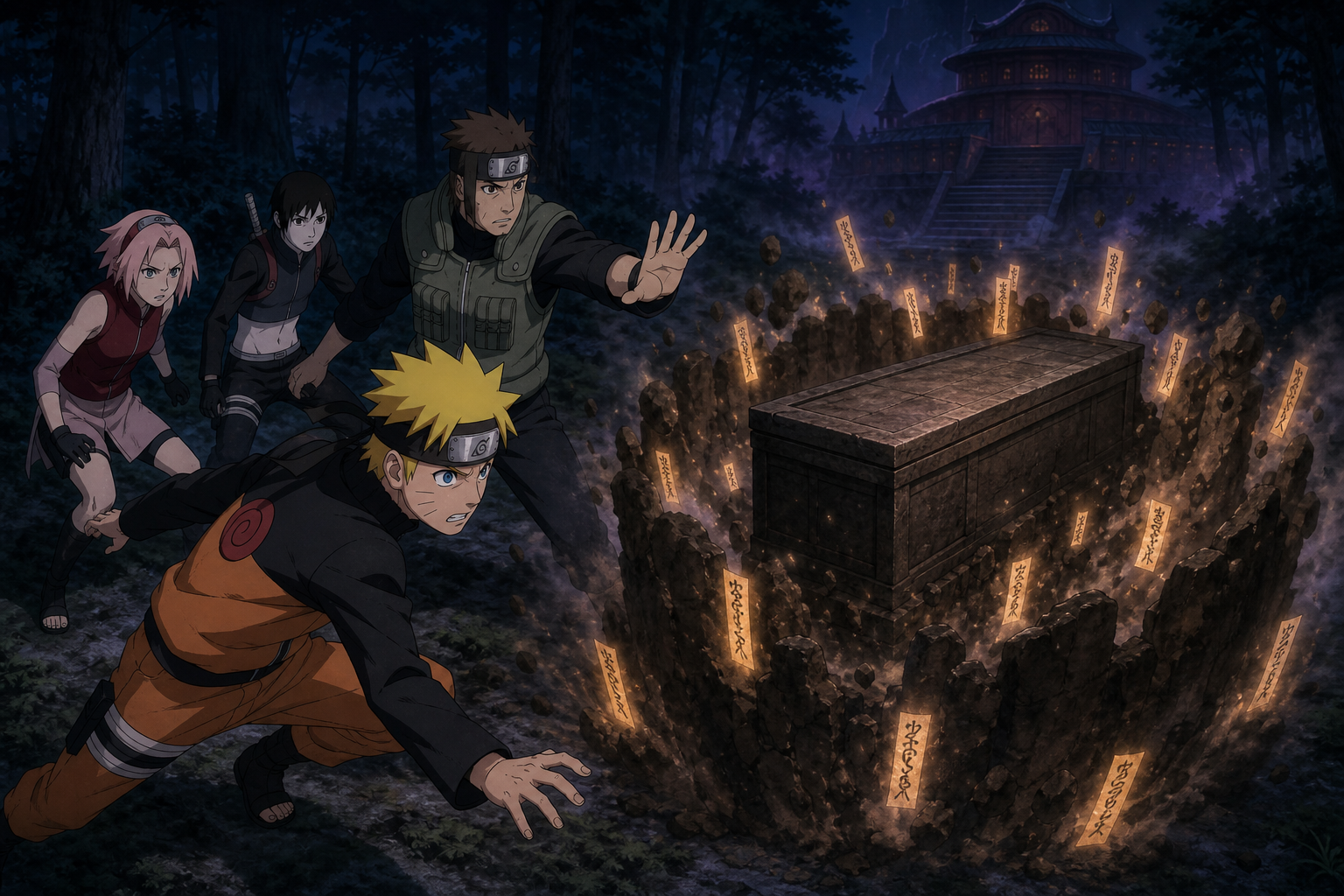
Episode 59 begins with the news Team Kakashi feared: the final hidden grave has been broken into. The team pursues the stolen coffin before the thieves can disappear with the last Guardian Shinobi Twelve body.
The pursuit feels straightforward because the objective is visible. A coffin is moving away, and stopping it seems more important than slowing down to question why the trail is so easy to follow.
That assumption is exactly what the enemy uses. The coffin is bait, and Team Kakashi runs into a trap designed around its sense of responsibility.
A visible target can hide the real operation
The grave thieves understand what the team values. Team Kakashi will protect the Fire Temple, respect the dead, and chase evidence connected to the stolen remains. The enemy turns those predictable commitments into control over where the team moves.
This does not mean caring is a weakness. It means an opponent can exploit care when urgency replaces observation.
Yamato's challenge is to preserve the team's values while refusing the route the enemy has prepared for them.
The trap confirms that the thefts were never random
Repeated grave violations already suggested planning. A prepared ambush around the final coffin confirms an organized group with intelligence, resources, and a larger objective.
The thieves knew which grave remained, anticipated the response, and arranged the environment to isolate or delay the pursuers. The theft and the trap are parts of one operation.
Team Kakashi is no longer investigating damage left behind. It is facing an enemy that expects the investigation and has incorporated the team into its plan.
Yamato recognizes the moment pursuit becomes containment
Yamato's leadership matters in the second before the trap closes. Naruto's attention stays on the coffin. Yamato reads the activating seals and rising earth as a change in the battlefield.
Stopping the team is not hesitation. It is adaptation. The original objective cannot matter more than the survival of the people trying to complete it.
The lesson follows directly from the Sasuke mission. A goal can be important and still require limits when the path toward it becomes destructive.
Naruto's training is tested through restraint before technique
Naruto has begun learning wind transformation, but the episode does not need him to unveil a finished attack. The more immediate test is whether he can listen when Yamato tells him the obvious target is unsafe.
Naruto often equates speed with commitment. If he reaches the coffin first, he proves he cares most. The ambush exposes how that instinct can give the enemy control.
Restraint is part of combat growth. A shinobi who cannot pause can be aimed by anyone who knows what he will chase.
Sakura reads the physical scene while Sai watches for the unseen attacker
Sakura and Sai contribute different forms of attention. Sakura can assess disturbed ground, activating tags, and the likely injury pattern of a collapsing barrier. Sai can scan the perimeter and use ink techniques to probe spaces without committing a body.
Their roles make the team harder to manipulate. Naruto sees the target. Yamato sees the structure. Sakura and Sai gather the details that reveal how the structure may move.
The mission works when these perspectives remain connected rather than competing for the first action.
The closed coffin is a symbol the enemy can move without explanation
Nobody can confirm what the coffin contains while it remains sealed. The team responds to its meaning: a stolen guardian, a violated grave, and a final chance to prevent desecration.
The enemy needs that meaning more than the body itself in this moment. A closed coffin lets expectation do the work.
This is a useful warning about symbols. People can be directed by what an object represents even when they lack evidence about what is actually inside it.
The new enemy is defined first by method
The episode title promises an opponent, but the enemy's identity matters less initially than the way the group operates. It steals bodies, controls information, chooses terrain, and prepares traps around predictable responses.
That method distinguishes the threat from Orochimaru's open psychological pressure or Sasuke's overwhelming presence. Team Kakashi is now facing someone who prefers indirect control.
Understanding the method may reveal the people behind it more reliably than waiting for a dramatic introduction.
The Fire Temple mission forces the team to function as a unit
The Tenchi Bridge mission was shaped by secrecy inside Team Kakashi. Sai had a hidden order, Naruto lost control, and Sakura concealed the source of her injury. The new mission gives the group a chance to work from shared information.
That does not guarantee success. The coffin trap proves an external enemy can still manipulate them. The difference is that the team can respond together instead of discovering that one member has been playing a separate game.
Trust becomes operational when people communicate before acting.
RaeRae's reaction
The coffin is such effective bait because the team has every moral reason to chase it. I do not blame them for moving quickly. I do want Naruto to learn that caring about the mission does not require giving the enemy exactly the response it planned.
Yamato throwing up a hand is the image of leadership here. He is not less committed to recovering the guardian. He sees that the battlefield has changed before urgency carries everyone into the center.
I also like that the enemy is introduced through competence. We do not need a speech to know the group is dangerous. Four graves were targeted, the final pursuit was anticipated, and the trap activates at the moment Team Kakashi reaches the bait.
The chase becomes the first direct contest of the arc
Episode 59 moves the Guardian Shinobi Twelve story from investigation to confrontation. The stolen bodies point toward an old political conflict, and the last coffin draws Team Kakashi into a prepared enclosure.
The team now knows the enemy is watching its responses. Future decisions must account for that intelligence. Every obvious trail may be an invitation, and every urgent objective may be positioned to control the pursuers.
The new enemy has not only taken the dead. It is testing how easily the living can be moved.
Official episode reference: Naruto Official episode guide
Licensed episode route: Crunchyroll licensed episode page
The coffin works as bait because the team supplies its meaning
The enemy does not need to explain why the coffin matters. Team Kakashi already knows a Guardian Shinobi Twelve body was stolen, understands the violation, and feels responsible for preventing the final theft. The object arrives loaded with urgency before anyone confirms what sits inside it.
That is what makes symbolic bait so effective. A plain box would invite inspection. A coffin linked to a sacred grave invites immediate rescue.
The trap turns the team’s moral knowledge against its tactical judgment.
Responsibility becomes exploitable when it is confused with predictability
Caring about the dead is not the mistake. Moving along the only route the enemy has offered without testing it is the mistake. An opponent can predict values without owning them, but predictable behavior gives that opponent leverage.
Yamato must help the team keep the obligation while varying the response. They can protect the remains, warn the temple, probe the terrain, and pursue from more than one angle.
Strategy protects values by preventing an enemy from turning them into automatic commands.
The prepared earth confirms surveillance happened before the pursuit
Sealing tags and engineered terrain require time. The grave thieves did not improvise after spotting Team Kakashi. They selected the clearing, established boundaries, and calculated where the pursuers would stop.
That preparation means somebody studied the likely response from Konoha and the Fire Temple. The enemy may know team composition, standard pursuit methods, or Naruto’s tendency to rush visible objectives.
A trap this tailored should make every earlier clue feel less accidental.
Yamato’s warning is valuable because it interrupts momentum
Momentum feels like progress when a target remains ahead. The team is running, the coffin is visible, and distance is closing. Stopping can feel like surrendering an advantage even when the terrain has become hostile.
Yamato recognizes that the mission changed. Once the seals activate, continuing the same movement no longer serves the same goal.
Leadership sometimes means becoming the unpopular pause between urgency and disaster.
Naruto’s first wind lesson applies before he throws a technique
Wind transformation teaches Naruto to narrow force into a deliberate edge. The ambush asks for the same mental discipline. He must separate the real target from the surrounding pressure and direct attention where it can change the outcome.
Charging at the coffin is broad force. Reading the seal, locating the caster, and coordinating an exit are precision.
A training arc matters more when its principle enters Naruto’s decisions before its signature attack enters the fight.
The team’s separation is an enemy-authored assignment
When barriers divide Naruto, Sakura, Sai, and Yamato, each person is pushed toward an encounter selected by the trap’s designer. The enemy is not only choosing terrain. It is deciding which skills and vulnerabilities appear without support.
That makes regrouping more than convenience. Reuniting rejects the roles the opponent assigned them.
Team Kakashi must remember that surviving an individual duel is not the same as escaping a system built to keep them apart.
Sai’s reconnaissance tools threaten an enemy that depends on hidden structure
Ink creatures can scout paths, test openings, and carry information without exposing Sai’s body to every surface. That makes him useful against a trap whose power comes from controlling what the team can see.
The enemy will therefore have reason to isolate, misdirect, or neutralize him quickly. Reconnaissance is not secondary when information determines freedom of movement.
Sai’s value comes from making the battlefield less private to the people who designed it.
Sakura cannot be reduced to the teammate who needs extraction
A collapsing or enclosed battlefield makes medical knowledge immediately relevant. Sakura can assess injuries, recognize dangerous materials, and apply strength precisely to structural weaknesses. Her response should be planned around capability rather than the assumption that Naruto must rescue her.
Isolation may still place her at risk. Risk and helplessness are not synonyms.
The team becomes stronger when concern for Sakura does not erase evidence that she can change the terrain herself.
The new enemies introduce themselves through control rather than ideology
Viewers know the Guardian Shinobi Twelve conflict has political roots, but the attackers do not begin by making a case. They begin by stealing bodies and arranging people inside an ambush.
That order matters. Their method reveals what any later rhetoric may try to hide. A movement that treats corpses and living opponents as pieces has already declared its relationship to consent.
Competence can be impressive without making coercion noble.
The title withholds names because method is the first identity that matters
“A New Enemy” does not ask the audience to memorize a roster immediately. The enemy is first the intelligence behind four thefts, one bait coffin, a prepared clearing, and the forced division of Team Kakashi.
Names will help organize later encounters. Method tells the team how danger operates now.
When an opponent controls routes and information, learning the pattern may matter more than learning a biography.
The Fire Temple’s sacred boundary has become a tactical map
The thieves convert graves, paths, and memorial knowledge into coordinates for an operation. Places maintained for remembrance become staging points. The transformation is another form of desecration beyond removing bodies.
Team Kakashi must respond without treating the temple the same way. Protecting sacred ground cannot mean occupying it carelessly, withholding everything from its caretakers, or causing damage in pursuit of an enemy.
How the team fights should still reflect what it claims to protect.
The closed coffin should be verified before recovery becomes certainty
The team knows a coffin was taken. It does not know that the visible coffin holds the expected body. The distinction sounds cautious only until the trap proves how much the enemy depends on assumption.
A clone, ink creature, earth probe, or sensory check could test the object while the team holds safer positions. Verification costs time, but unverified certainty can cost the entire mission.
Evidence does not become disrespectful because urgency wants an immediate answer.
Naruto is especially vulnerable to targets that resemble abandonment
A stolen body looks like someone being carried away while Naruto arrives too late. That image touches the same wound driving his pursuit of Sasuke. An enemy does not need to know every detail to benefit from the reaction.
Naruto’s fear of failing another person can make any moving target feel morally absolute. The coffin trap asks whether he can care without losing awareness of everyone beside him.
Protecting one person should not require emotionally abandoning the team currently within reach.
Yamato must lead without turning caution into permanent control
His ability to stop Naruto is necessary in dangerous moments, but good leadership cannot become a series of commands that Naruto obeys without understanding. Yamato should name what he sees: active seals, altered terrain, and a route chosen too neatly.
Explanation builds the judgment Naruto will need when Yamato is not present. Containment solves only the immediate movement.
The goal is a shinobi who recognizes the trap himself, not one who waits forever for an adult’s raised hand.
Separation tests whether recent trust can survive missing information
Team Kakashi has barely stabilized after Sai’s secret mission and Naruto’s loss of control. Once barriers cut visual contact, every member must act without knowing exactly what the others face.
Trust means assuming competence while still working to restore communication. It rejects both panic and indifference.
The enemy expects isolation to make four smaller problems. The team can answer by carrying a shared plan across the walls.
The trap reveals an opponent who studies systems, not only fighters
The attackers target burial customs, response routes, team formations, and terrain. They are exploiting the system around Team Kakashi instead of challenging raw strength at the gate.
That approach demands institutional learning. Konoha and the temple must examine how information about the tombs leaked, how the remaining site was protected, and why the pursuit entered prepared ground.
Defeating one fighter will not close every weakness the operation exposed.
A trap can fail tactically and still succeed as surveillance
Even if Team Kakashi escapes, the attackers learn how quickly Konoha responds, who takes command, which techniques appear under pressure, and how the members behave when separated. The encounter can produce intelligence without producing a capture.
That possibility should change how the team evaluates victory. Surviving matters, but they must also ask what they revealed and whether the coffin pursuit distracted them from another operation.
A prepared enemy may treat every fight as data collection for the next one.
The team needs a regrouping rule that survives broken sight lines
Communication plans built only for open terrain disappear when earth walls rise. Before pursuing another obvious target, Team Kakashi should establish signals, time limits, fallback locations, and priorities each member can follow alone.
Those rules do not replace judgment. They give isolated people a shared starting point when fresh information cannot travel.
The enemy designed separation to make four reactions easier to manage. A durable regrouping plan keeps the team present inside each individual decision.
Recovering the coffin cannot be the only definition of success
The mission includes protecting the temple, preserving evidence, identifying the attackers, preventing additional desecration, and returning the team alive. Focusing on one visible object can erase every other obligation.
That narrower definition is exactly what bait requires. If Naruto believes touching the coffin equals success, the enemy controls the scoreboard before the fight begins.
Yamato’s leadership must keep the broader mission visible so one loss does not provoke reckless compensation and one recovery does not conceal a larger failure.
Naruto also needs to remember that the enemy can weaponize impatience without defeating him directly. Every rushed step narrows his choices and widens the trap’s control. When he pauses, listens, and checks the terrain with his team, he does more than avoid injury. He denies the attackers the predictable version of himself they planned to use against everyone there today.
RaeRae’s full take
I love that the enemy’s first real flex is making Team Kakashi run exactly where it wants. No giant speech. No dramatic invitation. Just a stolen coffin positioned so every decent instinct says chase it now.
That does not make the team foolish for caring. It makes verification part of care. If the coffin is bait and everybody dies reaching it, nobody protected the dead, the temple, or each other.
Yamato’s pause is the smartest action in the episode because he recognizes that visible progress has become containment. Naruto sees the objective. Yamato sees who selected the path.
I want Naruto’s training to count here. Wind chakra is about creating an edge instead of throwing force everywhere. The same principle should help him distinguish urgency from panic and the target from the trap built around it.
The separation also gives the new Team Kakashi a clean test. They cannot depend on standing shoulder to shoulder. They have to carry trust through walls, assume each other’s competence, and work against assignments the enemy chose for them.
This enemy is dangerous because it studies what people will do when they care. The answer cannot be caring less. The answer is learning to care without becoming programmable.
RaeRae checkpoint: The coffin is not proof that the enemy controls the dead. The team’s unquestioned pursuit is proof that the enemy can control the living. Yamato’s pause is where that control starts breaking.
Receipts and official routes
- Episode number, Japanese title, stolen-coffin pursuit, trap, separated encounters, and official placement: Naruto Official Site episode guide.
- Licensed title and episode route: Crunchyroll.