
Loneliness
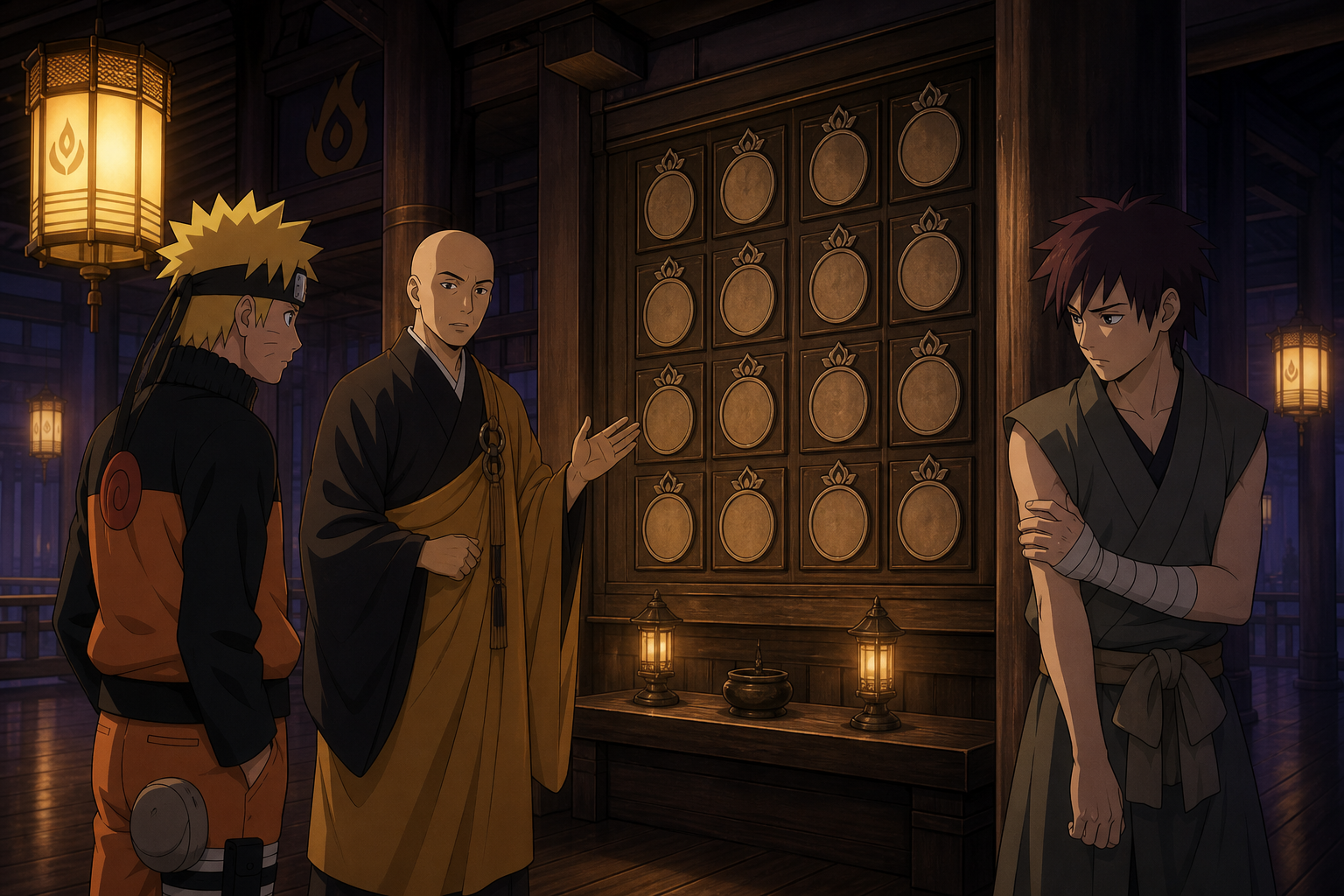
A memorial explains the dead while Naruto recognizes the living person left outside.
Chiriku gives the empty tombs a political history
Episode 58 moves Team Kakashi from the violated cemetery into the Fire Temple, where Chiriku explains who was buried in the hidden tombs. The dead were members of the Guardian Shinobi Twelve, an elite group assigned to protect the Land of Fire's feudal lord.
The explanation changes the scale of the theft. These bodies are connected to a political conflict that involved powerful shinobi and competing ideas about who should control the country. Whoever removed them is not collecting random remains.
The graves were hidden because the history inside them was never harmless.
Asuma and Chiriku survived the same organization differently
Chiriku reveals that he and Asuma once served among the twelve. Their shared past adds weight to a part of Asuma's life Team Kakashi may know only in fragments.
Membership was not simply an honor. The organization fractured over loyalty, authority, and the relationship between the feudal lord and the Hidden Leaf. Some members imagined a different political order and were willing to use force to create it.
Chiriku now lives at the temple. Asuma returned to the Leaf. Their paths suggest survival required choosing what to carry forward from that conflict.
The memorial shows how institutions remember selectively
A wall of twelve emblems can present unity after the people behind it divided violently. Memorials often simplify a history so communities can live beside it. Chiriku's account restores the disagreement hidden by the neat arrangement.
That does not make remembrance dishonest by definition. It shows why context matters. The stolen bodies could be used to revive the conflict while stripping away the choices and consequences that defined the people themselves.
History becomes dangerous when someone treats its symbols as instructions instead of evidence.
Naruto notices Sora standing outside the room emotionally
Sora is physically present at the Fire Temple but carries himself like someone expecting rejection. His guarded expression and quick temper warn people away before they can decide to leave him.
Naruto recognizes the pattern because he lived it. Loneliness taught him to make noise, provoke reactions, and turn negative attention into proof that he existed. Sora's version is sharper, but the defense comes from a similar fear.
Recognition does not mean Naruto immediately understands every part of Sora. It gives him a reason to look past the hostility.
Shared isolation does not make two people identical
Naruto may see himself in Sora, but the episode works best when the comparison stays specific. Naruto grew up inside the Leaf as a jinchuriki everyone avoided. Sora grew up around the Fire Temple with his own missing history, anger, and relationship to authority.
Both know what it means to feel marked before another person learns who they are. Their responses and circumstances remain different.
A bond can begin through recognition without requiring one person to become a copy of the other.
Chiriku's compassion includes boundaries
Chiriku does not describe Sora as easy. He understands the young man's volatility and the effect it has on the community. At the same time, he does not reduce Sora to the behavior that causes trouble.
That balance matters. Compassion is not pretending harm or risk does not exist. It is refusing to treat a person's worst defense as the whole person.
The Fire Temple's response to Sora will influence whether he learns belonging as accountability or continues experiencing every boundary as rejection.
Naruto's recent failure changes how he approaches loneliness
The Sasuke reunion showed Naruto that recognizing pain does not automatically give him the power to change another person's choice. That lesson should shape his contact with Sora.
Naruto can offer curiosity, honesty, and the evidence of his own survival. He cannot force Sora to trust him or use shared loneliness as permission to cross every boundary.
If Naruto learned anything from chasing Sasuke through the hideout, it should be that connection requires listening as well as persistence.
The stolen guardians threaten to turn loyalty into a weapon
The Guardian Shinobi Twelve were defined by service, but they disagreed about what service required. Removing their bodies suggests someone wants the power associated with that conflict without the consent of the people who lived it.
The threat is especially disturbing because loyalty can be rewritten after death. A corpse cannot object to being used under a banner it might have rejected while alive.
Team Kakashi's mission is therefore about protecting more than bodies. It is about preventing someone from claiming authority over the meaning of the dead.
“Loneliness” belongs to the living people around the memorial
The episode title shifts attention away from the political history toward what isolation does to Naruto and Sora. A room can be full of people and still leave someone outside every relationship that seems to hold the others together.
Naruto understands that pain, but he now has Sakura, Sai, Yamato, Kakashi, and many others who choose him. Sora appears less certain that any connection is secure.
The difference shows that loneliness is not only physical solitude. It is the expectation that belonging will be withdrawn once people see too much.
RaeRae's reaction
I like Chiriku explaining the tombs because it makes the grave theft feel intentional in a much larger way. These were not only powerful ninja. They were people tied to a political split over the Land of Fire, and someone has decided their bodies still have strategic value.
The Naruto and Sora comparison is the emotional hook for me. Naruto recognizes the posture of someone who wants connection and makes rejection happen first. He used to do the same thing with pranks and shouting. Sora does it with anger.
What I want from Naruto is empathy without overconfidence. He knows loneliness, but he does not automatically know Sora. The best thing he can offer is proof that being marked by other people's fear does not have to determine every future relationship.
History and loneliness meet at the Fire Temple
Episode 58 gives the arc two connected mysteries. The hidden tombs contain the unresolved political history of the Guardian Shinobi Twelve. Sora carries a personal history he does not fully share and a loneliness Naruto immediately recognizes.
Both problems involve stories that other people may try to define. The grave thieves want ownership of dead shinobi. The temple community risks defining Sora only through danger. Naruto's own life demonstrates how destructive that reduction can be.
The next threat will test whether Team Kakashi can protect the past without repeating its failures in the present.
Official episode reference: Naruto Official episode guide
Licensed episode route: Crunchyroll licensed episode page
The memorial gives twelve symbols one shape and hides twelve different choices
The emblems look orderly. The history was not. Some members of the Guardian Shinobi Twelve defended cooperation between the feudal lord and Konoha, while others believed authority should be consolidated through force. A clean memorial can preserve names without preserving the argument that separated them.
Chiriku restores the conflict because Team Kakashi cannot understand the theft by admiring the symbols alone. Whoever targeted the tombs knows which bodies belonged to which side and may intend to make that old division operational again.
Memory without context becomes easy material for manipulation.
Chiriku is not delivering trivia about Asuma’s mysterious phase
Asuma’s former service explains his connection to the temple, but the revelation matters beyond character decoration. He survived a political fracture that placed loyalty to the Land of Fire, its feudal lord, and the Hidden Leaf into direct tension.
That history may shape why Asuma now teaches teamwork with such seriousness. He has seen skilled comrades share a title while disagreeing about what their duty means.
The cigarette, relaxed posture, and patient mentoring sit on top of choices he once had to make when institutional loyalty stopped being simple.
Sora’s anger announces pain before anybody earns the full story
Sora does not present loneliness in a tidy form designed to attract sympathy. He is defensive, abrasive, and ready to interpret attention as judgment. That behavior can exhaust people around him while still pointing toward real abandonment.
The episode does not require viewers to excuse every outburst. It asks them to recognize that hostility can become a person’s advance defense against expected rejection.
If Sora makes people leave first, he never has to wait helplessly for them to decide he is unwanted.
Naruto recognizes the performance because he built his own version
Young Naruto used pranks, noise, and disruption to force the village into acknowledging him. Negative attention hurt, but invisibility hurt worse. Sora’s sharpness serves a related purpose even though their personalities and circumstances differ.
Naruto can see the desire underneath the behavior because other people once stopped at his behavior. Iruka’s great gift was refusing to confuse a coping strategy with a complete identity.
Naruto now has an opportunity to extend that recognition without pretending he can reproduce Iruka’s role instantly.
Empathy becomes dangerous when Naruto treats resemblance as ownership
Seeing himself in Sora does not grant Naruto permission to explain Sora to everyone, demand disclosure, or insist on friendship. Shared loneliness creates an opening, not a claim.
Naruto’s pursuit of Sasuke repeatedly showed how love can become controlling when he assumes understanding entitles him to determine another person’s path. Sora offers a smaller and more immediate test of that lesson.
Real empathy leaves room for the other person to contradict the comparison.
The temple community can care about Sora and still contribute to his isolation
People may believe they are protecting Sora while discussing him as a problem, monitoring him differently, or withholding information about his past. Good intentions do not erase the experience of being treated as the dangerous exception in every room.
At the same time, fear does not appear from nowhere. Sora’s temper affects people. The community needs boundaries that protect everyone without making exclusion the only response.
Belonging has to include accountability on both sides or it becomes another polite word for containment.
Chiriku’s patience has limits because caregiving is not magic
Chiriku offers steadiness, history, and a place inside the temple. He cannot single-handedly remove Sora’s anger or make every monk respond perfectly. The expectation that one compassionate adult can repair institutional harm lets the institution avoid changing.
Caregiving also needs support. Chiriku carries responsibility for the temple, the graves, the current threat, and a young person whose pain often emerges as conflict.
Compassion becomes sustainable when it is shared rather than assigned to the kindest person available.
Loneliness survives in crowded places through constant anticipation
Sora is not literally alone. Monks live around him. Chiriku knows him. Team Kakashi arrives. Yet connection does not feel secure when every interaction is filtered through the expectation that rejection is coming.
Anticipation changes behavior before another person acts. A neutral glance looks suspicious. A question sounds like an accusation. A boundary feels like proof that affection was never real.
The title names that interior distance, not merely the number of bodies in the room.
Naruto’s current support network proves loneliness can change without disappearing
Naruto has Sakura beside him, Yamato leading him, Sai trying to join him, Kakashi teaching him, and friends across the village. That network is real. It does not erase the child who learned that attention had to be stolen.
His recognition of Sora shows how old loneliness can become knowledge rather than only injury. Naruto can notice somebody the room has emotionally placed at the edge.
Healing becomes visible when pain expands a person’s capacity to see others instead of determining every reaction.
The stolen guardians and isolated Sora share the danger of being reduced to power
The thieves value the dead for what their bodies can do. The temple may fear Sora for what it believes his anger or ability might do. In both cases, power threatens to swallow personhood.
A body becomes a weapon. A young man becomes a risk. Once those reductions take hold, consent, grief, history, and ordinary needs disappear from the conversation.
The arc’s political and emotional plots connect through the same question: can this world see a person before it sees a resource or threat?
Asuma’s absence from the room makes his history more intriguing
Chiriku can name Asuma’s service, but he cannot provide Asuma’s entire interpretation of it. Team Kakashi receives one necessary account and still needs to hear from the person whose choices shaped his return to Konoha.
That gap protects the difference between information and testimony. Facts establish membership and conflict. Asuma’s own voice would explain what he believed, feared, regretted, and chose.
A responsible history leaves space for surviving participants instead of treating one explanation as total access.
Political loyalty is never abstract when young shinobi carry the consequences
The Guardian Shinobi Twelve argued about national authority, but those ideas moved through bodies, missions, and deaths. Political structures become personal when someone is ordered to fight a former comrade or defend an institution that has failed them.
Sora inherits consequences from a conflict he did not design. Naruto also inherited village fear attached to decisions made before he could speak.
Children are often told an old conflict is history while being asked to live inside its unfinished damage.
Sai’s presence makes the conversation about belonging quietly sharper
Sai has only recently chosen Team Kakashi over Root’s command. He stands inside a new bond without possessing Naruto’s instinctive language for friendship. Watching Naruto notice Sora offers him another lesson in how relationships begin.
They begin through attention, but attention alone is not enough. People need honesty, boundaries, repeated actions, and the freedom to answer differently than expected.
Sai can learn from Naruto’s empathy and from the mistakes Naruto makes when urgency overwhelms listening.
Sakura can recognize pain without assigning Naruto the role of rescuer
Naruto’s history may help him reach Sora, but the entire team shares responsibility for how it treats the young monk. Sakura should not stand aside while Naruto carries every emotional bridge because he has experienced public rejection.
She can observe, challenge disrespect, offer practical care, and notice when Naruto’s identification becomes too intense. Support sometimes means helping the helper maintain perspective.
No lonely person should become another wounded person’s personal redemption project.
The episode asks whether memorials protect history or only make it look settled
The twelve emblems suggest completion, yet bodies are missing and old factions remain relevant. A memorial can honor the dead while encouraging the living to believe conflict ended neatly.
Chiriku’s explanation refuses that comfort. The Guardian Shinobi Twelve fractured. People chose sides. Survivors carried different futures. Someone now intends to use those remains precisely because the underlying struggle still has meaning.
Remembering responsibly means preserving disagreement alongside sacrifice.
Sora needs truthful context more than another vague warning about his temper
If adults know important facts about Sora’s past or abilities, secrecy will not keep him emotionally safe. It will leave him sensing fear without understanding its source. That uncertainty feeds the belief that everybody knows something terrible about him.
Truth should be delivered with care, age-appropriate detail, and support, but it should still be truth. A person cannot build agency around information everyone else controls.
Loneliness grows when the room shares a secret whose subject is the only excluded person.
Naruto can offer company without demanding immediate trust
The most useful response to loneliness is not always a dramatic confession. Sometimes it is staying nearby, inviting someone into ordinary activity, and accepting that the first answer may be rude or uncertain.
Naruto tends to pursue connection at full volume because persistence once broke through other people’s assumptions about him. Sora may need a different rhythm. Consistency can prove more than intensity when trust has repeatedly felt temporary.
Company also needs boundaries. Naruto should not tolerate every insult or ignore risk to demonstrate loyalty. He can be honest about impact while refusing to abandon Sora as a person.
That combination would show real growth: attention without possession, patience without passivity, and care that survives an imperfect first meeting.
Trust grows slowly when a person expects rejection, so Naruto must let repeated respectful choices carry more weight than one emotional promise.
RaeRae’s full take
I appreciate that Naruto notices Sora before Sora becomes easy to like. That is the entire point. Loneliness rarely arrives polished, reasonable, and grateful for help. Sometimes it arrives rude because rudeness feels safer than hope.
Naruto knows that posture. He spent years creating trouble so the village would have to say his name. That recognition can make him compassionate, but it can also make him push too hard. He needs to let Sora be similar without turning him into a mirror.
The Guardian Shinobi Twelve history gives the emotional story teeth. These adults fought over competing definitions of loyalty, and the next generation is living with the remains. Sora carries consequences. Asuma carries memories. Chiriku carries responsibility. The graves carry bodies somebody believes can still serve a cause.
I want the temple’s care examined honestly. Chiriku’s compassion matters, but one good adult cannot cancel an environment where a young person feels watched, discussed, and permanently outside. Boundaries are necessary. Exile disguised as safety is not.
“Loneliness” connects the whole episode because isolation makes people easier to define from the outside. The dead cannot object to being weaponized. Sora expects nobody to hear him accurately. Naruto’s real task is not to save both with one speech. It is to refuse the reduction and keep listening after recognition stops being comfortable.
RaeRae checkpoint: Naruto seeing himself in Sora is valuable only if he remembers that Sora is not him. Recognition opens the door. Respect waits for the other person to decide how far it opens.
Receipts and official routes
- Episode number, Japanese title, Fire Temple setting, Guardian Shinobi Twelve history, Sora’s introduction, and official placement: Naruto Official Site episode guide.
- Licensed title and episode route: Crunchyroll.