
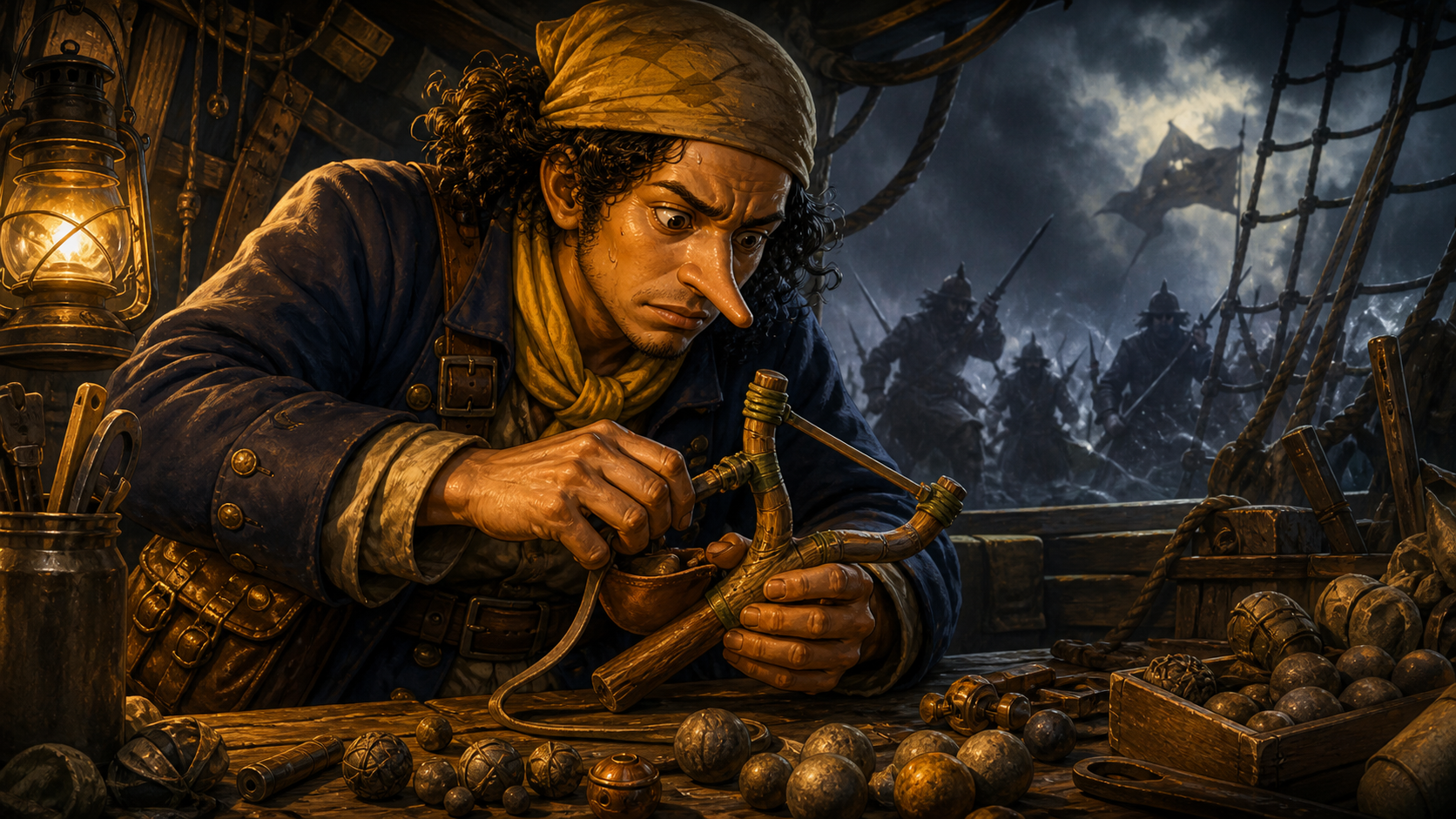
Usopp: One Piece Character Profile
Quick profile
Full name: Usopp
Known as: God Usopp and Sogeking
Role: Sniper of the Straw Hat Pirates
Origin: Syrup Village, East Blue
Age: 19 after the time skip
Birthday: April 1
Specialties: Marksmanship, invention, traps, ammunition, repair, and storytelling
Weapon: Kabuto with specialized ammunition and Pop Greens
Haki: Observation
Current bounty: 500 million berries
Japanese voice: Kappei Yamaguchi
Bottom line
Usopp proves courage is not the absence of fear. Courage is skilled action taken while fear keeps reporting the danger accurately. He screams, lies, runs, bargains, panics, and still finds the angle nobody else can reach. A fearless fighter may charge because the risk never registered. Usopp acts after understanding exactly how badly the plan can hurt.
His growth becomes frustrating when the series treats every new island as permission to reset him to the same cowardice joke. Anxiety does not disappear because someone completed one brave act. Still, continuity matters. Usopp should carry learned competence forward even when his body remains afraid.
Syrup Village, Banchina, and the boy who cried pirates
Usopp grows up in Syrup Village after his father Yasopp leaves to sail with the Red-Haired Pirates. His mother Banchina becomes ill, and young Usopp calls out that pirates are coming because he hopes his father has returned. After her death, the warning becomes routine. Villagers chase him, children follow him, and Kaya listens to his stories.
The lies serve several jobs. They entertain, demand attention, rehearse danger, and protect a lonely child from saying the plain sentence: his father chose the sea and did not come home. Yasopp’s reputation gives Usopp pride, but parental absence does not become responsible because the absent parent has an impressive job.
Captain Kuro and the first true warning
Usopp discovers that Kaya’s trusted butler is Captain Kuro and that the Black Cat Pirates plan to attack. Nobody believes him because he has spent years making the same warning into a game. The consequence is not a lesson that lying always destroys credibility. The consequence is more specific. A coping ritual becomes a trap when the feared event finally arrives.
Usopp decides the village should never learn the pirates were real. He wants his familiar lie to remain harmless in their memory, even after he fights to make the lie true. Leaving with Luffy gives his storytelling a larger world and his marksmanship a crew that needs both.
Lies as rehearsal, shield, and weapon
Many of Usopp’s stories describe the person he wants to become: a captain, a warrior, a traveler with impossible adventures, and someone powerful enough to protect others. The lies are rehearsal. He gives language to a future before his body has evidence.
Not every lie is harmless. He manipulates people, inflates his status, and sometimes leaves friends to sort truth from panic. In combat, bluffing becomes tactical. An opponent who believes the wrong thing may expose a weakness, waste an attack, or surrender. Usopp’s mouth is part of his equipment.
Marksmanship and the work behind the shot
Usopp’s accuracy is not a consolation prize for lacking superhuman strength. Long-range combat requires distance judgment, wind reading, timing, target prediction, ammunition choice, and the ability to create a firing line under pressure. He can protect an ally who cannot see him and strike an enemy stronger fighters cannot reach.
The Kabuto slingshot extends range and power. Specialized stars create fire, smoke, explosions, adhesive effects, light, noise, and other tactical outcomes. After training on the Boin Archipelago, Pop Greens add aggressive plants and environmental control. The arsenal remains strongest when the story treats preparation as power rather than a bag of convenient surprises.
Inventor, repair worker, and the labor before Franky
Before Franky joins, Usopp performs much of the Going Merry’s repair work despite lacking formal shipwright training. He patches damage because somebody must. The mismatch between responsibility and expertise becomes one reason Water 7 hurts so badly. Every failed repair can feel like evidence that his care was not enough.
Usopp also builds tools for himself and Nami. The first Clima-Tact looks like party equipment because the design brief and communication were imperfect. Nami turns the strange system into a weapon. Their collaboration shows invention is iterative, and the user’s expertise can reveal functions the maker did not understand.
Water 7, the Going Merry, and material insecurity
The fight over the Going Merry is not simply a man being sentimental about a boat. Professional shipwrights determine that the keel cannot be repaired. Luffy accepts a technical verdict and communicates the decision badly. Usopp hears that a damaged crew member can be replaced when repair becomes inconvenient.
His own recent defeat and stolen money intensify the fear. The Merry came from Kaya and carries the labor that made him useful. Challenging Luffy is wrong, painful, and emotionally legible. The duel lets Usopp use intimate knowledge of his captain’s body against him. Skill cannot close the full power gap, but the fight proves he was never dead weight.
Sogeking creates enough distance to act
The Sogeking mask allows Usopp to return before he can admit that he wants to return. The disguise is obvious to nearly everyone, but psychological distance matters more than visual credibility. Sogeking can declare war, burn the World Government flag, and support Robin while Usopp remains trapped behind shame.
The persona is funny because Luffy and Chopper believe the performance. The device is also precise. Sometimes courage needs a costume before action can become part of the ordinary self. His later apology matters because the mask cannot repair the relationship for him.
Observation Haki and Dressrosa
Dressrosa turns a ridiculous reputation into political force. Former toys and fighters call him God Usopp after his accidental role in freeing them from Sugar’s power. The title is exaggerated, but the liberation is real. People whose existence was erased can finally be remembered.
His long-range shot to stop Sugar from harming Luffy and Law awakens Observation Haki. Usopp perceives distant presences and creates an impossible firing solution. The ability fits a character who has always survived by noticing danger early. Haki extends his attention. Haki does not replace craft.
Fear, regression, and the joke that can become cruelty
Usopp’s fear keeps action measurable. A monster is frightening because someone reacts like a normal body might die. The problem appears when every panic scene erases prior growth or makes humiliation the only comedy available to him.
Bravery is not a permanent cure for anxiety, but experience should change his options. A veteran sniper may still want to run while identifying cover, preparing ammunition, locating allies, and choosing a retreat path. Letting those skills remain visible would protect both the fear and the development.
Relationships and accountability
Luffy gives Usopp belonging and becomes the captain he must challenge. Nami shares practical caution, technical collaboration, and the experience of surviving fights through planning. Chopper believes his stories and gives him uncomplicated admiration. Franky replaces him as shipwright without replacing him as a friend or maker. Sanji understands the value of completing the task another fighter cannot.
Kaya represents home, an audience, and the possibility that his impossible stories may become travel reports. Yasopp represents inheritance and abandonment at once. Usopp can admire his father’s skill without pretending a child did not carry the cost of that freedom.
Design chronology
Early Usopp is recognizable through his long nose, bandanna, goggles, overalls, tool bag, and slingshot. The design shows a village tinkerer who carries supplies because nobody else will pack the exact object he needs. Sogeking adds the sun mask and cape, turning private fear into theatrical confidence.
After the time skip, greater muscle, longer hair, a hat, upgraded goggles, Kabuto, and more visible ammunition mark two years of survival training. The stronger body should not erase his identity as a ranged specialist. His best visual language remains tools, distance, and preparation.
Kappei Yamaguchi’s Japanese performance
Kappei Yamaguchi gives Usopp speed, theatricality, terror, false confidence, and sincerity. A boast can expand until everyone knows the sentence is impossible, then crack just enough to expose the need underneath. The timing keeps his lies character-specific rather than generic chatter.
Water 7 requires anger and humiliation without losing affection. Sogeking requires a heroic register that remains connected to the same man. Yamaguchi makes those layers coexist, which lets comedy and grief share a scene without canceling each other.
Anime, films, games, and continuity
Usopp appears throughout the television anime, theatrical films, specials, OVAs, games, crossovers, and promotional projects. Alternate productions may give him ammunition or feats that belong to that version. Familiar clothing and voices do not automatically place every adventure in manga continuity.
The numbered television route remains the primary animated adaptation. Film and game material stays connected through this profile while retaining the correct continuity label. Sogeking, God Usopp, and ordinary Usopp remain one canonical person, not duplicate identities.
RaeRae’s verdict
Usopp is brave because he knows the danger and builds something useful anyway. Courage without fear may be temperament. Courage with shaking hands, tools, and a firing solution is labor.
I want the series to stop treating continuity as an enemy of comedy. Usopp can panic and still be the sniper who crossed Enies Lobby, fought his captain, freed Dressrosa’s forgotten people, and made a shot nobody else could attempt. Fear tells the truth about the distance. Skill closes the distance.
Courage is not a personality transplant
Usopp never stops being afraid, which is exactly why his bravest moments work. Courage would be cheaper if the story cured fear and replaced him with a calmer character. Instead, his body keeps telling the truth. He shakes, runs, bargains, invents catastrophes, and then sometimes turns around because somebody behind him needs the person he has not fully become yet.
The lies are part of that process. Young Usopp uses stories to fill an empty horizon after Yasopp leaves and Banchina dies. The daily pirate alarm becomes community theater, grief ritual, and rehearsal for danger. Later boasts do similar work. He speaks a heroic identity before he can consistently inhabit the identity. Sometimes that becomes manipulation, and the harm should not be excused because the lie was funny. Sometimes the invented self creates enough distance for a frightened person to take the next shot.
Sogeking makes that mechanism visible. Usopp cannot return to Enies Lobby as himself without facing the crew conflict, the loss of the Merry, and the shame attached to both. A mask lets him help before he knows how to apologize. The disguise is ridiculous, but the need underneath is painfully ordinary. People often perform their way back toward a community before they can say the sentence that repairs the relationship.
The crew’s insecurity is not comic relief
Water 7 lands because Usopp’s fight with Luffy is not only pride. The Going Merry is damaged beyond repair, and Usopp hears the decision to replace the ship as a warning about bodies that can no longer keep up. He has been injured, surpassed, and repeatedly rescued. If usefulness determines belonging, he believes his own dismissal is already approaching. The ship becomes the place where that fear can speak.
Luffy mishandles the confrontation. Usopp weaponizes private knowledge and challenges a captain he knows is grieving too. Neither man emerges clean, which is why the eventual apology matters. Zoro’s insistence that the apology be spoken is severe, but returning without naming the rupture would leave everybody pretending trust repaired itself. Friendship needs warmth. A working crew also needs conflict to have language.
I want the story to remember that lesson whenever later arcs regress Usopp into cowardice without enough interior consequence. Dressrosa gives him one of his finest victories because the shot depends on distance, calculation, observation, and a willingness to act while nobody nearby can reassure him. His value is not becoming another close-range monster. Usopp sees routes other fighters overlook, builds tools from scraps, and understands what frightened civilians sound like because fear has never been abstract to him. The sniper’s dream is not to stop being scared. The dream is to become dependable while scared.
Sources and official routes
ONE PIECE.com: Usopp official character profile
ONE PIECE.com: anime staff, cast, and broadcasters
Watch One Piece on Crunchyroll
Return to the One Piece anime hub
Browse One Piece character profiles