
Beasts: Alive Again!
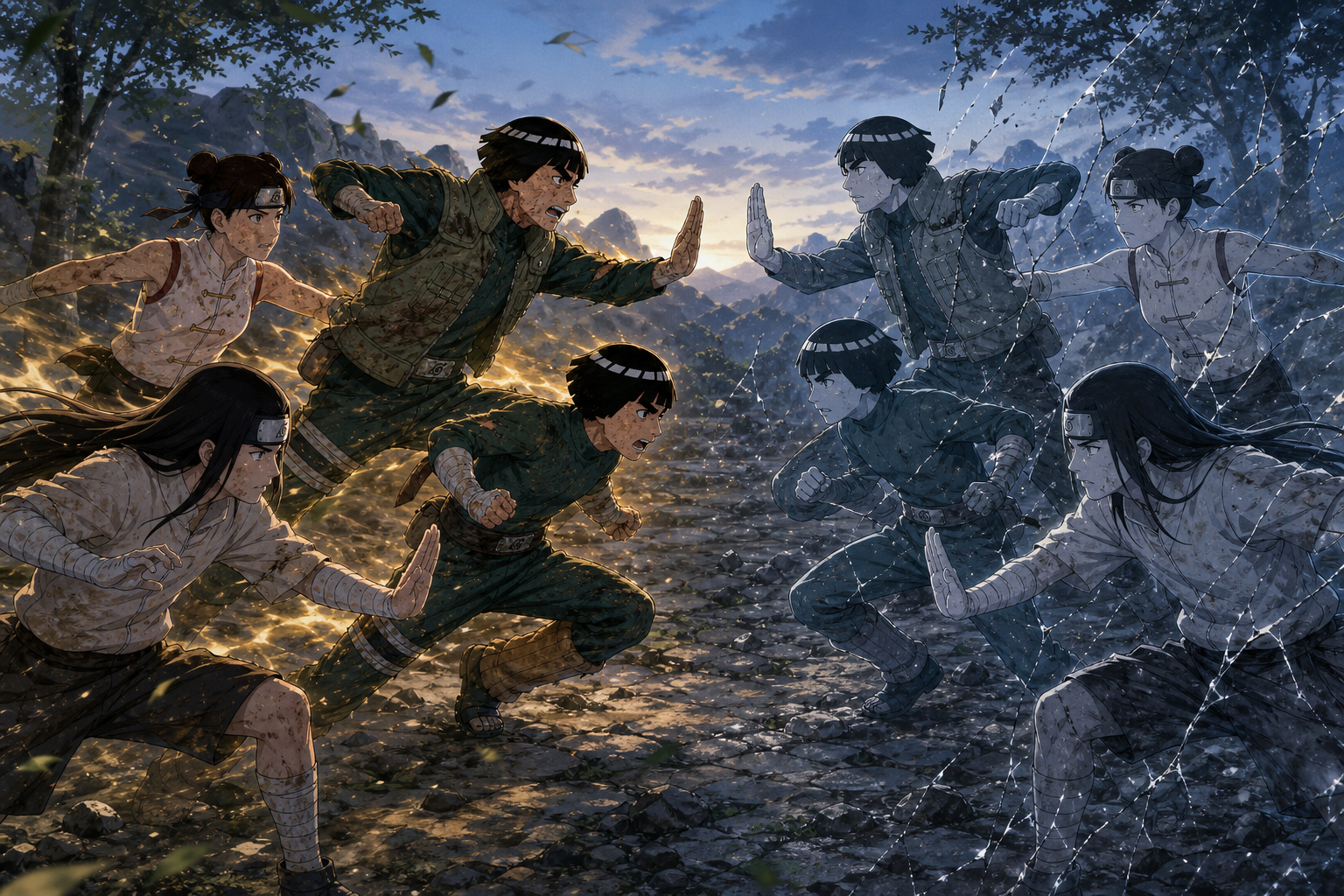
Team Guy defeats copies calibrated to their earlier strength by refusing to remain fixed snapshots.
The copies are perfect records and terrible people
Naruto Shippuden Episode 28 returns to Team Guy's mirror battles with a solution that sounds suspiciously like motivational merchandise: become stronger than you were five minutes ago. It works because the episode has built a specific mechanical problem. The copies reproduce the strength each ninja had when the barrier tags were removed. They are accurate snapshots. They are not growing people.
Guy, Lee, Neji, and Tenten begin at a disadvantage because fatigue accumulates while the copies retain their recorded condition. Repeating the same level of effort only widens the gap. The team cannot discover a hidden flaw in the doubles because the flaw is not physical. It is temporal.
The answer is to become something the barrier did not record. That does not mean wishing harder. It means finding enough purpose, coordination, and discipline to exceed a previous limit while already exhausted.
A snapshot cannot learn
The copies are dangerous because they know every familiar movement. Each double has the original fighter's techniques, habits, speed, and strength from the moment of creation. Conventional surprise disappears when an opponent begins with your own knowledge.
What the copies lack is a continuing relationship with experience. They can execute the recorded person. They cannot become the person who has spent the last several minutes failing, adapting, worrying about comrades, and deciding to try something different.
That distinction turns the repeated fights from padding into an argument about identity. A person is not a fixed list of abilities. Guy is not only his current speed. Neji is not only the exact reach of his Gentle Fist. Tenten is not only the weapons she had already thrown. Lee is not only the endurance measured at the barrier.
The copies preserve competence while missing development. They are perfect records and terrible people.
Fatigue is evidence, not disgrace
Team Guy's exhaustion matters because growth is not being measured from a comfortable starting line. The originals have taken hits, spent chakra, and repeated attacks against opponents who do not tire in the same way. Their bodies carry the cost of the trap.
The episode does not solve fatigue by pretending it vanished. Dirt, strain, and reduced speed remain visible. The team wins by finding additional effort inside those limits, not by resetting to full health.
This makes Lee's realization more convincing. He understands training as a process of pushing past a known threshold. The mirror copies turn that philosophy into a battlefield rule. If the copy represents the last measured limit, victory requires a new one.
There is still a danger in romanticizing exhaustion. More effort is not always a solution, and bodies are not failures when they need rest. Here the mechanism is unusually precise: the doubles are fixed at an earlier level. Growth is relevant because it directly breaks the trap's assumption.
Lee names the rule Team Guy already lives by
Lee is the natural person to recognize the answer. His entire career has been built around refusing fixed judgments about what he can become. He lacks the ninjutsu and genjutsu skills his peers take for granted, so he built another path through taijutsu and relentless practice.
The mirror copy is a literal version of the labels Lee has always faced. It says this is what you are, measured and complete. Lee answers that a measurement describes a moment, not a future.
His insight works for the whole team because Guy built their training around shared belief in improvement. The language may be loud, but the practice underneath it is consistent. They train to change what their bodies can do, not merely repeat what they already know.
Lee does not win the episode alone by delivering the right sentence. His realization becomes useful only when Guy, Neji, and Tenten translate it into their own effort.
Neji has to exceed precision
Neji's mirror fight presents a different challenge from Lee's. His technique depends on precision, vision, and control. A copy with the same Byakugan and Gentle Fist knowledge can anticipate the exact structure he normally uses to dominate an exchange.
For Neji, becoming stronger is not simply producing a louder attack. It means sharpening decisions while fatigued and breaking the rhythm his double expects. He has to prove that precision is a living practice rather than a stored routine.
This continues his larger movement away from fatalism. Earlier Neji treated destiny as a closed system. The mirror copy embodies another closed system, one that claims the person recorded at the barrier is the only person available. Neji defeats it by changing inside the fight.
The symbolism is almost too neat, but it earns its place because Neji's technique makes the problem concrete. Vision can reveal a system. Choice determines whether that system remains final.
Tenten's growth deserves to be visible
Tenten is often the easiest member of Team Guy for the story to compress into a weapon display. Episode 28 gives her the same structural problem as the others: her copy knows the familiar arsenal and can match the earlier level of execution.
Her answer depends on more than adding projectiles. Tenten has to alter timing, sequence, placement, and commitment. Weapon mastery is spatial thinking. An attack becomes useful through the route it closes and the opening it creates.
The mirror premise highlights why her craft should not be reduced to inventory. A copy can reproduce the weapons that were recorded. Tenten can decide how the battlefield has changed since then.
Her place in the team also matters. The renewed effort is collective. She is not background encouragement for the men. Her breakthrough is one of the four conditions required for Team Guy to reunite and assist the larger mission.
Guy has to embody his own lesson
Guy regularly asks his students to believe that effort can change a limit. The copy forces him to demonstrate that belief without the comfort of being only the teacher. His opponent has his strength, style, and earlier condition. Inspirational language cannot substitute for performance.
That pressure keeps the episode from treating Guy's philosophy as effortless optimism. He is tired. His double is not. He has to find more while accepting that the fight already cost him something.
Guy's leadership appears in the way the team responds together. He has spent years building a culture where a student can name the principle and the teacher can listen. Lee's realization does not threaten Guy's authority. It completes the lesson they share.
The team becomes stronger because information moves through it. Sasori's puppet army concentrated every decision in one controller. Team Guy distributes insight among four people.
Comrades give effort a direction
The turning point is not only personal ambition. Team Guy remembers why they need to finish. Sakura, Chiyo, Naruto, Kakashi, and Gaara are connected to the mission continuing beyond these isolated clearings. The copies can reproduce technique. They cannot reproduce concern for people elsewhere.
That concern does not magically create energy. It creates a reason to spend what remains. Purpose organizes effort that fatigue has made difficult.
This is where the episode's motivational language earns more than a slogan. Becoming stronger is not framed as self-improvement for its own sake. The team needs to rejoin the rescue. Every minute trapped with a copy is a minute their comrades face Akatsuki without them.
The copies fight because the barrier tells them to. The originals fight because people are waiting.
Growth is not a secret stat increase
The phrase surpass your previous self can suggest that the team simply unlocks a higher number. The action works better when understood as adaptation. The originals have gathered information throughout the failed exchanges. They know where the copies match them and where repetition becomes predictable.
Growth during a fight can be small and decisive. A different angle, a tighter transition, a willingness to commit sooner, or trust that a teammate will also finish can move someone beyond the recorded pattern.
The copies cannot incorporate these experiences because their strength is fixed. Their apparent advantage becomes a ceiling. The originals' fatigue is accompanied by learning.
That is the elegant part of the trap. At first, fixed strength looks like stability. Over time, it becomes stagnation.
The title belongs to the originals
Beasts: Alive Again! describes renewed ferocity, but the important word is alive. The originals are capable of change because they are living people. Their bodies tire, their emotions shift, and their decisions respond to new information.
The copies are animated but not alive in that sense. They preserve a moment and execute it indefinitely. Their perfection is sterile.
Team Guy's renewed attack does not make them less human. It comes from the human features the copies lack: vulnerability, memory, relationship, and the ability to assign meaning to effort.
The episode pairs neatly with Sasori's defeat. Sasori sought permanence through bodies that would not age or change. Team Guy survives a related threat by proving that change is the advantage.
The barrier recorded strength but not responsibility
The trap assumes that duplicating a fighter's abilities duplicates the fighter. It misses responsibility. Guy knows his students depend on him. Lee wants to honor the people who believed in his path. Neji has chosen bonds beyond the destiny he once accepted. Tenten is committed to a team and mission larger than any single duel.
Those responsibilities developed through time. They cannot be copied from a chakra measurement taken when a tag came off a wall.
The gap explains why the originals can act beyond expectation. Responsibility does not guarantee victory, but it changes what a person is willing to attempt and why.
This also reinforces the arc's wider rejection of turning people into objects. Akatsuki treats Gaara as a container. Sasori treated bodies as puppets. The barrier treats Team Guy as replicable data. Each reduction misses the will that continues after measurement.
Final reaction
Beasts: Alive Again! solves the mirror-copy trap with an idea tailored to its rules. The copies match the strength recorded when the barrier fell. They remain fixed. Team Guy is exhausted, but the team can still learn, choose, and grow.
Lee identifies the opening because his life has already disproved fixed assessments. Guy, Neji, and Tenten make the principle their own. Their victory belongs to four different fighters rather than one inspirational speech.
Yes, becoming stronger than you were moments ago sounds like something printed on a gym wall. In this episode, the doubles are frozen snapshots, so the slogan becomes a tactical diagnosis. A person is not a stat sheet. The trap loses when Team Guy proves it.
Official episode reference: Naruto Official episode guide
Licensed episode route: Crunchyroll licensed episode page
The episode makes repetition the enemy
Team Guy does not face a puzzle that rewards finding one secret switch. The trap weaponizes repetition itself. Every familiar attack confirms the copy’s advantage because the copy begins with the same answer and none of the exhaustion. That is why the early exchanges feel so suffocating. Skill has not abandoned the originals. Skill has become predictable.
The breakthrough asks each fighter to stop treating the match as a contest against an equal and recognize it as a fight against a preserved version of the self. The copy can repeat yesterday’s certainty forever. The person has to make a decision today.
Rock Lee understands measurements because people used them against him
Lee has heard fixed assessments dressed up as truth since childhood. No ninjutsu. No genjutsu. No proper future as a shinobi. He survived those judgments by turning practice into evidence that a limit can describe the present without owning the future.
That history makes him more than the team’s motivational speaker. He recognizes the trap’s false authority. The doubles look definitive because they reproduce measurable strength, but Lee knows better than anyone that a measurement becomes a lie when somebody pretends it cannot change.
Might Guy listens when his student finds the answer
Guy could have protected his pride and insisted that the teacher solve the problem. He does the healthier thing. He hears Lee, understands the principle, and lets the insight travel through the team.
That response matters because their bond is not built on one-way worship. Guy teaches Lee, but Lee’s life also proves Guy’s philosophy. When the student names the route forward, the teacher follows it. Authority becomes useful because it can receive information instead of merely issuing commands.
Neji defeats another version of destiny
The mirror copy tells Neji that an observed state is final. That claim should sound familiar. The Hyuga system assigned him a branch-family role, placed a seal on his body, and treated hierarchy as fate. His earlier worldview accepted closed systems because resisting them seemed childish.
Now he breaks a closed system by changing after it measures him. The victory does not erase the Hyuga structure waiting at home, but it keeps his development legible. Neji has moved from defending inevitability to proving that a person can exceed the definition imposed on him.
Tenten’s battle exposes how often the camera underserves her
The premise gives Tenten an excellent tactical problem: fight an opponent with the same arsenal and an exact record of her earlier execution. Weapon specialists live through timing, distance, sequence, and control of available space. A mirror match should let all of that breathe.
The episode gives her the necessary win but not the attention her craft deserves. I can appreciate the collective structure and still say the obvious thing: Tenten repeatedly receives less interiority than the men standing beside her. Team Guy needs four breakthroughs. The storytelling should be equally curious about all four.
Fatigue separates growth from fantasy
The originals do not become stronger after a nap, a meal, or a clean training session. They have to exceed the recorded state while carrying every hit that came afterward. That makes the solution brutal rather than cute.
It also gives the idea a boundary. “Try harder” is terrible advice when a problem requires medicine, rest, resources, or structural change. Here the barrier’s exact rule makes new performance relevant. The episode is not proving exhaustion morally superior. It is showing why a fixed copy cannot answer adaptation.
The copies have technique without a reason
Each double can reproduce movement, power, and habit. None can reproduce the mission’s emotional map. The copies do not care that Gaara was taken, that Sakura and Chiyo are inside the cave, or that Naruto is chasing Deidara through grief. They execute because the barrier sustains them.
The originals attach every remaining ounce of effort to people beyond the clearing. Purpose does not create chakra from nowhere, but it changes which risks make sense. Concern becomes tactical because it keeps the fighters oriented toward escape rather than endless symmetry.
The team wins as four people, not one slogan
Lee supplies the language, but no speech throws Neji’s strikes, controls Tenten’s weapons, or carries Guy through his own exhaustion. Each member has to convert a shared principle into a different physical answer.
That is the part motivational summaries often flatten. Inspiration only matters when people can translate it through their own skills and circumstances. Team Guy does not become a single beast. Four distinct fighters move beyond four distinct recordings.
The mirror trap belongs beside Sasori’s puppets
Sasori tried to defeat time by converting human bodies into permanent objects. The barrier creates another kind of preservation: a perfect combat record frozen at the moment of activation. Both systems mistake stability for superiority.
Episode 28 answers with living change. Bodies tire. People worry. Students teach teachers. Fighters learn from failed exchanges. Those vulnerabilities look inefficient beside a tireless copy, but they are also the conditions that make development possible.
“Alive again” means more than fighting loudly
The title announces renewed ferocity, yet the episode’s strongest distinction is not volume. Living people can revise themselves. They absorb experience, attach action to responsibility, and become different because a relationship matters.
The copies move, attack, and defend. They still cannot participate in time the way the originals do. They are alive only as instructions. Team Guy returns to the mission because life refuses to remain a completed record.
Growth does not cancel the cost
Victory cannot make the hours of resistance free. The team remains worn down, the rescue remains unfinished, and the cave battle has already taken lives. Surpassing a limit is not a refund.
This keeps the episode connected to the arc rather than turning the mirror fights into a detached training exercise. Team Guy gains access to the next emergency with fewer reserves than they had before the trap. Growth creates capacity, but consequence follows them out of the clearing.
RaeRae’s full take
Yes, “become stronger than you were five minutes ago” sounds like a slogan somebody would print over a wolf at the gym. The episode earns it because the barrier created a specific opponent that cannot update. Team Guy does not win through vibes. They win because failure gave the originals information the copies could never keep.
Lee naming the rule is perfect. His whole life is an argument against treating one measurement as a final identity. Guy listening is just as important. Neji breaks another closed system. Tenten proves the team cannot finish with one member reduced to decoration, even if the episode still owes her more attention.
The copies are strong, clean, and stable. Team Guy is bruised, tired, worried, and changing. Naruto Shippuden chooses the messy living people. Good. Permanence has already done enough damage in this arc.
RaeRae checkpoint: The barrier copied Team Guy’s strength and missed the point of Team Guy. A record can preserve what somebody did. It cannot decide what that person does next.
Receipts and official routes
- Episode title, placement, and Team Guy’s battle against tireless copies: Naruto Official Site episode guide.
- Licensed episode route: Crunchyroll.