
Three Minutes Between Life and Death
Sakura’s antidote creates a three-minute window against a puppet body built to keep changing the terms of battle.
Three minutes is not immunity
Sakura's antidote changes the battle in Naruto Shippuden Episode 25, but it does not make her safe. That is the point. She has solved Sasori's poison well enough to create a temporary window, not a permanent cure. For three minutes, the toxin can be converted into harmless protein. When that time ends, every blade, cable, flame, and poisoned mechanism becomes deadly again.
The reveal is a victory for Sakura before she throws another punch. Sasori built his reputation around a poison no one could counter. Sakura studied it under pressure, stabilized Kankuro, prepared doses, and carried that work into the hideout. Her answer is not luck arriving at the correct moment. It is preparation meeting the problem it was designed to solve.
Yet medicine does not erase resource limits. Sakura has only a small number of doses. The protection expires. Sasori can continue changing weapons after the antidote stops working. Competence buys time, and Episode 25 asks what Sakura will do with every second she earned.
The antidote is an argument
Sasori treats poison as certainty. Once it enters a body, he assumes the rest is delay. The victim may struggle, but the outcome belongs to him. Sakura's antidote rejects that ownership. A body Sasori expected to control through chemistry remains capable of choice.
This makes the medical work part of the fight rather than support happening outside it. Sakura is not merely patching damage after the important characters act. She has attacked the foundation of Sasori's strategy. His poison was supposed to make even a shallow wound decisive. By neutralizing it temporarily, she forces him to prove that his broader arsenal can survive resistance.
Her solution also carries restraint. Sakura does not pretend that one formula has ended the danger. She understands duration, dosage, and uncertainty. That honesty is a strength. Sasori speaks in absolutes because control is central to his identity. Sakura works with limits because real medicine requires them.
The three-minute window therefore feels more credible than a miraculous cure. It recognizes that a talented medic can solve an urgent problem without becoming limitless. Sakura's achievement remains impressive because the boundary is visible.
Sasori turns himself into an arsenal
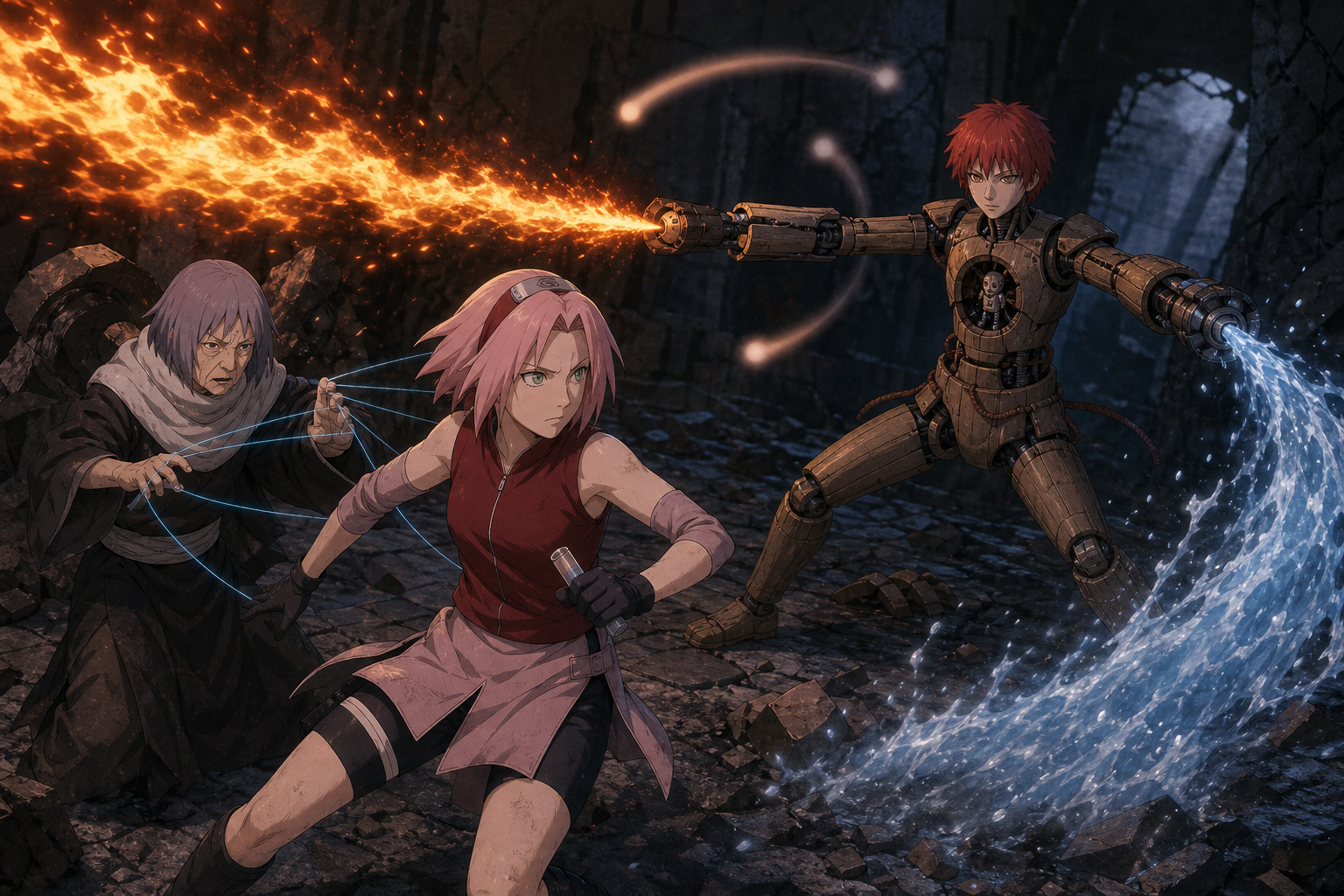
After the Third Kazekage puppet is broken, Sasori reveals that the next weapon is his own constructed body. The escalation is personal. He no longer stands behind a shell or a prized human puppet. His torso, arms, cables, and hidden mechanisms show how completely he has reorganized himself around combat and preservation.
The body can change attacks because it was built to avoid ordinary human limits. Fire pours from one mechanism. Pressurized water cuts with a different kind of force. Components can be replaced. Distance and angle can shift without the hesitation of flesh. Sasori has made adaptability mechanical.
This is not freedom from vulnerability. It is dependence on a system he must keep controlling. His living core remains the part that carries chakra and self. Everything around it is designed to be detached, exchanged, and repaired. Sasori calls that permanence, but the episode makes it look like an endless refusal to inhabit a body that can change without his permission.
There is a bitter contrast with Sakura. Her body can be poisoned, exhausted, and injured. She accepts those facts and trains within them. Sasori rejects the body's limits by replacing nearly all of it. Sakura's temporary antidote supports a living body. Sasori's puppet construction treats the living body as a defect.
Fire, water, and forced decisions
The new weapons keep Sakura from settling into the rhythm she learned against the Iron Sand. Fire spreads and denies space. Pressurized water attacks with focused cutting power. One threatens through heat and coverage; the other through speed and precision. Sasori is testing whether Sakura's judgment can update as quickly as his machinery.
Chiyo's experience remains vital, but the chakra strings cannot solve every angle. Sakura must read the attacks herself and move before guidance becomes rescue. Their partnership is entering a more demanding phase. Chiyo can help interpret Sasori's mechanisms. Sakura has to make decisions inside the time limit.
The sequence avoids turning the countdown into a decorative number. Three minutes affects behavior. Sakura cannot spend the window only avoiding damage. She has to close distance, protect Chiyo, and find a route toward Sasori's core. Every defensive move has an opportunity cost.
That pressure is familiar to medical work. A crisis rarely waits for perfect certainty. A medic gathers enough information, prioritizes the most dangerous problem, and acts while conditions continue changing. Sakura brings that same discipline into combat.
Preparation has a visible history
The antidote works because earlier episodes allowed Sakura's medical skill to occupy real narrative space. She examined Kankuro. She identified the toxin. She separated it from his body. She built an answer while the rescue team prepared to leave. Those scenes were not errands delaying the main plot. They created the possibility of surviving this chamber.
Episode 25 rewards attention to that labor. Sakura did not know every detail of the coming battle, but she understood the enemy's method well enough to prepare for recurrence. That is what planning looks like when information is incomplete.
The work also reaches beyond Sakura herself. Her antidote saved Kankuro before it protected her. Its first purpose was care. Combat use came later. That order matters because it keeps her medical identity from becoming a convenient source of personal power. She developed the solution for a patient, then carried the knowledge into the confrontation with the person who caused the harm.
Sasori's craft has a history too, but his preparation accumulates victims. Each puppet, mechanism, and poison formula expands his control. Sakura's preparation restores options to other people. Both are technically gifted. The ethics of what they build could not be further apart.
Chiyo has to trust the clock
Chiyo understands Sasori's danger better than anyone in the chamber, but the antidote is Sakura's field. The older master has to accept information from the younger medic and adjust her strategy around it. That reversal strengthens their partnership.
Earlier, Sakura entrusted her movement to Chiyo's strings because Chiyo could read puppet combat. Now Chiyo entrusts the battle's timing to Sakura's explanation of the antidote. Neither woman has complete knowledge. Cooperation works because each respects the other's expertise.
The trust is practical rather than sentimental. Chiyo cannot stop to celebrate Sakura's accomplishment. She uses it. Sakura does not demand recognition before acting. She states the limit and returns to the fight. Their relationship grows through shared decisions under pressure.
This is also another challenge to Chiyo's old assumptions about the Leaf. Tsunade's student created the one tool capable of interrupting a Sand-born poison master's certainty. The villages' histories remain complicated, but the immediate evidence is clear: knowledge shared across generations and borders is keeping them alive.
Sasori's body reveals his philosophy
Sasori wants art to remain unchanged. His puppet body makes that belief physical. He has preserved a youthful face and replaced processes he cannot control with mechanisms he can. Aging, injury, and ordinary dependence have been pushed to the edges of his identity.
The result is not a person untouched by time. It is a person spending constant effort to prevent time from being visible. Parts must still move. Weapons need fuel. The living core must remain intact. A puppet body is not the absence of maintenance. It is maintenance turned into a worldview.
Sakura's three-minute antidote offers the opposite relationship with time. She does not claim permanence. She creates a useful interval and accepts that it will end. Her solution is powerful because it is honest about duration.
That contrast gives the title more weight. Life and death are separated by three minutes, but not because time itself is cruel. The interval matters because Sakura, Chiyo, and Sasori make different choices inside it. Time exposes priorities.
The pursuit beyond the chamber
Naruto and Kakashi continue chasing Deidara with Gaara's body, keeping the larger rescue mission present. The two battles operate under different clocks. Sakura has three minutes of protection from poison. Naruto feels every moment as distance between himself and Gaara.
Both threads are about refusing Akatsuki's claim that the outcome is already decided. Deidara treats Gaara as cargo after extracting Shukaku. Sasori treats poisoned opponents as future corpses. Naruto, Sakura, Kakashi, and Chiyo keep acting because a body is not an object simply because Akatsuki has used it as one.
The episode does not let the chase distract from Sakura's fight, but it reminds us what victory must serve. Defeating Sasori is not a tournament result. The team is trying to recover a person, protect one another, and prevent the organization from turning more lives into materials.
A countdown tests priorities
Countdowns can make characters reckless for the sake of excitement. Sakura's clock does something better. It clarifies the discipline already present in her choices. She cannot waste movement, but she also cannot abandon Chiyo or ignore a fatal angle. Speed has to remain accountable.
Her task is not to land the most dramatic attack before time expires. It is to create the next survivable position. Sometimes that means advancing. Sometimes it means evading. Sometimes it means trusting Chiyo's thread. The countdown does not simplify the fight. It forces Sakura to rank competing needs.
Sasori faces pressure too. The antidote tells him his poison is no longer absolute, at least for the moment. He responds by widening his arsenal rather than reconsidering his certainty. Every new mechanism is an attempt to restore control.
That reaction exposes the fragility beneath his confidence. Sasori can tolerate resistance only by escalating. Sakura can tolerate uncertainty because her training prepared her to work within it.
Final reaction
Three Minutes Between Life and Death makes Sakura's medical intelligence the engine of the battle. Her antidote does not remove danger. It gives her a measurable, temporary chance to confront it. That limitation makes the achievement stronger, not weaker.
Sasori's revealed puppet body is the perfect opposing image. He has built himself to keep changing weapons while appearing permanently young. Sakura protects a vulnerable living body for three minutes and uses that body to make responsible choices. Sasori tries to escape limits. Sakura understands them well enough to act.
The episode's tension comes from watching competence operate under a deadline. Sakura solved the poison. Now she has to solve the person who made it before the solution expires. Chiyo can guide her, but neither of them can stop the clock. What they can do is make each remaining second belong to them rather than Sasori.
Official episode reference: Naruto Official episode guide
Licensed episode route: Crunchyroll licensed episode page
The antidote begins with Kankuro, not Sakura
Sakura developed the treatment because another patient was dying. Its later combat value grows from care rather than a personal upgrade waiting in inventory.
That origin matters. Medical knowledge becomes powerful because it restores options to people Sasori expected poison to control, first Kankuro and now Sakura.
Three minutes makes the achievement more credible
A limitless cure would flatten the work into a convenient answer. The temporary window preserves dosage, uncertainty, scarcity, and the need to keep making decisions after the medicine works.
Sakura earns time rather than immunity. Every second still needs a purpose.
The clock belongs to the patient who understands it
Sakura knows when she took the dose, what it neutralizes, and when protection will end. Chiyo must trust her account because this is the younger medic’s field.
Authority shifts without damaging their partnership. The person with the relevant expertise defines the limit, regardless of age.
A temporary antidote attacks Sasori’s certainty
His poison usually lets him treat exposure as a delayed death he already owns. Sakura interrupts that assumption and forces him to respond to a body that remains active after contamination.
The medicine does not defeat him by itself. It removes the guarantee around which he designed the rest of the fight.
Sakura cannot spend the window proving fearlessness
Three minutes creates pressure to attack, but reckless movement could waste the interval or expose Chiyo. Urgency has to remain accountable.
Her job is to create a survivable next position, not perform bravery loudly enough that the countdown feels impressed.
Sasori responds to resistance by widening the machinery
When poison loses temporary control, he reveals fire, pressurized water, cables, and interchangeable components. Each mechanism tries to restore his ability to dictate distance and movement.
Escalation exposes the fragility beneath his calm. He needs the battlefield to remain predictable from the operator’s position.
His puppet body is not freedom from maintenance
Replaceable parts still need fuel, repair, design, and protection for the living core. Sasori did not escape dependence; he reorganized it into a system he can control.
Permanence becomes constant labor devoted to preventing ordinary change from appearing on his body.
Sakura accepts vulnerability without worshipping it
Her body can tire, bleed, and be poisoned. She does not treat those facts as noble proof or shameful defects.
Medicine supports the living body long enough for choice to continue. Her strength grows from working within limits rather than pretending limits make life inferior.
Fire and water demand different forms of attention
Flame controls broad space and heat while pressurized water threatens focused cutting force. A response suited to one may place Sakura directly inside the other.
She must update the model as Sasori changes tools. Adaptability becomes judgment, not simply possessing more attacks.
Chiyo’s threads cannot replace Sakura’s clock
The elder can adjust position and warn about mechanisms, but only Sakura can integrate the medicine’s remaining duration with what her own body reports.
Cooperation works because information moves both directions. Chiyo guides movement while Sakura guides resource timing.
The antidote is finite because preparation had finite conditions
Sakura worked quickly from the sample available after treating Kankuro. She could not manufacture endless doses during an urgent pursuit.
Scarcity is not evidence of inadequate competence. It records the real time, material, and information limits under which the solution was created.
Resource ethics matter after the first successful dose
Every remaining antidote has possible future patients attached to it. Using one now protects Sakura, Chiyo, the mission, and the knowledge needed to treat later exposure.
The choice cannot be reduced to selfishness versus sacrifice. A medic’s continued survival is itself a shared resource.
Sasori’s body turns adaptability into private ownership
He can swap weapons and components because every mechanism answers only him. No teammate contributes a separate judgment capable of changing the plan.
Sakura and Chiyo adapt through conversation. Their system may be messier, but it can learn from two people rather than one closed will.
The countdown reveals what each fighter protects
Sasori protects control and the living core hidden inside replaceable parts. Chiyo protects Sakura’s ability to keep acting. Sakura protects Chiyo, the mission, and future patients her knowledge may reach.
Time does not create those values. It makes them visible by denying anyone the comfort of delay.
Medical realism belongs inside spectacle
Duration, dosage, toxicity, and treatment boundaries are not boring obstacles placed around the battle. They generate its central tension.
Sakura’s expertise matters because the episode lets medicine constrain action instead of treating healing as magic that resets consequences after the exciting part.
The chase and the cave carry related clocks
Naruto measures time as distance from Gaara’s body. Sakura measures it as remaining protection from poison. Both resist Akatsuki’s claim that death turns people into settled outcomes.
The separate battles remain one rescue because each clock asks whether care can continue after the enemy declares the person already lost.
Preparation cannot guarantee victory, but it changes possibility
Sakura did not know every weapon Sasori would reveal. She prepared against the method she had evidence for and created a window capable of meeting new danger.
Planning under uncertainty is not prediction of everything. It is building enough capacity that surprise does not immediately end choice.
RaeRae’s full take
The antidote is one of Sakura’s best achievements because the episode refuses to turn it into magic. She gets three minutes. She has limited doses. Sasori still has a body full of weapons she has never seen. Competence does not erase the problem; it gives her a real chance to keep solving it.
I also love that Chiyo has to trust Sakura’s clock. The elder knows puppets and poison history, but Sakura knows this treatment. Their authority moves according to the question in front of them, which is how partnership should work.
Sasori rebuilt himself so every replaceable part obeys him. Sakura protects a vulnerable living body long enough to choose with Chiyo, protect future patients, and make each second serve more than survival. That is the difference between control and care under pressure.
RaeRae checkpoint: Three minutes is not a miracle. It is medical labor buying a finite window, and Sakura’s strength is knowing that every second inside it still carries responsibility.
Scarcity gives every dose an invisible waiting room
Sakura carries only a few antidotes because she created them during an emergency with limited time and material. Each dose has more than one possible future attached to it.
Using one on herself protects the person currently exposed, the medic capable of understanding later symptoms, and the teammate Chiyo needs beside her. Saving the dose for an imagined future patient could let the only available specialist die before that patient appears.
This is why medical allocation cannot be reduced to selflessness. A clinician’s body is part of the care system, but it is still a person’s body rather than communal equipment. Sakura chooses the dose because her survival and the mission remain connected without becoming identical.
Receipts and official routes
- Episode number, titles, Sakura’s temporary antidote window, and Sasori’s fire and water mechanisms: Naruto Official Site episode guide.
- Licensed episode route: Crunchyroll.