
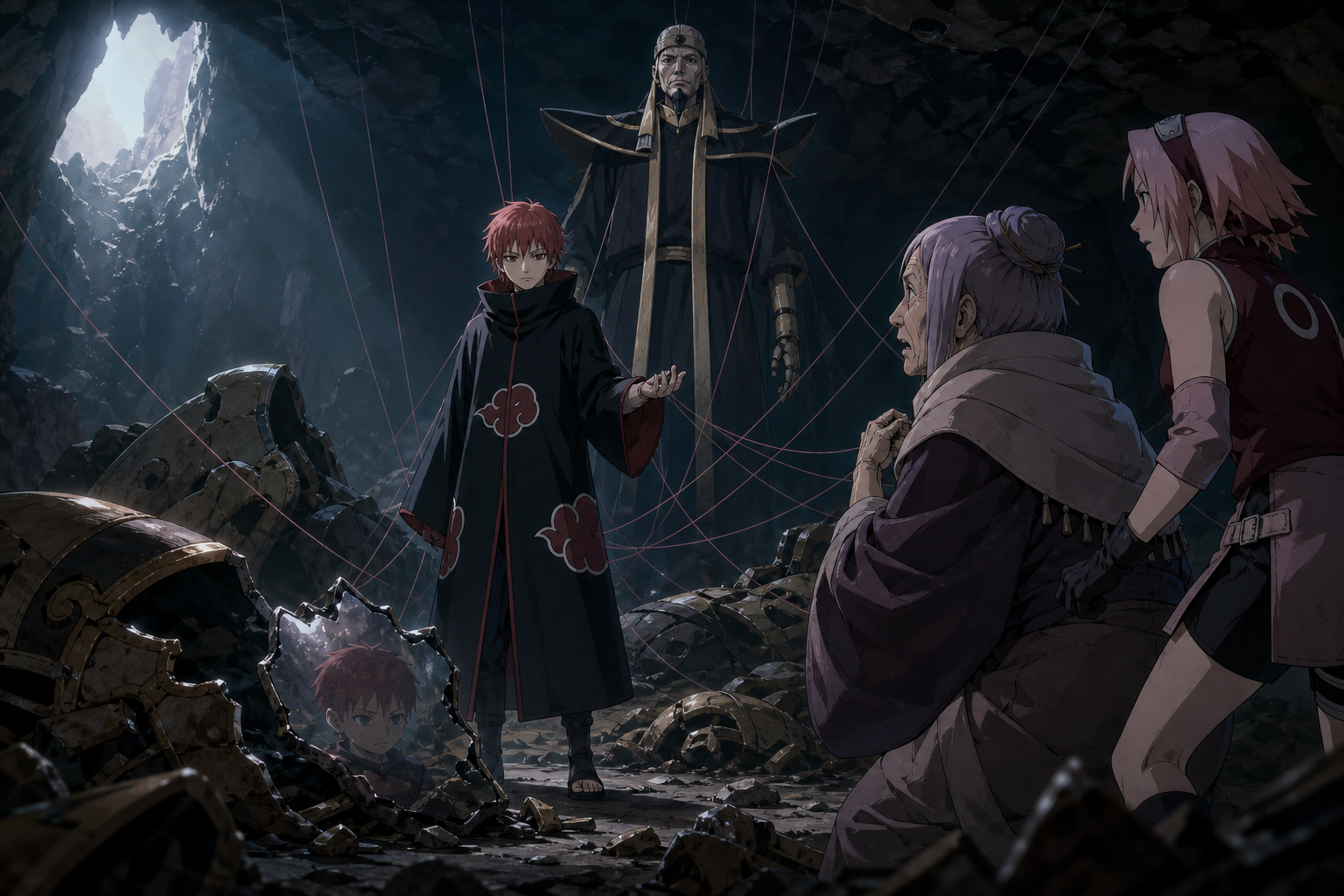
Sasori’s Real Face
Hiruko’s destruction reveals Sasori’s unchanged youthful face and the Third Kazekage body he turned into a human puppet.
The human face is more disturbing than Hiruko
Naruto Shippuden Episode 21 breaks Hiruko apart and reveals a red-haired young man who looks almost unchanged from Chiyo's memory of twenty years earlier. The monstrous shell was easier to understand. Sasori's real face creates an impossible collision between childhood familiarity and adult responsibility.
Chiyo sees the grandson she remembers, but the person standing before her is not preserved innocence. He chose Akatsuki, poison, assassination, and human puppetry. A youthful appearance cannot cancel the time in which those choices accumulated.
The reveal turns recognition into a trap. Chiyo's memory invites tenderness at the exact moment the battlefield requires clarity.
Preserved youth is not preserved innocence
Sasori treats permanence as mastery. His body appears untouched by ordinary aging, suggesting he has escaped one of the limits that govern human life.
The episode immediately exposes the moral failure inside that achievement. Youthful skin does not preserve the person who once wore it. Sasori has changed profoundly while arranging his surface to deny change.
This is the opposite of growth. Growth accepts that experience alters the self and creates responsibilities across time. Sasori wants the benefits of accumulated skill without allowing the body to testify that time passed.
His face therefore functions like another puppet shell. It is a familiar exterior carrying something Chiyo can no longer safely recognize as the child she lost.
Chiyo has to separate memory from evidence
Chiyo's first response is shock. The face contradicts the twenty-year absence she has lived through.
Memory tells her that Sasori should have aged. Evidence tells her that he transformed his relationship to embodiment itself.
The battle requires Chiyo to hold two truths at once. Sasori was a lonely child worthy of care, and Sasori is now an adult responsible for lethal choices. Erasing the child would flatten the history. Erasing the adult would excuse the harm.
Her task is not to choose which face is real. It is to understand that both belong to one life, and that compassion cannot mean surrendering judgment.
Sakura sees the present before the past
Sakura does not share Chiyo's family memory. She sees an Akatsuki member who survived Hiruko's destruction and is already revealing another weapon.
That distance becomes useful. Sakura can keep the present danger visible while Chiyo processes recognition.
She is not indifferent to the emotional weight. Her partnership with Chiyo has made the elder's history relevant to her survival. Yet she does not mistake a young face for proof that the fight has changed categories.
Sakura's position lets the team balance empathy with immediate evidence. One woman knows too much history to feel neutral. The other knows enough danger not to be disarmed by appearance.
The Third Kazekage becomes the second shock
Sasori reveals a human puppet made from the Third Kazekage, remembered as the strongest leader in Sand history.
This is not merely a powerful addition to an arsenal. It answers a political mystery. The missing Kazekage did not vanish into uncertainty. Sasori killed him and converted his body into property.
Chiyo's shock expands from family grief to village history. Her grandson did not only abandon the Sand. He removed one of its leaders and kept the remains as a weapon.
The puppet makes Sasori's philosophy concrete. He responds to powerful people by preventing change, preserving bodies, and placing their abilities under his control.
A human puppet steals more than a body
Ordinary puppets reproduce movement through craft. Human puppets preserve a victim's physical traits and techniques after death.
That preservation is theft disguised as art. The Third Kazekage's abilities continue to appear, but choice has been removed from them.
Sasori can deploy the authority and power of a former leader without carrying the obligations that once governed those abilities. He keeps capacity and discards personhood.
This makes the human puppet a political object. The Sand's strongest Kazekage has been reduced to an extension of the person who murdered him.
Sasori turns grief into inventory
Sasori's collection suggests a way of responding to loss: preserve the body, control the memory, and refuse the unpredictability of living relationships.
Puppets do not leave unless their operator moves them. They do not age, disagree, or demand repair on their own terms.
That stability is purchased by eliminating agency. Sasori calls permanence art because it lets him avoid the conditions that make attachment vulnerable.
The Third Kazekage puppet shows the scale of that avoidance. A person who once led a village is now one item in a private inventory.
Chiyo confronts the failure of inherited craft
Puppetry belongs to Chiyo's expertise and Sand tradition. Sasori learned inside that lineage, then pushed it toward human bodies.
The elder cannot dismiss his work as unrelated corruption. The technical foundation came from knowledge her world valued and transmitted.
That does not make Chiyo responsible for every choice Sasori made. It gives her a particular responsibility to understand how the craft was transformed and to oppose its abusive use.
Episode 21 keeps asking what elders owe when inherited skill produces harm. Chiyo's answer must involve more than regret. She has to place her knowledge in Sakura's hands and fight.
The Third Kazekage reveals a village wound
For the Sand, the disappearance of a Kazekage would have shaped policy, fear, and succession. Sasori has carried the answer privately for years.
This turns secrecy into power. The village could not mourn accurately or assign responsibility because the evidence had been converted into Sasori's weapon.
When Chiyo recognizes the puppet, private knowledge becomes public truth within the battle. The missing leader's body is evidence of a crime even while it attacks her.
Recovering that truth matters separately from winning. A village cannot address a wound whose cause remains hidden.
Sakura must fight a symbol without worshipping it
The Third Kazekage's reputation could create hesitation. He was considered the strongest Kazekage, a figure of political authority and military power.
The human puppet carries those abilities without the person or office that once gave them context. Sakura must respond to the attack rather than the title.
This is not disrespect toward the dead leader. It is refusal to let Sasori use reputation as additional armor.
Destroying or disabling the puppet may be the only way to stop the continued exploitation of the Kazekage's remains.
A face can be another form of armor
Hiruko protected Sasori through metal, hidden weapons, and physical distance. His youthful face protects him differently.
It creates hesitation in Chiyo and confusion about the person before her. The appearance suggests vulnerability even when Sasori controls one of the most dangerous puppets in Sand history.
Emotional armor can be as effective as physical armor when an opponent has a relationship with the image being displayed.
Chiyo must recognize that the face is real without letting it define the whole truth. Sasori is not impersonating his younger self. He has preserved the surface while rejecting the obligations Chiyo associates with it.
The episode separates appearance from chronology
Human beings often read age as evidence of experience. Sasori breaks that shortcut.
He looks young but carries two decades of additional decisions, skills, and crimes. Chiyo looks old but remains capable of rapid analysis, adaptation, and combat leadership.
The contrast exposes the weakness of judging authority or innocence through appearance. Time has affected both characters even when it has not marked Sasori's face conventionally.
Chiyo's wrinkles show survival. Sasori's smooth face shows refusal.
Sakura and Chiyo need different kinds of clarity
Sakura needs technical clarity about the new puppet: its reach, hidden weapons, poison delivery, and preserved abilities.
Chiyo needs emotional clarity about Sasori: the person she remembers cannot be used to deny the person attacking them.
Each woman can help the other. Chiyo translates Sand history and puppet mechanisms. Sakura's immediate attention keeps the team anchored in the present.
Their earlier chakra-thread tactic proved that bodies can cooperate. Episode 21 asks their perceptions to cooperate too.
The real face does not produce the real self
The title promises Sasori's real face, not a complete explanation of Sasori.
Removing Hiruko reveals appearance and another layer of technique. It does not reveal every motive, fear, or alteration behind his preserved body.
The distinction matters because stories often treat unmasking as access to truth. Sasori has built himself from layers of artifice so thoroughly that a face may only be the next surface.
Chiyo recognizes what the face was. The battle will have to discover what Sasori made it become.
The Kazekage puppet accuses the whole system
The Sand celebrated the Third Kazekage's strength. Sasori demonstrates that exceptional power can become a reason a body is targeted, preserved, and owned.
That logic resembles the treatment of jinchuriki. Institutions value an ability, tie it to a person, then allow the ability to overshadow the person's right to bodily autonomy.
Gaara was killed for Shukaku. The Third Kazekage was killed and preserved for his techniques. Different methods lead to the same refusal to separate useful power from ownership of the person carrying it.
Sakura and Chiyo now stand between two victims turned into resources by Akatsuki.
Art without consent becomes possession
Sasori describes puppetry through the language of art, permanence, and technical achievement. The Third Kazekage forces a harder question: can a work remain art when its material is a murdered person's body and abilities?
Craft does not erase acquisition. The sophistication of the mechanism may increase the evidence of deliberate violation because Sasori had to preserve, alter, and maintain what he took.
The puppet can perform recognizable techniques, but it cannot consent to the performance or refuse the operator. Sasori has preserved capability by removing the subject who once chose how to use it.
This is possession in both senses. He owns the body as an object and possesses its movements through chakra threads.
Chiyo's earlier coordination with Sakura offers the counterexample. Their thread connection was temporary, visible, and chosen. Sakura remained able to contribute judgment. The Third Kazekage puppet retains power only after judgment has been eliminated.
Recognition should increase responsibility
Chiyo's recognition of Sasori could become a reason to protect him from consequence. The episode instead positions recognition as greater responsibility.
She knows the lineage of his technique, the conditions of his childhood, and the political significance of the puppet behind him. That knowledge gives her fewer excuses to misunderstand the harm.
Sakura's presence prevents family history from becoming a closed conversation in which the victims disappear. The Third Kazekage's body and the poison aimed at Sakura are evidence that Sasori's choices reach far beyond Chiyo's grief.
Love for who someone was does not require denial of who they harmed. A responsible elder can remember the child, oppose the adult, and refuse to pretend those commitments cancel one another.
That is the moral weight of the real face. Chiyo is not being asked whether she recognizes Sasori. She is being asked what recognition obligates her to do now.
Fandom arguments worth sorting out
One argument says Sasori's young appearance proves he stopped developing emotionally as a child. The visual suggests arrested attachment, but he still made adult choices across twenty years and remains responsible for them.
Another argument treats the Third Kazekage puppet as a cool power reveal only. It is also evidence of murder, political disappearance, and the conversion of a leader's body into property.
A third argument says Chiyo should attack without hesitation because Sasori is clearly dangerous. Recognition is involuntary. Her responsibility lies in what she does after the shock.
The final argument treats Sakura's lack of family history as a disadvantage. It also lets her see current danger without being disarmed by the familiar face.
RaeRae's verdict
“Sasori's Real Face” makes revelation worse than concealment. Hiruko's monster shell hid a youthful face Chiyo knows, while the youthful face reveals an adult who turned the Third Kazekage into a human puppet.
Sasori preserves surfaces and calls permanence art. The episode shows what that permanence costs: aging is denied, agency is removed, political truth is hidden, and bodies become inventory.
Chiyo must honor the child she remembers without using him to excuse the man before her. Sakura must respect Sand history without allowing the Kazekage's title to immobilize her.
The real face is not the real self. It is another preserved object asking the women to confuse familiarity with innocence. Their survival depends on refusing that mistake.
The face creates recognition without restoring relationship
Chiyo knows the features immediately, but recognition does not mean the bond survived unchanged. Twenty years of absence, murder, Akatsuki service, and bodily transformation stand between the child in her memory and the adult before her.
The shock is real without becoming evidence of innocence. Family resemblance can open grief while leaving responsibility intact.
Sasori controls the witness his body gives
Aging normally records time through change. His youthful surface refuses that testimony and lets him confront Chiyo wearing the age at which her longing may be strongest.
Preservation becomes narrative control. He decides which version of himself the body displays while keeping the skills and choices accumulated afterward.
Arrested appearance is not arrested accountability
It may be tempting to read Sasori as emotionally frozen in childhood. Even if his attachments remained wounded or undeveloped, he continued making decisions as years passed.
Trauma can explain why permanence appealed to him. It cannot transfer ownership of the Third Kazekage’s body or erase the people poisoned by his craft.
Sakura protects the distinction between sympathy and surrender
She can understand why Chiyo hesitates without accepting the face as a reason to stop reading the battlefield. Sasori is already selecting another weapon.
Her presence keeps compassion connected to evidence. The women do not need emotional coldness; they need enough clarity that recognition does not decide whether Sasori may continue harming them.
The Third Kazekage’s disappearance was stolen public knowledge
A missing leader leaves a village with rumor, fear, succession questions, and grief that cannot attach to verified events. Sasori privately possessed the answer while Sunagakure lived with uncertainty.
Turning the corpse into a puppet did not only steal a body. It withheld a political truth the dead man’s community needed to understand its own history.
The puppet forces Chiyo to witness two family failures together
Her grandson stands behind the remains of the village leader he murdered. Personal grief and public responsibility can no longer be kept in separate rooms.
Chiyo must confront what happened to Sasori and what Sasori did to others. Centering only the first story would make the Kazekage disappear again.
Preserved technique is not preserved consent
The Third Kazekage’s abilities may survive in material form, but the person who chose when and why to use them is gone. Sasori keeps capacity while removing authorship.
That theft is deeper than imitation. The puppet makes a dead leader appear to act in service of his killer, reversing the meaning of the power it displays.
Reputation becomes another weapon Sasori can operate
Calling the Third Kazekage the strongest carries emotional and political force before any technique begins. Sasori benefits from the hesitation attached to the title.
Sakura’s task is to respect the victim without submitting to the stolen symbol. Fighting the puppet can be an act of refusing its continued exploitation.
Sand tradition has to examine what its craft made possible
Puppetry did not inevitably produce human puppets, and Chiyo did not choose Sasori’s murders. Still, inherited technique supplied concepts and tools he transformed toward domination.
Responsible tradition does not protect itself by calling abuse unrelated. It studies the path, names the violation, and teaches future practitioners where skill lost its ethical boundary.
Sasori’s permanence depends on other people becoming objects
He can avoid abandonment by collecting bodies incapable of leaving. He can preserve ability by removing the person capable of refusing him.
The stable world he creates is not free from loss. It relocates loss into victims while giving the operator control over what remains visible.
Chiyo’s love creates more responsibility, not less
Because she knows Sasori’s childhood, techniques, family wounds, and village context, she is positioned to understand the scope of the harm more fully than Sakura can.
Love cannot require ignorance after evidence appears. Remembering who he was should sharpen the tragedy of what he chose, not protect those choices from consequence.
The real-face reveal is another warning about surfaces
Projected Akatsuki members, the sealed cave, Hiruko, and Sasori’s youthful body each invite the rescuers to treat a visible layer as complete truth.
Progress comes through refusing that shortcut. A revealed face can be factually real while still functioning as one layer in a system built to manage perception.
The body records competing claims about art
Sasori sees technical triumph: a famous body preserved with its abilities. The victim’s history records murder, desecration, disappearance, and forced performance.
Calling the result art does not settle the argument. Craftsmanship can intensify the violation when every refined mechanism depends on sustained control of stolen remains.
Recovery would require returning the Kazekage to history
Defeating the puppet is not the only obligation. Sunagakure needs the truth about what happened, and the dead leader deserves to be remembered as more than Sasori’s strongest acquisition.
Restoring history cannot restore life, but it can end the killer’s private ownership of the story and let public grief attach to evidence.
RaeRae’s full take
The young face is the cruelest possible thing Chiyo could see because it arrives carrying twenty years the skin refuses to show. She can recognize her grandson and still recognize that he is an adult who murdered a Kazekage, hid the truth, and made the man’s body perform for him.
Sakura matters because she will not let family grief erase the current victim. The Third Kazekage is not a dramatic prop waiting to prove Sasori’s power level. He was a person, a leader, and a missing piece of Sand history before he became inventory.
Sasori calls permanence art, but his permanence requires other people to lose every right to move, age, refuse, or be remembered on their own terms. The face is real. The innocence Chiyo wants to find inside it is not.
RaeRae checkpoint: Recognition does not absolve Sasori. It gives Chiyo a fuller record of what was lost, what he chose, and why love now requires opposition instead of denial.
Receipts and official routes
- Episode number, titles, Sasori’s youthful appearance, Chiyo’s recognition, and the reveal of the Third Kazekage human puppet: Naruto Official Site episode guide.
- Licensed episode route: Crunchyroll.