
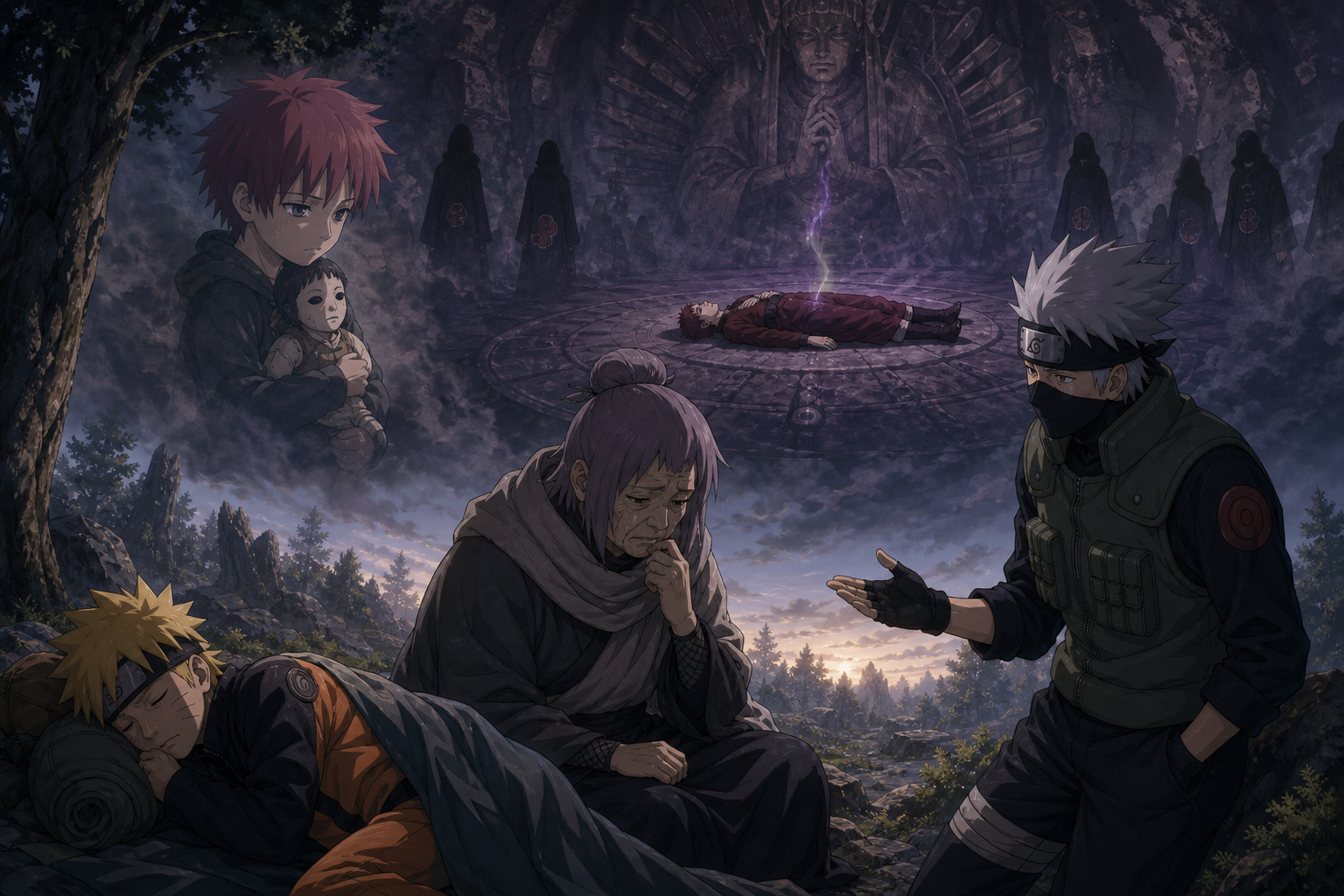
The Death of Gaara!
Chiyo confronts her part in Gaara’s fate as Akatsuki completes Shukaku’s extraction and Naruto races toward a friend already lost.
The title refuses to soften the result
Naruto Shippuden Episode 17 does not hide behind a rescue cliffhanger. Akatsuki finishes extracting Shukaku, and Gaara dies. The title states the outcome before the team reaches the cave because suspense is not the episode's only purpose. The real question is what everyone does with a death produced by choices older than the mission.
Gaara survived assassination attempts, public fear, and years of being treated as the Sand's unstable weapon. He became Kazekage and began earning the village's trust. None of that protects him from an organization that sees only the creature sealed inside him.
The ritual leaves behind the consequence of reducing a person to storage. Once the useful power is removed, Akatsuki treats the emptied body as waste. The episode makes that logic visible without granting it the dignity of ambiguity.
Rest becomes part of the tragedy
Teams Kakashi and Guy stop briefly after defeating the substitute bodies. The pause is tactically necessary. They have spent chakra against projected versions of Itachi and Kisame, and charging ahead without recovery could destroy the rescue force before it reaches the hideout.
The audience knows what the characters cannot measure: the ritual is almost complete. That knowledge makes every quiet breath feel cruel. Rest is not laziness, yet the minutes still belong to Akatsuki.
This is the mission's impossible arithmetic. A team that never stops may arrive unable to fight. A team that stops may arrive too late. There is no clean choice because the enemy designed the route to make survival and speed compete.
Naruto's exhaustion matters most. His sleeping body proves he is not powered by determination alone. He is a child carrying enormous chakra, grief, and responsibility, and all three have limits.
Chiyo sees Sasori in Naruto's sleep
Watching Naruto sleep draws Chiyo back toward Sasori as a child. The memory is not a claim that the boys are identical. It exposes the point at which adults could still have chosen differently.
Sasori once had needs before he became someone Chiyo could describe only through danger and betrayal. Naruto still carries those needs openly, even after a village taught him that loneliness was normal. Chiyo recognizes a familiar child on a different path.
That recognition turns memory into judgment. Nostalgia would let her mourn the grandson she lost without examining the world that shaped him. Naruto's presence makes avoidance harder. He is proof that a lonely child can still reach toward other people when somebody answers.
Chiyo's grief therefore widens. She is not only grieving Sasori. She is confronting the adults, institutions, and silences that allowed children to become containers, weapons, and fugitives.
Kakashi names Naruto's connection to Gaara
Chiyo does not understand why Naruto is investing so much of himself in Gaara's rescue. Kakashi gives her the missing fact: Naruto is also a jinchuriki.
That disclosure is not gossip. It explains the urgency Chiyo has been watching since the team left Konoha. Naruto knows the particular loneliness of carrying a tailed beast while a village decides whether to fear, use, or tolerate him.
Kakashi's explanation also shifts Chiyo's view of the alliance. The Leaf did not send a distant specialist to recover the Sand's military asset. It sent another host who recognizes Gaara as a person.
The truth creates a sharper comparison between villages. Konoha failed Naruto in countless ways, while the Sand actively weaponized Gaara under Chiyo's generation. Neither village can claim innocence. The rescue becomes a chance to act against that shared history instead of defending it.
Chiyo admits her part in Gaara's suffering
Chiyo helped place Shukaku inside Gaara in the name of protecting Sunagakure. Episode 17 forces her to connect that decision to the body lying inside Akatsuki's cave.
Akatsuki is responsible for the extraction and death. Chiyo's remorse does not transfer that responsibility away from the killers. It recognizes that the ritual exploits a condition her village deliberately created.
This distinction matters. Institutional accountability is not the same as claiming every later crime was inevitable. The Sand could not predict every Akatsuki decision, but it knew a child would carry the costs of its weapon.
Chiyo begins considering what she must do now. Regret becomes meaningful only when it changes the use of her remaining power. The episode positions her knowledge, life, and medical ability as resources she may spend differently from the way her generation spent Gaara.
Gaara dies after becoming visible
Gaara's death lands differently because it occurs after he has begun to be seen by his village. He is no longer only the terrifying child introduced during the Chunin Exams. He is a leader whom Sand shinobi follow and civilians hope will return.
That growth does not make his life newly valuable. It makes other people's delayed recognition visible. Gaara deserved protection before he became useful, respected, or politically successful.
The rescue arc repeatedly shows villagers discovering affection under emergency conditions. Their fear of losing Gaara reveals bonds that daily life may not have named clearly enough.
Akatsuki arrives at the moment when Gaara's public identity has expanded beyond Shukaku. The extraction violently tries to collapse him back into the old definition: a body containing a beast. His death is therefore personal and political. It attacks both the person he became and the village relationship he was rebuilding.
The ritual completes its accounting
The Phantom Dragons Nine Consuming Seals reaches completion. For Akatsuki, the result is a captured tailed beast. For Gaara, it is the end of bodily life. The same event receives different names depending on whose value system describes it.
Technical language can hide violence by making a process sound neutral. Extraction, sealing, and containment describe operations without naming the person who pays for them.
Episode 17 places Gaara's still body beside the ritual's success so those descriptions cannot be separated. Akatsuki does not merely gain Shukaku. It kills the host required to obtain that power.
The organization also disperses responsibility across many members. Each contributes chakra, while the collective structure makes the death feel like procedure. Shared participation does not dilute responsibility. It distributes it.
Naruto's bond with Gaara is not projection
Naruto sees himself in Gaara, but his effort is not valuable only as self-recognition. He remembers a person who understood isolation, chose a different direction, and accepted responsibility for a village that once feared him.
Their connection began through conflict. Naruto opposed Gaara's belief that strength required isolation, then discovered how close he might have come to the same conclusion. That history gives their bond honesty without requiring constant companionship.
Naruto's rescue effort says that infrequent contact does not make a relationship unreal. Gaara's existence changed Naruto's understanding of what a jinchuriki could become, and Naruto's defiance changed Gaara's.
Kakashi recognizes that weight when he explains Naruto's behavior to Chiyo. He does not dismiss the urgency as recklessness. He gives it context, then keeps the team moving within the limits of its bodies.
A village cannot outsource its remorse
Chiyo's regret is personal, but the decision to seal Shukaku into Gaara belonged to a political system. One elder's sorrow cannot substitute for institutional change.
Sunagakure wanted a deterrent against other nations. That language made the act sound protective while placing danger inside a child who had no voice in the decision. When the weapon proved difficult to control, the village blamed the host for the conditions it imposed.
Gaara becoming Kazekage interrupted that logic. The supposed weapon claimed political authority and began protecting the people who had treated him as a threat.
His death now tests whether the village learned to value him or merely found a more convenient use for his power. Grief must eventually become policy, memory, and different choices for other children. Otherwise remorse remains another feeling Gaara was forced to produce for adults.
Sasori's memory warns against late recognition
Chiyo remembers Sasori when repair may already be impossible. That timing parallels the Sand's response to Gaara. Adults often discover a child's humanity after distance, violence, or death makes recognition emotionally safe.
The memory does not absolve Sasori of what he becomes. It asks what was neglected before his choices hardened into a life built around puppets and preserved bodies.
Naruto represents an unfinished path. He still needs adults to tell the truth, share responsibility, and protect his personhood from the institutions interested in Kurama.
Chiyo cannot change Sasori's childhood or remove Shukaku from Gaara's history. She can decide whether late recognition leads only to grief or to an act that changes another person's future.
This is where the episode quietly prepares its next moral decision. Chiyo's remorse is not an endpoint. It is a demand.
Akatsuki wins before the heroes arrive
The extraction finishes while the rescue teams are still outside the hideout. Structurally, this denies the familiar fantasy that enough determination guarantees punctual heroism.
Naruto did not care too little. Kakashi did not plan casually. Sakura did not train inadequately. Team Guy did not fail to fight. Akatsuki created delays, barriers, remote substitutes, and a ritual schedule designed to survive pursuit.
That does not mean effort was pointless. The teams remain capable of confronting the people responsible, recovering Gaara's body, and preventing the organization from leaving without consequence.
Failure changes the mission instead of ending every possibility. The danger is allowing the missed deadline to become a verdict on whether continued action matters. Naruto's refusal to accept that logic will become the pressure that keeps the rescue from collapsing into retrieval.
Death exposes what office cannot protect
Gaara holds the highest office in Sunagakure, yet Akatsuki can still reduce him to the condition imposed in childhood. Political rank gives him authority but cannot undo the seal or erase the people seeking Shukaku.
This complicates the comforting idea that personal achievement defeats structural harm. Becoming Kazekage proves Gaara's growth and the village's changing relationship with him. It does not make the jinchuriki system safe.
The same warning applies to Naruto's dream of becoming Hokage. Recognition may heal parts of his isolation, but office alone cannot prevent others from treating Kurama as a resource.
Real protection requires changes beyond one exceptional survivor. Villages must question why children are made hosts, why secrecy replaces consent, and why the host is blamed whenever the contained power creates fear.
The episode makes grief political
Gaara's death will hurt Naruto, Temari, Kankuro, and the Sand differently. Episode 17 begins that grief before every character learns the result by showing the choices surrounding his body.
Chiyo's remorse ties grief to policy. Naruto's identification ties it to the treatment of jinchuriki across borders. Kakashi's explanation ties it to truths adults decide children are allowed to know.
This prevents the death from functioning only as shock. The emotional response carries questions about who built the conditions, who benefited, and who was expected to survive them.
Akatsuki would prefer a simpler accounting: one beast acquired, one container discarded. The rescuers' relationships make that accounting impossible. Gaara has a name, office, siblings, village, rival, and friend. Each bond contradicts the organization's definition of him.
Fandom arguments worth sorting out
One argument says the teams should not have rested. They had fought powerful decoys and still faced an unknown hideout defense. Exhaustion was part of Akatsuki's trap, not proof that the rescuers stopped caring.
Another argument says Chiyo's remorse arrives too late to matter. It is late. Its value depends on whether she converts regret into an action that changes the present.
A third argument treats Gaara's death as a device meant only to motivate Naruto. The episode grounds the outcome in Gaara's history, the Sand's policy, Chiyo's responsibility, and Akatsuki's extraction system. Naruto is one witness to that life, not its owner.
The final argument says becoming Kazekage should have protected Gaara. Rank cannot cancel a seal placed inside his body or the larger system competing for its power.
RaeRae's verdict
“The Death of Gaara!” is blunt because the world around Gaara has used softer language for violence too often. The Sand called him a weapon. Akatsuki calls its murder extraction. The ritual calls a dead person successful containment.
Naruto, Kakashi, and Chiyo restore the human terms. Naruto's urgency comes from recognition. Kakashi explains the connection without belittling it. Chiyo admits that Gaara's danger began with a choice her generation made.
The episode's quiet rest and completed ritual belong together. Akatsuki engineered a mission where responsible recovery could cost the very minutes the victim needed.
Gaara dies after building a life larger than Shukaku. That is precisely why the extraction cannot define him. The body in the cave is not an emptied container. It is the Kazekage, Naruto's friend, Temari and Kankuro's brother, and a person his village learned to see too late.
The exclamation point does not make the death triumphant
The title’s punctuation can sound sensational before the episode begins. What follows is quieter and crueler: a ritual completes, a body stops moving, and the people racing toward Gaara do not receive a dramatic final exchange.
The blunt title removes the comfort of pretending arrival alone will reverse the clock. It asks the audience to remain with consequence instead of treating death as a surprise reserved for the last frame.
Gaara is killed by a process built to look orderly
Akatsuki members stand in assigned positions, contribute chakra, and complete a technique with recognizable stages. Procedure gives the violence a clean surface.
That organization does not reduce responsibility. Every participant sustains a process whose successful endpoint requires Gaara’s death. Ritual language cannot turn collective murder into neutral administration.
The rescuers’ rest was forced into the enemy’s design
Teams Kakashi and Guy need recovery because Akatsuki made them spend real bodies and chakra against remote substitutes. Rest becomes one more cost transferred from the attackers to the people trying to stop them.
Blaming the teams would accept the organization’s framing. Akatsuki engineered the choice between arriving exhausted and arriving later, then benefited from either answer.
Naruto sleeping does not mean his commitment weakened
His body reaches a limit before his promise does. That distinction matters in a franchise that often turns determination into physical fuel.
Exhaustion is not a moral failure. Treating it as one would reproduce the shinobi system’s habit of valuing children according to how much danger their bodies can absorb without interrupting the mission.
Kakashi protects Naruto’s story when he explains the bond
He gives Chiyo the fact needed to understand Naruto’s urgency without making Naruto perform his childhood for her. The disclosure serves the mission and keeps the focus on the shared jinchuriki condition.
Context changes her interpretation. What looked like reckless fixation becomes recognition between two people whose villages placed power inside them and then judged the consequences.
Chiyo’s memory identifies a preventable distance
Seeing Sasori in Naruto does not collapse the boys into one person. It reveals the stretch of time between a lonely child and the adult everyone later calls irredeemable.
Her grief becomes accountable when she asks what adults did during that distance. Memory cannot rewrite Sasori’s choices, but it can expose how often elders wait until harm becomes spectacular before recognizing need.
Remorse needs a beneficiary other than the remorseful person
Chiyo feeling terrible may be emotionally honest, but sorrow that only relieves her conscience would still center the elder. Repair has to reach somebody harmed by the same system.
The episode begins turning her remaining knowledge and life toward Gaara and Naruto. Regret becomes meaningful when another person receives protection, truth, or possibility from it.
Gaara did not earn humanity by becoming useful
His successful leadership makes the village’s affection visible, but it cannot be the reason his death matters. The frightened child who hurt people, rejected connection, and had not yet become Kazekage was already human.
If recognition depends on exceptional achievement, the system remains ready to discard every host who cannot convert trauma into public service.
The village’s grief must remember the child before the office
Sunagakure will mourn a leader, symbol, brother, and protector. Honest grief also has to remember the child it isolated, targeted, and trained as a weapon.
Otherwise the village can celebrate the Kazekage while avoiding responsibility for the years that made his survival extraordinary. Love after recognition should reopen the record, not polish it.
Akatsuki’s success does not own the meaning of Gaara’s body
The organization sees a completed extraction and a discarded host. Naruto sees his friend. Temari and Kankuro will see their brother. The Sand sees the leader it sent people to recover.
Those relationships cannot revive him in this moment, but they prevent Akatsuki’s category from becoming the final description. A body remains somebody even after an institution has taken the power it wanted.
Failure changes the work without ending responsibility
The rescue deadline has been missed, yet reaching the hideout still matters. Gaara’s body must be recovered, the people responsible confronted, and the larger threat understood before another host is taken.
This is a harder model of action than guaranteed rescue. People continue because the victim matters, not because success has been promised as a reward for caring enough.
The episode refuses to make grief private
Naruto’s pain belongs to a relationship, but the causes extend through Sand policy, Konoha secrecy, jinchuriki practice, and Akatsuki extraction. The loss cannot be reduced to one boy’s motivation.
Private feeling becomes political evidence. Gaara died inside a condition created by institutions and exploited by an organization that understood exactly how disposable hosts had been taught to appear.
RaeRae’s full take
I hate the timing because nobody stopped caring. Naruto did not sleep through Gaara’s life. Team Guy did not waste time for fun. Sakura did not lack urgency. Akatsuki built a road where surviving the obstacles consumed the minutes the victim needed.
Chiyo finally looks at the whole chain. Her generation helped put Shukaku inside a child, the village punished that child for carrying the result, and Akatsuki arrived to claim the power while discarding the person. Her remorse matters only if she spends what remains of herself against that chain.
Gaara becoming Kazekage makes the loss public, but office did not create his value. The lonely child mattered before anybody applauded him. Naruto understands that because their bond began before the Sand finished learning the lesson.
RaeRae checkpoint: Gaara did not become worth saving when he became Kazekage. The title hurts because every institution had years to recognize the child before his body became the place where their choices came due.
Receipts and official routes
- Episode number, titles, the teams’ recovery pause, Chiyo’s memory of Sasori, Kakashi explaining Naruto’s jinchuriki status, and the completed extraction: Naruto Official Site episode guide.
- Licensed episode route: Crunchyroll.