
The Secret Weapon is Called….
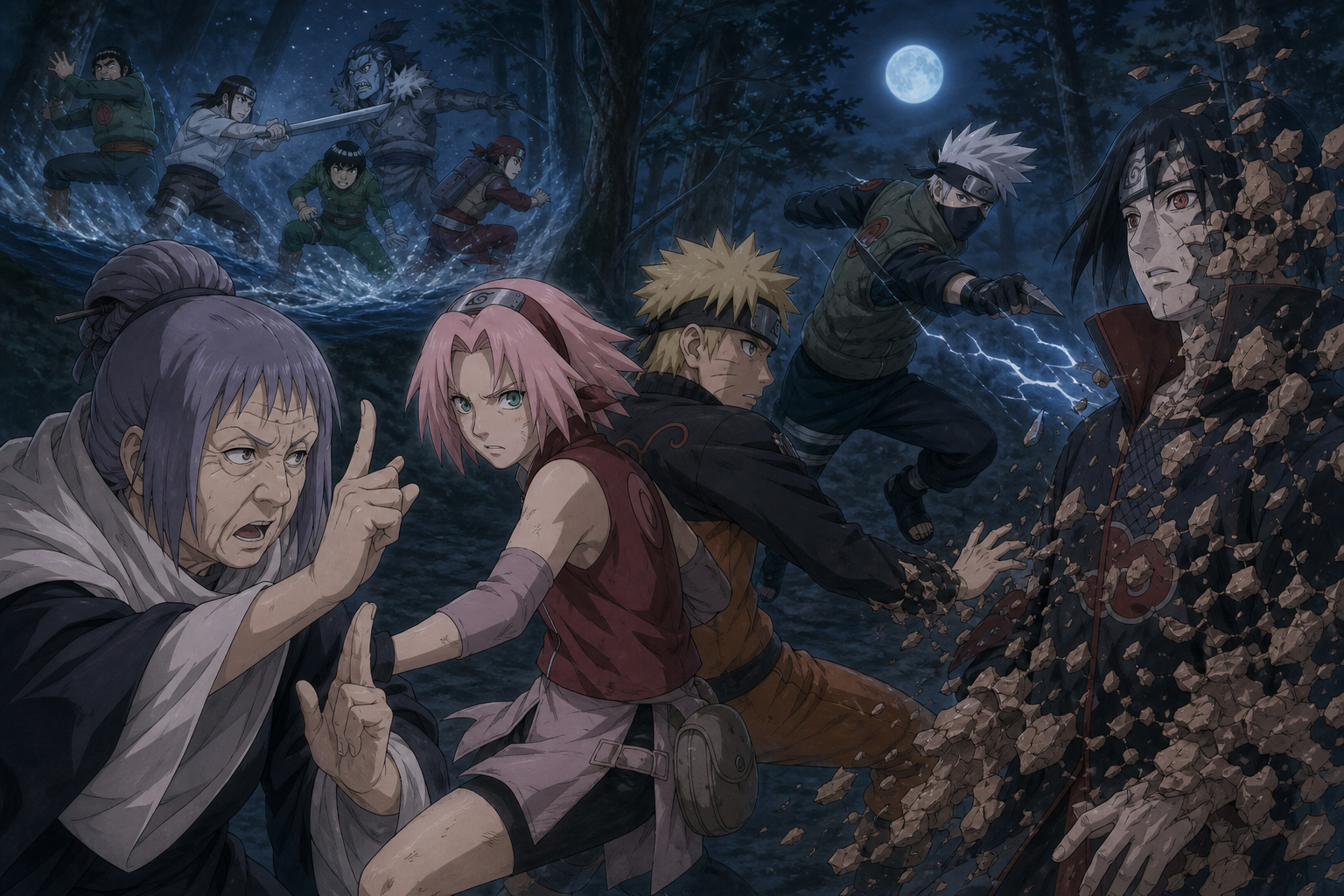
Chiyo turns anti-genjutsu knowledge into a team formation while Kakashi counters the substitute body buying Akatsuki more time.
The secret weapon is knowledge that travels
Naruto Shippuden Episode 15 gives its grandest title to an unglamorous advantage. Chiyo explains how a team can confront Sharingan genjutsu by protecting one another, disrupting compromised chakra, and refusing the isolation the technique requires.
The secret weapon is not a hidden bloodline or forbidden attack. It is survival knowledge shared quickly enough to change formation. That choice fits the Kazekage Rescue arc, where expertise keeps moving across generations and village borders.
Sakura and Chiyo have already shown that medicine becomes more powerful when knowledge is applied cooperatively. Now Chiyo turns experience with visual genjutsu into collective protection. The lesson does not make Itachi harmless. It gives the team a way to remain a team while facing him.
Chiyo translates danger into a rule
Elite enemies often create awe by appearing beyond explanation. Chiyo reduces part of Itachi's advantage to a usable principle: do not let one person face the genjutsu user as an isolated mind.
That translation matters more than another warning that Itachi is dangerous. Fear describes the problem. A rule changes behavior.
Chiyo's advice also reveals the value of age when age remains willing to serve the present. She does not hoard knowledge to prove superiority or use it to shame Naruto for being caught. She places the lesson directly into the team's hands.
The moment continues her movement away from retirement's cynical distance. Earlier, Chiyo spoke as if younger shinobi would repeat every failure. Here, she gives them information that may help them act differently.
Kakashi turns warning into counterattack
Kakashi does not stop at avoiding Itachi's gaze. Once Sakura and Chiyo restore Naruto, he begins a coordinated counterattack designed around what the team now understands.
This is leadership as tempo control. Kakashi allows the recovery work to happen, then acts before the enemy can reset the psychological advantage. He treats care and offense as consecutive parts of one plan.
His earlier defeat under Tsukuyomi informs the approach without controlling it. Kakashi does not seek revenge for humiliation. He uses remembered pain to keep the team operational.
The counterattack also demonstrates that caution is not passivity. Refusing direct eye contact, using clones, and coordinating angles can look less heroic than charging forward. It is more respectful of the opponent and the mission clock.
Naruto's growth becomes formation discipline
Naruto has just been pulled out of an illusion built from Sasuke, Sakura, and his own fear of failure. Episode 15 asks whether he can return to formation without pretending the attack meant nothing.
He does not need to stop caring about Sasuke. He needs to keep that care from deciding where his eyes, chakra, and teammates go next.
Working back-to-back with Sakura turns trust into physical strategy. Each teammate becomes responsible for noticing when the other's perception changes. Their relationship is no longer only emotional support attached to combat. It is part of the combat system.
This is a meaningful evolution from Naruto's habit of proving commitment through solitary risk. The secret weapon works only if he accepts that another person may need to interrupt him again.
Sakura becomes both medic and anchor
Sakura's medical training makes her especially suited to anti-genjutsu support. She understands chakra control, notices changes in behavior, and can intervene without escalating panic.
Her role is not limited to repairing bodies after stronger people finish fighting. She helps preserve the team's perception while the fight is happening.
That distinction matters for how the series values support work. A teammate who can restore agency under mental attack changes which offensive options remain available. Kakashi can counter because Sakura and Chiyo returned Naruto to the present.
Sakura also carries her own vulnerability to Itachi's connection with Sasuke. Remaining an anchor does not mean she has no emotional response. It means she refuses to let the enemy choose its operational form.
The decoy body changes the meaning of victory
As the fight develops, the rescuers begin to understand that Akatsuki may not be seeking a clean battlefield victory. Itachi's presence is part of a delaying structure tied to sacrificial substitute bodies.
That realization reframes every successful hit. Defeating the figure in front of them may not injure the real Itachi or reduce Akatsuki's core strength. It may only end one use of a disposable person.
The tactic is cruel because it spends another human body as time. Akatsuki protects its members and extraction schedule by turning someone else into the surface on which the rescuers exhaust chakra.
This extends the organization's larger logic. Gaara is treated as a container for Shukaku. The substitute is treated as a container for a member's technique. Different targets, same refusal to respect the life holding the desired power.
Akatsuki fights for minutes, not honor
The projected Itachi and Kisame encounters make the organization's objective clear. They do not need to destroy both rescue teams. They need to keep them away from the hideout until extraction finishes.
That strategic asymmetry favors Akatsuki. The rescuers must pass, preserve enough chakra for the cave, and arrive in time. The decoys only have to consume attention.
Itachi's genjutsu is ideal for delay because it creates internal work. Even after an illusion breaks, teammates must reorient, verify perception, and rebuild formation. Kisame's water techniques create environmental work, forcing Team Guy to spend effort regaining movement.
The enemy wins whenever the heroes mistake the obstacle for the mission. Kakashi has to fight decisively without allowing Itachi to become the emotional center of the arc.
Team Guy learns the cost of a second front
Team Guy's battle with Kisame continues in parallel, confirming that support is not a protected category. Akatsuki assigns a tailored obstruction to each route.
Kisame's massive water techniques interfere with the team's natural strengths. Guy and Lee need footing and distance control. Neji needs enough stability to read the field. Tenten needs space for ranged weapons.
Their four-person formation is the counterpart to Chiyo's lesson. Survival depends on keeping complementary skills connected under pressure.
The parallel also emphasizes incomplete information. Team Guy cannot see what Itachi is doing to Naruto, and Team Kakashi cannot measure Kisame's effect on support. Coordination has to survive separation.
Shared knowledge is the opposite of a secret
The episode's title contains a productive irony. Chiyo's “secret weapon” becomes useful by no longer being secret.
Hidden villages often protect techniques as private assets tied to clans, ranks, or national advantage. That culture can preserve power while preventing help from reaching the people who need it.
Chiyo crosses that habit. She gives Leaf ninja knowledge from her own experience because the immediate purpose is keeping them alive and reaching Gaara.
Sakura embodies the same principle through medicine. Tsunade taught her knowledge that now serves Sunagakure. The alliance grows whenever expertise moves toward need instead of remaining proof of ownership.
Decoys expose the ethics of substitution
Akatsuki's substitute technique asks the audience to look past spectacle. The person wearing Itachi's face is not simply a clone made of neutral energy. A body has been repurposed.
That fact makes the fight morally uglier. The rescuers have little choice but to neutralize the threat, while the organization that created it remains distant from the immediate cost.
Substitution protects powerful people by concentrating danger in someone considered disposable. The hidden-village world already understands that logic through jinchuriki and child soldiers. Akatsuki perfects it without pretending the sacrifice is honorable.
Recognizing the decoy does not remove responsibility from the rescuers' hands. It redirects blame toward the system that engineered the impossible choice.
The team's real resource is attention
Chakra is the obvious currency of the fight, but attention is the resource Akatsuki most aggressively drains. Itachi makes Naruto look inward at accusation and memory. Kisame forces Team Guy to look outward at a battlefield transformed by water. Both encounters keep eyes away from the extraction cave.
Attention has tactical limits. A fighter can track only so many threats, protect only so many angles, and maintain only so many mental models at once. Genjutsu exploits those limits directly by filling perception with false information.
Chiyo's formation rule redistributes attention. No one person has to monitor the enemy, their own chakra, and every sign of illusion alone. Teammates watch one another, creating a small verification network.
That structure resembles Sakura's medical practice. Diagnosis depends on comparing signals rather than trusting one dramatic symptom. Anti-genjutsu teamwork also asks the group to compare reality across bodies and perspectives.
Kakashi protects the mission's attention by refusing to let Itachi's identity set the emotional agenda. The opponent matters because he blocks the route, not because every question about Sasuke can be answered on this path.
Naruto's hardest task is accepting that focus is not betrayal. Continuing toward Gaara does not mean Sasuke matters less. It means Akatsuki does not get to schedule Naruto's loyalties for him.
The decoy tactic works because powerful enemies are naturally compelling. Defeating Itachi feels like a worthy objective even when the body is only a projection using someone else's life. The rescue team must distinguish importance from urgency.
Gaara remains urgent. Itachi is important, dangerous, and emotionally charged, but the extraction clock determines what this encounter is allowed to become.
Countermeasures are a form of collective memory
Every countermeasure begins as somebody's earlier injury, observation, or failure. Kakashi knows the danger of Itachi's eyes because Tsukuyomi once devastated him. Chiyo knows the value of paired support because genjutsu has predictable effects on chakra and perception.
When that knowledge is shared, pain stops belonging only to the person who paid for it. It becomes protection for people who were not present at the original loss.
This is one of the healthier ways shinobi institutions can use history. The alternative is secrecy, where each generation repeats the same injury because experts protect prestige or clans protect technique.
Kakashi does not conceal his vulnerability to appear stronger. Chiyo does not keep her rule inside Sand authority. Both make the team harder to isolate by admitting what can happen.
Sakura then helps operationalize the lesson. Her chakra control makes disruption possible, while her steadiness helps Naruto understand that intervention is not judgment.
Collective memory remains imperfect. Itachi can change delivery methods, exploit different emotions, or combine genjutsu with physical attack. A countermeasure is not immunity.
Its value lies in giving the team a starting response before panic chooses one for them. Shared knowledge shortens the distance between recognizing harm and acting against it.
That saved time matters because Akatsuki's entire defense is built around delay. Every second the team does not spend rediscovering an old lesson is a second returned to Gaara.
Fandom arguments worth sorting out
One argument says Chiyo's anti-genjutsu explanation makes the Sharingan too easy to counter. A team rule reduces isolation; it does not erase Itachi's speed, intelligence, or ability to use other attack routes.
Another argument treats Naruto needing rescue again as regression. He returns to formation, accepts intervention, and continues the mission. Recovery with help is growth.
A third argument says the decoy reveal makes the fight pointless. The point is delay. Akatsuki spends substitute bodies to purchase extraction time and force the rescuers to spend real chakra.
The final argument treats Team Guy's parallel battle as repetitive. The symmetry reveals a coordinated defense plan tailored to two different teams.
RaeRae's verdict
“The Secret Weapon is Called….” understands that information becomes power only when people can use it together. Chiyo turns experience into formation. Sakura turns chakra control into an anchor. Kakashi turns caution into counterattack. Naruto turns trust into discipline.
Akatsuki answers with the opposite model. It centralizes knowledge, protects its core members, and spends other bodies to buy time.
That contrast gives the episode more weight than its transitional position suggests. One side shares skill so people remain themselves. The other distributes harm so powerful members remain safe.
The rescuers may win the immediate fight, but Akatsuki controls the clock. The real secret weapon is remembering that passage, not pride, is the objective.
Chiyo makes expertise portable
Knowledge locked inside one veteran may protect that veteran’s reputation, but it cannot protect the teenager standing beside her. Chiyo turns experience into a formation simple enough to use under pressure: one fighter engages while another watches for the moment perception breaks.
The lesson travels across age, village, and rank. That movement is the episode’s quiet answer to institutions that treat technique as property rather than public safety.
A usable rule is more valuable than a legend
Calling Itachi unbeatable would produce awe and hesitation. Naming the condition of his advantage gives Team Kakashi something to practice. They still face an elite opponent, but danger now has a shape.
Good instruction does not promise immunity. It reduces uncertainty enough for people to coordinate. Chiyo respects the threat without turning fear into worship.
Two-person resistance changes who carries the shame
Genjutsu can make the trapped person feel responsible for failing to recognize reality. A paired formation relocates responsibility. Teammates agree in advance that either mind may need outside interruption.
That agreement weakens shame before the next attack begins. Help is no longer an emergency favor granted to the weak. It is part of the plan everyone accepted.
Sakura turns attention into protection
Her most important resource is not raw strength in this encounter. It is the ability to watch Naruto closely while tracking Itachi, Kakashi, Chiyo, and the rescue clock.
Attention becomes care when it preserves another person’s authorship. Sakura intervenes so Naruto can decide again; Itachi observes him to decide on his behalf.
Kakashi refuses to let his history choose the mission
He has personal reasons to fear and resent Itachi after Tsukuyomi. Instead of chasing repayment, he turns the memory into a countermeasure and keeps Gaara at the center of the operation.
This is emotional discipline without denial. Kakashi remembers exactly enough to protect the team, then refuses to give an old humiliation unlimited time.
The decoy protects power by hiding cost in another body
Akatsuki’s projection looks like tactical efficiency until the substitute person becomes visible. A distant member receives reach and protection while somebody judged expendable absorbs the consequences.
The method belongs beside the organization’s treatment of jinchuriki. In both cases, a human life is reduced to a container that matters only for the power someone else can extract or transmit through it.
Discovery changes the moral record, not the immediate danger
Knowing the opponent is a substitute does not let Team Kakashi stop defending itself. The projected techniques can still trap, injure, and delay them.
The revelation changes where responsibility belongs. The rescuers confront a weaponized body; Akatsuki created the conditions that made neutralizing that body necessary.
Every spectacular exchange has an invisible invoice
Kakashi, Naruto, Sakura, and Chiyo spend chakra and concentration on someone who is not physically present. The real Akatsuki members remain closer to the extraction while their enemies pay travel and combat costs.
The episode asks viewers to count minutes and bodies alongside techniques. A dazzling victory can still be strategically expensive.
Team Guy’s parallel fight proves the design is coordinated
Kisame is not a random encounter running beside Itachi’s battle. Each projection is matched to a team and placed where it can consume the route.
Itachi attacks perception and private history. Kisame attacks footing, space, and formation. Akatsuki understands that delay works best when customized.
Support teams deserve independent survival plans
Calling Team Guy reinforcement can make its danger sound secondary. Yet nobody on Team Kakashi can reach across the distance if Kisame isolates Lee, Neji, or Tenten.
Mutual aid has to account for separation. Each squad needs enough knowledge, authority, and redundancy to survive when the other cannot answer.
Naruto learns that focus is not betrayal
Sasuke remains emotionally present, but Naruto does not owe Itachi a complete reckoning on Akatsuki’s schedule. Continuing toward Gaara does not weaken his promise.
Boundaries protect loyalty from manipulation. Naruto can refuse this encounter’s invitation and still care with his whole heart.
The secret weapon is a culture that remembers together
Kakashi’s injury, Chiyo’s experience, Sakura’s chakra control, and Naruto’s trust become more useful when combined than when guarded as individual proof of strength.
Collective memory shortens the time between harm and response. In an arc ruled by an extraction clock, that saved time is a form of rescue.
Countermeasures must remain adaptable
A formation can reduce isolation without solving every variation of genjutsu. Itachi can change range, timing, emotional bait, or combine illusion with physical movement.
The rule is a beginning, not doctrine carved beyond revision. Healthy teams carry shared knowledge and keep observing when reality refuses to match the lesson perfectly.
RaeRae’s full take
I love that the episode hides its secret weapon in something shinobi culture routinely undervalues: telling people what you know before they repeat your pain. Chiyo could perform superiority. Kakashi could perform invulnerability. Neither performance gets Gaara back.
The paired formation works because nobody has to be the flawless mind in the room. Sakura can catch Naruto. Naruto can protect Sakura. Chiyo can lend knowledge without owning the team. Kakashi can lead without pretending his earlier defeat never happened.
Then the substitute body ruins any easy celebration. Akatsuki stays distant and powerful by spending somebody else. That cruelty is the receipt underneath the spectacle. Team Kakashi still has to win, but the story makes us look at who was forced to pay for the fight.
RaeRae checkpoint: The secret weapon is not a bigger attack. It is shared knowledge strong enough to keep one frightened mind from becoming an enemy’s private battlefield.
The formation creates a promise between teammates
The person watching agrees to notice without mocking, and the person fighting agrees to accept interruption without treating care as an attack on pride. That mutual permission is what turns technique into trust.
It also gives the team a practice that can outlast Itachi. Any enemy who isolates perception becomes less powerful when the group has already decided that reality may need to be rebuilt together.
Receipts and official routes
- Episode number, titles, Chiyo’s anti-genjutsu guidance, Kakashi’s counterattack, and Akatsuki’s delaying tactic: Naruto Official Site episode guide.
- Licensed episode route: Crunchyroll.