
Sealing Jutsu: Nine Phantom Dragons
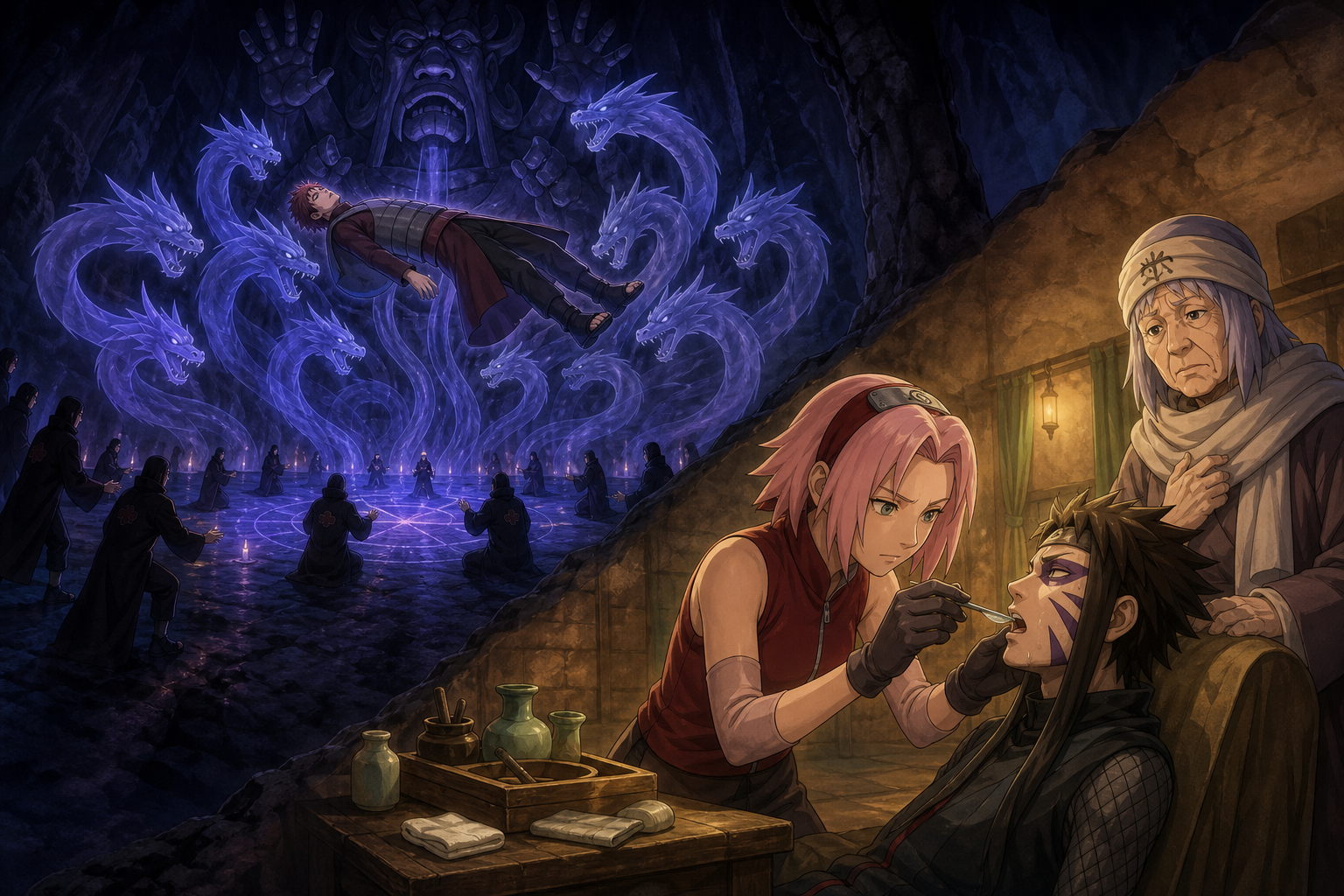
Akatsuki begins extracting Shukaku from Gaara while Sakura’s antidote gives Kankuro a future beyond Sasori’s poison.
Two rooms spend chakra in opposite directions
Naruto Shippuden Episode 10 places its moral argument in parallel spaces. In one, Akatsuki gathers around the Demonic Statue of the Outer Path and begins extracting Shukaku from Gaara. In the other, Sakura completes an antidote and uses it to keep Kankuro alive. Both processes demand rare knowledge, precise chakra control, and time. Only one treats a human life as the point.
That contrast turns “Sealing Jutsu: Nine Phantom Dragons” into more than an explanation episode. Akatsuki's ritual is spectacular, but its scale does not make it sacred. The statue, spectral dragons, and gathered projections create the visual language of ceremony around an act of organized consumption. Sakura's clinic work looks smaller because care usually does. It is still the more difficult moral achievement.
The episode also makes the rescue deadline concrete. Gaara is not waiting in a cell for heroes to reach him. The extraction is already underway, and it will continue for days. Every hour spent treating Kankuro, assembling teams, or following the trail belongs to the same clock. The story refuses the comfort of assuming the victim remains unchanged while everyone else prepares.
Akatsuki turns cooperation into machinery
The sealing ritual is our first sustained look at Akatsuki operating as an institution. Members spread across great distances contribute chakra through projected forms, coordinating without sharing a room in the ordinary sense. Their cloaks and rings advertise individuality, but the ritual reduces them to positions in a system.
That system is terrifying because it is patient. Deidara's attack on Sunagakure was loud and improvisational. Sasori's poison was intimate and technical. The extraction absorbs both styles into a scheduled process. Akatsuki can abduct a political leader, transport him to a prepared site, convene specialists, and spend days turning his body into inventory.
The nine phantom dragons give the process mythic scale, yet the objective is brutally administrative. Remove the tailed beast. Preserve the organization's target. Discard what remains of the host. Akatsuki's power is not only that its members are dangerous in combat. It is that they have built procedures for converting danger into repeatable work.
The ritual therefore mirrors the villages in an uncomfortable way. Hidden villages also sealed tailed beasts inside children and described the result as strategic necessity. Akatsuki is not inventing the logic that a jinchuriki can be treated as a container. It is taking that logic to its terminal conclusion.
Gaara is present even while unconscious
Gaara cannot argue, fight, or govern during the extraction. The composition risks turning him into the object Akatsuki believes he is. The surrounding episodes prevent that erasure. We have seen him protect Sunagakure, worry about civilians, and accept the responsibility of Kazekage. We know the person suspended before the statue.
That knowledge changes how the ritual reads. The dragons are not pulling an abstract resource from a neutral vessel. They are tearing power out of someone who constructed an identity beyond the purpose adults assigned him. The violence attacks both his body and the life he made in defiance of that assignment.
Naruto's reaction in the previous episode matters here because it supplies language Gaara cannot provide for himself. Naruto understands that the target and the host are not separable moral categories. Akatsuki wants Shukaku, but it reaches Shukaku by destroying Gaara. Any explanation that treats one as valuable and the other as packaging repeats the crime.
The episode's patience forces the audience to sit with his helplessness. A quicker ritual would be easier to classify as one dramatic blow. A multi-day extraction is a process of attrition. It makes time itself part of the violence.
Sakura's antidote is not a miracle button
Back in Sunagakure, Sakura finishes the first antidote dose for Sasori's poison. The achievement is extraordinary, but the episode protects it from becoming magic. Kankuro needs continued treatment. His damaged body does not reset because one skilled person found the right compound.
This detail gives medical labor dignity. Diagnosis, synthesis, administration, observation, and follow-up are separate responsibilities. Sakura can create a countermeasure and still acknowledge uncertainty. Confidence does not require pretending recovery is instantaneous.
Her method also reveals what Tsunade taught beyond technique. Sakura controls the room by giving fear a sequence. Identify the toxin. Remove what can be removed. stabilize the patient. Prepare an antidote. Monitor the response. Each step replaces helplessness with a task without denying the danger.
The antidote becomes a form of intelligence as well. Once Sakura can counter Sasori's poison, the rescue party knows something about an enemy weapon that previously seemed absolute. Medical analysis converts an attack into evidence. The patient and the mission benefit from the same work.
Chiyo has to revise her hierarchy
Chiyo's reputation rests partly on poison expertise. Sasori's toxin defeats her first reading, while Sakura arrives from Konoha and constructs an answer. The episode could play that reversal as humiliation. Instead, it uses surprise to open a relationship.
Chiyo sees Tsunade's teaching in Sakura's hands. That recognition complicates her image of the Leaf. Konoha remains connected to losses she carries, especially through Sakumo Hatake, but it has also produced a young medic willing to spend rare skill on Chiyo's grandson.
Respect does not erase grief. It changes what grief is allowed to decide. Chiyo can maintain the truth of her family's deaths without treating every Leaf ninja as a substitute target. Sakura gives her a present-tense fact strong enough to compete with inherited hostility.
The scene also asks Chiyo to confront the limits of retirement. She withdrew from the village's active life, preserved knowledge, and cultivated cynicism. Akatsuki's return through Sasori makes withdrawal impossible. The poison in Kankuro's body is a message from the family history she tried to leave alone.
Care and extraction use similar tools
The episode's sharpest idea is that technique has no independent morality. Akatsuki and Sakura both rely on chakra control, specialized knowledge, preparation, and coordinated labor. The ethical difference lies in what the process is designed to do to another person.
Akatsuki's members synchronize their power to separate Gaara from Shukaku, accepting his death as an operational consequence. Sakura combines medical ninjutsu and pharmacology to keep Kankuro inside his own future. One process sees a body as access to a resource. The other sees a body as a life requiring protection.
That distinction applies beyond obvious villains. Hidden villages praise sacrifice and weaponize jinchuriki while insisting their motives are protective. Episode 10 makes motive insufficient. Systems should be judged by what they demand from the people placed inside them.
Sakura's work is not morally superior because it looks gentle. It is superior because Kankuro remains the subject of the process. His survival is the objective, not a useful side effect.
The rescue party inherits a divided clock
Team Kakashi cannot simply sprint from the gate to Gaara. The mission depends on Kankuro's clue, Sand coordination, tracking expertise, and enough medical stability to leave the village without creating another casualty. Every necessary task consumes time Akatsuki is also using.
This is why the early Kazekage Rescue arc feels tense even during preparation. The protagonists do not control the schedule. Akatsuki has already moved from attack to extraction. Team Kakashi is solving prerequisites while the enemy advances its main objective.
Kakashi's role is to keep urgency from destroying sequence. Naruto wants a direct line to Gaara. Sakura must complete work at the bedside. Chiyo is becoming relevant to the pursuit. A good leader cannot make any of those needs disappear. He has to organize them into a mission that can actually reach the cave.
The rescue therefore becomes an alliance stress test. Konoha brings personnel and medical expertise. Sunagakure brings intelligence, terrain knowledge, and the personal history connecting Chiyo to Sasori. Neither village can finish the job alone without paying for pride.
Why the ritual's scale matters
The Demonic Statue introduces a level of threat beyond individual Akatsuki personalities. Deidara can be reckless. Sasori can be bitter. The statue suggests an architecture that will outlast any one argument between them. It turns captured tailed beasts into components of a larger plan the audience cannot yet fully see.
The projected members expand that scale geographically. Akatsuki does not need everyone physically present to act as one body. That capacity makes ordinary pursuit less useful. Finding Deidara or Sasori is not the same as locating the organization's center.
At the same time, the ritual exposes dependence. It takes days and multiple members to extract Shukaku. Akatsuki is powerful, not effortless. The rescue has a narrowing window because the process has requirements. Structure creates capability and vulnerability at once.
That balance prevents the organization from feeling like pure magic. Its horror comes from logistics as much as strength. Someone planned the cave, the statue, the communication method, the positions, and the sequence. Evil has a workflow.
The workflow also redistributes responsibility. No member can pretend the extraction belongs only to Deidara because he carried Gaara into the cave. Every figure feeding chakra into the statue participates in the outcome. Distance does not create innocence. The ritual makes complicity visible by giving each contributor a place around the same victim.
For the rescue party, shared labor works in the opposite direction. Sakura does not claim Kankuro's recovery as a private triumph. Sand medics maintain his condition, Kakashi organizes the mission, Naruto keeps Gaara's personhood in view, and Chiyo begins offering knowledge the pursuit will need. Responsibility expands without dissolving. Each person remains answerable for the care only they can provide.
Fandom arguments worth sorting out
One argument says the sealing sequence is too long. Its duration is the threat. A quick visual would show power; the sustained ritual shows an institution built to repeat the act across multiple jinchuriki.
Another argument treats Sakura's antidote as implausibly easy. The episode emphasizes the opposite. She draws on elite training, examines a sample, stabilizes Kankuro, prepares a limited treatment, and warns that continued care is necessary. Expertise can be fast without being effortless.
A third argument says Chiyo's surprise exists only to praise Sakura. It also changes Chiyo. The young Leaf medic becomes evidence that present cooperation can produce something her old categories cannot explain.
The final argument separates the cave from the clinic as unrelated plotlines. They are the same argument about bodies. Akatsuki extracts value until the host is gone. Sakura spends knowledge so the patient can remain.
RaeRae's verdict
“Sealing Jutsu: Nine Phantom Dragons” makes process frightening. The Akatsuki ritual has grandeur, but the episode never lets grandeur become dignity. Gaara hangs at its center because an organization decided the power inside him mattered more than the life around it.
Sakura answers with a process of her own. Her antidote does not explode, summon a monument, or require nine silhouettes. It gives Kankuro another hour, then another possibility. That is what care often looks like: smaller on screen, larger for the person who survives.
Chiyo's respect, Naruto's urgency, Kakashi's structure, and Kankuro's fragile recovery begin turning two allied villages into one rescue effort. The work remains incomplete. Gaara's clock is still running. But the episode identifies the moral line clearly.
Power is not redeemed by complexity. Cooperation is not virtuous because many people participate. The question is what the system makes of the person at its center. Akatsuki makes a resource. Sakura protects a life.
That is why the quieter half of the episode wins. The statue promises a future built from stolen power. The antidote preserves a future Kankuro can still choose. One process accumulates control by emptying people. The other returns time to someone who was about to lose all of it.
The cave and clinic are competing systems
Both spaces organize rare knowledge, precise chakra control, specialized tools, and people working against a clock. The similarity prevents technique from carrying automatic moral value.
Akatsuki coordinates to empty Gaara for a resource. Sakura coordinates care so Kankuro remains inside his own future. Purpose changes what expertise becomes.
The ritual makes violence repeatable
Deidara’s attack could be mistaken for one spectacular abduction. The statue, assigned positions, remote projections, and multi-day sequence reveal a process designed for more than one target.
Akatsuki becomes frightening as an institution because members can convert individual combat success into scheduled extraction. Evil has documentation, infrastructure, and a workflow.
Remote participation does not create innocence
Members feeding chakra from distant locations are not spectators to what happens in the cave. Each contribution sustains the process destroying Gaara.
Distance can hide sensory consequence without reducing responsibility. The ritual makes complicity visible by placing every projected body around the same captive.
Gaara’s unconsciousness cannot erase his subjecthood
He cannot speak or resist while Shukaku is removed, which is exactly how Akatsuki prefers the target: silent enough to resemble a container.
The arc has already shown the person the ritual excludes. Gaara protected civilians, governed a village, taught Matsuri, and chose connection. Viewers carry that record into the cave even when his body cannot testify.
Extraction completes the villages’ container logic
Hidden villages placed tailed beasts inside children for strategic power, then managed the resulting people as risks and assets. Akatsuki did not invent the premise that host and resource can be morally separated.
It follows that premise to its final violence. If the beast is the valuable part and the child is packaging, killing the host during removal becomes an acceptable technical consequence.
Sakura’s antidote returns time rather than promising magic
The first dose does not reset Kankuro’s injuries or eliminate the need for observation. Diagnosis, synthesis, administration, and continued care remain separate tasks.
That limitation makes the achievement stronger. Sakura creates a future where none existed without pretending expertise abolishes biology.
Medical analysis turns an attack into intelligence
Once the poison can be isolated and countered, Sasori’s weapon stops being absolute secrecy. Symptoms, compound behavior, timing, and response become information the next team can use.
Care for one patient produces defense for others when the knowledge is documented and shared. The clinic fights the enemy’s future attacks as well as the toxin already present.
Chiyo must revise authority without being humiliated
Her poison knowledge is legendary, yet Sakura brings methods capable of answering a compound she cannot immediately identify. Respecting the younger medic does not require pretending Chiyo’s experience became worthless overnight.
The better relationship lets expertise travel both ways. Sakura brings Tsunade’s medical discipline. Chiyo brings Sasori’s history, Sand puppetry knowledge, and the context the pursuit will need.
Withdrawal from public life did not end Chiyo’s consequences
Retirement allowed her to preserve knowledge and distance herself from village politics. Sasori’s return through poison reaches directly into her family and the jinchuriki system her generation helped maintain.
She is not responsible for fixing every institutional failure alone. She is responsible for deciding what her knowledge does now that remaining absent carries a visible cost.
The rescue works on a clock it did not choose
Team Kakashi needs Kankuro’s trail, medical stability, Sand coordination, and tracking support before moving effectively. Each necessary step consumes hours Akatsuki uses on extraction.
Kakashi cannot solve the tension by skipping prerequisites or pretending time is abundant. Command means organizing essential work while the enemy remains ahead.
The statue’s scale reveals capability and dependency
Nine spectral dragons and projected members make Akatsuki appear almost limitless. The same ritual requires time, positions, contributors, a prepared cave, and sustained concentration.
Structure creates power and potential vulnerability together. The rescuers have a narrowing window because extraction is not instantaneous, even if they do not yet know how to exploit every requirement.
RaeRae’s full take
I do not care how grand the statue looks. Ceremony does not make consumption sacred. Gaara hangs in the middle because an organization decided everything he built around Shukaku mattered less than taking Shukaku itself.
Sakura’s work is quieter and morally enormous. She gives Kankuro time, converts Sasori’s poison into evidence, and forces Chiyo to see a Leaf shinobi outside the enemy story she carried into the room.
The episode asks us to judge systems by what they make of the person at the center. Akatsuki makes inventory. The clinic makes a patient whose choices still matter. Complexity is not virtue. Cooperation earns meaning from the life it preserves.
RaeRae checkpoint: Nine people can cooperate in destroying one life. One medic can use equally disciplined knowledge to return a future. Cooperation is only as moral as the person it allows to remain human.
Repeatable violence creates repeatable points of failure
Akatsuki gains enormous capability by standardizing extraction, but standardization also produces requirements that recur: a secured host, a prepared location, sustained contributors, uninterrupted time, and coordination around the statue.
The rescue party does not yet possess enough intelligence to exploit those dependencies. Recognizing that they exist still matters. An organization can look supernatural while relying on a chain of ordinary conditions that later operations may interrupt.
The antidote should outlive Kankuro’s treatment
Sakura’s work becomes stronger when the sample analysis, symptom progression, dosage, and observed response are preserved for Sand and Leaf medical teams. Sasori’s secrecy loses value each time knowledge crosses from one specialist into shared practice.
Saving the current patient is the first obligation. Preventing the same poison from creating another isolated crisis is how individual expertise becomes institutional protection.
Both institutions distribute responsibility differently
Akatsuki spreads participation so no single member carries the entire technical burden, yet every member contributes to the same destruction. The clinic spreads care across medics, analysts, command, and witnesses while keeping Kankuro’s survival central.
Shared labor does not dissolve accountability in either room. It reveals what each person’s assigned role is designed to produce.
Receipts and official routes
- Episode number, titles, Akatsuki’s sealing ritual, Gaara’s extraction, Kankuro’s poison crisis, and Sakura’s antidote work: Naruto Official Site episode guide.
- Licensed Naruto Shippuden series route: Crunchyroll.