
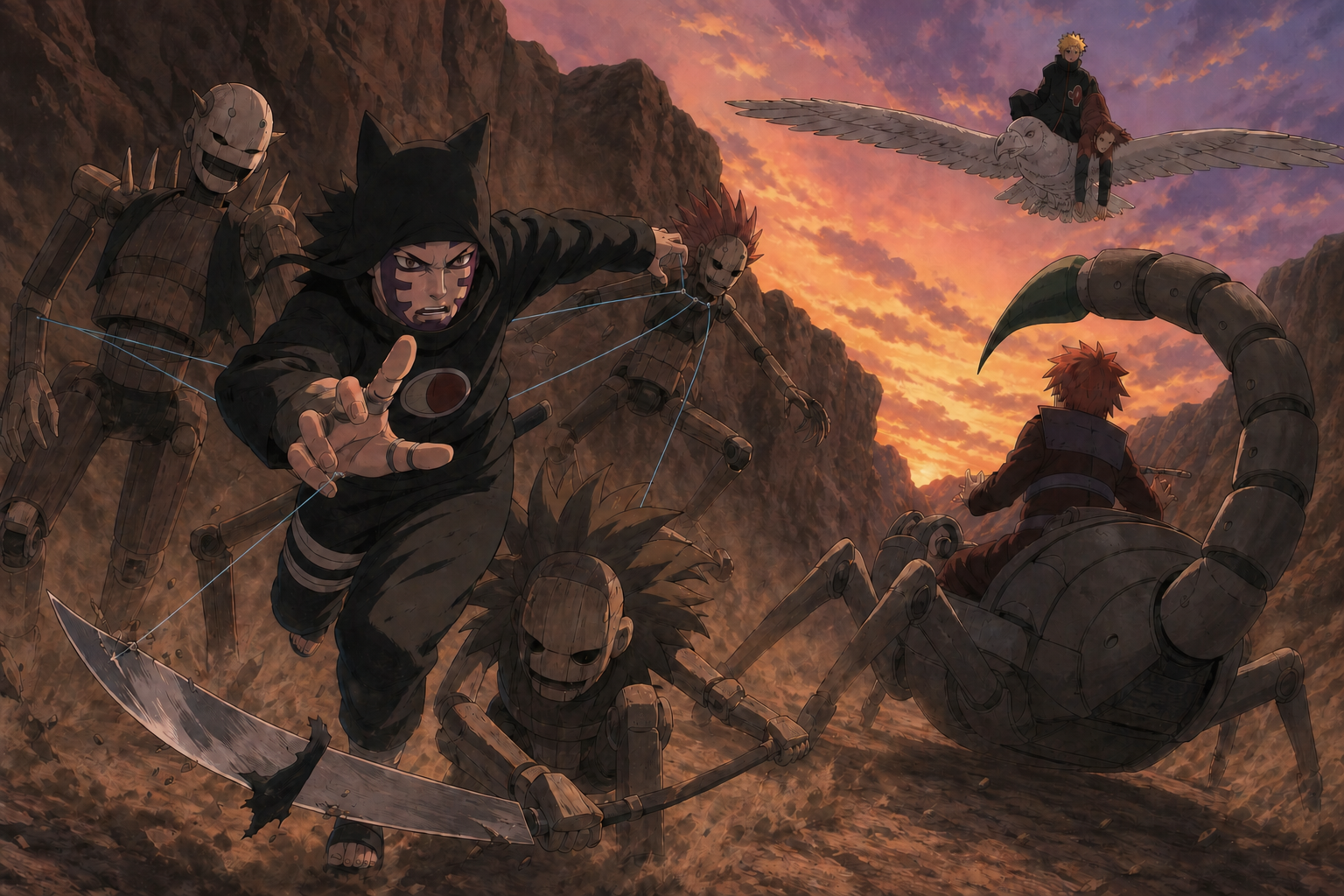
Run, Kankuro
Kankuro pursues Gaara, collides with the designer of his own puppets, and preserves a clue after Sasori’s poison defeats him.
Bottom line
Naruto Shippuden Episode 7 lets Kankuro make the emotionally correct decision in the tactically worst possible way. Gaara has been taken, Baki tells him to wait, and Kankuro runs after Deidara anyway. He catches up, encounters Sasori, and deploys puppets whose mechanisms Sasori already knows because Sasori designed them. Kankuro loses, is poisoned, and still tears away a piece of Akatsuki cloth that gives the rescue effort a trail.
The episode refuses the lazy conclusion that losing makes an action useless. Kankuro's pursuit is reckless. His love for Gaara is real. His preparation is inadequate. His final clue still matters. All four statements can occupy the same fight without canceling one another.
The title is an order and a warning
“Run, Kankuro” sounds like encouragement because the emotional goal is obvious. His brother is being carried away. Every second increases the distance between Gaara and the people who might save him.
The title also sounds like a warning once Sasori enters the road. Kankuro should run toward Gaara and away from the opponent whose knowledge makes his arsenal transparent. The same urgency that pushes him forward removes the time needed to understand what he is facing.
Speed closes physical distance while widening the information gap, and Sasori is waiting inside that gap.
Baki's attempt to stop him is not proof that Baki cares less. A village has just lost its Kazekage after a catastrophic breach. Organizing pursuit, medical support, tracking, communication, and defense is rational. The next attacker could arrive while every capable shinobi chases the first one into the desert.
Kankuro hears delay as abandonment because the target is his brother. That reaction is emotionally credible. It is also the reason personal stakes can distort mission judgment. Love tells him Gaara cannot wait. Love does not tell him what poison Sasori uses or how to counter a puppet master who understands his tools better than he does.
Kankuro finally runs for his brother
The pursuit carries years of family failure inside it. Kankuro once feared Gaara and maintained distance because the Sand taught the siblings to treat him as an unstable weapon. By the time Gaara becomes Kazekage, Kankuro trusts his resolve enough to reject the assumption that Shukaku will take control.
Now that trust has an immediate cost. Gaara protected the village and was captured. Kankuro cannot retreat into the old story that Gaara is dangerous enough to save himself. He knows his brother spent that danger on everyone else.
The run is therefore more than duty to a village leader. It is a brother refusing to let institutional caution repeat the family's old abandonment. Kankuro is late to the relationship, and he knows it. Urgency becomes a form of accountability.
That does not make every choice wise. Naruto is often generous about reckless devotion because the franchise values people who refuse to give up on bonds. Episode 7 keeps the consequence visible. Kankuro's heart points in the right direction, but the body carrying that heart can still be poisoned and removed from the rescue effort.
Yasuyuki Kase's Japanese performance gives Kankuro urgency without reducing him to shouting. The anger and fear sit under the movement. His confidence in his puppetry remains present, which makes the collision with Sasori's knowledge more painful.
Sasori owns the history inside the puppets
Kankuro's puppets are not neutral equipment. Their designs carry Sasori's work. That means Kankuro enters the fight with weapons whose architecture is already known to the enemy.
This is a brutal form of information asymmetry. Kankuro knows how to operate the puppets. Sasori knows why they were built that way, where mechanisms sit, what sequences they support, and which assumptions shaped their design. User knowledge meets creator knowledge.
The episode does not say creators automatically defeat every later user. Skill, modification, and context still matter. Kankuro's problem is that he has no time to establish what Sasori knows or how much the puppets changed after leaving Sasori's hands. He discovers the relationship during the fight.
That discovery turns inheritance into vulnerability. Sunagakure preserved powerful technology without fully controlling the knowledge attached to it. The village can possess the objects while the absent maker retains a map of their weaknesses.
Sasori's advantage is therefore institutional as well as personal. A missing-nin carries proprietary knowledge out of the village. The security problem did not begin when he appeared in front of Kankuro. It began when the village failed to account for what left with him.
Puppetry is combat through distance
Puppet techniques let a shinobi move danger away from the operator's body. Chakra threads carry intent into wooden frames, hidden blades, traps, gas, and projectiles. The style rewards coordination, mechanical understanding, misdirection, and control of space.
Kankuro's fighting identity depends on that distance. His face remains expressive while the puppets perform violence through constructed bodies. The arrangement can make him appear safer than a close-range fighter, but Sasori understands how to collapse the safety.
The scorpion-like shell around Sasori complicates the body question further. Kankuro does not simply fight a person using a puppet. He fights a person concealed within puppet architecture, with a poisoned tail turning the boundary between operator and weapon into a trap.
This matters thematically because Sasori treats bodies as material. A puppet is useful when it obeys, conceals, and preserves function beyond ordinary flesh. Kankuro uses constructed bodies as tools. Sasori moves toward making construction the condition of his own existence.
The episode does not reveal every implication yet, but the mechanical mismatch is already clear. Kankuro controls puppets. Sasori has organized his life around becoming inseparable from the system controlling them.
Poison changes the mission clock
Sasori's poison means a small injury is not a small event. The immediate wound becomes a delayed death sentence unless somebody can identify the compound and produce an antidote.
That changes the rescue mission in two ways. First, Kankuro becomes another person who needs saving. Second, the Sand must divide scarce attention between pursuing Gaara and preventing Kankuro's death. Sasori creates operational drag with one successful strike.
Poison is especially effective against courage because bravery does not metabolize toxins. Kankuro can push through pain, refuse to surrender, and continue manipulating puppets. None of that neutralizes chemistry.
This is one of the franchise's cleaner reminders that willpower has limits. Determination influences choices and endurance. It does not rewrite every biological mechanism on demand.
The threat also prepares the ground for medical ninjutsu to matter as more than recovery after the exciting people finish fighting. Identifying a poison, stabilizing a patient, and creating an antidote are mission-critical acts. The battlefield extends into the treatment room.
The cloth scrap is not a consolation prize
Before Kankuro collapses, he secures a piece of Sasori's clothing. That clue does not make the fight a secret win. He has been defeated and poisoned. Gaara remains captive.
The evidence still changes what the next team can do. Tracking requires a scent, material trace, direction, witness account, or other bridge between the lost target and the rescuers. Kankuro preserves one.
This is field competence under failure. A shinobi who cannot complete the main objective can still reduce uncertainty for the people continuing it. The action matters because missions are collective chains, not isolated hero moments.
The clue also contradicts Sasori's attempt to turn Kankuro into a dead end. Poison is supposed to remove the pursuer and delay response. The torn cloth means Kankuro's contribution persists after his body can no longer move.
There is a practical humility in that outcome. Kankuro does not get the rescue, the victory, or the antidote. He gets information. Information is less glamorous than triumph and often more useful than a dramatic final pose.
Baki and Kankuro are solving different emergencies
Baki is responsible for a village whose leader was abducted after its airspace and internal security failed. Kankuro is responsible, in his own mind, for a brother disappearing into enemy hands. Their disagreement comes from scale as much as temperament.
The institution needs coordination. The family member feels every coordination step as distance. Both perceptions contain truth.
The problem is that Sunagakure should have procedures capable of moving quickly without requiring Kankuro to choose between waiting passively and pursuing blindly. The gap reveals institutional unpreparedness for exactly the threat Akatsuki represents.
Jinchuriki were created and monitored as strategic assets, yet the village response to an organized extraction is improvised. That contradiction is not unique to the Sand. Institutions often invest more in controlling a person than in protecting that person from the predictable consequences of being controlled.
Kankuro's disobedience is therefore a personal error inside a larger planning failure. Blaming him alone would make the system disappear from the analysis.
Sasori's calm is part of the threat
Sasori does not need Deidara's performative excitement. His danger comes through patience, mechanical certainty, and the confidence of someone who already understands the opposing toolkit.
Takahiro Sakurai's Japanese performance keeps Sasori controlled and cool. The delivery avoids turning the character into a generic shouting villain. That restraint supports the sense that Kankuro has entered a problem Sasori considers already solved.
Deidara wants destruction recognized as art. Sasori's relationship to art emphasizes permanence and preservation. The ideological argument between them has not fully opened, but their combat styles already express it: detonation versus construction, moment versus object, spectacle versus control.
Kankuro occupies an uncomfortable middle ground. He also creates combat through objects, but his puppets remain tools in service of a living operator and community. Sasori's practice pushes farther toward replacing the unstable living body with crafted permanence.
That shared medium makes the fight more personal than a random matchup. Kankuro sees a master of his discipline and discovers that mastery detached from responsibility can turn the discipline against its inheritors.
Fandom arguments worth sorting out
The first argument asks whether Kankuro was stupid to chase. He was tactically reckless and emotionally understandable. Reducing the scene to either “heroic” or “stupid” avoids the point. Love can motivate necessary action and still impair preparation.
The second argument says Kankuro was weak because Sasori dismantled his puppets. The matchup is unusually bad. Sasori's design knowledge removes surprise and exposes mechanisms. That does not erase Kankuro's skill against opponents who do not possess the blueprint.
The third argument treats the cloth scrap as plot convenience. The opportunity is dramatic, but preserving trace evidence is exactly the kind of useful action a field operative should attempt when the main objective becomes unreachable.
The fourth argument romanticizes poison resistance through willpower. Kankuro's endurance lets him act briefly after exposure. It does not solve the toxin. Medical expertise will be required because physiology does not care how sincere the rescue attempt was.
RaeRae's verdict
“Run, Kankuro” works because it lets devotion fail without calling devotion meaningless. Kankuro cannot rescue Gaara. He cannot defeat Sasori. He cannot neutralize the poison. He can refuse abandonment, learn who stands in the road, and preserve a clue.
Sasori is frightening because he attacks Kankuro's confidence at the level of design. The puppets are familiar to Kankuro and more familiar to their maker. Poison then ensures the loss follows him after the exchange ends.
The episode's judgment is firm: good motives do not cancel tactical consequences, but tactical failure does not erase every useful choice. Kankuro runs because Gaara is his brother. He falls because love is not an antidote. The scrap in his hand makes sure somebody else can keep running.
Running is accountability before it is strategy
Kankuro knows how often fear and village policy left Gaara alone when they were younger. Waiting after the abduction feels like repeating that abandonment at the exact moment his brother needs somebody to choose him.
The pursuit carries moral repair inside it, but repair does not supply intelligence, backup, antidotes, or a safe route. Kankuro can be right about refusing abandonment and wrong about entering alone.
Baki and Kankuro answer different clocks
Baki sees a breached village, missing Kazekage, possible second attack, and the need to organize teams before committing more people. Kankuro sees the distance between himself and Gaara increasing with every planning step.
Neither clock is imaginary. The institutional failure is that Sand appears unable to protect the village and launch a prepared pursuit quickly enough to honor both. Kankuro’s disobedience occupies the gap between family urgency and inadequate procedure.
Sasori has creator-level intelligence
Kankuro understands operation, timing, repairs, and the combinations his puppets can perform. Sasori understands the design assumptions beneath those mechanisms because the work began with him.
That advantage is not mystical superiority. It is access to architecture: where joints sit, which sequence reveals a hidden blade, how control lines shape movement, and what an operator is likely to attempt next.
Possession does not equal control of knowledge
Sunagakure kept powerful puppets after Sasori left, but the maker carried knowledge the village could not confiscate by retaining the objects. Kankuro inherits equipment without owning the complete history inside it.
The security breach therefore predates this road. When specialized knowledge leaves with a missing-nin, every preserved tool may also preserve vulnerabilities the absent creator can recognize faster than current users.
Puppetry moves risk without eliminating it
Chakra threads let Kankuro place constructed bodies between himself and an opponent. Hidden weapons, traps, and articulated frames expand reach while keeping flesh away from the first collision.
Sasori collapses that safety by understanding the proxies and hiding his own body inside puppet architecture. Distance becomes unreliable when the opponent knows how every layer was meant to protect the operator.
Poison turns one wound into two missions
Kankuro’s injury threatens delayed death after the visible fight ends. Sand must now continue tracing Gaara while stabilizing, diagnosing, and treating another member of the Kazekage’s family.
Sasori creates operational drag with a small successful strike. Courage can extend the time Kankuro acts after exposure, but determination cannot identify compounds or neutralize chemistry.
Medical ninjutsu belongs inside the rescue chain
The toxin makes treatment a continuation of combat rather than cleanup after the important work. An antidote preserves intelligence, personnel, and the possibility that Kankuro can identify Sasori’s mechanisms later.
A rescue force without medical expertise may win the road and still lose everyone poisoned along it. Sakura’s training is about to matter at the same level as tracking and attack power.
The cloth scrap is field competence under defeat
Kankuro does not secretly win by tearing evidence free. He loses the fight, remains poisoned, and fails to retrieve Gaara. The scrap still reduces uncertainty for whoever continues.
That is how collective missions survive individual failure. A shinobi who cannot complete the main objective can preserve a scent, material trace, direction, or description that prevents the next team from starting blind.
Failure and uselessness are not synonyms
Fandom often converts results into a total judgment of the person who produced them. Kankuro’s loss becomes proof he should never have run, or the clue becomes proof the run was secretly correct.
The episode permits a harder answer. His pursuit is reckless, loving, costly, and useful in one specific way. Honest analysis does not need one adjective to erase the others.
Sasori treats bodies and tools as one design problem
Kankuro uses puppets in service of a living operator and community. Sasori’s shell begins blurring operator, weapon, armor, and constructed body into a single controlled system.
The shared discipline makes the encounter intimate. Kankuro is not only facing a stronger puppeteer. He is seeing where the craft can go when permanence and control become more valuable than responsibility to living people.
RaeRae’s full take
I am not asking Kankuro to watch calmly while strangers carry his brother into the desert. I am asking Sunagakure why the only visible choices are delay or one furious puppeteer running without the information needed to survive Sasori.
Kankuro’s heart points correctly. His preparation does not. Sasori knows the puppets from the inside, brings poison Kankuro cannot answer, and understands exactly how urgency will keep the younger man committed after retreat becomes sensible.
The scrap matters because missions belong to chains of people. Kankuro does not rescue Gaara, but he refuses to become a dead end. Love is not an antidote and losing is not nothing. He falls with evidence in his hand so somebody else can keep running.
RaeRae checkpoint: Kankuro runs because Gaara is finally his brother before he is Sand’s weapon. Sasori wins because love cannot replace preparation, then Kankuro leaves the next team a trail anyway.
Sand prepared to control a jinchuriki better than rescue one
The village spent years monitoring Gaara as a possible internal threat. Once an outside organization extracts him, the response appears improvised. That contrast reveals where institutional imagination was invested.
Control systems ask how to contain the dangerous person. Protection systems ask who might target that person, what routes they could use, which medical threats they carry, and how a pursuit launches without sacrificing the village left behind. Sunagakure built more of the first than the second.
Creator knowledge should have changed Kankuro’s withdrawal threshold
The moment Sasori identifies the puppets should alter the mission. Familiar equipment has become compromised equipment because surprise, hidden mechanisms, and expected sequences may all be exposed.
Kankuro continues partly because Gaara is moving farther away and partly because puppetry is the skill he trusts most. Retreat would feel like admitting both personal and technical helplessness. That emotional pressure is exactly why teams need predetermined withdrawal rules. A shinobi should not have to invent the acceptable limit while facing an opponent who already knows his machinery.
The clue converts private failure into shared intelligence
Without the cloth, Kankuro’s encounter could end as pain known only to the people who find him. The material lets trackers connect Sasori’s route to a scent and lets the next team begin from evidence rather than grief.
This is not consolation. It is transfer. Kankuro makes sure the mission knows something his body can no longer carry forward by itself.
Receipts and official routes
- Episode number, titles, Gaara’s abduction, Baki’s attempted restraint, Kankuro’s pursuit, Sasori’s interception, poison, and the preserved trace: Naruto Official Site episode guide.
- Licensed English episode route: Crunchyroll.