
The Jinchuriki of the Sand
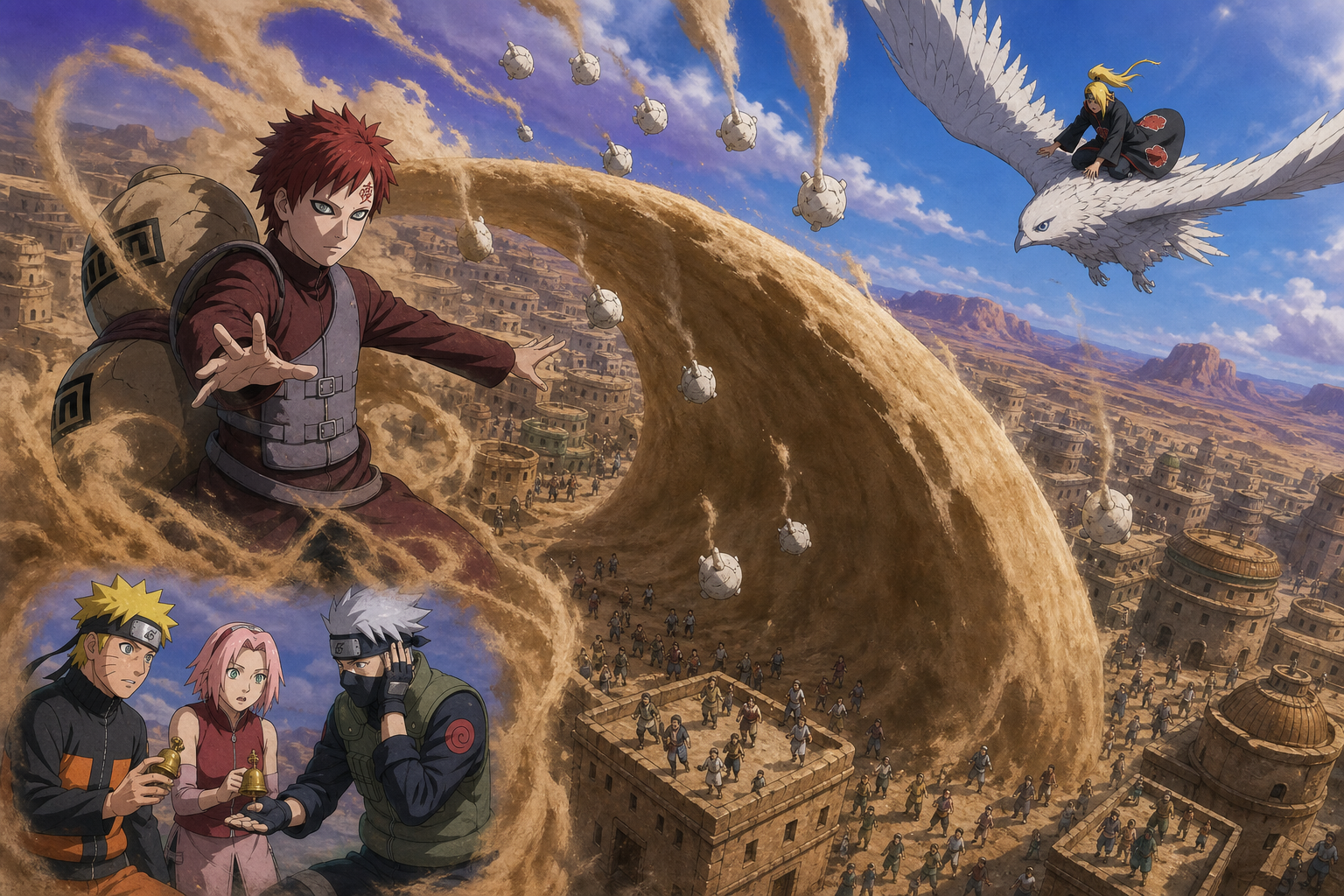
Naruto and Sakura outsmart Kakashi while Gaara shields the Hidden Sand during Deidara’s aerial attack.
Bottom line
Naruto Shippuden Episode 4 gives us one joke victory and one deadly responsibility test. Naruto and Sakura beat Kakashi by threatening to spoil the ending of his beloved Icha Icha book. Gaara fights Deidara above Sunagakure while every person and building below him limits what he can safely do. The bell test says cleverness counts as growth. The aerial battle says leadership means power is never only yours to spend.
That contrast is the episode's real engine. Naruto and Sakura can exploit a teacher who ultimately wants them to succeed. Gaara must outthink an attacker who sees the village as leverage and Gaara's body as inventory. Both stories reward attention, but only one allows laughter after the trick works.
The best technique is knowing your teacher
Naruto's spoiler threat is ridiculous, specific, and completely valid. Kakashi can copy techniques, read movement, and survive attacks that would flatten ordinary shinobi. None of those advantages helps when the information he wants to avoid enters through his ears. Covering the Sharingan does nothing. Closing his visible eye is not enough. He has to block both hearing and sight, and that gives Naruto and Sakura the opening.
The trick works because Naruto finally treats Kakashi as a person instead of a wall of superior skill. Younger Naruto often solved problems by adding force until reality got tired. This Naruto notices an attachment, predicts behavior, and uses that knowledge with Sakura at the right moment. It is not elegant ninja doctrine. It is intelligence grounded in relationship.
Sakura deserves equal credit. The plan requires timing and trust. She does not dismiss Naruto's silly idea because it sounds silly. She recognizes that the target's weakness matters more than the plan's dignity. Their teamwork is no longer an inspirational statement Kakashi has to explain after tying them to posts. It is an operating habit.
Kakashi's loss also feels fair because the episode does not make him suddenly stupid. His investment in the book has been established for years. The students win by applying known evidence under pressure. That is strategy, even if the evidence happens to be a grown man's inability to behave normally about romantic fiction.
A rematch with an honest result
The bells are not proof that Naruto and Sakura have surpassed Kakashi overall. They prove that they completed the assignment under the stated conditions. This distinction matters because battle anime loves turning every exercise into a crude power ranking. Kakashi remains the more experienced shinobi. His students still made him use the Sharingan and then found a route around it.
A good test does not require the teacher to become weaker. It requires the students to demonstrate that old methods of controlling them no longer guarantee the outcome. Sakura's chakra-enhanced strength changed the terrain. Naruto's clones complicated Kakashi's reads. Their shared spoiler play attacked the one defense Kakashi could not maintain while protecting the experience he wanted.
The scene also corrects the emotional problem in the original bell test. Back then, Kakashi had to force the lesson of teamwork into three children organized around rivalry, loneliness, and crushes. Now Naruto and Sakura arrive at cooperation themselves. Sasuke's absence hurts, but it does not prevent the remaining teammates from becoming functional partners.
Kazuhiko Inoue sells Kakashi's panic without throwing away his competence. Junko Takeuchi gives Naruto's threat the delighted precision of a teenager who has finally found the adult's emergency shutoff. Chie Nakamura keeps Sakura aligned with the plan instead of turning her into a spectator to Naruto's joke. The performances make the win communal.
The title chooses Gaara's category
“The Jinchuriki of the Sand” is an accurate description and a warning. Gaara is the Kazekage, a young man, a brother, and the village's public protector. Akatsuki's operation strips those identities away and prioritizes the tailed beast sealed inside him. The title places the extraction category over the office, mirroring what the enemy sees.
The episode's action pushes back. Gaara does not respond as a passive container. He detects Deidara, rises above the village, controls enormous volumes of sand, and shapes the battle around civilians. His identity as a jinchuriki explains part of his power and danger. It does not explain the moral decisions he makes with that power.
That difference separates Gaara from Deidara. Both can attack at range and reshape the airspace. Deidara treats the sky as a stage for his art. Gaara treats it as the roof over his people. The same tactical freedom means spectacle to one fighter and obligation to the other.
Akira Ishida's restraint remains essential. Gaara does not need loud declarations to prove that the village matters. His attention, positioning, and controlled tone carry the change. The boy who once used killing to confirm his own existence is now thinking about lives beyond his own body.
Deidara understands hostage geometry
Deidara's clay bird gives him more than flight. It lets him choose an altitude and angle that make Gaara's strongest responses dangerous to Sunagakure. The village becomes a field of potential collateral damage. Even before Deidara launches his worst attack, his position forces Gaara to calculate around roofs, streets, guards, and civilians.
This is why “just dodge” is not a serious analysis of Gaara's options. A private fighter can prioritize survival and relocate. A Kazekage defending a populated village cannot move as though empty desert surrounds him. Deidara knows the office has turned Gaara's empathy into a tactical constraint.
Calling that empathy a weakness would be morally backward. The constraint proves Gaara is doing the job. The villain gains leverage because the leader refuses to spend civilian lives for personal convenience. A defense system that requires the defender not to care whom it crushes is not protection. It is another threat.
Deidara's behavior also exposes Akatsuki's organizational intelligence. The group did not merely identify a powerful target. It chose a fighter whose mobility and explosive range pressure Gaara's responsibilities. Sasori's sleeper agent opened the village. Deidara's technique exploits its density. This is planning, not a random villain entrance.
Sand against clay
The visual opposition is clean. Gaara's sand is abundant, fluid, defensive, and tied to the landscape. Deidara's clay is manufactured, shaped into false life, and converted into explosions. One material surrounds and catches. The other infiltrates and ruptures.
That contrast should not be flattened into “defense versus offense,” because Gaara can attack brutally and Deidara's creatures can carry, evade, and distract. The more useful difference is their relationship to creation. Gaara forms sand into protection under pressure. Deidara forms clay into temporary bodies designed to be destroyed.
Deidara's claim that explosions are art is not automatically profound because he says it with confidence. It is a philosophy that gives him permission to value the instant of destruction over the lives and labor that existed before it. Sunagakure is full of architecture, routines, and people. To Deidara, all of that can become background for a satisfying detonation.
Gaara's sand answers with duration. It can disperse and gather again. It carries traces of his mother's protection in the character's history, but the episode does not need to announce symbolism over every movement. The visible fact is enough: Gaara uses material associated with his isolation to shield a community.
Naruto and Gaara keep moving in parallel
The episode continues the franchise's long parallel between Naruto and Gaara without pretending their circumstances are identical. Both carry tailed beasts. Both were feared as children. Both wanted acknowledgment. Naruto found bonds that interrupted his worst possibilities. Gaara met Naruto after violence had already become his primary language and then chose to rebuild.
Now Naruto completes a protected exercise in the village that trained him, while Gaara defends the village that once tried to weaponize and kill him. That is not evidence that Gaara's pain was useful or necessary. It is evidence that he built responsibility without receiving a clean moral foundation from the institution he serves.
Naruto's victory with Sakura shows what support can make possible. He has a teammate, teacher, and Hokage who can evaluate growth without reducing him to Kurama. Gaara's battle shows how quickly an enemy can reactivate the reduction. Akatsuki does not care how far either jinchuriki has come as a person.
This parallel raises the stakes for Naruto before he knows Gaara is under attack. The audience understands that the threat above the Sand is also a preview of the category Akatsuki will apply to him. Gaara is not a side mission disconnected from Naruto's body. He is the first visible demonstration of the extraction system moving toward all nine hosts.
Leadership without a clean choice
Gaara's new title does not grant a menu of good options. He can focus on Deidara and risk attacks reaching the village. He can prioritize shielding the village and give Deidara openings. He can move the battle outward only if the attacker cooperates with the relocation, which Deidara has no reason to do.
This is a recognizable political problem inside a fantasy fight. Leaders are often judged as though power means access to an outcome with no victims, no delay, and no tradeoffs. The real test is how they distribute risk when every option carries cost. Gaara chooses to keep the cost on himself as much as his power allows.
The village's earlier treatment of him makes that choice more painful. Sunagakure did not earn this protection through consistent care. Gaara protects it because he decided what kind of leader and person he wants to be. That does not absolve the institution. It makes his ethics visible against its failures.
Fandom arguments worth sorting out
The bell-test ending sometimes gets dismissed as a gag that cheats the exercise. It is a gag, and it is still legitimate. Shinobi exploit information, habits, attention, and emotional vulnerabilities. Kakashi set the condition as taking the bells, not defeating him in a clean arena match. Naruto and Sakura meet the actual condition.
Another argument treats Gaara's automatic sand defense as proof he should dominate Deidara easily. Automatic defense protects Gaara's body. It does not automatically protect an entire village, solve airborne explosives, or remove Deidara's tactical intelligence. Scale changes the problem.
There is also a bad habit of praising Gaara's willingness to protect the Sand as though suffering improved him. Trauma did not teach Gaara empathy in a healthy curriculum. People who reached him, especially Naruto, helped him reject the conclusions trauma had taught. His leadership is an achievement against abuse, not a benefit produced by abuse.
Finally, Deidara's art philosophy is often treated as charming villain flavor without following its consequence. He makes beautiful shapes that exist to explode. The aesthetic appeal is part of the danger because it invites viewers to admire the mechanism before counting what it destroys. The episode knows spectacle can seduce even when the target is a city.
RaeRae's verdict
“The Jinchuriki of the Sand” earns both halves of its structure. Naruto and Sakura's win is funny, character-specific, and strategically honest. It confirms that their growth includes knowing how to work together and how to read Kakashi as more than a superior stat block.
Gaara's battle removes any temptation to treat the sequel as a comfortable graduation tour. His power is enormous, but leadership narrows how he can use it. Deidara's attack is dangerous because it targets both the tailed beast and the Kazekage's obligation to everyone beneath him.
The episode's sharpest idea is that intelligence looks different under different stakes. Naruto wins by recognizing a harmless obsession. Deidara gains leverage by recognizing a moral commitment. One insight produces bells and laughter. The other turns a village into a hostage. Shippuden is telling us that reading people can be intimacy, strategy, or cruelty depending on what you do with the knowledge.
The spoiler plan wins under Kakashi’s actual rules
The assignment is to take the bells before dawn. Kakashi never promises a clean duel, immunity from embarrassment, or a solution based only on recognized combat techniques. Naruto attacks the sensory channels Kakashi must close to preserve the unread ending.
That is shinobi thinking even when the weapon is ridiculous. Information changes behavior. Naruto predicts the behavior, Sakura trusts the timing, and both move before Kakashi can protect the book and the bells at once.
Sakura turns a joke into teamwork
The plan would fail if she paused to judge whether Naruto’s idea looked dignified. She recognizes that an established weakness is more valuable than a respectable tactic with no path through the Sharingan.
Her participation matters because the outcome is not Naruto performing a prank while Sakura happens to be nearby. Two teammates coordinate speech, movement, and the final grab. The original lesson has become habit instead of a lecture delivered after failure.
Passing the test does not flatten the power scale
Naruto and Sakura satisfy the exercise without proving they can defeat Kakashi across every possible condition. Their win is narrower and more credible: they force him to take them seriously, discover a vulnerability, and execute before he adjusts.
That is what a useful test should reveal. Students do not need their teacher to become incompetent. They need to show that the teacher’s old method of controlling them no longer guarantees the result.
The episode title performs Akatsuki’s reduction
Gaara is Kazekage, brother, teacher, survivor, and public protector. “The Jinchuriki of the Sand” moves the container category to the front because that is how Akatsuki organizes his value.
The battle pushes against the title’s narrowing force. Gaara detects the intruder, chooses the airspace, manages enormous sand reserves, and calculates around civilians. Shukaku explains part of his condition. It does not author those decisions.
Deidara weaponizes the duty Gaara chose
Positioning above Sunagakure means every evasive move and counterattack must account for roofs and residents below. A fighter protecting only himself could abandon the city geometry. The Kazekage cannot.
Calling that constraint weakness gets the morality backward. Deidara gains leverage because Gaara refuses to spend other lives for tactical convenience. The burden proves he is performing the office rather than merely wearing its hat.
Automatic defense cannot automate leadership
Sand may intercept threats aimed at Gaara’s body, but it cannot decide how much village damage is acceptable, where to move the fight, or which attack creates the safest outcome for civilians.
Those judgments remain Gaara’s. Enormous inherited power does not remove the need for attention and restraint. It increases the number of people who can be harmed when judgment fails.
Sand and clay carry opposite ideas about making
Gaara gathers material into shields, platforms, and controlled force meant to endure long enough for people to survive. Deidara shapes apparent life whose intended completion is destruction.
The contrast is not simply defense against offense. Both materials can carry, surround, or kill. Their meaning comes from purpose: one fighter creates forms to preserve a community, while the other treats the instant those forms explode as the highest artistic value.
Deidara’s beauty is part of the threat
The birds are visually clever and the aerial movement is exciting. That pleasure mirrors Deidara’s own demand that destruction be admired before anyone counts its victims.
The episode lets the technique look compelling without accepting his philosophy. Sunagakure is not an empty canvas. Its buildings hold labor, routine, memory, and people whose lives do not become less real because the bomb arrived in a beautiful shape.
Naruto’s harmless insight and Deidara’s cruel insight rhyme
Naruto knows Kakashi loves a book and uses that intimacy to win bells inside a test. Deidara knows Gaara loves his village and uses that commitment to restrict him inside a lethal attack.
Both plans depend on reading a person rather than overpowering a technique. The moral distance lies in what the knowledge is used to produce: laughter and evaluation on one side, civilian leverage and extraction on the other.
Gaara’s battle previews Naruto’s category problem
Naruto finishes the bell test before learning that Akatsuki has reached Gaara. The audience already understands that an organization willing to erase Kazekage, friend, and brother beneath the word jinchuriki will apply the same logic to him.
Gaara is not a side target disconnected from Team 7’s future. He is the first visible proof that personal growth cannot persuade an extraction system to recognize personhood.
RaeRae’s full take
I will defend the spoiler trick forever because Kakashi wrote the rules and Naruto finally read the man. Strength matters. Speed matters. So does knowing that your teacher would rather temporarily lose every combat sense than hear the ending of his nasty little book.
Then the episode turns that same power of attention into something vicious. Deidara reads Gaara’s obligation to the village and builds the fight around it. He cannot make Gaara stop caring, so he makes care expensive.
That split is why the episode works. Naruto and Sakura prove they have become better partners in a protected space. Gaara proves he has become a leader in a space where protection is the entire problem. One result earns bells. The other decides what survives beneath the battlefield.
RaeRae checkpoint: Naruto wins because he knows what Kakashi loves. Deidara gains leverage because he knows what Gaara loves. Reading people is not automatically kindness; purpose decides what the knowledge becomes.
Konoha can celebrate because the test contains mercy
Kakashi’s frustration ends with two students holding bells and a teacher forced to admit they passed. Nobody beneath the training field becomes collateral damage when Naruto’s trick works. The institution designed an endpoint where success can be recognized without somebody dying.
Gaara’s battlefield has no such agreement. Deidara decides when civilians become leverage and Akatsuki decides what counts as success. The contrast explains why identical intelligence can feel playful in one storyline and brutal in the other. Safety is not only personal strength. It is also the presence of rules, witnesses, and people powerful enough to stop the exercise when the lesson has been learned.
Receipts and official routes
- Episode number, Japanese and licensed titles, the bell-test deadline and final plan, Deidara’s aerial intrusion, and Gaara’s response: Naruto Official Site episode guide.
- Licensed English episode route and Gaara-versus-Deidara premise: Crunchyroll.