
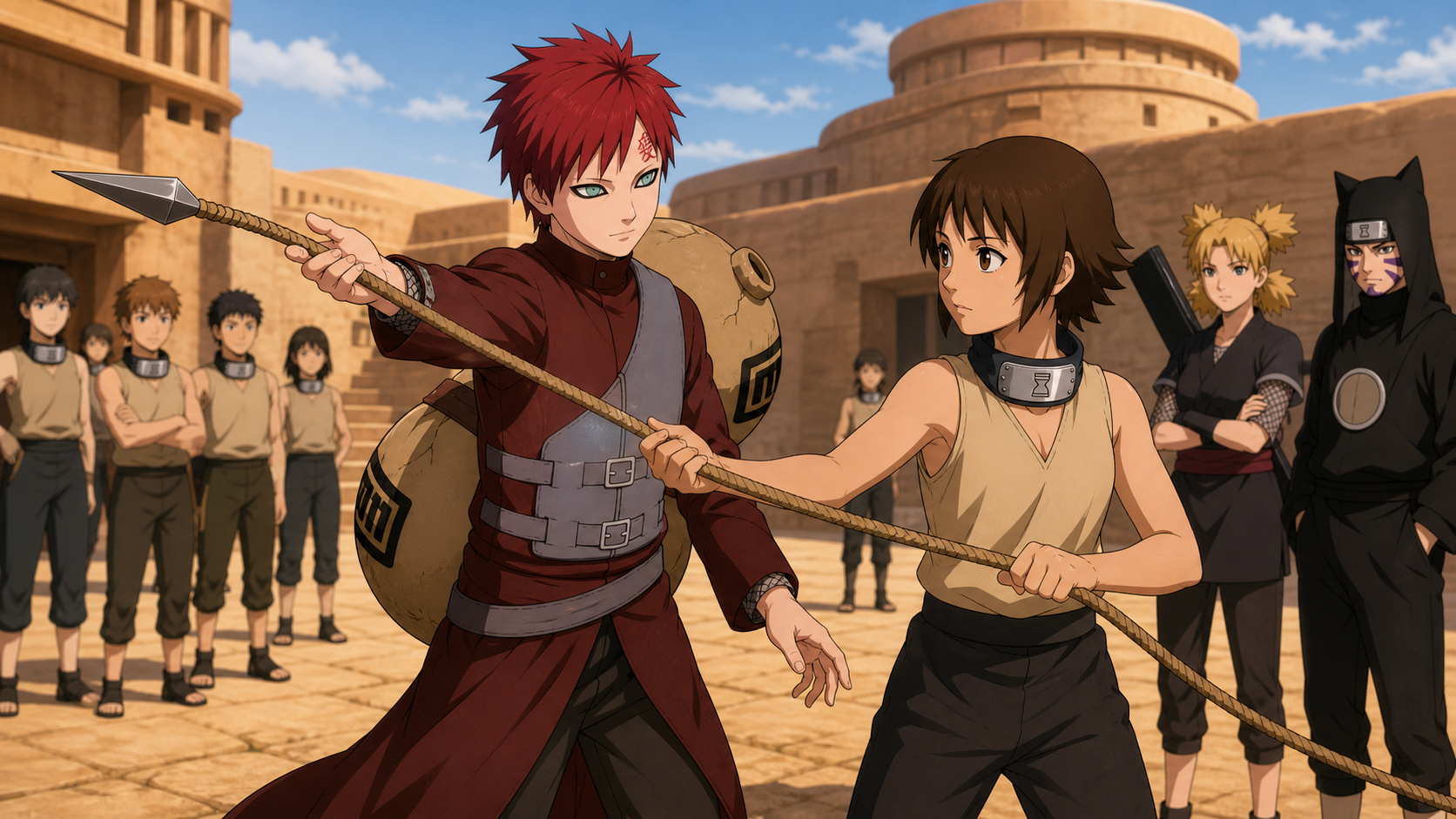
The Targeted Shukaku
Gaara becomes Matsuri’s teacher before the Four Celestial Symbols Men abduct her, drawing the Sand siblings into a trap and Konoha into a rescue mission.
Gaara has a student.
Some Sand elders still call him a weapon.
Naruto Episode 216, `The Targeted Shukaku`, opens the final mission of the original series with Matsuri's kidnapping and a challenge aimed directly at Gaara. The Four Celestial Symbols Men want Sand's ultimate weapon to follow them into a trap.
Gaara goes because Matsuri is not bait to him.
She is his responsibility.
Konoha receives the request for help, and Shikamaru gets a chance to reverse the worst mission of his young career.
This time, Sand needs the rescue.
The Village of Artisans Has Vanished
Takumi's relationship with the great villages makes the disappearance politically awkward. The nations depend on its craftsmanship while holding far more military power than the people producing their tools. A rumor that the supplier now wants an ultimate weapon suggests resentment, defense, or an attempt to renegotiate that imbalance through force.
The empty streets provide no immediate enemy to question. Residents, workshops, and the founder's remains disappear together, which makes evacuation unlikely and coordinated action almost certain. Somebody did not merely raid the village for inventory.
Seimei's open coffin adds a separate category of threat. Missing craftspeople could have relocated. A missing corpse suggests ritual, theft, or a plan centered on the founder himself. Episode 216 wisely leaves the purpose unresolved.
Three investigators fly toward the Village of Artisans on a summoned bird.
Takumi Village supplies advanced ninja tools to the Five Great Nations. Now a rumor claims its craftspeople have developed an ultimate weapon and plan to challenge those nations.
The investigators expect a search.
They find an empty village.
Every resident has disappeared, and the coffin of Seimei, the village's founder, stands open without his body inside. An abandoned weapons village with a missing corpse is not subtle foreshadowing, but it gets the job done.
The larger shinobi world has a problem.
Naruto is currently worried about whether Sakura has a date.
Naruto Interrupts a Very Secret Errand
Naruto spots Sakura handing Shikamaru a document and assumes they arranged a meeting without him.
They did not.
Sakura is delivering a medicinal research list for Tsunade. A newly discovered poison requires preparations from Shikamaru's father, Shikaku.
Naruto's romantic investigation ends before it earns a mission rank.
Sakura has more useful news. Sunagakure started a ninja education program modeled after Konoha's curriculum. Temari, Kankuro, and Gaara now work as instructors.
Naruto can picture Temari teaching.
Gaara standing in front of a class takes more imagination.
The episode cuts to Sand and proves that the students have the same concern.
Nobody Wants Gaara as a Teacher
Matsuri's fear is grounded in experience rather than squeamishness. Weapons are not neutral abstractions to her. They are the last thing between her parents and death. Asking her to choose one means asking her to hold an object already connected to helplessness and loss.
Gaara's warning respects the seriousness even though it lacks warmth. He does not laugh at her, tell her to become less sensitive, or pretend missions will accommodate hesitation. His own life taught him what happens when adults make a child into a weapon without teaching the child how purpose, restraint, and protection fit together.
The other students' avoidance shows that Sand's new curriculum cannot reform the village by itself. Adults still transmit the old story about Gaara to their children. Matsuri has to judge the instructor in front of her against the fear inherited from home.
The Sand siblings divide students into practical weapon classes.
Matsuri asks whether she must choose a weapon. Her parents died after attackers struck them with countless weapons, so she fears hurting or killing another person.
Gaara tells her that a mission is not a game. Entering battle with that hesitation could get her killed.
His answer sounds severe because Gaara has never been hired for soothing delivery.
He almost explains what a weapon can mean, then stops.
When students choose instructors, they crowd around Temari and Kankuro. Adults have taught them to fear Gaara as Sand's ultimate weapon, a monster who could destroy the village if angered.
Matsuri watches him standing alone.
She realizes he was trying to teach her something and asks to join his class.
Gaara quietly asks whether she is sure.
She is.
Gaara Gives Matsuri a Defensive Weapon
The rope javelin translates Matsuri's values into distance and control. She can stop movement, redirect an opponent, and avoid the close-range strike she fears. Gaara teaches adaptation instead of demanding that every shinobi use violence in the same way.
His question about why a person holds a weapon echoes Naruto's effect on him. Gaara once treated power as proof of existence and violence as protection from attachment. Naruto showed him strength organized around other people's survival. Gaara now passes that distinction to someone at the beginning of training.
Teaching becomes part of his own recovery. He cannot change what Sand made him carry as a child, but he can refuse to repeat that education with Matsuri.
Matsuri does not choose the largest club available.
Gaara gives her a rope javelin.
The blade keeps an opponent at a distance, while the rope can restrict movement. It suits a student who wants protection without charging directly into somebody else's body.
Gaara does not tell Matsuri to stop caring about the damage a weapon can cause. He gives that concern a practical form.
When Matsuri reveals how her parents died, Gaara asks why someone holds a weapon.
She remembers Naruto facing the transformed Gaara. Naruto fought to protect Sakura and Sasuke, then called Gaara his friend.
A weapon does not decide its purpose.
The person holding it does.
Gaara teaches that lesson while people elsewhere continue speaking about him as equipment.
The Four Celestials Choose Their First Sacrifice
Their daily-hostage threat is designed to turn connection into a countdown. Gaara can refuse the challenge only by accepting that someone close to him will be taken each day. The attackers expect his history of isolation to make bonds feel like liabilities.
Choosing Matsuri reveals careful observation. She is a new student, not a senior officer or sibling protected by years of combat experience. Her connection is emotionally meaningful and tactically vulnerable.
Using her rope javelin adds deliberate cruelty. The tool Gaara selected to help her maintain safety becomes proof that the enemy can reverse any protection. They are not only abducting Matsuri. They are attacking Gaara's first attempt to guide a student.
Four attackers carrying unusual ninja tools overwhelm a Sand patrol.
They leave one shinobi alive to deliver a message.
The Four Celestial Symbols Men challenge Gaara, calling him the ultimate weapon. If he refuses to follow them, they will abduct one person close to him every day and make each hostage pay the price.
Their first target is Matsuri.
They identify her as Gaara's student and capture her with the same rope javelin she has only begun learning to control.
The weapon Gaara selected to protect her becomes the line used to drag her away.
That is not an accident in the writing.
The enemy wants Gaara to believe every bond creates another handle someone can grab.
Sand Sends Gaara Straight Into the Trap
The diversion concern deserves operational respect. An attacker capable of emptying the Artisan Village may want Sand to commit its defenses to a distant pursuit. Sending every available shinobi after one hostage could expose thousands of residents.
That does not justify treating Gaara as the expendable compromise. The elders preserve the village force while dispatching the exact target without Baki's support. Their plan is defensible only if Gaara's life counts less than everyone else's, which some privately admit they believe.
Temari and Kankuro reject that arithmetic through action. They do not wait for permission to care whether their brother returns. The three siblings leave as a unit even when the council prefers Gaara to function as detached military hardware.
The kidnappers flee northeast toward the Land of Rivers and the Land of Fire.
Sand leadership prepares to request Konoha's assistance. It also orders Gaara, Temari, and Kankuro to pursue Matsuri immediately.
Baki objects.
The enemy openly wants Gaara. Sending him is exactly what the trap requires. A larger Sand pursuit force would provide better protection, but the council fears the kidnapping could be a diversion designed to empty the village.
That concern is legitimate.
The private reasoning is not.
Some elders still view Gaara as a dangerous double-edged sword. If he and the attackers destroy each other, they consider that an acceptable outcome for Sunagakure.
They deny Baki permission to accompany the siblings.
Gaara goes anyway.
Matsuri chose him when the rest of the class backed away. He will not abandon her because the people governing Sand find his possible death convenient.
Temari and Kankuro go with him.
Family apparently remains Sand's most reliable chain of command.
Tsunade Gives Shikamaru Thirty Minutes
The deadline prevents Shikamaru from waiting for perfect intelligence. Matsuri is moving across borders, the Sand siblings are already in pursuit, and each hour increases the distance between Konoha's response and the target. Planning must continue while the team runs.
His request for Sakura shows a concrete change from the Sasuke operation. That mission treated medical attention as something waiting back in Konoha if survivors returned. This time, a trainee medic travels within the response structure, close enough to stabilize injuries before transport.
Shikamaru also understands that Sakura's inclusion is not charity toward a teammate left off the combat list. Medical capacity expands what every pair can survive and therefore changes the entire plan.
The assistance request reaches Konoha.
Gaara, Temari, and Kankuro are already pursuing the hostage into the Land of Rivers. Tsunade has limited information, while most available jonin and chunin are deployed elsewhere, including around the Artisan Village incident.
She assigns Shikamaru.
He points out how little they know and how different an interception will be from a normal pursuit. Tsunade gives him the available genin and thirty minutes to leave.
Shikamaru notices Sakura is absent from the list because she is training in medical ninjutsu.
He accepts the mission on one condition.
He wants Sakura too.
That request shows where his mind goes first now. The last rescue mission returned with severe injuries and nearly killed Choji and Neji. Shikamaru does not treat medical support as something to request after people collapse.
He builds it into the plan.
Team Return the Favor Needs a Better Name
Naruto arrives late because he stopped for ramen.
Choji objects mainly because Naruto ate without him.
The visible team includes Shikamaru, Ino, Choji, Kiba and Akamaru, Naruto, and Lee. Naruto names them Team Return the Favor because Gaara, Temari, and Kankuro saved the Leaf squad during the Sasuke Retrieval Mission.
It is a terrible team name.
The reason behind it is solid.
Shikamaru once watched his plan disintegrate while Sand reinforcements arrived in time to save three separate fights. Now he leads the people returning that debt.
He refuses to repeat the same structure simply because the situation looks familiar.
Shikamaru Plans Against His Last Failure
Two-person cells prevent one enemy from forcing every Leaf shinobi into an isolated duel. Each fighter has support, a witness, and someone capable of carrying information if the pair must disengage. The design sacrifices concentrated strength for resilience across a wide search area.
The separate scouts make that structure possible. Neji can inspect long distances, Hinata provides another Byakugan route, and Shino's insects can search and carry information without exposing a human messenger. Sakura follows the information network rather than occupying the first visible combat pair.
Naruto reads absence from a fight as wasted strength because he still measures plans through immediate confrontation. Shikamaru measures the same people through coverage, survival, and communication. Command means assigning valuable fighters to work that may never produce a dramatic victory shot.
The Sasuke mission used a single pursuit line that broke apart every time an enemy stayed behind.
This mission requires interception across a broad area. Shikamaru creates two-person combat cells instead.
He pairs himself with Ino, Kiba with Choji, and Naruto with Lee. Nobody may act alone under any circumstances.
Shino, Neji, Hinata, and Sakura have already left on separate routes. The three trackers widen the search area, while Sakura supplies medical response and supports communication once combat begins.
Naruto complains that keeping strong fighters out of the first clash wastes battle power.
Shikamaru answers with the authority Tsunade gave him.
She entrusted him with their lives. This is his strategy.
Returning Sand's favor does not mean producing another list of nearly dead genin.
Shikamaru learned from failure, which is more impressive than pretending failure never happened.
Gaara Is a Teacher Before He Is a Target
The Four Celestials call Gaara the ultimate weapon.
The Sand elders use the same language.
Both groups look at Shukaku and calculate what Gaara's body can do for them.
Matsuri sees the person who listened to her fear and gave her a way to protect herself. Gaara sees the student who trusted him when nobody else entered his class.
That relationship sends him into danger.
It also proves how far he has moved beyond the role Sand assigned him.
Naruto runs to return a debt to his friend. Shikamaru organizes Konoha around keeping everyone alive. Temari and Kankuro close ranks around their brother.
The trap depends on Gaara having bonds.
The rescue depends on those bonds reaching farther than the enemy expected.
Sand’s classroom reform exposes the village outside it
Opening a Konoha-style academy program suggests Sunagakure wants a different future for its children. The students still arrive carrying stories taught by adults who call Gaara a monster. A new curriculum cannot instantly remove the fear a village spent years building around one child.
Matsuri choosing Gaara is therefore larger than an instructor assignment. She looks past the empty space other students create and listens to what he actually tried to teach. Trust begins as a small public refusal to inherit somebody else’s judgment.
Matsuri’s fear deserves instruction, not ridicule
Her parents died under a storm of weapons, so choosing one is not an ordinary classroom exercise. The request forces her to touch the symbol of her worst memory and imagine becoming capable of the same harm.
Gaara does not pretend missions are harmless, but he also does not punish her sensitivity. The rope javelin gives her reach, restraint, and options beyond a direct strike. Good teaching does not erase a student’s values to make training easier. It builds technique around the kind of protector that student is trying to become.
Gaara passes forward what Naruto taught him
Gaara once understood power as proof that he existed and violence as the safest answer to attachment. Naruto challenged that belief by fighting harder because Sakura and Sasuke mattered to him. Now Gaara asks Matsuri why a person holds a weapon and lets purpose become part of the lesson.
This is not Gaara copying Naruto’s personality. He remains quiet, blunt, and a little frightening in front of a class. The change lives in what he does with authority. He gives a vulnerable child choice and control where Sand once gave him isolation and orders.
The kidnapping attacks Gaara’s first act of care
The Four Celestial Symbols Men do not select a random civilian. They take the one student who crossed the distance between Gaara and the class. They even use her rope javelin, reversing a protective tool into the means of capture.
The threat depends on teaching Gaara that every bond creates a weakness. If caring for Matsuri brings danger to her, isolation can begin to look responsible again. His pursuit rejects that conclusion before the enemy ever explains its larger plan.
Sand’s elders and the attackers share a vocabulary
Both groups call Gaara an ultimate weapon. The kidnappers want the power sealed inside him, while some elders see an opportunity for Gaara and the threat to eliminate each other. The purposes differ, but the dehumanization is the same.
Baki’s objection identifies the obvious tactical danger: sending the exact target into an announced trap serves the enemy. The council’s private acceptance of Gaara’s death reveals why the bad strategy survives. They are protecting the village as though he is not one of its people.
Temari and Kankuro answer policy with family
The siblings accompany Gaara without waiting for the council to discover a conscience. Their presence does not erase the years when fear and resentment shaped the household, but it proves those years are no longer the only truth between them.
Gaara goes as Matsuri’s teacher. Temari and Kankuro go as his sister and brother. The council dispatches a weapon and accidentally sends a family, which is exactly the variable the enemy’s calculation fails to understand.
Shikamaru redesigns the rescue around survival
The Sasuke Retrieval Mission separated the squad into single fights until nearly every member was critically wounded. Shikamaru does not romanticize that disaster as bravery. He changes the formation.
Two-person combat cells provide immediate support and keep information moving if one shinobi falls. Separate Byakugan and insect scouts widen coverage without concentrating every asset in the first clash. The plan is less dramatic than a straight pursuit because command is supposed to keep people alive, not arrange heroic entrances.
Sakura’s medical role belongs inside the strategy
Shikamaru specifically asks for Sakura even though her name is absent from the available combat list. He has learned that treatment cannot remain a service waiting behind village walls after the damage is done.
Her presence changes what every cell can risk, how long an injured shinobi can remain stable, and whether a rescue becomes an exchange of casualties. The episode treats medical training as operational power rather than a reason to leave Sakura out of the mission.
Returning the favor is not a transaction
Naruto remembers that Gaara, Temari, and Kankuro saved Leaf shinobi during the failed Sasuke pursuit. His terrible team name makes the debt sound almost cheerful, but the impulse underneath it is serious.
Friendship here is not a ledger that becomes balanced after one rescue. Sand showed up when Konoha’s children were breaking apart across the forest. Konoha now runs because Gaara’s student matters to Gaara, and that is enough to make her matter to them.
RaeRae’s full take
I love this episode most when it refuses to announce Gaara’s growth and simply lets him teach. He studies Matsuri’s fear, chooses a weapon suited to restraint, and gives her the lesson his own childhood withheld: strength has a purpose beyond surviving everyone around you.
I am also not letting Sand’s elders hide behind the word strategy. Holding forces back in case of a diversion is reasonable. Sending Gaara because his death might solve an old political discomfort is not. A village does not become safer by treating its future Kazekage as disposable equipment.
Shikamaru’s formation provides the matching evolution on the Leaf side. He cannot undo the last rescue or the bodies he watched return from it, but he can refuse to repeat its design. Gaara becomes a teacher. Shikamaru becomes a better commander. Episode 216 builds its rescue from young people doing what their institutions should have done for them.
RaeRae checkpoint: The enemy believes Matsuri proves that Gaara’s bonds make him vulnerable. The rescue begins proving that those bonds are the reason he is no longer alone inside the trap.
Receipts and official routes
- Episode number, licensed title, Matsuri’s abduction, the Sand pursuit, and Konoha’s rescue deployment: Naruto Official Site.
- Japanese title, January 11, 2007 broadcast record, and TV Tokyo episode synopsis: TV Tokyo.