
Vanished Memories
Naruto brings an amnesiac stranger into Konoha and names him Menma, but the youth’s broken ocarina and chakra-enhancing music reveal trained instincts beneath the missing past.
Naruto goes looking for a ramen topping.
He returns with an unconscious stranger.
Sakura would like him to understand that Konoha Hospital is not a lost-and-found bin for people he pulled from rivers.
Naruto Episode 213, `Vanished Memories`, opens a three-part story about a kind young man with no name, no past, and one broken ocarina. Naruto calls him Menma because that is what he was collecting when they met.
It is not the worst naming system Naruto has used.
The boy saves a baby, cleans Naruto's apartment, helps half the elderly people in Konoha, and plays music that boosts chakra.
That last item deserves a few questions.
A Stranger Saves Fuki and Falls
The sequence gives the audience an advantage Naruto never receives. We know Menma acted before Konoha could praise him and before amnesia could shape a new personality. Whatever his missing history contains, the impulse to save Fuki existed outside Naruto's influence.
That evidence still has limits. The youth enters after bandits have already attacked, and the episode does not identify his relationship to them. He may be a traveler, a former victim, or someone connected to the group who has turned against it. The rescue proves what he chooses in this moment, not how he arrived there.
Fuki's necklace also becomes a small measure of motive. He returns it instead of treating the bandit's defeat as permission to take the stolen property. Protection includes restoring something to its owner.
The episode opens away from Konoha.
Bandits attack a man and his daughter, Fuki. They take a necklace, kill the father, and prepare to silence the child.
A blond youth intervenes.
He defeats the attacker, returns the necklace to Fuki, and comforts her. When the ground collapses beneath them, he saves the girl but falls into the river.
The scene tells us more than the youth will remember after waking. His instincts point toward protection. He puts himself between a child and violence without waiting for payment, orders, or applause.
It also places him near organized criminals before his memory disappears.
Kindness is evidence.
It is not a full biography.
Naruto Risks His Neck for Fancy Bamboo
The cliff errand sounds foolish because nobody assigned it. Naruto volunteers for danger in exchange for a future bowl of ramen. That same refusal to calculate personal convenience puts him near the river at exactly the moment the stranger needs help.
He does not pause to decide whether an unconscious outsider has earned rescue. The body comes first; questions can follow at the hospital. That order reflects one of Naruto's strongest instincts and one of Konoha's recurring security headaches.
Sakura's objection supplies the necessary counterweight. A medical facility inside a hidden village cannot accept every unidentified arrival without procedure. Treating the stranger is humane. Establishing who brought him, who accepts responsibility, and whether he presents a threat is also part of protecting patients.
Naruto is returning from a mission when ramen distracts him from the concept of returning.
Ichiraku needs rare bamboo to prepare a special menma topping. The plant grows on a ridiculous cliff because apparently even vegetables require a dangerous mission in this world.
Naruto climbs, slips, and keeps reaching until he gets the bamboo.
Then he sees a person near the river.
The ramen errand becomes a rescue. Naruto carries the injured youth back to Konoha Hospital, where Sakura is proudly helping the Medical Team in her new white coat.
Sakura points out that the hospital does not normally admit unknown outsiders.
Naruto hands her the stranger and leaves to deliver his bamboo.
Responsibility will catch him at Ichiraku.
It usually does.
Rare Menma Requires Three Weeks of Patience
Naruto expects immediate special ramen.
Teuchi explains that bamboo must be boiled and fermented for three or four weeks before it becomes the topping Naruto wants.
Naruto reacts like somebody has changed the laws of time specifically to inconvenience him.
Teuchi says delicious food requires determination.
That line quietly becomes a promise. Naruto and the stranger will later agree to return when the topping is ready. A jar of fermenting bamboo starts measuring how long this new friendship is supposed to last.
Nobody knows the answer yet.
Sakura arrives and drags Naruto back to the patient he deposited in her workplace.
The paperwork has found its owner.
Even Reverse Hypnosis Finds Nothing
The failed technique prevents the staff from treating amnesia as a convenient verbal claim. A trained medic enters the subconscious and finds no accessible identity. That does not prove every memory is gone, but it gives Naruto a clinical reason to believe Menma is not simply refusing to answer.
The broken ocarina complicates the blank record. Personal objects often carry names, makers, or regional markers. This one provides no immediate identification, yet Menma holds onto it strongly enough for the staff to list it as his sole possession.
Naruto's signature turns compassion into accountability. He is not merely asking Tsunade to assume the risk. He places his own name beneath the decision and agrees to supervise the consequences.
A medic uses Back to the Past Jutsu to probe the stranger's subconscious.
The technique cannot recover a name, home, address, or usable memory. The amnesia may be shock, but the hospital cannot establish whether it is temporary.
The youth owns one object: a broken dove flute, also called an ocarina.
Naruto signs a letter accepting responsibility for him.
This arrangement captures Naruto perfectly. He complains when the obligation becomes official, signs anyway, and calls the stranger troublesome after already climbing a cliff and carrying him into the village.
Naruto does not think trust begins after certainty.
He thinks somebody has to stand beside a person while certainty is missing.
That is compassionate.
It can also become dangerous, which Tsunade will point out with her whole face.
The Hospital Catches Fire
The clear-sky lightning makes coincidence hard to accept, especially after an outsider enters the building. Tsunade would be negligent if she ignored the timing. The rescue proves Menma responds bravely to the emergency, but it does not establish who caused it.
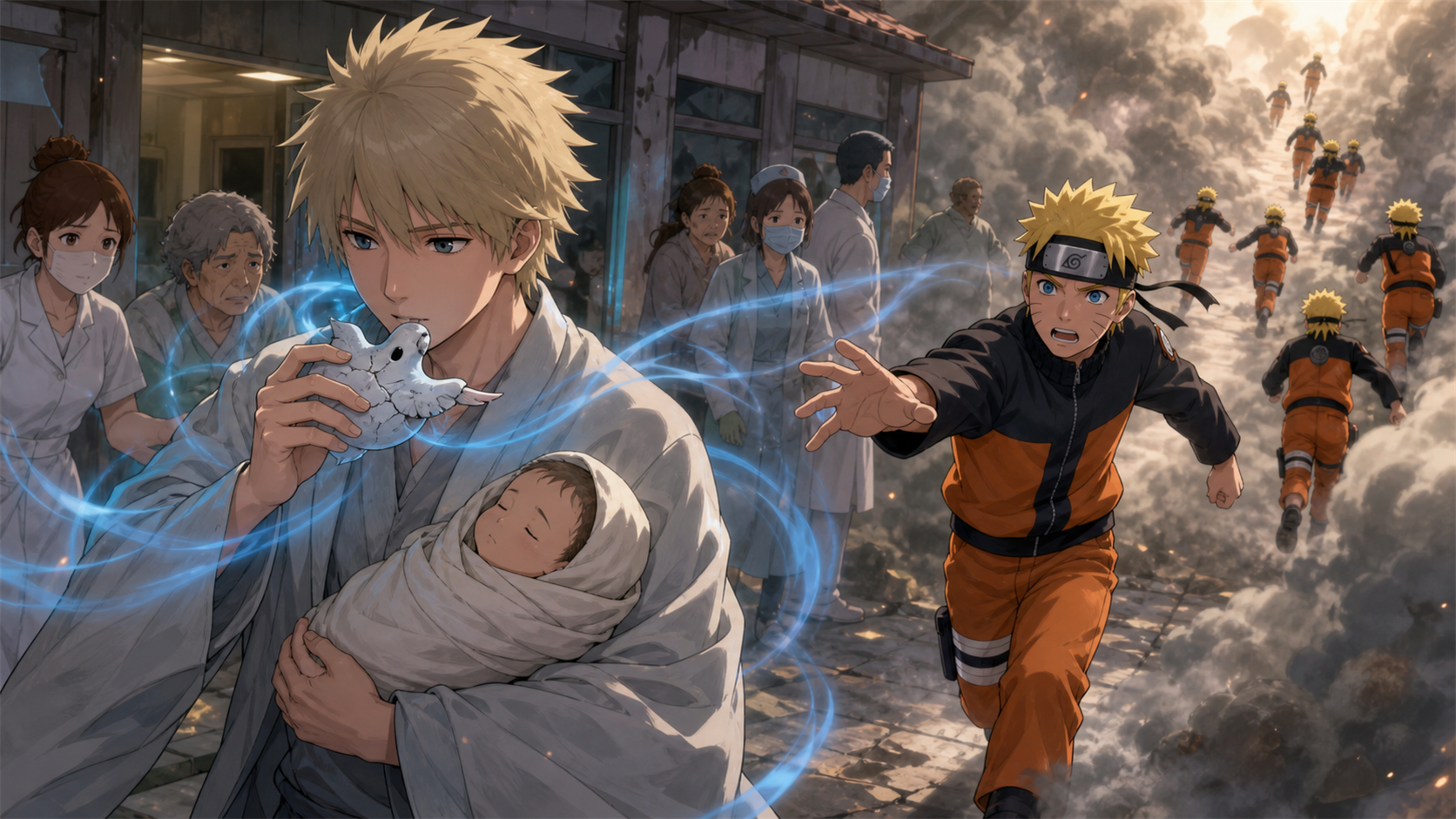
Inside the smoke, his ocarina becomes a navigation tool. The sound carries where vision fails and gives Naruto's clones a moving reference point. Menma does not simply retrieve the baby alone; he coordinates with people outside the room and accepts help for the final route.
That teamwork matters. A calculated infiltrator might also perform a public rescue, but Menma's decisions under pressure show practical concern for the child rather than a demand to be recognized as the sole hero.
Thunder sounds despite a clear sky.
Lightning strikes and the hospital burns.
Medical staff evacuate patients while Sakura checks rooms. A mother realizes her baby remains in the deepest part of the building. The flames have made entry nearly impossible.
The amnesiac youth is missing too.
Then an ocarina sounds inside the smoke.
He has gone after the baby.
The music lets Naruto and the rescuers track his movement when they cannot see him. Naruto sends shadow clones into position, voices guide the route, and the youth emerges carrying the child.
He risks his life for someone he does not know.
The cold open was not a single lucky decision. Protection appears to be his first response.
Tsunade Is Right to Ask Who He Is
Naruto frames responsibility as a personal promise. Tsunade has to frame it as village policy. If Menma harms someone, Naruto's willingness to take blame will not undo the injury. Her job requires evidence, limits, and a plan larger than one genin's confidence.
She also pays attention to behavior. Menma saved a patient when escape would have been easier, and Naruto does not make the request casually. Permission follows because the available evidence supports supervised compassion, not because security concerns disappear.
That balance keeps Tsunade from becoming the cold authority figure Naruto must defeat with feelings. She reaches almost the same humane result while carrying responsibility for thousands of people Naruto is not considering in the moment.
Naruto wants the stranger to remain in Konoha.
Tsunade and Shizune object.
An unidentified person entered a hidden ninja village carrying a tool nobody understands. The hospital then caught fire under strange weather, and nobody can verify where he came from. One heroic rescue does not erase the security problem.
Tsunade is not being cruel.
She is responsible for everyone inside the village walls.
Naruto offers to take responsibility if the youth causes trouble. Sakura confirms that his memory has not returned. Naruto keeps asking.
He even attempts bribery with rare pickled bamboo-shoot ramen, which leads Tsunade to discover that he wandered off during his trip home from a mission.
Negotiations experience a brief physical setback.
Tsunade eventually permits the stay because the youth saved a village child and Naruto is serious about caring for him.
The permission is trust with supervision, not a declaration of innocence.
Naruto Names Him Menma
Naming could become an act of ownership, but Naruto uses it as a temporary foothold. Menma accepts the name rather than having it forced onto him, and the ramen promise gives it a shared joke instead of an official replacement for the missing identity.
The apartment scenes provide quieter evidence about habit. Menma notices disorder, cleans efficiently, and treats domestic work as normal rather than humiliating. Those skills do not identify a country or profession, but they reveal routines preserved beneath conscious memory.
Naruto's embarrassment over the laundry also normalizes the relationship. Menma stops being only a patient or suspected stranger. He becomes a roommate capable of crossing a ridiculous personal boundary before breakfast.
The youth cannot introduce himself.
Naruto chooses Menma, the name of the ramen topping he went to collect before finding him.
Menma accepts it.
They eat at Ichiraku, where Naruto explains that the current bowl is incomplete without the rare topping. They promise to return together when fermentation finishes.
The promise gives Menma a small future before he recovers a past.
Then Naruto takes him home.
Menma looks around the apartment and correctly identifies it as dirty. Naruto asks him not to get hung up on details, which is a brave defense from somebody surrounded by every detail.
By morning, Menma has cleaned the room and washed the laundry.
Naruto appreciates the cleaning.
He draws a boundary at Menma washing his underwear.
At last, a sensible Konoha security policy.
Naruto Attempts Memory Recovery Through Snacks
Naruto decides regional food might trigger a memory.
He takes Menma through specialties from the Lands of Wind, Earth, and Water. Sand dumplings, stone rice cakes, and mist-themed sweets produce no recognition.
Menma apologizes.
Naruto tells him not to.
Menma suggests forgetting the memory search because Naruto has his own work. Naruto remembers that he must clean the Great Stone Faces.
They do not reach them immediately.
Menma sees an elderly woman carrying belongings and offers to help. Then he notices her overgrown yard and removes the weeds. Other elderly residents request help, and the pair spends the day doing chores across the neighborhood.
Thank-you gifts begin arriving from across Konoha.
Naruto calls Menma the embodiment of kindness.
Menma says he wants to live correctly and avoid any more regrets.
That wording catches Naruto's attention.
It sounds like a memory even if Menma denies remembering one.
The Ocarina Is Not Just an Instrument
The technique changes the investigation because it cannot be explained by general kindness. Menma directs chakra through sound with control precise enough to strengthen another shinobi during combat. Someone taught him, trained with him, or depended on that ability before his injury.
The timing is equally revealing. He does not experiment until the right effect appears. Menma recognizes Naruto's difficulty and plays the necessary pattern without conscious explanation. His body remembers a tactical role even while his mind cannot name the group that used it.
That makes Naruto's question fair rather than accusatory. Present conduct has earned Menma protection. Specialized combat knowledge has earned closer examination. Trust should survive a question it cannot yet answer.
An injured bird falls nearby, blood leading Naruto and Menma to a wounded person.
Someone has entered the village.
Naruto pursues the intruder but struggles to locate him. Menma plays the repaired ocarina.
Power floods Naruto's body.
His speed, strength, and perception increase enough to find and strike the attacker. The intruder escapes through substitution, but the music has revealed that Menma possesses a trained chakra ability.
The boy who remembers nothing knows how to use a specialized technique under pressure.
Muscle memory can survive where names do not.
It can also expose a history Menma may not want to recover.
Naruto turns to his new roommate and asks the question Tsunade raised from the beginning.
Who are you?
Present Kindness Does Not Solve the Past
Episode 213 gives Naruto strong reasons to trust Menma.
Menma saves children, helps strangers, protects animals, cleans without being asked, and uses his ability to support Naruto during an attack.
The episode also gives Konoha strong reasons to investigate him.
An intruder appears soon after Menma enters the village. Menma possesses a rare chakra-enhancing technique. His language about regret suggests that something survives beneath the amnesia.
Naruto sees the person Menma is choosing to be.
Neji, Tenten, and the village must discover who he was.
Both questions matter.
The cold-open rescue belongs to Menma before amnesia
The audience sees him protect Fuki, return her necklace, and fall into the river before Naruto supplies a name or Konoha rewards the behavior. That timing matters. Present kindness is not a personality Naruto manufactures after the injury.
The evidence remains bounded. Menma appears near organized criminals, and the episode does not explain his relationship to them. Saving one child proves what he chooses in that moment, not the entire route that placed him there.
Naruto rescues first and asks questions later
Carrying an unconscious stranger to medical care is the humane decision. Leaving him at a hidden-village hospital and returning to ramen without a clear intake process is a security problem Sakura correctly identifies.
The order still reveals Naruto’s strongest instinct. A body in danger does not need to earn rescue through biography. Identity checks, supervision, and village risk can follow once the person is alive enough to answer.
Failed hypnosis supports amnesia without proving permanent erasure
A trained medic cannot recover a name, home, or accessible history. That gives Konoha clinical evidence beyond Menma’s own claim and makes simple refusal less likely.
The result does not prove every memory is destroyed. The ocarina, domestic habits, language about regret, and later chakra technique show that procedural and emotional traces survive even when conscious identity remains unavailable.
Naruto’s signature turns feeling into responsibility
He does more than insist that Tsunade trust his instinct. By signing, he accepts supervision and attaches his own standing to Menma’s conduct. That is still an imperfect safeguard, but it converts compassion from a speech into an obligation.
Tsunade’s permission remains conditional. One rescue supports a humane supervised stay; it does not erase the unknown origin, strange lightning, or specialized object carried into Konoha.
The hospital rescue is evidence and not a clearance
Menma enters smoke for a baby, uses sound to help Naruto’s clones track movement, and emerges without demanding recognition. Those decisions strongly support concern for others under pressure.
A skilled infiltrator could perform a public rescue, so Tsunade cannot treat bravery as proof of harmlessness. Security asks who caused the crisis and why an outsider arrived nearby. Character evidence asks what the outsider chose once the crisis began. Both questions remain valid.
Naming gives a temporary future without confiscating the past
Naruto chooses “Menma” from the ramen topping and the youth accepts it. The joke creates a usable name and a promise to return when fermentation finishes, giving their relationship a date beyond the hospital.
The name should not become institutional pressure to remain the person Konoha prefers. It is a foothold while identity is missing, not an official replacement for whatever history later returns.
Domestic skill survives where conscious biography does not
Menma cleans efficiently, handles laundry, and helps neighbors without needing instruction. Those habits imply routines learned before the river even though they do not identify a country or affiliation.
Amnesia therefore does not create a blank person. Bodies retain sequences, preferences, reflexes, and social expectations. Konoha must investigate those traces without pretending each one has only one explanation.
“No more regrets” is a memory-shaped sentence
Menma denies remembering a specific event, yet the language carries emotional weight larger than a day of chores. It suggests that some evaluation of the past survives without a retrievable scene attached.
Naruto notices correctly. He does not need to accuse Menma of lying to recognize that emotion can remain accessible after names and images vanish.
The ocarina converts suspicion into a concrete question
Directing chakra through music with enough precision to strengthen Naruto is trained combat support, not general musical talent. Menma recognizes the required effect under pressure even though he cannot explain where he learned it.
That skill deserves examination because it connects him to people, training, and earlier operations. Present kindness has earned protection and fair treatment. It has not made specialized military knowledge irrelevant.
Tsunade and Naruto are protecting different populations
Naruto sees the person without a past standing in front of him. Tsunade must also see patients, civilians, intelligence systems, and every resident affected if the stranger proves dangerous.
Their positions do not need a cold-versus-caring argument. Supervised compassion is the responsible overlap: treat the person, preserve dignity, assign accountability, and keep investigating evidence that could change the risk.
RaeRae’s full take
Episode 213 gives Menma a pile of decent choices and refuses to pretend they answer who he was. Good. A person can be kind now and still carry a dangerous history. A dangerous history can also contain earlier kindness nobody recorded.
Naruto is right to give him a bed, a name, and enough future to wait for fermented bamboo. Tsunade is right that one teenager’s confidence cannot function as village security. The interesting answer is the conditional trust they build between those positions.
The ocarina changes everything because the body remembers a combat role. Menma does not become guilty when the music strengthens Naruto. He becomes connected to a past that deserves precise questions. Trust worth having should survive those questions.
RaeRae checkpoint: Menma’s present choices deserve protection. They do not require Konoha to stop asking which training, loyalties, and regrets survived inside the missing memories.
Receipts and official routes
- Episode number, licensed title, amnesia, hospital rescue, Naruto naming Menma, and the ocarina’s chakra effect: Naruto Official Site.
- Japanese title, December 14, 2006 broadcast record, and TV Tokyo episode synopsis: TV Tokyo.